U.S. Immigration Through the EB3 Visa in 2026: Reasonable Costs, Green Cards for the Entire Family
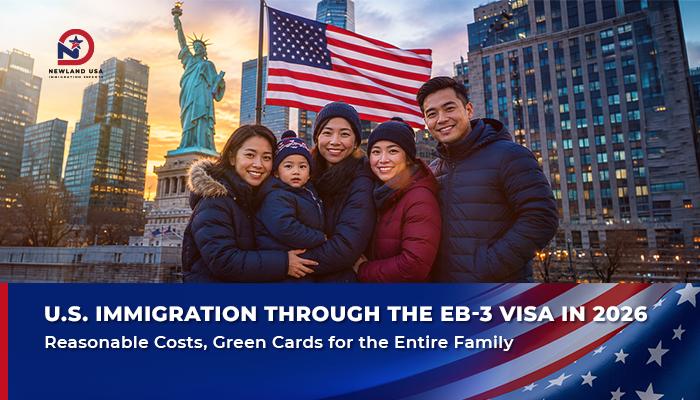
As the U.S. labor market continues to face workforce shortages across many industries, U.S. immigration through EB3 remains one of the most practical pathways for Vietnamese individuals who want to settle permanently in America. The year 2026 has seen many positive developments from U.S. Citizenship and Immigration Services (USCIS) and the U.S. Department of Labor (DOL), opening up opportunities for Vietnamese applicants to obtain a Green Card at costs considered reasonable compared to other immigration routes. This article from Newland USA will provide a complete picture of the EB3 Visa specifically for the Skilled Workers category, helping readers clearly understand the eligibility requirements, process, estimated budget, and benefits that the entire family can receive when choosing the path of getting a Green Card through employment.
1. Overview of the EB3 Skilled Workers Category in 2026
U.S. immigration through EB3 falls under the Employment-Based Third Preference visa category, designed by the U.S. Congress to supplement the workforce in industries facing labor shortages. Under current regulations, the EB3 Visa is divided into three subcategories: Skilled Workers, Professionals, and Unskilled/Other Workers. Among these, the Skilled Workers category is for individuals with at least two years of work experience or who have completed a vocational training program in the field for which a U.S. employer is sponsoring them.
One of the key reasons this program attracts so much interest is the ability to get a Green Card through employment for the entire family, including the spouse and unmarried children under 21 years of age. The principal applicant does not need to have a multi-million-dollar investment like the EB-5 category — they only need a full-time job offer from a U.S. employer along with an approved PERM Labor Certification. This “accessibility” is exactly what makes U.S. immigration through EB3 a suitable option for the majority of middle-class Vietnamese families.
2. Why Is EB3 Skilled Workers Considered a Low-Cost U.S. Immigration Option?
When comparing various U.S. immigration options, the term low-cost U.S. immigration is often associated with EB3 Skilled Workers. The reason many Vietnamese families choose this program is that the total budget typically ranges from just tens of thousands of dollars — significantly lower than the EB-5 investment category (which requires a minimum capital of $800,000) or the L-1 and E-2 categories (which require business operations in other countries).
Beyond the financial aspect, the path to getting a Green Card through employment via EB3 does not require applicants to hold a college degree or possess significant assets. This is a standout advantage given that many Vietnamese individuals wish to settle in the U.S. but do not meet the requirements for more advanced programs. In essence, this pathway opens a realistic door for the working class in Vietnam.
An additional bonus that makes the EB3 Visa so popular is that U.S. employers typically cover most of the costs related to the PERM process, the Form I-140 filing fee, and the internal recruitment process. As a result, the financial burden on the applicant is significantly reduced, making the dream of low-cost U.S. immigration more accessible to a wider range of Vietnamese families. It is this well-balanced cost structure that has helped U.S. immigration through EB3 consistently maintain its position among the most sought-after low-cost U.S. immigration programs.

3. Eligibility Requirements for EB3 Skilled Workers
To be eligible for U.S. immigration through EB3 under the Skilled Workers category, applicants must meet all of the following mandatory criteria set by USCIS:
- Minimum of two years of work experience: Applicants must demonstrate at least 24 months of hands-on work experience or vocational training in the field of the sponsored position. Seasonal or part-time positions do not count toward this requirement.
- Full-time and permanent job offer: The position in the U.S. must be permanent in nature, not a short-term contract.
- Employer’s ability to pay the offered wage: The U.S. employer must demonstrate financial capability through tax returns, audited financial statements, or annual reports to ensure they can pay the proposed wage.
- Approved PERM Labor Certification: This is a confirmation from the U.S. Department of Labor that no qualified U.S. workers are available for the position being offered.
- Good health and clean criminal record: Applicants must pass a medical examination conducted by a USCIS-designated physician, and must have no criminal record that would affect their immigration eligibility.
Meeting these requirements is a critical stepping stone toward having your EB3 Visa petition processed smoothly, bringing you closer to the goal of getting a Green Card through employment for the entire family. Thorough preparation from the start also helps applicants minimize the risk of receiving a Request for Evidence (RFE) from USCIS during the review process.
4. The Three-Step Process for EB3 Immigration in 2026
The U.S. immigration through EB3 Skilled Workers pathway in 2026 is divided into three main stages, each handled by a separate government agency:
Step 1: PERM Labor Certification
This is the first stage, handled by the U.S. Department of Labor (DOL). The U.S. employer must conduct a domestic recruitment process to demonstrate that no U.S. citizens or permanent residents are qualified to fill the position. As of early 2026, the DOL is processing PERM applications that were filed around August 2024, meaning the wait time is approximately 16–17 months from the filing date to approval.
The PERM filing date also serves as the Priority Date — the timestamp that determines the applicant’s position in the visa queue. This is an extremely important milestone because it affects the entire timeline for getting a Green Card through employment going forward.
Step 2: Form I-140 Petition
After the PERM is approved, the U.S. employer files Form I-140 (Immigrant Petition for Alien Worker) with USCIS. This is the formal sponsorship petition that classifies the worker under the EB3 category. The base filing fee for Form I-140 in 2026 is $715, paid by the employer. Standard processing time averages about 5–6 months.
If the applicant wants to shorten the waiting time at this stage, they can request Premium Processing for a fee of $2,805 (increasing to $2,965 starting March 2026). In that case, USCIS commits to responding within 15 business days. However, Premium Processing only speeds up the I-140 processing — it does not affect the overall Visa Bulletin timeline.
Step 3: Adjustment of Status (I-485) or Consular Processing (DS-260)
At the final stage, the applicant chooses one of two paths depending on where they are residing when their Priority Date becomes current:
- If currently in the U.S. with lawful status: File Form I-485 to adjust status to permanent resident. The filing fee for Form I-485 is $1,440 per person.
- If in Vietnam or abroad: File Form DS-260 for processing through the U.S. Consulate. The immigrant visa fee is $345 per person as of early 2026.
Upon completing this step, Vietnamese applicants will officially receive their Green Card through employment, beginning a new chapter in the U.S. with their family.
5. Detailed Costs of EB3 Immigration in 2026
One of the reasons the EB3 Visa is considered a low-cost U.S. immigration option lies in its transparent fee structure, with the majority of costs covered by the employer. Specifically, the expenses in 2026 include:
- PERM Labor Certification: All costs related to domestic recruitment, job advertising, and processing fees are the responsibility of the U.S. employer as required by the DOL.
- Form I-140: $715 base filing fee, plus an Asylum Program Fee of $600 (for large companies) or $300 (for small companies with fewer than 25 employees). This is also paid by the employer.
- Premium Processing (optional): $2,805–$2,965 if the applicant wishes to expedite I-140 processing.
- Form I-485 (Adjustment of Status): $1,440 per person if the applicant is currently living in the U.S. Spouses and children also pay separate fees.
- Immigrant Visa Fee (DS-260): $345 per person for applicants outside the U.S.
- USCIS-required medical examination: Ranges from $200–$500 per person depending on the country.
- USCIS Immigrant Fee: $235 per person, applied after entering the U.S. to have the official Green Card printed and mailed.
- Immigration attorney service fees: Average of $5,000 to $13,500, depending on the consulting firm and the complexity of the case.
The actual total cost that a Vietnamese family typically bears ranges from approximately $80,000 to $85,000 for the entire family, including both service fees and government fees. Even so, this remains an accessible budget, explaining why U.S. immigration through EB3 is increasingly seen as a low-cost U.S. immigration gateway suitable for the majority of middle-class Vietnamese families.

6. Processing Times for the EB3 Visa in 2026
Processing time is a factor that every U.S. immigration through EB3 applicant cares about. According to updated data from early 2026, the average processing time for the entire process ranges from 24 to 48 months, depending on nationality and the pace of the relevant government agencies. Specifically:
- Prevailing Wage Determination: 4–8 months.
- Domestic recruitment and ETA-9089 filing: 2–3 months for recruitment, followed by 16–17 months waiting for DOL approval.
- Form I-140 (standard processing): 5–6 months; with Premium Processing, only 15 business days.
- Waiting for Priority Date to become current (Visa Bulletin): For Vietnam and most countries other than China and India, the average wait is about 2–3 years. Chinese citizens face a 4–6 year wait, while Indian citizens wait more than 12 years.
- I-485 or DS-260: 9–24 months for the interview and Green Card issuance.
For Vietnamese applicants, the journey to get a Green Card through employment via the EB3 Skilled Workers category typically takes about 3 to 4 years — a timeframe considered reasonable given the long-term stability that a Green Card provides. Understanding each milestone also helps applicants prepare financially, professionally, and mentally throughout the EB3 Visa process.
7. Family Benefits When Immigrating Through EB3
One of the standout features that makes U.S. immigration through EB3 a popular choice among Vietnamese families is the ability to bring the spouse and children to settle in the U.S. along with the principal applicant. When the EB3 Visa petition is approved, the specific benefits include:
- Applicant’s spouse: Receives an E34 Visa (if the applicant is in the Skilled Workers/Professionals category), becomes a lawful permanent resident, and is allowed to live, work, study, and travel freely throughout the United States.
- Unmarried children under 21 years of age: Also receive a Green Card, are entitled to free public education from kindergarten through 12th grade, are eligible for student loans, and can attend public universities at in-state tuition rates — significantly lower than those for international students.
- Access to healthcare and social security systems: Permanent residents can participate in public health insurance programs, unemployment insurance, and social security benefits on par with U.S. citizens.
- Path to citizenship: After continuously holding a Green Card for 5 years, all family members are eligible to apply for U.S. citizenship, obtaining a U.S. passport with visa-free access to over 180 countries.
It is fair to say that not many immigration programs allow the entire family to get a Green Card through employment with such moderate costs and requirements as the EB3 Skilled Workers category. This is precisely why U.S. immigration through EB3 consistently ranks among the most popular choices in the Vietnamese community seeking to settle in the U.S. — especially when considered from the perspective of low-cost U.S. immigration.
8. Important Notes When Preparing an EB3 Petition
To ensure a smooth U.S. immigration through EB3 journey, applicants should keep the following points in mind:
Choose a reputable employer: This is the most critical factor. The employer must be a legally registered U.S. business with stable finances and a willingness to support the entire sponsorship process. Applicants should be cautious of offers that “guarantee 100% immigration success” from unverified agencies.
Prepare thorough work experience documentation: Employment verification letters from previous employers must clearly state the job title, job description, dates of employment, salary, and contact information so USCIS can verify the details. Even small inaccuracies can lead to a Request for Evidence (RFE) or a denial, delaying the process of getting a Green Card through employment.
Ensure accurate certified translations: Vietnamese-language documents (diplomas, employment contracts, pay stubs, etc.) must be translated into English and certified according to USCIS requirements.
Monitor the Visa Bulletin regularly: The U.S. Department of State updates the Visa Bulletin every month. Applicants should check both the “Dates for Filing” and “Final Action Dates” columns to know when their Priority Date becomes current.
Consult with immigration experts: The EB3 Visa process involves many complex stages that require coordination between the employer, attorney, applicant, and government agencies. Working with a reputable consulting firm experienced in handling Vietnamese applicants’ cases can significantly reduce risks and shorten the timeline for getting a Green Card through employment.
9. Comparing EB3 Skilled Workers with Other Low-Cost U.S. Immigration Options
When it comes to low-cost U.S. immigration, beyond EB3 there are a few other options such as the F category (family reunification), the DV category (Diversity Visa lottery), and the K-1 category (fiancé/fiancée visa). However, each has its own limitations:
- F category (family reunification): Requires a relative who is a U.S. citizen or permanent resident to sponsor the applicant, with wait times for some subcategories stretching over 15–20 years.
- DV category (Diversity Visa): Depends on luck, with an extremely low selection rate, and Vietnam may be removed from the eligible country list in the future.
- K-1 category: Requires a legitimate marital relationship with a U.S. citizen, and is currently under very strict scrutiny by the U.S. government.
In contrast, the EB3 Visa Skilled Workers category only requires two years of professional experience, a valid job offer, and a budget of approximately $80,000 for the entire family. For this reason, it remains the most practical and sustainable low-cost U.S. immigration option for the majority of Vietnamese families wishing to build their future in the United States. The balance between cost, timeline, and benefits is what keeps U.S. immigration through EB3 consistently mentioned in immigration consultations for the Vietnamese community.

10. Conclusion
The year 2026 is expected to be a favorable time for Vietnamese families to seriously explore U.S. immigration through EB3 Skilled Workers. With a reasonable cost structure, a clear process, signs of improving processing times, and benefits extended to the entire family, the EB3 Visa continues to hold its position as one of the most worthwhile pathways for getting a Green Card through employment. In particular, when placed alongside other options such as EB-5, family sponsorship, DV, and others, EB3 stands out as a low-cost U.S. immigration choice that still guarantees long-term stability.
Learn more:
- Step-by-Step Guide to Proving Work Experience in the EB3 Application Package
- Working as an EB3 Auto Mechanic in the U.S. 2026: How Much Do You Actually Take Home Each Week?
- What Is a PERM Audit? Reasons EB3 Cases Get Delayed and How to Respond to the DOL
- ASE and OSHA Certifications for Auto Mechanics Under the EB3 Visa Program in the U.S. 2026
- The Medical Glove Industry in the U.S.: Market Analysis & EB3 Job Opportunities in 2026
News Categories



Related news

From Motorcycle Mechanic to Automotive Technician in the U.S.: Skills and Qualifications to Prepare in 2026
AI in Auto Repair in the U.S. 2026: How Artificial Intelligence Diagnoses Vehicle Problems Faster and More Accurately
7 Key Technologies Every Industrial Maintenance Technician in the U.S. Needs to Know in 2026

PLC & Automation Skills: A Launchpad for Maintenance Technicians in the United States in 2026
What Is the ASE Certification? Requirements, Exam Roadmap, and Its Importance for Auto Technicians in the U.S. in 2026

EB5 Capital Recovery Time: How Long It Takes and the Key Milestones
Electric Vehicle Technicians in the U.S.: The “Golden” Skills Helping Vietnamese Auto Mechanics Get Ahead of the 2026 EV Trend
US Engineering & Maintenance Labor Shortage 2026: The Driving Force Behind the EB3 Skilled Workers Visa Policy
Industrial Maintenance Technician: Job Duties, Requirements & U.S. Immigration Opportunities in 2026