The Medical Glove Industry in the U.S.: Market Analysis & EB3 Job Opportunities in 2026
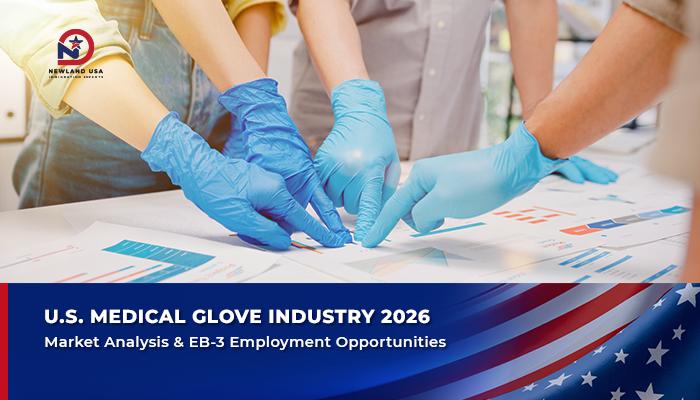
After the COVID-19 pandemic, the U.S. medical glove industry has undergone a major shift — moving from near-total dependence on Southeast Asian suppliers to the goal of domestic manufacturing self-sufficiency. With tariff policies jumping to 100% on medical gloves imported from China starting January 1, 2026, along with billions of dollars in investments flowing into factories across major U.S. states, U.S. medical glove manufacturing in 2026 is creating thousands of new job positions. This is a golden opportunity for Vietnamese workers to pursue a path to U.S. immigration through the medical glove industry via the EB3 Visa for medical glove manufacturing — one of the most practical and sustainable routes available today.
1. Overview of the U.S. Medical Glove Market in 2026
According to updated reports from January 2026 published by leading market research platforms, the global surgical glove market was valued at $5.04 billion in 2025 and is expected to reach $5.26 billion in 2026, growing at a compound annual growth rate (CAGR) of approximately 4.44% and projected to hit $6.54 billion by 2031. For the overall medical glove segment, analyses indicate the market could achieve double-digit growth during the 2025–2032 period, with total value exceeding $25 billion by the end of the decade.
North America — especially the United States — continues to lead in revenue thanks to three key factors: one of the world’s most advanced healthcare systems, strict infection control regulations from the U.S. Food and Drug Administration (FDA), and federal-level strategic stockpiling initiatives. Data from the Centers for Disease Control and Prevention (CDC) shows that 1 in every 31 hospitalized patients in the U.S. contracts a healthcare-associated infection (HAI) — a figure that confirms the demand for medical gloves is virtually unlimited across the hospital system.
Notably, nitrile gloves are gradually replacing traditional latex gloves because they offer three times the puncture resistance, cause no protein allergies, and have superior durability. By 2025, powder-free gloves accounted for 87.65% of market share after the FDA officially banned powdered gloves in 2016 due to concerns about respiratory complications and granulomatous inflammation.
2. Factors Driving U.S. Medical Glove Manufacturing in 2026
The story of U.S. medical glove manufacturing in 2026 cannot be separated from the hard lessons learned during the pandemic. In 2020, less than 1% of America’s nitrile glove needs were produced domestically; the rest depended on Malaysia, Thailand, Vietnam, and China. When global supply chains broke down, glove prices soared and hospitals faced critical shortages of personal protective equipment (PPE). This lesson drove the U.S. government to introduce a series of reindustrialization policies.
Tariff Policies and Section 301
The Office of the United States Trade Representative (USTR) announced a tariff escalation schedule for medical-grade nitrile gloves imported from China: from 7.5% up to 50% on January 1, 2025, then further increasing to 100% starting January 1, 2026. For rubber surgical gloves, tariffs rose from 7.5% to 25% during the same period. According to analysts, the goal of these measures is to put U.S. manufacturers and allied nations on a level playing field with Chinese goods.
Federal Procurement Programs
The Centers for Medicare & Medicaid Services (CMS) under the Department of Health and Human Services (HHS) proposed in 2025 a reimbursement program for hospitals that purchase nitrile gloves fully manufactured domestically, effective starting in 2026. At the same time, the Strategic National Stockpile was replenished with 1.5 billion gloves to prepare for future public health emergencies.

3. Job Opportunities and Workforce Demand
The boom in manufacturing facilities has led to massive workforce demand for positions in production operations, packaging, quality control, and machine maintenance. The U.S. Chamber of Commerce and the Bureau of Labor Statistics (BLS) have consistently reported labor shortages in the manufacturing sector, with millions of unfilled positions nationwide.
This is the critical intersection between real demand from U.S. businesses and the desire of international workers to immigrate to the U.S. through the medical glove industry. When employers cannot find enough domestic workers, they are forced to turn to long-term work Visa sponsorship programs — and EB3 becomes the top choice. Recent BLS reports project that manufacturing, healthcare support, and logistics industries will continue to face workforce shortages through the end of this decade.
4. The EB3 Visa for Medical Glove Manufacturing: A Wide-Open Door to Immigration
The EB3 Visa (Employment-Based Third Preference) is an employment-based immigrant Visa under the third preference category, managed by USCIS. Under the Immigration and Nationality Act (INA), approximately 28.6% of the total annual employment-based Visa quota is allocated to EB3.
Three Main Subcategories of EB3
- Skilled Workers: Requires a minimum of 2 years of work experience or training in the occupation.
- Professionals: Must hold a U.S. bachelor’s degree or its foreign equivalent.
- Other Workers: Positions that require less than 2 years of training; the job must be full-time and permanent.
Given that medical glove production lines primarily involve machine operation, packaging, and product inspection roles, these positions are an excellent fit for the Skilled Workers subcategory. That is why the EB3 medical glove manufacturing program is becoming a realistic path for Vietnamese workers who do not hold advanced degrees or have extensive specialized experience.
The Application Process
The application process for EB3 medical glove manufacturing includes the following steps:
- Step 1 – PERM Labor Certification: The U.S. employer files a petition with the Department of Labor (DOL) to prove that no qualified domestic workers are available for the position.
- Step 2 – Form I-140: After PERM approval, the sponsoring employer files an I-140 petition (Immigrant Petition for Alien Worker) with USCIS.
- Step 3 – Monitor the Visa Bulletin: The applicant waits for their priority date to become current according to the monthly Visa Bulletin published by the Department of State.
- Step 4 – Consular Interview (DS-260): The applicant submits their immigrant Visa application and attends an interview at the U.S. Embassy or Consulate.
- Step 5 – Enter the U.S. and Receive a Green Card: Once the Visa is issued, the applicant, along with their spouse and children under 21, enters the U.S. and receives permanent resident status.
Benefits Included
One of the reasons the EB3 category is so attractive is the extended benefits for the entire family. The accompanying spouse receives a green card at the same time and can work legally in the U.S. without needing a separate work Visa. Children under 21 also receive permanent resident status, qualify for public school tuition support, and are eligible for federal student loans when entering college.

5. Advantages of U.S. Immigration Through the Medical Glove Industry for Vietnamese Workers
For Vietnamese workers, immigrating to the U.S. through the medical glove industry offers several unique advantages compared to other traditional EB3 fields such as restaurants, hotels, or care services.
Wages and Benefits
Base wages at major nitrile factories in Ohio, Illinois, and South Carolina range from $17 to $24 per hour, depending on the position and experience level. With a 40-hour work week plus night shift and weekend shift premiums, workers can earn an average annual income of $40,000 to $55,000 — not including health insurance, 401(k) retirement plans, and dental and vision benefits.
Job Stability
Unlike service industries that fluctuate with tourism seasons or consumer trends, the U.S. medical glove industry has steady and consistently growing demand thanks to public policy and unchanging infection control standards. Hospitals, clinics, laboratories, and ambulatory surgery centers (ASCs) all need gloves year-round. Combined with the U.S. government’s commitment to maintaining the strategic stockpile, workers in this field will have a solid long-term career foundation.
Reasonable Entry Requirements
For the Skilled Workers subcategory, applicants do not need a college degree, do not need a minimum English proficiency certificate — they just need to be in good health, have a clean background, be willing to meet the minimum job requirements, and have at least 2 years of relevant experience or training. This is one of the lowest entry barriers among all U.S. immigration Visa programs.
6. Important Things to Keep in Mind When Joining the Program
Although the EB3 medical glove manufacturing program opens up great opportunities, workers should keep the following points in mind to minimize risks during the application review process.
Processing Times
The annual EB3 quota frequently reaches its limit before the end of the fiscal year. In fiscal year 2024, the U.S. Department of State announced that the quota was exhausted and had to temporarily suspend Visa issuance until the start of fiscal year 2025. Therefore, applicants need to closely monitor the Visa Bulletin and prepare their documents early to shorten wait times.
Personal Legal Documents
A clean criminal record, no history of immigration violations, complete medical documentation, and basic proof of financial standing are requirements that must be met. Additionally, applicants should work with a professional immigration consulting firm to receive guidance on certified translations, prepare a complete application package, and handle any RFE (Request for Evidence) questions if they arise.

7. Long-Term Outlook for the Industry
Looking ahead, U.S. medical glove manufacturing in 2026 is not just a short-term story tied to tariff policies. According to forecasts, this market will maintain steady growth through 2031–2032, driven by three main forces: an aging population leading to increased demand for surgeries and long-term care as life expectancy rises; increasingly strict hygiene standards as infection control regulations continue to be upgraded in both hospital and outpatient care settings; and diversified applications as medical gloves are increasingly used across the pharmaceutical, biotechnology, and food industries.
The combined effect of these factors ensures that jobs in the U.S. medical glove industry will not only exist for a few years but will remain attractive throughout the next decade — providing a solid foundation for workers and their families to build new lives in the United States.
8. Conclusion
The U.S. medical glove industry is going through a historic restructuring phase, with tough tariff policies, billions of dollars in domestic manufacturing investment, and tens of thousands of new jobs being created across U.S. states. In this context, the EB3 medical glove manufacturing program has become one of the most practical, stable, and sustainable U.S. immigration pathways through the medical glove industry for Vietnamese workers.
Learn more:
- EB3 Skilled Workers Wait Time: Comprehensive Analysis of the Latest 2026 Movement
- What Is an EAD Card? Latest 2026 Regulations for the EB3 Category
- Working at Medical Glove Factories in the USA: Salary, Benefits, and EB3 Green Card Opportunities
- How Much Does EB3 Skilled Worker Immigration to the US Cost? A Complete Financial Preparation Guide from A to Z
- EB3 Immigration to the US: Can Your Spouse and Children Come Along?
News Categories



Related news

AI in Auto Repair in the U.S. 2026: How Artificial Intelligence Diagnoses Vehicle Problems Faster and More Accurately
7 Key Technologies Every Industrial Maintenance Technician in the U.S. Needs to Know in 2026
PLC & Automation Skills: A Launchpad for Maintenance Technicians in the United States in 2026

What Is the ASE Certification? Requirements, Exam Roadmap, and Its Importance for Auto Technicians in the U.S. in 2026

EB5 Capital Recovery Time: How Long It Takes and the Key Milestones
Electric Vehicle Technicians in the U.S.: The “Golden” Skills Helping Vietnamese Auto Mechanics Get Ahead of the 2026 EV Trend
US Engineering & Maintenance Labor Shortage 2026: The Driving Force Behind the EB3 Skilled Workers Visa Policy
Industrial Maintenance Technician: Job Duties, Requirements & U.S. Immigration Opportunities in 2026

Lương thợ sửa xe tại Mỹ: Cách tối ưu giờ công để nhân đôi thu nhập năm 2026