What Is an EAD Card? Latest 2026 Regulations for the EB3 Category
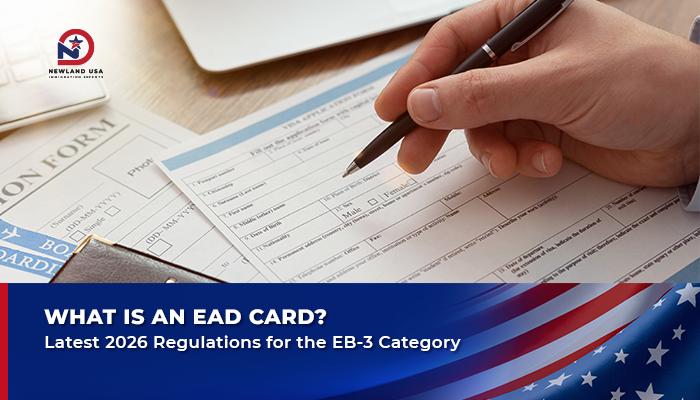
For Vietnamese workers pursuing the path to U.S. permanent residency through the EB3 program, understanding the EAD card — your pass to work legally on American soil — is extremely important. The year 2026 has brought significant changes related to U.S. work permits, from shorter card validity periods to the end of automatic extension policies. This article by Newland USA will help you grasp all the essential information about the EAD card for the EB3 2026 category, from the basic concept and application process to the latest regulations that every applicant needs to be aware of.
1. What Is an EAD Card?
The EAD card (Employment Authorization Document), also known as Form I-766, is an official document issued by U.S. Citizenship and Immigration Services (USCIS) to foreign nationals, allowing them to work legally in the United States for a specific period of time. In other words, this is the U.S. work permit for individuals who do not yet have a green card but are in the process of waiting for their immigration case to be reviewed.
It’s important to note that the EAD card does not grant immigration status or long-term residency rights. The sole function of this card is to prove that the holder has the right to be hired by any employer in the United States. In addition, EAD card holders can also use this document to apply for a Social Security Number (SSN).
In terms of appearance, the EAD card is a plastic card about the size of a credit card, displaying the holder’s personal information, the type of employment authorization, and the expiration date. This card is legally valid when used together with Form I-9 — the form employers use to verify an employee’s work eligibility.
2. Who Needs to Apply for an EAD Card?
Not all foreign nationals living in the U.S. need a U.S. work permit in the form of an EAD. Specifically, if you are a lawful permanent resident (already holding a green card), the green card itself serves as proof that you are authorized to work without needing any additional documents. Similarly, those holding employer-specific work visas such as H-1B or L-1 are also not required to apply for an EAD.
So who actually needs an EAD card? Below are the most common cases:
Individuals with a pending I-485 petition (Adjustment of Status) — this is also the group directly related to the EB3 category. In addition, those applying for asylum, refugees, spouses of H-4 or L-2 visa holders, along with several other groups as defined by USCIS, all fall under the category of individuals who need to apply for this document.
For EB3 applicants, the EAD card serves as a “bridge” — allowing them to work freely while waiting for their green card to be officially approved. Notably, this U.S. work permit offers significant flexibility: workers can change jobs or work for multiple employers without being tied to a single sponsoring employer.

3. EAD Card for the EB3 Category: Application and Approval Process
The EB3 program (Employment-Based Third Preference) is designed for three main groups: Skilled Workers, Professionals, and Other Workers. To apply for an EB3 EAD card, applicants need to go through several key steps in the immigration process.
Step 1: Complete the PERM Labor Certification
The U.S. employer must file a labor certification application (PERM Labor Certification) with the U.S. Department of Labor, proving that no qualified domestic workers are available for the position being offered. Processing time for this stage can range from several months to over a year.
Step 2: File the I-140 Petition
After the PERM is approved, the employer proceeds to file Form I-140 (Immigrant Petition for Alien Workers) so that USCIS can classify the applicant under the EB3 category. With the Premium Processing fee having increased to $2,965 as of March 1, 2026, the I-140 processing time under this option takes only 15 days. However, it’s important to understand that Premium Processing only applies to the I-140 portion and has absolutely no effect on the green card approval timeline or the movement of the Visa Bulletin.
Step 3: File the I-485 and Apply for an EAD Card
When the applicant’s Priority Date becomes “current” on the Visa Bulletin, they can file Form I-485 (Adjustment of Status) to adjust their residency status. At the same time, the applicant is allowed to file Form I-765 to apply for an EAD card and Form I-131 to apply for Advance Parole (re-entry permit).
A notable point in 2026 is that USCIS allows concurrent filing of I-140 and I-485 for the EB3 category when visa numbers are available. This mechanism helps applicants significantly reduce their waiting time and gain earlier access to a U.S. work permit through the EAD.
4. April 2026 Visa Bulletin Update and Its Impact on EB3 EAD Cards
For EB3 applicants in the “Rest of World” category (which includes Vietnam), Chart B is currently at “Current” — meaning there is no backlog. This allows Vietnamese applicants to file I-485 immediately and, accordingly, apply for an EAD card for the EB3 2026 category without any further waiting.
However, Chart A (Final Action Dates) for EB3 “Rest of World” is currently at June 1, 2024 — meaning visas cannot be issued right away for everyone. In other words, applicants can file I-485 and receive an EAD card as well as Advance Parole, but the final decision on the green card will have to wait until Chart A advances further.
This is an important strategy: even without receiving a green card right away, filing I-485 early helps applicants gain legal work authorization, freedom of movement, and protection against the risk of retrogression (when priority dates move backward) in the future.

5. Major Changes to EAD Cards in 2026
The year 2026 marks significant shifts in policies related to the EAD card, directly affecting foreign workers, including EB3 applicants.
End of Automatic EAD Extensions (Effective October 30, 2025)
As of October 30, 2025, DHS officially ended the automatic extension policy for most EAD card renewal cases. Previously, applicants who filed for renewal on time could continue working for up to 540 days while waiting for the new card. Now, work authorization ends as soon as the old card expires, unless the new card has already been approved and issued.
This change puts significant pressure on EB3 applicants and anyone holding a U.S. work permit in the form of an EAD. If you don’t proactively file for renewal early, the risk of losing your work authorization is very high. According to USCIS recommendations, cardholders should file for renewal at least 180 days before the expiration date on the card.
Shorter EAD Validity Period Reduced to 18 Months (Effective December 5, 2025)
Starting December 5, 2025, USCIS reduced the maximum validity of the EAD card from 5 years down to just 18 months for certain groups, including those with a pending I-485 application (category C09). This rule applies to all I-765 applications that are pending or filed on or after this date.
The direct consequence of this change is that applicants must renew their EB3 EAD card more frequently, leading to additional costs and a significantly increased volume of paperwork. Combined with the end of automatic extensions, this is a “double hit” that requires workers to be especially careful about managing their card expiration timelines.
I-765 Filing Fee and Payment Notes
For Adjustment of Status (AOS) applicants, the filing fee for Form I-765 is currently $260 — lower than the standard fee. However, an important change is that USCIS no longer accepts payment by personal check, business check, or money order for applications submitted by mail. Instead, applicants must use a credit card, debit card, or prepaid card through Form G-1450.
6. Benefits of Holding an EAD Card for the EB3 2026 Category
Holding an EAD card for the EB3 2026 category provides many practical benefits for applicants while they wait for their green card:
Freedom to choose your job: Unlike work visas tied to a specific employer, the EAD card allows holders to work for any business in the U.S. without needing permission from USCIS. This is an “open market” work right — a major advantage over temporary visas.
Right to change employers under AC21: After the I-485 has been pending for 180 days and the I-140 has been approved, EB3 applicants can switch to a new employer under the provisions of the AC21 Act (American Competitiveness in the 21st Century Act), as long as the new job is in the same or a similar field as the original position. The EAD card is the document that proves work authorization in this case.
Register for an SSN and build your financial profile: With a U.S. work permit, applicants can register for a Social Security Number, open bank accounts, and start building their credit history — important foundations for long-term life in America.
Combo Card — EAD combined with Advance Parole: In many cases, USCIS issues a combination card (combo card) that allows both working and traveling in and out of the U.S. without needing a separate visa stamp. This is a major advantage for EB3 applicants who want to visit family in Vietnam while waiting for their green card.
7. Important Things to Keep in Mind When Using an EAD Card
While the EB3 EAD card offers many benefits, using it also comes with certain risks and considerations that applicants should not overlook.
First, if the I-140 is denied, the I-485 application will also be rejected, resulting in the revocation of the EAD card and work authorization. At that point, the applicant may lose their lawful residency status if they are not maintaining any other temporary visa.
Second, for applicants currently holding an H-1B or L-1 visa, using the EAD card to work instead of maintaining the old visa may result in losing their nonimmigrant visa status. This is a complex issue that should be carefully discussed with an immigration attorney before making a decision.
Third, in the context of 2026 with shorter card validity periods and no more automatic extensions, applicants need to set up a personal reminder system to track expiration dates and ensure timely renewal filings. Any delay could lead to a gap in work authorization.

8. Best Strategies for Vietnamese EB3 Applicants in 2026
Given the April 2026 Visa Bulletin showing that the EB3 Skilled Workers category is at Current on Chart B, this is a favorable time for Vietnamese applicants to take action. Here are some strategies worth considering:
File I-485 as soon as you’re eligible to start the “180-day clock” for the right to change employers under AC21, while also gaining early access to the EAD card for the EB3 2026 category. Filing Form I-765 and Form I-131 together with the same application package helps save time and costs.
Consider Premium Processing for the I-140 (fee: $2,965) if it hasn’t been approved yet. Although this doesn’t speed up I-485 processing or the Visa Bulletin, having the I-140 approved quickly helps Vietnamese applicants start the entire process sooner.
Plan your EAD card renewal at least 6 months before the expiration date, especially given that the automatic extension policy has been eliminated. Current processing times for Form I-765 range from 2 to 5 months, so being proactive is the deciding factor.
9. Conclusion
In a landscape where U.S. immigration policy is constantly changing, having a thorough understanding of the EAD card is not just an advantage but a prerequisite for EB3 applicants to protect their rights. The year 2026 presents new challenges — from card validity shortened to 18 months, the end of automatic extensions, to the need to be more proactive than ever in managing your case. However, alongside challenges come opportunities: the April 2026 Visa Bulletin shows that the EB3 Skilled Workers category for Vietnam has reached Current on Chart B, opening the door for Vietnamese applicants to file I-485 and access the EAD card for the EB3 2026 category as soon as possible.
Whether you’re at the stage of preparing your PERM, waiting for the I-140, or ready to file the I-485, understanding how the U.S. work permit works, keeping track of important deadlines, and planning your EB3 EAD card renewal on time will help you avoid unnecessary disruptions in your life and career in the United States. The immigration journey is a long-distance race, and thorough preparation is the key to crossing the finish line successfully.
Learn more:
- EB3 Immigration to the US: Can Your Spouse and Children Come Along?
- Working at Medical Glove Factories in the USA: Salary, Benefits, and EB3 Green Card Opportunities
- How Much Does EB3 Skilled Worker Immigration to the US Cost? A Complete Financial Preparation Guide from A to Z
- Retrogression: What It Is and How It Affects Your EB3 Case
- Why is the EB3 Visa waiting time for skilled workers faster than for other workers?
News Categories


Related news

From Motorcycle Mechanic to Automotive Technician in the U.S.: Skills and Qualifications to Prepare in 2026

AI in Auto Repair in the U.S. 2026: How Artificial Intelligence Diagnoses Vehicle Problems Faster and More Accurately

7 Key Technologies Every Industrial Maintenance Technician in the U.S. Needs to Know in 2026

PLC & Automation Skills: A Launchpad for Maintenance Technicians in the United States in 2026

What Is the ASE Certification? Requirements, Exam Roadmap, and Its Importance for Auto Technicians in the U.S. in 2026

EB5 Capital Recovery Time: How Long It Takes and the Key Milestones
Electric Vehicle Technicians in the U.S.: The “Golden” Skills Helping Vietnamese Auto Mechanics Get Ahead of the 2026 EV Trend
US Engineering & Maintenance Labor Shortage 2026: The Driving Force Behind the EB3 Skilled Workers Visa Policy
Industrial Maintenance Technician: Job Duties, Requirements & U.S. Immigration Opportunities in 2026