From Motorcycle Mechanic to Automotive Technician in the U.S.: Skills and Qualifications to Prepare in 2026
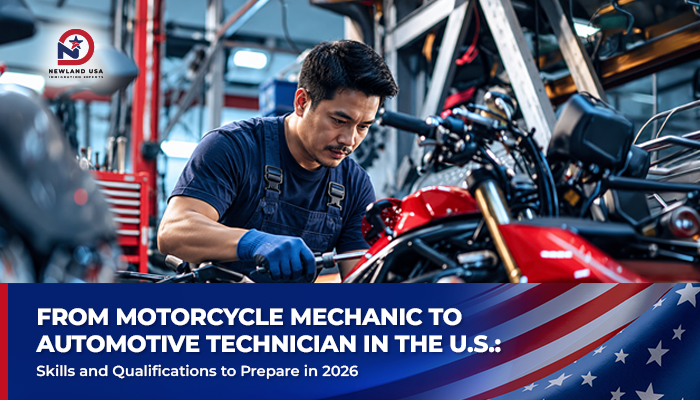
In Vietnam, motorcycle repair employs a huge workforce. Many people have held a wrench since they were very young and have built up decades of experience. With demand for automotive technicians in the U.S. staying high in 2026, a question many people are asking is whether two-wheeler repair skills can become a “springboard” to working in America. In this article, Newland USA will walk you through the car repair skills needed in the U.S., the types of U.S. automotive qualifications to prepare, a practical roadmap for motorcycle mechanics switching to car repair, and the role of the ESTA program in connecting Vietnamese skills with the U.S. labor market.
1. What is an Automotive Technician? An overview of the profession in the U.S.
What is an Automotive Technician? It is the job title for someone who inspects, maintains and repairs cars and light trucks. In Vietnamese, it is usually called “kỹ thuật viên ô tô.” According to the BLS (U.S. Bureau of Labor Statistics), the daily work of an automotive technician in the U.S. includes finding problems with electronic diagnostic equipment, inspecting systems, changing oil, rotating tires, replacing brake pads or sensors, as well as recording repair work and explaining the vehicle’s condition to customers. Besides traditional mechanical systems like the engine and transmission, technicians also need to understand electronic systems and sensors related to braking, the drivetrain and collision-avoidance technology.
In terms of market size, the BLS recorded about 825,800 jobs in this occupation in 2025 and projects a 5% increase from 2025 to 2035, higher than the 3% average for all occupations. Each year, the U.S. needs to fill about 66,200 positions, mostly to replace workers who retire or change careers. Growth is driven by the rising number of vehicles on the road, owners keeping their cars longer, and growing demand for calibrating modern safety systems. bls
Looking at the supply side, the picture is even clearer. According to the TechForce Foundation, the automotive industry needs about 70,865 new technicians each year, while supply is expected to reach only about 50,085. That leaves a gap of more than 20,000 positions, meeting only 59% of demand. This gap is why many U.S. employers turn to skilled international workers through the EB-3 immigration category, opening a “door” for Vietnamese people who want to become automotive technicians in the U.S.
As for income, the median wage for this occupation was $50,620 per year (about $24.34 per hour) as of May 2025, while the top 10% earned more than $81,790 per year. Car dealerships are the largest employers, with about 32% of the workforce, and they also pay more, around $59,920 per year. The income of an automotive technician in the U.S. therefore depends heavily on where they work, their experience and their professional certifications.
Learn more:
- AI in Auto Repair in the U.S. 2026: How Artificial Intelligence Diagnoses Vehicle Problems Faster and More Accurately
- 7 Key Technologies Every Industrial Maintenance Technician in the U.S. Needs to Know in 2026
- PLC & Automation Skills: A Launchpad for Maintenance Technicians in the United States in 2026
- What Is the ASE Certification? Requirements, Exam Roadmap, and Its Importance for Auto Technicians in the U.S. in 2026
2. Can a motorcycle mechanic work as a car mechanic in the U.S.?
The short answer to can a motorcycle mechanic work as a car mechanic in the U.S. is yes, as long as they add in-depth car knowledge and build real hands-on experience with four-wheel vehicles. In other words, motorcycle experience is an advantage when you want to become an automotive technician in the U.S., but it is not a “ticket” that qualifies you on its own.
One thing to keep in mind is how jobs are classified in the U.S. The BLS places repair work on motorcycles, motorboats and small off-road vehicles in the small engine mechanics group, separate from automotive technicians. This means U.S. employers and immigration authorities will not automatically treat motorcycle repair experience as car repair experience. So a motorcycle mechanic switching to car repair needs real working time on cars for their profile to be recognized.
On the other hand, a background in motorcycle repair makes learning much faster. Some skills carry over directly:
- Internal combustion engine principles: The four-stroke cycle, lubrication, cooling and ignition systems on motorcycles are basically the same as on cars, just different in scale and number of cylinders.
- Electronic fuel injection systems: Mechanics who are used to repairing FI motorcycles will find it easier to work with sensors, fuel injectors and engine control units on cars.
- Disassembly skills and a feel for engines: The habit of listening to an engine, watching exhaust smoke and feeling vibration is a valuable “toolkit” for diagnostic work.
- Customer communication skills: Experience advising customers and giving quotes at a motorcycle shop is very similar to explaining problems to car owners.
These foundations are the stepping stones that help you shorten your path into the profession.
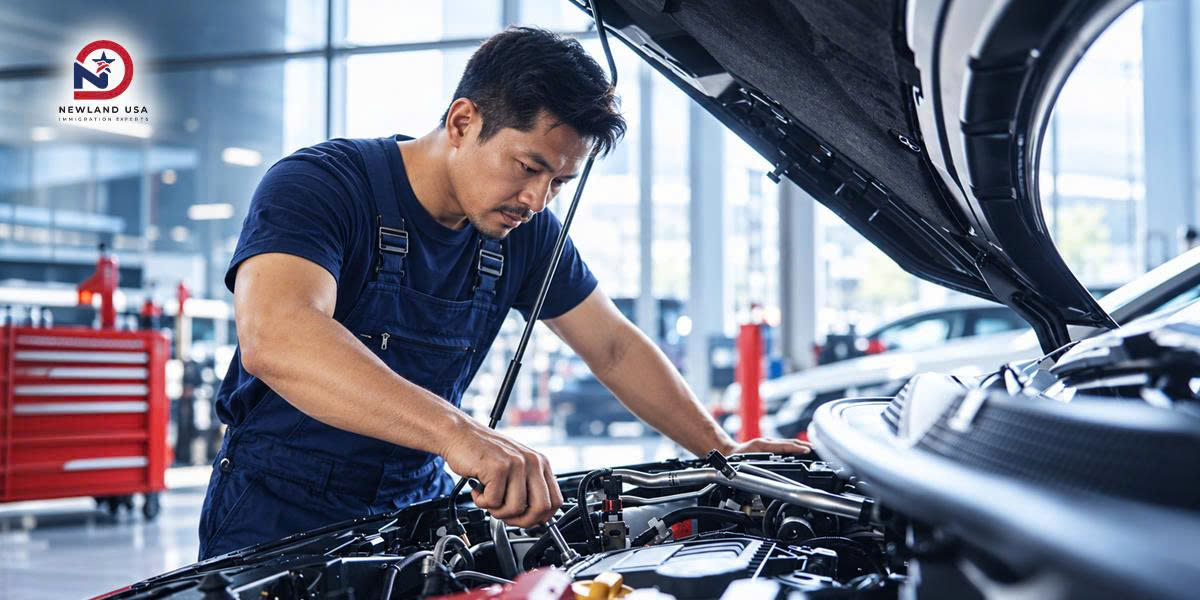
3. Technical differences between motorcycles and cars to overcome
Even though they share a mechanical foundation, a car is a far more complex system. To meet job requirements in the U.S., you need to master areas of knowledge that motorcycle repair rarely touches:
- Electrical and electronic systems: A modern car has many electronic control units (ECUs) that exchange data over a CAN network. In the U.S., cars and light trucks built since 1996 all have a standard OBD-II diagnostic port, so the ability to read fault codes and analyze live data is almost a default requirement.
- Automatic transmissions: Most vehicles in the U.S. use automatic, CVT or dual-clutch transmissions. The BLS notes that transmission repair requires knowledge of electronic controls and the ability to diagnose both electrical and hydraulic problems.
- Chassis, suspension and steering: Independent suspension, electric power steering and wheel alignment with specialized machines are almost entirely new areas for motorcycle mechanics.
- Air conditioning systems: Repairing car A/C involves refrigerants, which are strictly regulated by federal environmental rules.
- New technology: Advanced driver assistance systems (ADAS), hybrids and electric vehicles require knowledge of high-voltage safety as well as skills in calibrating sensors and cameras.
On top of that, the weight and size of cars require technicians to be skilled with lifts and hydraulic jacks, and to follow stricter safety procedures than in a motorcycle shop.
4. Car repair skills to prepare for the U.S.
Once you understand these differences, the next step is to build a set of car repair skills for the U.S. that match employers’ expectations. These can be divided into three main groups.
Technical skills: For an automotive technician in the U.S., diagnostics is the most valued skill. The BLS describes diagnostic technicians using scan tools, multimeters and on-board diagnostic systems to find the cause of poor engine performance. In addition, you need to read wiring diagrams, look up manufacturer repair manuals, and be skilled in routine maintenance as well as brake, suspension, steering and A/C repairs.
Soft skills: Technical English is a “key” that many Vietnamese workers tend to overlook. Technicians need to read and understand repair orders and technical documents, and communicate with both service advisors and customers. The BLS also highlights important qualities such as customer service skills, attention to detail, good hand skills and problem-solving ability.
Work habits: This occupation has one of the highest injury rates, so following safety procedures and wearing steel-toe shoes and personal protective equipment is mandatory. Technicians must also follow environmental rules when handling used oil or chemicals. Another difference is that technicians in the U.S. usually own their own hand tools, such as wrenches, pliers and sockets, while diagnostic equipment and large machinery are provided by the shop owner. Also, some shops pay by the hour, while others pay based on the amount of work completed. Under the second type, the speed and accuracy of an automotive technician in the U.S. directly affect their monthly income.
As you can see, car repair skills in the U.S. are not just about your hands. They also involve thinking, communication and professional conduct.
5. What qualifications does an automotive technician in the U.S. need?
As for what qualifications an automotive technician in the U.S. needs, the answer is that there is no single required nationwide degree. According to the BLS, most technicians complete a postsecondary automotive service technology program, some enter the field with just a high school diploma and learn on the job, and depending on the position, additional certifications may be required. The system of U.S. automotive qualifications can be pictured in layers as follows:
- Vocational diplomas and training certificates: In Vietnam, an intermediate or college diploma in automotive technology, or an elementary vocational certificate in car repair, is important proof of formal training. For a motorcycle mechanic switching to car repair, this is usually the first step to make their new knowledge official.
- ASE certification: For an automotive technician in the U.S., ASE (National Institute for Automotive Service Excellence) is the industry’s widely recognized certification system. To get certified, a technician must pass an exam and have full-time hands-on experience. Anyone who passes all tests from A1 to A8 is recognized as a Master Automobile Technician, and certifications must be retaken every 5 years. The usual experience requirement is 2 years, or 1 year if you have completed a recognized training program. The exams are currently offered in English, so your technical English will decide whether you can earn this certification.
- EPA Section 609 certification: The federal Clean Air Act requires technicians who repair car A/C systems to hold Section 609 certification. It is an open-book exam where you need 42 correct answers out of 50, and it can be taken online for about $20 per attempt. This certification is valid for life and never needs to be retaken.
- State requirements and manufacturer training: Licensing, registration and inspection requirements can vary significantly from state to state. There are also training programs sponsored by car manufacturers or dealerships that focus on a specific vehicle brand. This is an advantage when an automotive technician in the U.S. works at a dealership.
The good news is that some employers are willing to pay for their employees to get certified, and holding industry certifications can lead to higher pay. So workers can keep working toward ASE after they have started their job in the U.S.
6. Experience requirements for going to the U.S. under EB-3
For Vietnamese people, the common path to becoming an automotive technician in the U.S. is the EB-3 Skilled Workers category. This category requires workers to show at least 2 years of work experience or training. They must also have a full-time, permanent job offer and a labor certification approved by the U.S. Department of Labor before the I-140 petition is filed with USCIS.
The key point is that the experience must match the job description the employer registered in the PERM application. When the automotive technician in the U.S. position is registered under the title Automotive Maintenance Technician, the experience reviewed will be car repair and maintenance experience. This is why a motorcycle mechanic switching to car repair should start building working time at a car garage as early as possible.
Documents proving your skills usually include:
- Employment verification letter: Clearly stating your job title, period of employment and a specific job description.
- Employment contract and social insurance contribution history: These help make your declared working time more credible.
- Diplomas and vocational certificates: Intermediate or college diplomas, or automotive training certificates.
- Supporting materials: Photos and videos of real hands-on work for skills assessments (if required).
Each employer may have its own requirements, so you should get specific advice before preparing your application, for example through the ESTA program.
7. How to move from motorcycle mechanic to car mechanic: A 4-stage roadmap
Based on the analysis above, the most effective way to move from motorcycle mechanic to car mechanic is to follow a planned roadmap instead of learning on your own without direction:
- Stage 1 – Learn automotive basics: Sign up for an elementary, intermediate or college course in automotive technology. This can take anywhere from a few months to about two years depending on the format. Choose programs with lots of hands-on hours and a strong focus on electrical and electronic systems.
- Stage 2 – Gain real work experience: Work at a manufacturer’s service center or a garage with clear procedures. Start as an assistant or in quick maintenance, then move step by step to in-depth repairs, making sure you build enough verified experience.
- Stage 3 – Improve diagnostics and technical English: Practice using diagnostic tools, reading live data, learning industry terms and getting familiar with the content of ASE exams.
- Stage 4 – Connect with opportunities in the U.S.: Look into trusted recruitment programs such as the ESTA program, prepare documents that prove your skills, and take part in skills assessments as required by employers.
This roadmap helps you make the switch in a structured way while building a strong enough profile when applying for an automotive technician in the U.S. position.

8. The ESTA Program: A bridge between real skills and real hiring needs
Understanding the concerns of skilled Vietnamese workers, Newland USA has developed the ESTA program (EB-3 Skilled Trade America). The program focuses on technical trades in the U.S., including two positions: Automotive Maintenance Technician and Industrial Maintenance Technician.
What makes the ESTA program different is its approach: EB-3 is seen as a long-term career path, not just a visa process. The ESTA program connects Vietnamese workers who have real skills with real hiring needs in the U.S., so that years of experience become the foundation for their career and their whole family’s future.
For mechanics considering the path to becoming an automotive technician in the U.S., the ESTA program can help assess how well their profile fits, point out which car repair skills for the U.S. they need to add, and support them throughout the EB-3 application process. This way, workers know clearly where they stand and what to do next.
Conclusion
The journey from a motorcycle repair shop to a role as an automotive technician in the U.S. is not short, but it is completely achievable with a clear plan. Your mechanical background from motorcycle repair is an advantage, while electrical and electronic knowledge, real car experience, technical English and certifications like ASE and EPA 609 are the missing pieces. As the U.S. still faces a shortage of tens of thousands of auto technicians every year, solid preparation starting today can turn your skills into a “ticket” to the future. If you are looking for a path with clear direction, Newland USA’s ESTA program is a starting point worth exploring.
Learn more:
- EB5 Capital Recovery Time: How Long It Takes and the Key Milestones
- Electric Vehicle Technicians in the U.S.: The “Golden” Skills Helping Vietnamese Auto Mechanics Get Ahead of the 2026 EV Trend
- US Engineering & Maintenance Labor Shortage 2026: The Driving Force Behind the EB3 Skilled Workers Visa Policy
- Industrial Maintenance Technician: Job Duties, Requirements & U.S. Immigration Opportunities in 2026
News Categories



Related news

From Motorcycle Mechanic to Automotive Technician in the U.S.: Skills and Qualifications to Prepare in 2026
AI in Auto Repair in the U.S. 2026: How Artificial Intelligence Diagnoses Vehicle Problems Faster and More Accurately
7 Key Technologies Every Industrial Maintenance Technician in the U.S. Needs to Know in 2026
PLC & Automation Skills: A Launchpad for Maintenance Technicians in the United States in 2026
What Is the ASE Certification? Requirements, Exam Roadmap, and Its Importance for Auto Technicians in the U.S. in 2026

EB5 Capital Recovery Time: How Long It Takes and the Key Milestones
Electric Vehicle Technicians in the U.S.: The “Golden” Skills Helping Vietnamese Auto Mechanics Get Ahead of the 2026 EV Trend
US Engineering & Maintenance Labor Shortage 2026: The Driving Force Behind the EB3 Skilled Workers Visa Policy
Industrial Maintenance Technician: Job Duties, Requirements & U.S. Immigration Opportunities in 2026