Work Culture in U.S. Auto Repair Shops in 2026
With many Vietnamese workers choosing to settle in the United States through the EB-3 program, auto repair and maintenance stands out as one of the fields offering steady hiring demand and a clear career path. However, strong technical skills alone are not enough; to truly fit in, workers also need to understand the distinctive work culture of this industry. In the article below, Newland USA takes a detailed look at the work culture in the U.S. within the environment of American auto repair shops — from safety principles and communication styles to pay and reward structures — so that you can step into this new chapter with confidence and a solid mindset.
1. Overview of U.S. work culture and what makes the auto industry unique
Before diving into the specifics of an auto shop, workers should first get a broader picture of work culture in the U.S. America is one of the countries that places the highest value on personal initiative and individual responsibility. Employees are expected to manage their own tasks, anticipate problems on their own, and propose solutions rather than waiting for step-by-step instructions from a supervisor. This “self-reliance” mindset runs deep across every industry, and auto repair shops are no exception.
Another defining feature of American work culture is punctuality. Showing up five to ten minutes before your shift starts is seen as a sign of professionalism and respect for your coworkers. On the other hand, being late is often interpreted as a lack of seriousness and can lead to disciplinary action. Americans also tend to favor direct, clear communication and value efficiency over formality. Work-related feedback — including criticism — is usually delivered head-on, but with a positive and respectful tone.
Compared with a typical office setting, U.S. work culture in the automotive technical field has its own flavor. Here, work performance is measured by the number of vehicles handled and the quality of each repair, not by appearances or credentials. The spirit of “teamwork” is also more visible, because diagnosing a complex fault or lifting heavy components nearly always requires coordination among multiple technicians.
2. The real-world working environment in U.S. auto repair shops
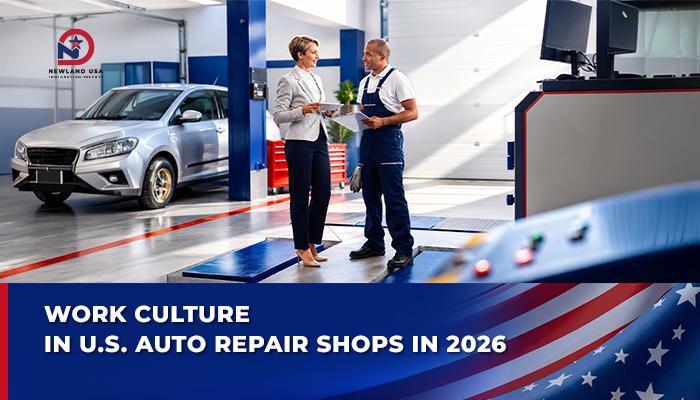
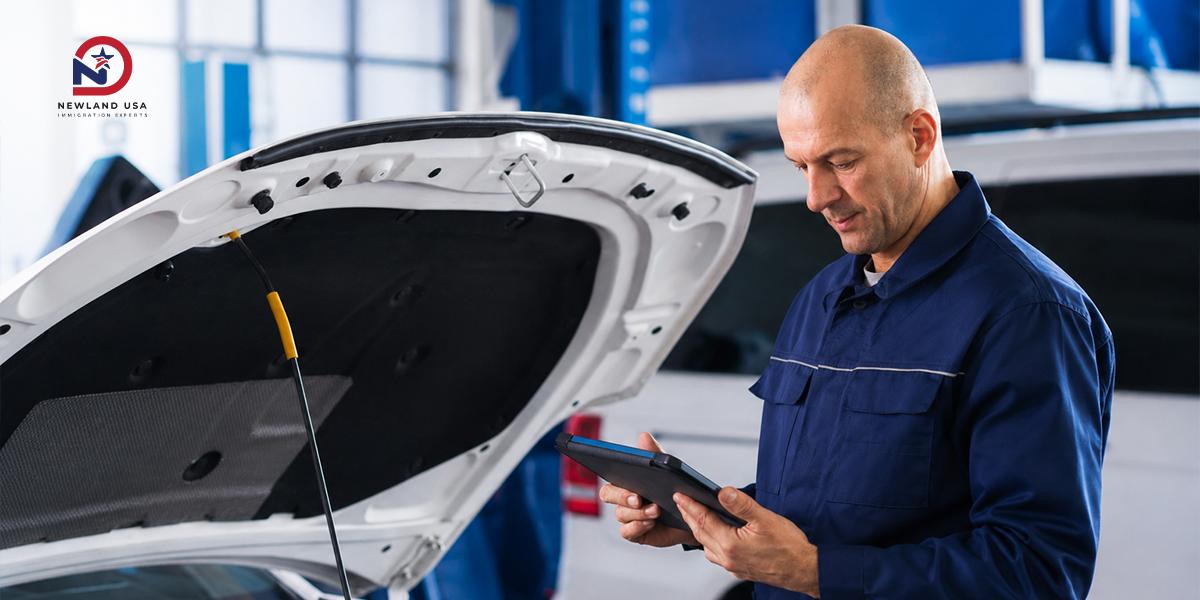
The image of a grease-covered mechanic working under a dim light has long stopped reflecting the reality of this job. Most auto repair shops in the U.S. today are bright, well-ventilated spaces equipped with air conditioning and separate work bays. Each bay has a lift and dedicated tools, allowing technicians to easily access the underside of vehicles and overhead components. Of course, not every facility is perfect — some older shops have weaker heating and cooling systems, so temperatures during summer and winter aren’t always ideal.
Physically, this is a job that demands stamina. Mechanics often stand throughout their entire shift, bending, lifting, and carrying bulky parts, and working in uncomfortable positions such as crawling under a car or kneeling to inspect a detail. They are also regularly exposed to chemicals, exposed electrical components, and sharp tools. The constant noise from pneumatic and electric equipment is the reason many shops require their staff to wear hearing protection.
When it comes to hours, most technicians follow a standard 40-hour workweek, though a sizable portion work overtime, evenings, or weekends to meet customer demand. This is something newcomers should keep in mind: the flexible schedules in U.S. auto shops can be a chance to earn more, but they also call for solid time-management skills.
3. Workplace rules in U.S. auto shops: occupational safety and OSHA compliance
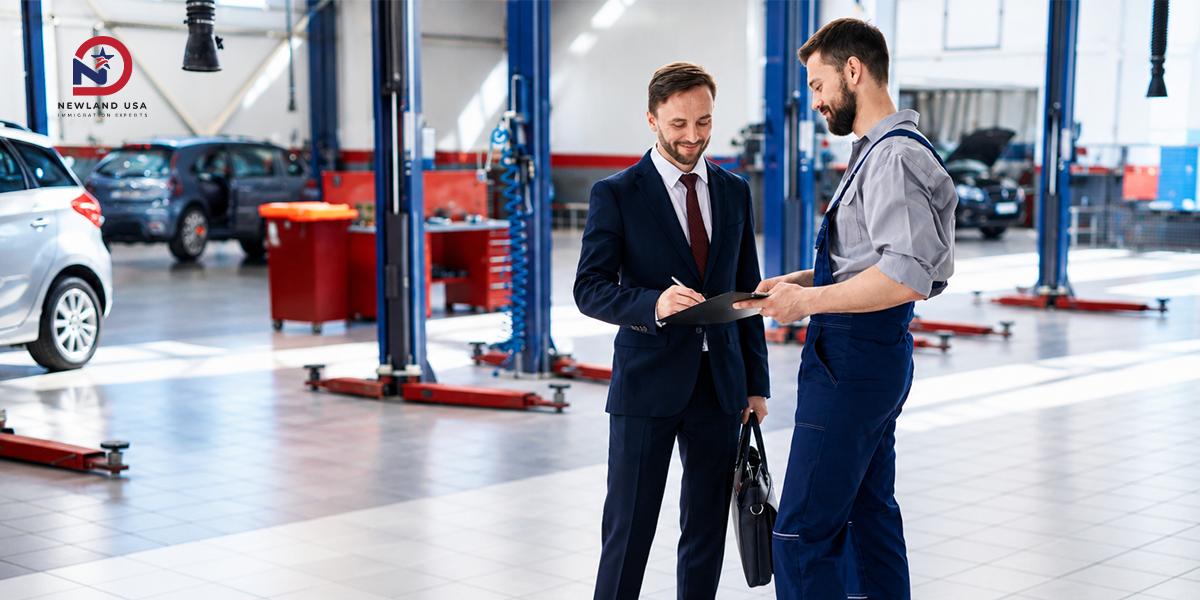
If we had to pick the single most important element, occupational safety would be the backbone of every workplace rule in U.S. auto shops. Most repair facilities fall under the oversight of the Occupational Safety and Health Administration (OSHA), specifically under the general industry standards (29 CFR 1910). These regulations are not a formality — they form a mandatory framework designed to protect workers’ lives.
First is the Hazard Communication Standard (HazCom), also known as the “Right to Know” rule. Every chemical in the shop — from brake cleaner, transmission fluid, and battery acid to refrigerants and paint solvents — must be fully labeled with the product name, warning symbols, and first-aid information. This is accompanied by a Safety Data Sheet (SDS) kept right at the work area, so technicians can look it up at any time.
Next, the rules on personal protective equipment (PPE) are strictly enforced. Depending on the task, technicians must wear safety goggles, burn-resistant gloves, steel-toed boots, and sometimes even a respirator. In fact, the most frequently cited OSHA violation actually involves respiratory protection equipment. Fire prevention standards also require shops to keep paths to fire extinguishers clear at all times, hold regular drills, and store flammable liquids according to regulations.
A number of other day-to-day principles also shape the rules at the shop: practicing safe lifting techniques, keeping tools neatly organized to prevent drops and breakage, ensuring proper ventilation, disposing of waste according to state and federal rules, and absolutely no eating or drinking inside the repair area to prevent contamination. Mastering and following these guidelines not only helps workers avoid accidents but is also a way to demonstrate professionalism in the eyes of customers.
4. Communication culture, teamwork, and personal accountability
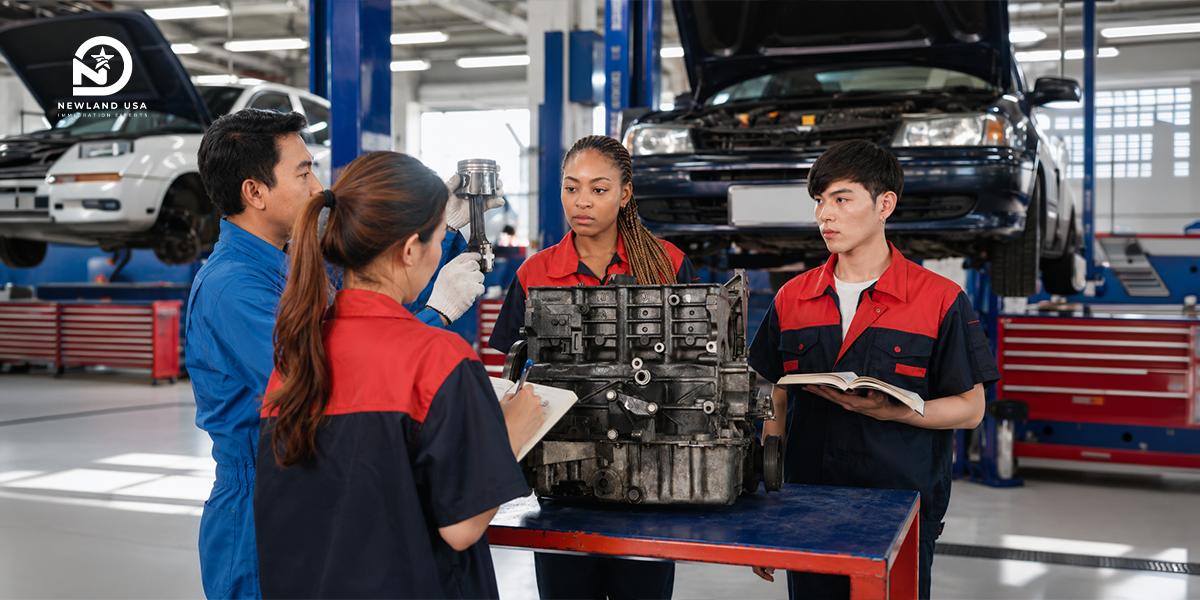
Another aspect that shapes the industry’s distinctive work culture is its communication style. In this environment, auto repair is, by nature, a team activity. Technicians work together to analyze tricky problems, share specialized knowledge across different areas, and assist colleagues with the heavy-lifting steps. Because of this, the ability to communicate briefly and accurately is valued just as much as technical skill.
Many shops run on a fairly structured schedule — for example, holding a short morning huddle to update everyone on pending repair orders, anticipate challenges for the day, and make sure everyone is on the same page. This practice clearly reflects the transparency embedded in U.S. work culture: expectations are explicit, and every individual has a voice.
For workers coming from cultures that emphasize strict hierarchy, this can be a major shift. In the U.S., when a new employee actively asks questions or shares opinions with their manager, it’s viewed positively — even as a sign of engagement with the job. Silence, on the other hand, can sometimes be misinterpreted as indifference. That said, a healthy workplace also values mutual respect and a clear boundary between work and personal life — Americans generally avoid contacting coworkers outside of work hours unless absolutely necessary.
5. Pay structures, ASE certifications, and career progression
Understanding income is essential when discussing U.S. work culture in the auto industry. According to data from the U.S. Bureau of Labor Statistics, the average wage for auto repair technicians is roughly $49,000 to $53,000 per year, with newcomers starting around $33,000 and highly skilled technicians sometimes exceeding $80,000. Technicians who hold Master certifications at luxury dealerships, or who specialize in electric vehicles and heavy-duty trucks, can even earn six-figure incomes.
One feature that may feel unfamiliar to Vietnamese workers is the flat-rate pay system. Under this model, each job is assigned a set number of standard hours, and the technician is paid for those hours regardless of how quickly or slowly they finish. A skilled, fast technician may be able to “bill” more than 60 hours of labor per week and earn significantly more than someone on an hourly wage. The downside is that during slow weeks, or on diagnostic jobs that take a long time, income can drop. These days, many shops use a hybrid model: a base hourly wage plus bonuses tied to billed hours or customer satisfaction.
The key to boosting your income lies in the ASE (Automotive Service Excellence) certification — widely regarded as the “gold standard” of the trade. ASE-certified technicians are typically paid 15% to 25% more than non-certified peers, and many dealerships even offer a separate bonus for each certification earned. As for career path, someone can start out as a helper, move up to service technician, then earn the title of ASE Master Technician, and from there go on to become a shop foreman, service advisor, and eventually a manager or shop owner. The good news for immigrant workers is that this industry is currently facing a severe labor shortage, with hundreds of thousands of open positions, while most states do not require a college degree or a professional license.
6. Key tips to help Vietnamese workers adapt to U.S. work culture
To shorten the adjustment period, workers should keep a few key principles in mind. First, build a habit of punctuality — it is the measure of personal credibility in American work culture. Second, take the initiative to improve your industry-specific English; the language barrier is one of the biggest obstacles, especially when you need to read chemical labels or quickly discuss a technical issue with a coworker.
Third, be willing to ask questions and receive feedback with an open, learning mindset — view it as a chance to grow rather than as criticism. Fourth, strictly follow every safety regulation — knowing the workplace rules in U.S. auto shops not only protects yourself but also leaves a strong impression on your employer. Finally, take advantage of mentorship programs and professional networks; many local employment-support centers offer training sessions on communication, teamwork, and conflict resolution.
Diversity is one of the strengths of the U.S. labor market, where nearly one-fifth of the workforce is made up of immigrants. Once you truly understand and respect its core values, you will find that adapting to U.S. work culture isn’t nearly as difficult as it might first seem.
7. Conclusion
Overall, the work culture inside U.S. auto repair shops is a blend of professionalism, personal accountability, and rigorous safety standards. For Vietnamese workers pursuing the dream of permanent residency through the EB-3 program, equipping yourself early with knowledge about the workplace rules in U.S. auto shops and the local working style is the most solid step you can take — opening the way to a sustainable path of integration and growth on American soil.
Learn more:
- Auto Repair Technician Shortage in the U.S.: A Golden Opportunity for EB3 Green Card Applicants
- DIY Culture: 5 Reasons Americans Prefer Repairing Their Own Homes Instead of Hiring Professionals
- Form I-131A – How to Board a Flight Back to the U.S. When You Lose Your Green Card Abroad
- Salary and Benefits of Automotive Technician Career in the USA through EB-3 Program
- 5 Important Steps When You Lose Your U.S. Green Card
News Categories



Related news
Who Is the ESTA Program For? How to Assess Your Fit Before Applying in 2026

Who Is the ESTA Program For? How to Assess Your Fit Before Applying in 2026

From Motorcycle Mechanic to Automotive Technician in the U.S.: Skills and Qualifications to Prepare in 2026
AI in Auto Repair in the U.S. 2026: How Artificial Intelligence Diagnoses Vehicle Problems Faster and More Accurately
7 Key Technologies Every Industrial Maintenance Technician in the U.S. Needs to Know in 2026
PLC & Automation Skills: A Launchpad for Maintenance Technicians in the United States in 2026
What Is the ASE Certification? Requirements, Exam Roadmap, and Its Importance for Auto Technicians in the U.S. in 2026

EB5 Capital Recovery Time: How Long It Takes and the Key Milestones
Electric Vehicle Technicians in the U.S.: The “Golden” Skills Helping Vietnamese Auto Mechanics Get Ahead of the 2026 EV Trend