Salary and Benefits of Automotive Technician Career in the USA through EB-3 Program
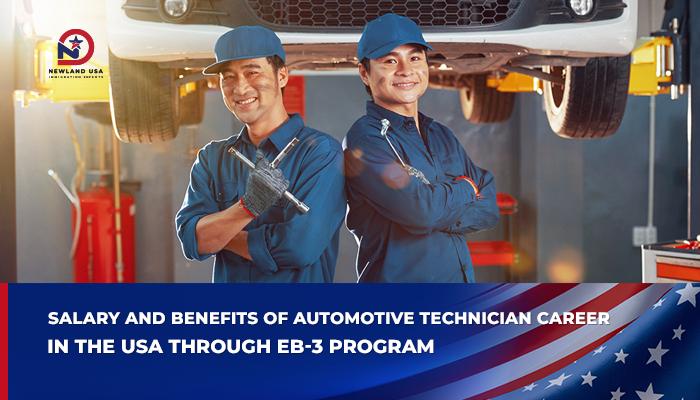
The automotive repair profession in the USA is opening up attractive settlement opportunities through the EB-3 program with competitive automotive technician salaries ranging from $30,000 to over $100,000 per year. This article from Newland USA provides a comprehensive analysis of salaries and benefits in the USA for automotive technicians at all levels, while clarifying the legal immigration path through the EB-3 program – an ideal solution for those who want to build a sustainable career in the United States.
1. Overview of the Automotive Technician Profession in the USA and the EB-3 Program
The American automotive industry plays a key role in the economy with over 289 million vehicles in circulation, creating stable demand for skilled technicians. Notably, the EB-3 program (Employment-Based Third Preference) has become a popular immigration route for the automotive repair profession, allowing skilled foreign workers to obtain a Green Card in the United States.
The EB-3 program is designed by U.S. Citizenship and Immigration Services (USCIS) for three groups: skilled workers, professionals, and other workers. The automotive repair profession falls under the skilled workers category of the EB-3 program, requiring applicants to have at least two years of professional experience. This suits most automotive technicians with intermediate level training or higher.
According to data from the Bureau of Labor Statistics, the automotive repair services industry is facing a serious labor shortage. Forecasts show an additional 370,000 automotive technicians will be needed by 2026, creating favorable conditions for U.S. employers to sponsor EB-3 programs for foreign workers. Salaries and benefits in the USA in this industry are also increasingly improved to attract and retain talent.
2. Automotive Technician Salaries in the USA by Level
2.1. Entry-Level: Career Start
For technicians new to the industry, entry-level automotive technician salaries range from $30,000 to $46,000 per year, with an average of around $40,714 annually. This figure translates to an hourly wage of $19 to $22, depending on geographic region and type of business.
Those participating in the EB-3 program typically start at entry-level positions when first arriving in the USA, even if they have experience in their home country. Automotive technician salaries and benefits in the USA at this level are still significantly higher than many countries, especially when factoring in accompanying benefits. States with high living costs like California, Alaska, or New Hampshire typically pay automotive technician salaries 15-25% above the national average.
According to 2024 data from ZipRecruiter and Salary.com, entry-level technicians can earn between $32,305 and $45,805 depending on work location. Those working at high-end car dealerships or specialized service centers typically receive better salaries and benefits in the USA compared to small independent garages.
2.2. Mid-Level: Professional Development
After 3-5 years of experience, automotive technicians can advance to mid-level with salaries ranging from $46,000 to $62,500 per year. This is an important stage when workers have completed ASE (Automotive Service Excellence) certifications and accumulated specialized skills.
The mid-level salary for the entire industry announced by the Bureau of Labor Statistics in October 2025 is $49,670 annually, showing automotive technician salaries and benefits in the USA at a fairly stable level. Technicians participating in the EB-3 program typically achieve this salary level after 2-3 years of working in the USA, especially if they invest in additional training and specialized certifications.
The hourly wage coefficient for automotive technicians at this level ranges from $22 to $30, allowing technicians to earn additional income through overtime. Many employers apply flat-rate systems or commissions based on billable hours, helping those with high productivity significantly increase their salaries and benefits in the USA.
2.3. Senior and Master Technician: Career Peak
For senior technicians and master technicians with over 8-10 years of experience, automotive technician salaries in the USA can reach $62,500 to $90,000 annually, with an average of around $78,078. The top tier (top 10%) earns between $100,000 and $117,000 per year.
Master technician is the highest title in the industry, requiring ASE Master certification and many years of experience handling complex systems. Automotive technician salaries and benefits in the USA at this level compete with many professions requiring college degrees. States like Washington, California, and the District of Columbia pay master technician automotive technician salaries highest, with rates from $85,000 to $100,000 per year.
EB-3 program participants can reach senior technician positions after 5-7 years of development in the USA. Many large car dealerships are willing to sponsor EB-3 programs for master technicians from abroad, especially those specializing in luxury cars or new hybrid/electric technology. Salaries and benefits in the USA for this group also include significant performance bonuses.

3. Detailed Analysis of Benefits in the Automotive Industry
3.1. Health Insurance and Health Benefits
One of the most attractive aspects of salaries and benefits in the USA is the comprehensive health insurance package. According to research by Employee Advisor, about 49% of repair shops provide health insurance for employees, with large car dealerships almost always having full insurance packages.
Health insurance packages typically cover medical, dental, and vision care. With high medical costs in the USA, this benefit has significant real value in total automotive technician salaries and benefits in the USA. Many employers also provide disability insurance and life insurance, especially important since the automotive repair industry has higher-than-average injury rates.
EB-3 program participants receive full health benefits like U.S. citizens when they have a Green Card, including the ability to participate in Medicare later. This is a major advantage over other temporary visa programs, demonstrating the long-term value of the EB-3 program.
3.2. Retirement and Savings Programs
Salaries and benefits in the USA in the automotive industry typically include 401(k) retirement programs, allowing employees to contribute pre-tax salary portions to retirement funds. Many employers also provide matching contributions of 3-6% of salary, effectively increasing total income.
The 401(k) program provides significant tax benefits and helps build long-term assets. For EB-3 program participants, the ability to accumulate retirement savings in the USA is one of the main reasons they choose this immigration path. Some high-end car dealerships also offer pension programs (traditional pensions), although this is increasingly rare.
On average, retirement benefits account for about 3-4% of total automotive technician salaries and benefits in the USA. Combined with Social Security where workers contribute 6.2% of salary, the U.S. retirement system provides financial security for old age.
3.3. Paid Time Off and Flexible Time
Most automotive repair businesses provide paid time off (PTO) of 10-20 days per year, depending on seniority. Large car dealerships typically have more generous leave policies, including paid holidays for major holidays like Thanksgiving, Christmas, and Independence Day.
Salaries and benefits in the USA also typically include sick days, allowing employees to take time off when ill while still being paid fully. Some states like California and New York have mandatory laws about paid sick leave, protecting worker rights.
Automotive technician work schedules are typically stable, following shop business hours, helping balance work and life. This is especially important for EB-3 program participants with families, as they need time to care for children and integrate into new communities.
3.4. Other Allowances and Subsidies
Automotive technician salaries and benefits in the USA also include many additional allowances. Tool allowance is a common benefit, with many employers supporting $500 to $2,000 per year to purchase or maintain professional tools. Some companies also reimburse costs for ASE certifications, encouraging employees to improve their skills.
Commissions and performance bonuses are an important part of automotive technician salary structure. Technicians working on flat-rate systems can earn an additional 10-30% income through commissions, especially if they work efficiently and complete many jobs.
Many businesses provide employee discounts on parts and repair services, helping employees save on personal vehicle maintenance costs. Some shops even allow employees to use workspace after hours to repair personal vehicles, an “unofficial benefit” with practical value.
Training and professional development are also part of salaries and benefits in the USA. Automobile manufacturers often sponsor specialized training courses for technicians, especially on new technologies like electric vehicles and ADAS (Advanced Driver Assistance Systems).
4. EB-3 Program and Opportunities for Automotive Technicians
4.1. Requirements and Application Process
The EB-3 program for automotive technicians requires applicants to meet basic criteria. First, workers need at least two years of professional experience in automotive repair. This experience must be proven through confirmation letters from previous employers, vocational degrees, or related certifications.
A prerequisite of the EB-3 program is having a U.S. employer willing to sponsor. This employer must prove to the U.S. Department of Labor that there are not enough qualified U.S. workers available and willing to take the job. This process is called PERM (Program Electronic Review Management) Labor Certification.
The PERM process requires employers to publicly post job listings, proving efforts to find domestic labor. The time to complete PERM typically takes 14 to 22 months. After PERM is approved, the employer files Form I-140 (Immigrant Petition for Alien Worker) with USCIS, taking an additional 5-7 months to process.
Workers then wait for available visa numbers according to the monthly Visa Bulletin. The EB-3 program has a quota of about 40,000 visas per year, with a 7% limit per country. Waiting time depends on country of origin, ranging from a few months to several years.
4.2. Benefits of EB-3 Program Compared to Other Visas
The EB-3 program provides many superior advantages for automotive technicians compared to temporary visas. The most prominent point is the ability to obtain a Green Card – permanent resident status in the USA. Unlike H-1B or H-2B visas with time limits, the EB-3 program leads to stable settlement status.
Green Card holders through the EB-3 program receive full salaries and benefits in the USA like U.S. citizens, without restrictions on residency time or work. They can freely change jobs after obtaining a Green Card (typically 6 months after receipt), not being tied to sponsoring employers like temporary visas.
The EB-3 program allows bringing family – spouse and unmarried children under 21 years old. Family members also receive Green Cards, with rights to work and study in the USA. This is a major advantage over many other visa programs that limit family rights.
After 5 years with a Green Card through the EB-3 program, workers are eligible to apply for U.S. citizenship, opening up full political and social rights, including voting rights and full social benefits. Automotive technician salaries and benefits in the USA as a citizen are completely equal to native-born Americans.
4.3. Program Costs and Timeline
Total costs for the EB-3 program from the employer side typically range from several thousand USD, including lawyer fees, posting fees, and administrative costs. Workers typically must pay medical examination costs (about $200-500), document translation fees, and travel expenses.
The time to complete the EB-3 program from starting PERM to receiving a Green Card typically takes 2-3 years for most countries. Countries with high quotas like India or the Philippines may take longer due to backlogs. Premium Processing for I-140 (additional $2,500) shortens processing time to 15 business days.
Despite significant costs and time, the EB-3 program is still considered a worthwhile investment. Salaries and benefits in the USA are much higher than most countries, and long-term career development opportunities fully compensate for initial costs.

5. Salary and Benefits Comparison by Geographic Region
5.1. Highest Paying States
Automotive technician salaries in the USA have significant differences between states. District of Columbia leads with average salaries of $65,390/year ($31.44/hour), followed by California, Alaska, New Hampshire, and Washington. Coastal states with high living costs typically pay better salaries and benefits in the USA.
California, with a strongly developed automotive industry, provides average automotive technician salaries of $45,000-71,000 depending on level. Large cities like Los Angeles, San Francisco, and San Diego particularly lack skilled technicians, creating conditions for the EB-3 program to be widely used by employers.
Alaska and Washington also stand out with attractive automotive technician salaries and benefits in the USA. Alaska pays master technicians an average of $70,527/year, while Washington reaches $88,431. However, high living costs in these areas need to be considered.
Conversely, Southern and Midwestern states like Mississippi, Louisiana, Kentucky have lower automotive technician salaries, from $35,000-42,000. But significantly lower living costs make real purchasing power potentially equivalent.
5.2. Cities and Metropolitan Areas with Good Opportunities
Major cities provide abundant job opportunities for the EB-3 program in the automotive industry. New York, with millions of vehicles, always needs technicians. Automotive technician salaries in New York average $52,000-75,000, depending on experience.
Los Angeles and the Greater LA area are automotive industry centers with thousands of dealerships and repair shops. Salaries and benefits in the USA in this area are very competitive, especially for those specializing in luxury cars like BMW, Mercedes-Benz, or Lexus.
Houston and Dallas, Texas, are also attractive destinations. Texas has no state income tax, increasing actual income from automotive technician salaries and benefits in the USA. Average salaries in Texas are about $39,000-58,000, with lower living costs than coastal states.
Chicago, Seattle, and Boston are other markets with high demand. These cities have harsh winters, requiring frequent vehicle maintenance, creating stable work for technicians. Many employers here actively participate in the EB-3 program to address labor shortages.
6. Trends and Career Prospects
6.1. New Technologies and Required Skills
The automotive industry is undergoing profound technological transformation, affecting automotive technician salaries and benefits in the USA. Electric vehicles (EVs) and hybrids are increasingly popular, requiring new skills in lithium-ion battery systems, electric motors, and energy management. Technicians with EV expertise can earn an additional 15-25% compared to traditional automotive technician salaries.
ADAS (Advanced Driver Assistance Systems) like adaptive cruise control, lane keeping assist, and automatic emergency braking are becoming standard. Calibrating and maintaining these systems requires specialized training, creating opportunities for the EB-3 program to recruit international specialists.
Advanced diagnostic technology is changing work methods. Modern technicians spend nearly half their working time with computers and diagnostic software. Information technology skills are increasingly important, affecting salaries and benefits in the USA workers receive.
6.2. Development and Advancement Opportunities
The EB-3 program opens doors to long-term careers in the USA. Many technicians start with entry-level positions and advance to master technician in 7-10 years, doubling or tripling automotive technician salaries.
Advancement paths include: specialization in specific areas like diesel engines, drivetrain systems, or automotive electronics; moving to management positions like service manager or shop foreman; or transitioning to service writer roles (customer consulting), which typically have higher salaries and benefits in the USA due to combining technical and sales skills.
Some technicians leverage experience to become mobile mechanics, serving customers at their locations. This model provides flexibility and high income potential. Others open their own garages after accumulating capital and experience, creating business opportunities from the EB-3 program.
Continuous training and certifications are the key to advancement. ASE Master certification, manufacturer certifications for brands like Toyota, Honda, or Ford, and training on new technologies all enhance automotive technician salaries and benefits in the USA. Many employers reimburse training costs, viewing this as an investment in service quality.

7. Conclusion
The EB-3 program is a golden opportunity for automotive technicians wanting to settle in the USA. Unlike immigration programs requiring college degrees or large investments, the EB-3 Skilled Workers program only requires two years of practical experience – something most skilled automotive technicians meet.
Salaries and benefits in the USA in the automotive industry far exceed many countries, with average salaries from $40,000-78,000 depending on level. Combined with comprehensive benefit systems – health insurance, retirement, paid time off – total value provided can be 30-40% higher than base salary.
Newland USA, with the motto “Stable Settlement – Lifelong Prosperity,” is ready to advise and support you in preparing documents and accompanying you throughout the EB-3 U.S. settlement process through the automotive repair profession. Contact Newland USA immediately via hotline 0785591988 or email: newsletter@newlandusa.asia for detailed and free consultation.
Learn more:
- Requirements to become an automotive mechanic in the USA through EB3 Visa
- How Important is Form I-140 in the EB3 Visa Process?
- Why Choose EB3 U.S. Immigration Through the Medical Glove Manufacturing Industry in 2026?
- What Factors Affect EB3 Immigration Processing Time to the United States?
- Why do many people give up on their EB3 application while it’s still being processed?
News Categories



Related news

Who Is the ESTA Program For? How to Assess Your Fit Before Applying in 2026

Who Is the ESTA Program For? How to Assess Your Fit Before Applying in 2026

From Motorcycle Mechanic to Automotive Technician in the U.S.: Skills and Qualifications to Prepare in 2026

AI in Auto Repair in the U.S. 2026: How Artificial Intelligence Diagnoses Vehicle Problems Faster and More Accurately

7 Key Technologies Every Industrial Maintenance Technician in the U.S. Needs to Know in 2026

PLC & Automation Skills: A Launchpad for Maintenance Technicians in the United States in 2026

What Is the ASE Certification? Requirements, Exam Roadmap, and Its Importance for Auto Technicians in the U.S. in 2026

EB5 Capital Recovery Time: How Long It Takes and the Key Milestones
Electric Vehicle Technicians in the U.S.: The “Golden” Skills Helping Vietnamese Auto Mechanics Get Ahead of the 2026 EV Trend