Form I-131A – How to Board a Flight Back to the U.S. When You Lose Your Green Card Abroad
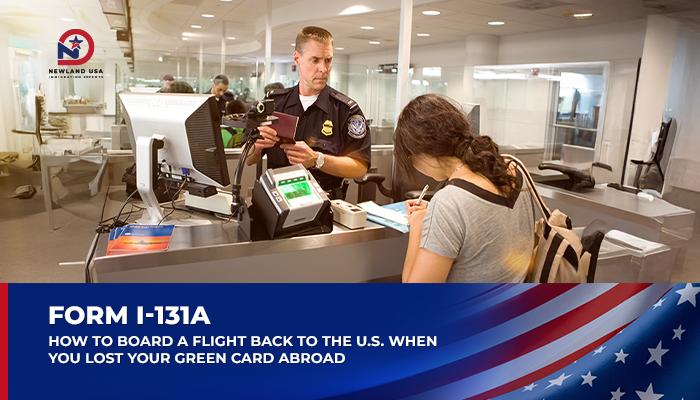
When you lose your green card during a trip abroad, returning to the United States can become a major challenge. Form I-131A, also known as the Application for Carrier Documentation, is the legal solution designed by the U.S. Citizenship and Immigration Services (USCIS) specifically for these situations. Through Form I-131A, permanent residents can apply for a temporary boarding permit to return to the U.S. legally, even without having the physical green card in hand.
1. What is Form I-131A and why do you need it?
Form I-131A is an official form issued by USCIS, specifically designed for lawful permanent residents (LPR) or conditional permanent residents who are outside the U.S. and encounter situations where their green card is lost, stolen, or damaged. When you no longer have a valid green card to present to airlines, commercial carriers will refuse to let you board a flight to the U.S. due to concerns about being penalized for transporting passengers without proper documentation.
The role of Form I-131A is to help you obtain a temporary travel document – commonly called a boarding foil or transportation letter – that allows airlines to accept you on a flight without violating regulations. This boarding permit will be affixed to your passport or issued as a separate document, confirming that you are still a lawful permanent resident of the U.S. and are permitted to return.
It’s important to note that Form I-131A is not a permanent replacement for a green card. It is only a temporary document valid for approximately 30 days, just enough to allow you to set foot back in the U.S. After returning to the U.S., you must still file Form I-90 to apply for a replacement green card for the lost card.
2. Who is eligible to file Form I-131A?
Not everyone can use Form I-131A. USCIS has established clear criteria for eligibility to file this application. To be considered for approval of Form I-131A and receive a boarding permit, you must fully meet the following requirements:
2.1. Must be a lawful permanent resident or conditional permanent resident
You must be someone who has been granted lawful permanent resident (LPR) status or conditional permanent resident status by the U.S. government. Form I-131A is not for those who have abandoned their green card status or have had their permanent resident status terminated. You must have been an LPR when you left the U.S. and still maintain this status when you want to return.
2.2. Currently outside U.S. territory
Form I-131A only applies to those currently abroad. If you are within U.S. territory and lose your green card, you need to file Form I-90 to apply for a replacement green card, not Form I-131A.
2.3. Time of absence since leaving the U.S.
This is one of the most important factors when considering eligibility for Form I-131A:
If your green card is lost: You have been away from the U.S. for less than 1 year. USCIS calculates this time from the date you departed until the date you pay the fee for Form I-131A.
If your Reentry Permit is lost: The absence must be less than 2 years since leaving the U.S.
If your Advance Parole document or Employment Authorization Document (EAD) with travel notation is lost: The document has not expired and was lost, stolen, damaged, or destroyed while you were abroad.
If you have been absent from the U.S. for more than 1 year without a valid reentry permit, USCIS will consider that you have abandoned your green card. In this case, Form I-131A will not be suitable, and you may need to file for an SB-1 Visa (Returning Resident Visa) instead.
3. Detailed step-by-step process for filing Form I-131A
Filing Form I-131A to obtain a boarding permit needs to be done carefully and in compliance with the proper procedures. Here is a detailed step-by-step guide:
Step 1: Verify that you actually need to file Form I-131A
Before starting the Form I-131A filing process, verify that you don’t have any alternative documents. According to guidance from U.S. Customs and Border Protection (CBP), some special cases may be accepted by airlines to board without needing Form I-131A:
- An expired green card accompanied by Form I-797 (Notice of Action) proving you have filed Form I-751 or I-829 to remove conditions on your permanent resident status. This Form I-797 will extend the validity of your green card for the specified period.
- An expired green card accompanied by military orders proving you are serving in the U.S. military abroad.
- Some airlines may accept other forms of documentation depending on their internal policies.
Contact your airline or carrier directly to ask if they accept these alternative documents before filing Form I-131A and incurring unnecessary fees.
Step 2: Prepare Form I-131A
You can download Form I-131A from the official USCIS website at www.uscis.gov/i-131a. This form must be filled out completely and accurately with all your personal information including:
- Full name
- Date of birth
- A-Number (Alien Registration Number) – can be found on your green card copy, on your immigrant visa, or in your passport at the U.S. entry stamp
- Current address abroad
- Trip information (date of departure from the U.S., expected return date)
- Details about the lost green card or travel document
Ensure that all information on Form I-131A matches exactly with the information on your passport and other identification documents. Any discrepancy may lead to denial of the application.
Step 3: Gather necessary supporting documents
When going to the U.S. Embassy or Consulate to file Form I-131A, you need to bring the following documents:
- Copy of airline ticket or travel itinerary: Proving the date you last left the U.S. and the date you plan to return.
- One passport-size photo: Photo must be taken within 30 days before filing, meeting U.S. passport photo standards.
- Valid passport: Your passport must still be valid.
- Proof of permanent resident status: Any documents proving you are an LPR such as a copy of your green card (if available), old immigration records, or documents related to receiving your green card.
- Proof of fee payment: Printout of payment confirmation or email notification from USCIS (details in the next step).
If any documents are written in a language other than English, you must attach a complete English translation along with the translator’s certification confirming that the translation is accurate and complete.
Step 4: Pay Form I-131A filing fee online
An important point to note about Form I-131A is that you must pay the fee online through USCIS’s payment system before going to the Embassy or Consulate. Currently, the Form I-131A filing fee is $575 (note that this fee may change, so check the latest fee on the USCIS website).
To pay:
- Visit the USCIS website at www.uscis.gov/i-131a
- Fill in accurate personal information: name, date of birth, A-Number
- Complete payment by credit card, debit card, or U.S. bank account
- Print the payment confirmation page or save the confirmation email – you need to bring it when filing
Note: This fee is non-refundable under any circumstances, even if your Form I-131A is denied or you decide not to continue with this process.
Step 5: Schedule an appointment at the U.S. Embassy or Consulate
Form I-131A must be filed in person at the U.S. Embassy or Consulate in the country where you are staying. Before scheduling, check whether that facility processes Form I-131A by:
- Visiting the Embassy/Consulate’s website
- Calling to confirm
- Learning about specific appointment scheduling procedures (each Embassy has different procedures)
Some countries require you to register an account on the online appointment system (such as ustraveldocs.com) and select the “Boarding Foil” or “Returning Resident” service type before being given an appointment.
Step 6: Attend the appointment and file Form I-131A
On the appointment date, arrive at the Embassy/Consulate on time with all documents. Consular officers will:
- Verify proof of payment for Form I-131A fee
- Review the completed Form I-131A
- Collect your supporting documents
- May interview you about the circumstances of losing your green card and plans to return to the U.S.
- Take photos and fingerprints if necessary
After receiving the application, USCIS will proceed to review your Form I-131A. They will check the completeness of your file, verify your permanent resident status, and evaluate whether you meet the criteria to receive a boarding permit.
Step 7: Receive boarding permit (Boarding Foil)
If Form I-131A is approved, you will receive one of the following types of documents:
- Boarding Foil: A special sticker affixed directly to your passport, confirming that you are permitted to board a flight to the U.S.
- Transportation Letter: An official letter issued by USCIS, allowing airlines to transport you to the U.S.
- Travel Document: A temporary travel document valid for 30 days, allowing you to return to the U.S.
This boarding permit is typically valid for single use only and for a short period (usually 30 days). Therefore, you need to arrange a flight back to the U.S. immediately after receiving the boarding permit to avoid document expiration.
Step 8: Return to the U.S.
Once you have the boarding permit from Form I-131A, book your ticket and fly to the U.S. within the allowed timeframe. At the port of entry, you will meet CBP officers. They will:
- Check your boarding permit and passport
- Verify your permanent resident status in the system
- Allow you to enter as a lawful permanent resident
Note that having a boarding permit does not guarantee entry. CBP officers still have the right to inspect and evaluate whether you can enter the U.S., especially if you have been absent for a long time.
Step 9: File for green card replacement
After successfully returning to the U.S. thanks to Form I-131A, the next important thing is to apply for a replacement of your actual green card. The boarding permit is only a temporary solution to allow you to return; it does not replace the official green card.
To apply for a green card replacement after losing your green card, you need to file Form I-90 (Application to Replace Permanent Resident Card) along with:
- Form I-90 filing fee (check current fee on USCIS website)
- Standard photo
- Copy of identification documents
- Explanation about losing your green card
USCIS will review Form I-90 and issue you a new green card to replace the lost one.
4. Processing time and costs related to Form I-131A
4.1. Costs
As mentioned above, the current fee for Form I-131A is $575. This is a mandatory fee, non-waivable under any circumstances. This fee must be paid online through USCIS’s system before you go to the Embassy or Consulate to file.
In addition to the Form I-131A fee, you also need to account for other costs such as:
- Travel costs to the Embassy/Consulate: If you are not near a U.S. diplomatic facility, you may need to pay for airfare or transportation.
- Passport photo costs: Usually ranging from $10-30 depending on the country.
- Translation costs: If you need to translate documents into English.
- Form I-90 filing costs: After returning to the U.S., you must file Form I-90 to apply for a replacement green card, with a current fee of approximately $540-600.
4.2. Processing time
USCIS publishes a target processing time for Form I-131A of approximately 2 weeks after you file at the Embassy or Consulate. However, actual time may vary depending on:
- USCIS workload at the time of filing
- The specific Embassy or Consulate where you file
- Completeness and accuracy of your Form I-131A file
- Whether USCIS requests additional documentation
In practice, many U.S. Embassies and Consulates can issue boarding permits within 48 hours to 10 business days after the appointment. Some emergency cases may be processed faster if you provide evidence of urgent need (such as a seriously ill family member, important events that cannot be postponed).
4.3. Requesting expedited processing for Form I-131A
If you have an urgent reason to return to the U.S. immediately, you can request USCIS to consider expediting your Form I-131A. To increase the likelihood of expedited approval, you should:
- Prepare clear evidence of the emergency situation (medical documents, work letters, etc.)
- Bring a booked airline ticket for an upcoming flight
- Clearly explain why you need the boarding permit urgently
- Ensure your Form I-131A file is complete without omissions
USCIS will consider each specific case and decide whether to expedite based on the evidence you provide.
5. Important notes when filing Form I-131A
5.1. Form I-131A does not replace a permanent green card
Many people mistakenly believe that after getting a boarding permit from Form I-131A, they don’t need to worry about replacing their green card. This is completely wrong. Form I-131A only gives you a temporary travel document valid for a very short time (usually 30 days) and only for boarding a flight to the U.S. It is not a replacement green card.
After returning to the U.S., you must still file Form I-90 to apply for a new green card. If you don’t do this, you will not have legal documentation to prove your permanent resident status in situations such as job applications, traveling again later, or other legal transactions.
5.2. Avoid being considered as having abandoned green card status
One of the biggest risks when losing your green card abroad is the danger of USCIS considering that you have abandoned your permanent resident status. This happens if:
- You have been absent from the U.S. for more than 1 year without a valid reentry permit
- You do not maintain ties to the U.S. (no home, no job, no tax payments, etc.)
- You have behaviors showing intent to permanently settle abroad
If USCIS suspects you have abandoned your green card status, they will deny your Form I-131A. In this case, you will need to file for an SB-1 Visa (Returning Resident Visa) at the U.S. Embassy, a much more complex process requiring proof that the prolonged absence was due to circumstances beyond your control.
5.3. Difference between Form I-131A and Form I-131
Many people confuse Form I-131A and Form I-131, as both relate to travel documents. However, they serve completely different purposes:
- Form I-131 (Application for Travel Document): Used by people currently in the U.S. who want to apply for travel documents such as Reentry Permit, Refugee Travel Document, or Advance Parole document. Form I-131 is filed before you leave the U.S. to prepare for the trip.
- Form I-131A: Used by people already outside the U.S. who encounter emergency situations such as losing their green card or other travel documents. Form I-131A is a “rescue” solution when you are already abroad and cannot return due to lack of documentation.
5.4. Note about boarding permit validity period
The boarding permit issued through Form I-131A is typically only valid for 30 days and for single use only. This means:
- You must fly to the U.S. within 30 days from receiving the boarding permit
- Once you use the boarding permit to board and enter the U.S., you cannot use it to travel again
- If the boarding permit expires before you can fly, you will have to file a new Form I-131A and pay the fee again
Therefore, plan your travel carefully, book airline tickets immediately after knowing Form I-131A is approved, and ensure no delays cause the boarding permit to expire.
5.5. No right to appeal if Form I-131A is denied
If USCIS denies your Form I-131A, you have no right to appeal this decision. The decision to approve or deny Form I-131A is entirely within USCIS’s authority. If denied, the $575 fee is also non-refundable.
Common reasons for Form I-131A denial include:
- Incomplete file or missing important documents
- Inaccurate or contradictory information on Form I-131A
- You have been absent from the U.S. too long (more than 1 year)
- You are not eligible to file Form I-131A
To avoid denial, prepare your file carefully, fill out the form accurately, and if possible, consult with an immigration attorney before filing.
5.6. Beware of fraud and scams
In emergency situations when losing your green card abroad, many people can easily become targets of fraudulent services promising expedited Form I-131A processing at exorbitant prices. Remember that:
- Only file Form I-131A at official U.S. Embassy or Consulate
- Only pay fees through USCIS’s online system at www.uscis.gov
- Don’t trust any “special services” promising immediate boarding permits
- If you need assistance, only work with reputable immigration attorneys
5.7. Prepare for inspection at port of entry
Even if you already have a boarding permit from Form I-131A, entry into the U.S. is still not 100% guaranteed. CBP officers at the port of entry have the right to:
- Ask about the time you were absent from the U.S.
- Request proof of your ties to the U.S. (tax bills, rental agreements, pay stubs, etc.)
- Check whether you maintained intent to reside in the U.S.
- Decide whether to allow you to enter as a permanent resident
To prepare for this inspection, bring:
- Proof of work or business in the U.S.
- Rental agreement or property ownership documents
- Recent year’s income tax returns
- Any documents proving you still maintain strong ties to the U.S.
6. Special cases related to Form I-131A
6.1. Traveling with children under 2 years old born abroad
If you are a lawful permanent resident and have a child born abroad, when returning to the U.S. for the first time with the child (under 2 years old), you may need Form I-131A for the child. However, this regulation is quite complex and depends on many factors. Contact the U.S. Embassy and airline for specific guidance for your situation.
6.2. Lost Reentry Permit
If you obtained a reentry permit before leaving the U.S. but this document is lost, stolen, or damaged while you are abroad, you can file Form I-131A provided that:
- You have been absent from the U.S. for less than 2 years (instead of 1 year as in the case of losing a green card)
- Your reentry permit was still valid at the time it was lost
Form I-131A will help you get a temporary boarding permit to return. Then, if you still need a reentry permit for subsequent trips, you must file a new Form I-131 after returning to the U.S.
6.3. Lost Advance Parole or EAD
People with Advance Parole documents or Employment Authorization Document (EAD) with travel notation can also use Form I-131A if this document is lost, stolen, or damaged abroad. The condition is:
- The document is still valid (not expired)
- You are abroad temporarily and need to return to the U.S.
The boarding permit from Form I-131A will allow you to board a flight to the U.S., but whether you are permitted to enter depends on the status of your adjustment of status application or other immigration applications.

7. Conclusion
Form I-131A is an important legal tool helping lawful permanent residents of the U.S. resolve difficult situations when losing their green card or other important travel documents while abroad. Through the Form I-131A filing process, you can apply for a temporary boarding permit, allowing airlines to accept transporting you to the U.S. without violating immigration law.
Understanding Form I-131A not only helps you handle current emergency situations but also better prepares you for future international trips. Always keep your green card carefully, make copies and store important information in a safe place, and consider applying for a reentry permit if planning prolonged absences.
Newland USA, with an experienced team of experts and the motto “Stable settlement – Lifelong prosperity,” is ready to consult and assist in preparing documents and accompany you throughout the EB3 U.S. settlement process. Contact Newland USA immediately via hotline 0785591988 or email: newsletter@newlandusa.asia for detailed and free consultation.
Learn more:
- 5 Important Steps When You Lose Your U.S. Green Card
- What is Form I-829? Guide to Filing a Petition to Remove Conditions on 2-Year Green Card for EB5 Immigrant Investor Program
- Auto Repair Technician Shortage in the U.S.: A Golden Opportunity for EB3 Green Card Applicants
- The Optimal Choice for EB5 Investors to Manage a Green Card Investment Project
- How Does the Set-Aside EB-5 Visa Positively Impact Green Card Processing Time?
News Categories


Related news

From Motorcycle Mechanic to Automotive Technician in the U.S.: Skills and Qualifications to Prepare in 2026

AI in Auto Repair in the U.S. 2026: How Artificial Intelligence Diagnoses Vehicle Problems Faster and More Accurately
7 Key Technologies Every Industrial Maintenance Technician in the U.S. Needs to Know in 2026

PLC & Automation Skills: A Launchpad for Maintenance Technicians in the United States in 2026
What Is the ASE Certification? Requirements, Exam Roadmap, and Its Importance for Auto Technicians in the U.S. in 2026

EB5 Capital Recovery Time: How Long It Takes and the Key Milestones

Electric Vehicle Technicians in the U.S.: The “Golden” Skills Helping Vietnamese Auto Mechanics Get Ahead of the 2026 EV Trend

US Engineering & Maintenance Labor Shortage 2026: The Driving Force Behind the EB3 Skilled Workers Visa Policy
Industrial Maintenance Technician: Job Duties, Requirements & U.S. Immigration Opportunities in 2026