Why Must Auto Mechanics in the U.S. Pay Out of Their Own Pockets for Their Work Tools?
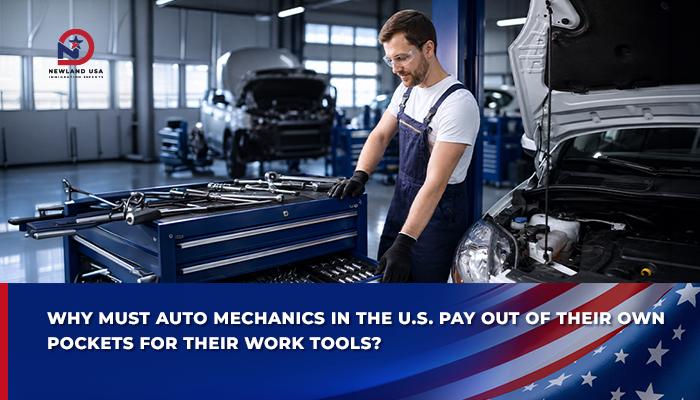
In Vietnam, a familiar scene at any garage is the shop owner equipping employees with all the machinery, wrenches, and pliers they need. However, when learning about the U.S. labor market, many people are surprised to discover that most auto mechanics in the United States must pay out of their own pockets for their work tools — an investment that can reach tens of thousands of dollars over the course of a career. This is considered an “unwritten rule” tied to the professional culture, compensation system, and unique operating model of the U.S. automotive service industry. The following article by Newland USA will help you thoroughly understand the reasons behind this seemingly unreasonable phenomenon.
1. The “Unwritten Rule” of Auto Repair in the U.S.
In the vast majority of independent repair shops and car dealerships across America, an auto mechanic owning their own toolbox has been the common standard for many decades. The general practice in the U.S. is that mechanics equip themselves with their own work tools, regardless of whether they are self-employed or hired employees. This is quite different from many people’s expectations of a workplace where all equipment is provided by the company.
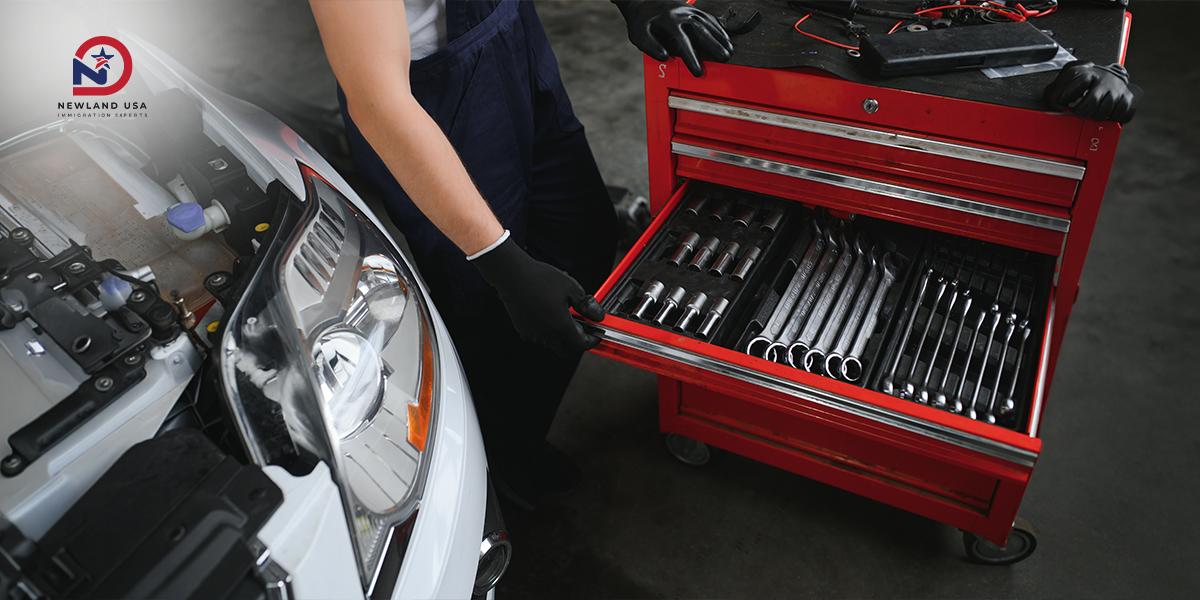
However, one important point should be clarified: not all equipment is supplied by the technicians themselves. The boundary of responsibility is usually drawn fairly clearly. Most technicians prepare their own toolboxes and hand tools such as sockets, screwdrivers, hammers, some basic power tools, and certain specialty tools, while the shop provides large equipment such as lifts, diagnostic machines, and most of the highly specialized devices. At authorized dealerships, the company also takes care of specialized machinery and provides personal protective equipment for workers.
In other words, auto mechanics in the U.S. are responsible for their personal “professional capital,” while the large-scale infrastructure still belongs to the shop owner. So why does such an unusual division exist? There are several intertwined reasons, ranging from historical and cultural factors to the economic concerns of both shops and employees.

2. Reason One: Tradition and Professional Pride
One of the deeper reasons is cultural. Within the U.S. automotive technician community, owning a quality automotive technician tool set has long been seen as a symbol of skill and professionalism. Many mechanics consider their tools a lifelong possession, and even a source of pride built up over the years.
This mindset creates a special bond between workers and their tools. By hand-picking each item, the mechanic gains a deep understanding of the characteristics, grip, and performance of every tool, which allows them to work more quickly and precisely. To them, a carefully curated tool set is no different from an instrument to a musician or a knife set to a professional chef.
The tradition of “buying your own tools” is also passed down from one generation to the next. Many veteran mechanics, upon retirement, sell or pass on their tool collections to younger workers, thereby maintaining a cultural cycle that has been deeply rooted in this industry for decades.
3. Reason Two: The “Flat-Rate” Pay System Turns Mechanics into “Mini Contractors”
This is perhaps the reason least known to Vietnamese workers. Most repair shops in the U.S. apply a job-based compensation system known as “flat-rate.” Unlike paying for actual hours worked, the flat-rate system pays mechanics based on the nature of each job; every task has a fixed labor allowance.
Specifically, each type of repair is assigned a standard number of labor hours based on industry-wide data. For example, replacing a certain engine component may be allotted three labor hours, regardless of how long it actually takes. The result is that if the mechanic finishes the job faster than the standard, they still get paid the full allotted hours and can take on more jobs within the same period to increase their income.
This system makes every U.S. auto mechanic operate more like a “mini contractor” than a regular employee. A flat-rate mechanic is not exactly an employee, but closer to the position of a subcontractor. When income is directly tied to productivity, mechanics have a very strong incentive to invest in professional auto repair tools that help them work faster and more efficiently. Because of the flat-rate system, many mechanics proactively buy specialized tools to shorten the time it takes to finish each job — the more jobs they can handle, the more money they earn.
From this perspective, the money spent on tools is not a wasteful expense, but a direct investment in one’s earning capacity. A better impact wrench or a more comprehensive socket set can significantly increase the number of jobs a mechanic can handle in a single day.
4. Reason Three: The Challenge of Managing Wear, Tear, and Tool Loss
From the shop owner’s perspective, requiring technicians to bring their own tools is also a reasonable risk management solution. Auto repair tools are a type of asset that is easy to lose, easy to damage, and difficult to control when shared among an entire team.
In practice, shared tools tend to be used carelessly and deteriorate quickly. When a shop provides shared tools, these items are quickly lost and used haphazardly; nobody bothers to take care of their own wrench when they can always grab another off the rack. This “tragedy of the commons” causes replacement costs to climb continuously.
An industry analysis has also pointed out that the ideal scenario in which every tool is well preserved rarely happens. In reality, brand-new tool sets purchased for a team of mechanics can be damaged, lost, or stolen within just a week, and this eats into both the shop’s profits and its ability to pay higher wages. So letting each person take responsibility for their own assets turns out to be both the simplest and the fairest option for everyone.
When each mechanic looks after their own tool set, the level of care goes up noticeably. They will neatly store their tools after every shift, avoid dropping or breaking them, and invest in regular maintenance — because this is their own hard-earned money.
5. Reason Four: Freedom of Choice and Personal Flexibility
Aside from the economic side, owning one’s own tools also gives technicians significant autonomy. Each person has their own habits and preferences when it comes to the brand, design, and durability of their tools.
According to many mechanics, equipping their own tools allows them the freedom to buy whatever item they want, as long as it performs well and matches their working style. One person may stay loyal to premium brands for their durability and warranty, while another may prefer more affordable lines to optimize cost. This kind of flexibility would be hard to achieve if every piece of professional auto repair equipment were uniformly issued by the shop.
In addition, personal ownership makes it easier for U.S. auto mechanics to change jobs without being dependent on any one employer. When switching workplaces, they simply bring their toolbox along and can start working immediately. The tool set becomes a “professional carry-on” that follows the mechanic throughout their career.
6. How Much Do U.S. Auto Mechanics Invest in Their Tools?
The amount mechanics invest in their tools is something that surprises many Vietnamese readers. This is not a small expense but a serious financial commitment for an entire career.
According to industry data, a technician’s tool collection is typically valued between $7,500 and $11,000, while highly specialized mechanics may invest around $27,000 in their tools. For newcomers, the starting cost is by no means low either. The initial investment for a new mechanic is usually between $3,500 and $5,000, and a complete toolbox from a premium brand alone can run up to $27,000.
Notably, spending on an automotive technician tool set is not a one-time event. It is not unusual for professional technicians to spend $25 to $60 per week on tools — more than they spend on lunch. The reason is that automotive technology keeps changing, which drives the need to constantly update equipment. A reality of this profession is that the tools used today may no longer be suitable in one or two years, so mechanics essentially keep buying tools throughout their entire careers.
The investment range is also wide depending on direction and specialization. A complete tool set for an automotive technician may range from $3,000 to over $50,000, depending on brand, quality, and variety of tools purchased. To ease this burden, many tool manufacturers and credit organizations offer installment plans, allowing mechanics to spread out payments rather than paying all at once.
Compared to industry income levels, this is no small investment ratio. The average wage for auto repair workers in the U.S. is about $22.58 per hour, equivalent to nearly $47,000 per year. However, for highly skilled mechanics working at larger facilities, income can far exceed that figure. A skilled automotive technician with several years of experience can comfortably earn around $80,000 per year.
7. The Legal Perspective: Not Every Place Lets It “Run Free”
One noteworthy point is that laws in some states have set out certain restrictions to protect the rights of workers who must supply their own tools. This shows that self-equipping is not entirely “left to the will” of the shop owner.
In California, for example, labor regulations are quite clear on this issue. If employees are required to supply their own tools, employers must pay them at least twice the minimum wage. This is how authorities help offset part of the personal investment that mechanics must make, while also preventing employee exploitation.
In addition, the line between “employee” and “independent contractor” is closely scrutinized by the U.S. Internal Revenue Service (IRS), with tool ownership being one of the factors used to classify employment status. Mechanics owning their own professional auto repair tools sometimes also brings tax benefits, since expenses for work tools can be factored into tax filings.
8. Career Opportunities and the Path to Immigration for Auto Mechanics in the U.S.
Behind the story about work tools is a career picture full of potential that Vietnamese workers should pay close attention to. The U.S. is currently facing a severe shortage of labor in the auto repair industry.
According to forecasts by the U.S. Bureau of Labor Statistics (BLS), recruitment demand in this field remains very high. The BLS projects an average of about 70,000 automotive technician positions to be filled each year during the 2024–2034 period, with demand coming mainly from car dealerships and repair and maintenance facilities. The reason for this shortage is the aging workforce and the wave of retirements. Currently, there are around 967,000 automotive technicians working at 270,300 independent repair facilities in the U.S., while the average age of mechanics has reached 40, meaning retirements are outpacing the rate at which new workers join the field.
This huge labor gap opens up stable employment opportunities and attractive income levels for those with skills. For Vietnamese workers, auto mechanic is a skilled occupation and one of the promising careers for realizing the American immigration dream through employment visa programs such as the EB-3 Skilled Workers visa.
When meeting the skill requirements and securing an employer sponsor, a Vietnamese mechanic can absolutely work in a professional environment while step by step building a path toward a green card and long-term settlement with their family. Having to invest in one’s own automotive technician tool set is no longer a barrier, but becomes a natural part of the journey to build a career in a labor market that values skill and is willing to pay accordingly.
9. Conclusion
The fact that U.S. auto mechanics must pay out of their own pockets for their tools may sound unreasonable to Vietnamese ears at first, but looking deeper into the matter, it is actually the logical result of many converging factors: from long-standing professional traditions and the flat-rate pay system, to the challenge of asset management and the freedom to choose professional auto repair tools that suit oneself. An investment of tens of thousands of dollars is not simply a burden, but capital that helps mechanics actively boost their productivity and income.
More importantly, behind the tool story is an industry “thirsty” for labor, with tens of thousands of job opportunities every year and ever-improving wages. For skilled Vietnamese workers, this is a wide-open door to both develop a career and move closer to the goal of sustainable settlement in the United States.
Learn more:
- U.S. Immigration Through the EB3 Visa in 2026: Reasonable Costs, Green Cards for the Entire Family
- How Long Is a U.S. Green Card Valid? The Complete 2026 Renewal Guide
- Securing the Green Card and Getting Your Money Back: How to Build an Effective EB5 Visa Exit Strategy
- What Is an EAD Card? Latest 2026 Regulations for the EB3 Category
News Categories



Related news

Who Is the ESTA Program For? How to Assess Your Fit Before Applying in 2026

Who Is the ESTA Program For? How to Assess Your Fit Before Applying in 2026

From Motorcycle Mechanic to Automotive Technician in the U.S.: Skills and Qualifications to Prepare in 2026

AI in Auto Repair in the U.S. 2026: How Artificial Intelligence Diagnoses Vehicle Problems Faster and More Accurately

7 Key Technologies Every Industrial Maintenance Technician in the U.S. Needs to Know in 2026

PLC & Automation Skills: A Launchpad for Maintenance Technicians in the United States in 2026

What Is the ASE Certification? Requirements, Exam Roadmap, and Its Importance for Auto Technicians in the U.S. in 2026

EB5 Capital Recovery Time: How Long It Takes and the Key Milestones
Electric Vehicle Technicians in the U.S.: The “Golden” Skills Helping Vietnamese Auto Mechanics Get Ahead of the 2026 EV Trend