U.S. International Students Switching from H1B Visa to Green Card: An Increasingly Difficult Journey in 2026?
For decades, the pathway “F-1 → OPT → H1B Visa → Employment-Based Green Card” has been viewed as the ideal route helping Vietnamese and international students turn their dream of settling in the U.S. into reality. However, entering 2026, an unprecedented series of changes — including sponsorship fees, wage-based selection mechanisms, and the new Adjustment of Status policy — are making the journey from H1B Visa to Green Card rougher than ever before. The following article by Newland USA will analyze this issue in detail and suggest practical alternative pathways for international students who still aim to obtain a U.S. green card.
1. The traditional pathway from international student to U.S. Green Card via H1B Visa
The most common journey of an international student in the United States is usually described in four stages.
First, the student enrolls under an F-1 visa for academic purposes.
After graduation, the student may join the Optional Practical Training (OPT) program, which allows temporary work for 12 months, or an additional 24 months for STEM majors.
The third step is entering the H1B Visa lottery — the ticket that grants long-term residence and work authorization in “specialty occupations” such as software engineers, civil engineers, researchers, doctors, and so on.
The final step is being sponsored by the employer for an employment-based U.S. green card, mainly under EB-2 or EB-3 (Professional and Skilled Workers).
On paper, this is a clear and promising pathway. In reality, each step carries its own risks, and the process of switching from H1B Visa to a green card has never been a straight line. According to the National Foundation for American Policy, the H1B Visa has long been one of the most tightly capped visa programs in the U.S., with only about 20% of applications being approved each year. The annual quota stops at 65,000 regular slots plus 20,000 reserved for applicants holding a U.S.-issued master’s degree or higher — a modest number compared with the actual demand of the labor market.
2. H1B Visa in 2026: A series of changes reshaping the game
Entering 2026, international students step into an almost completely overturned playing field. Two major reforms are reshaping the entire H1B Visa program.
2.1. The additional USD 100,000 fee effective from September 2025
On September 19, 2025, President Donald Trump signed the Proclamation “Restriction on Entry of Certain Nonimmigrant Workers,” which took effect on September 21, 2025. According to USCIS, every new H1B Visa petition filed after this date must be accompanied by an additional fee of up to USD 100,000. Compared with the traditional fee ranging from USD 2,000 to 5,000 per application (according to data from the American Immigration Council), the new fee is a massive financial shock for every employer, especially small and medium-sized businesses.
According to USCIS, this fee does not apply to those renewing with the same employer, nor to those currently holding a valid visa. However, for a freshly-graduated international student — who has never held an H1B Visa before — this financial barrier practically forces many employers to reconsider their sponsorship decision.

2.2. The wage-based selection mechanism
In parallel with the new fee, on December 29, 2025, the Department of Homeland Security announced the regulation “Weighted Selection Process for Registrants and Petitioners Seeking to File Cap-Subject H1B Petitions,” effective from February 27, 2026. According to experts, the new regulation completely replaces the random lottery mechanism with a selection system based on four wage levels drawn from the Department of Labor’s Occupational Employment and Wage Statistics (OEWS) data.
Specifically, candidates paid at Level 4 wages (the highest) get four chances in the selection round, Level 3 gets three chances, Level 2 gets two chances, and Level 1 (the entry level) gets only one chance. The consequence for international students is very clear: most new graduates are hired at Level 1 or Level 2 — entry-level wages. According to analysis, the new mechanism “weakens the talent pipeline from international students,” because entry-level positions — traditionally the gateway for fresh graduates — will struggle to compete against the applications of senior managers or engineers with 5–10 years of experience.
It is estimated that under the new regulation, a software engineer starting in San Francisco with a salary of USD 150,000/year could still be classified as Level 1 or Level 2 if the position is described as entry-level — showing that a high nominal wage does not necessarily increase the chance of selection. This is a very tough reality for international students who have just completed a master’s program at a top-tier U.S. university.
3. The new Adjustment of Status policy – A new barrier for international students
The next blow to the international student community came in May 2026. On May 21–22, 2026, USCIS issued Policy Memorandum PM-602-0199 with a controversial title: “Adjustment of Status is a Matter of Discretion and Administrative Grace.” According to immigration industry experts, the new policy affirms that Adjustment of Status (AOS) is no longer a matter of right but a “form of special relief,” only approved in “exceptional cases.”
The practical consequence: most people currently holding non-immigrant visas (including F-1, H1B Visa, O-1, L-1, B-2…) who wish to apply for a U.S. green card will be directed to return to their home country and process through consular processing at a U.S. consulate, rather than filing Form I-485 inside the United States. For international students who have settled their lives and secured jobs in the U.S., the prospect of having to leave the country — possibly for many months — to complete the conversion to a U.S. green card is a challenge both psychologically and financially.
According to analysis, holders of the H1B Visa and L-1 visa are in a better position thanks to the “dual intent” feature — meaning they are allowed to simultaneously maintain a temporary visa and apply for permanent residency. However, even for this group, USCIS still emphasizes that maintaining employment status “is a positive factor but not a determining factor.” Adjustment of Status applications will be reviewed case by case, are expected to receive more Requests for Evidence (RFEs), and may be required to undergo additional interviews.
For those without dual intent — especially F-1 students who have not yet moved to the H1B Visa — the chance of being granted Adjustment of Status within the U.S. has dropped significantly. This could be the factor that forces many international students to rethink their entire settlement plan.

4. Why international students are finding it harder to switch from H1B Visa to Green Card in 2026
When combining the factors above, we can identify five overlapping barriers that have turned the journey from H1B Visa to green card into a turbulent marathon.
First, the USD 100,000 financial pressure makes many U.S. companies — especially start-ups and small and medium-sized enterprises — no longer eager to sponsor fresh graduates.
Second, the wage-based selection mechanism directly eliminates most of the entry-level positions that international students can take on.
Third, even if the lottery is successful, H1B Visa holders still have to wait for the priority date to become “current” over an unpredictable period of time.
Fourth, the new Adjustment of Status policy tightens the ability to file Form I-485 from within the U.S., forcing many international students to return home and process through the consulate.
Fifth, according to the Presidents’ Alliance, the entry-level wage regulation effective from February 27, 2026 further excludes entry-level positions — closing off the traditional path international students used to rely on to stay in the country.
Combined, these changes show that international students must shift their planning mindset: instead of asking “Will I be selected for the H1B Visa?”, many international students now have to ask “Am I even eligible to enter the game?”
5. Alternative pathways: When the H1B Visa is no longer the only road
In this harsh context, an increasing number of international students are actively seeking alternative pathways that do not depend on the luck of the H1B Visa.
EB-2 NIW (National Interest Waiver) allows candidates with advanced degrees to self-petition, without requiring PERM or an employer. This is an ideal option for professionals, researchers, and engineers with outstanding achievements who can demonstrate contributions “in the national interest” of the United States.
EB-1A is for individuals belonging to the “extraordinary ability” group, typically those with international awards, academic publications, or breakthrough contributions in their field. This is the EB category with the shortest waiting time.
EB-3 — the preference category for skilled workers, professionals with U.S. bachelor’s degrees, and unskilled labor. Compared with EB-2, EB-3 has more flexible entry requirements and is especially suitable even for candidates who do not hold U.S. degrees. According to the June 2026 Visa Bulletin, EB-3 for Vietnamese citizens is operating relatively stably. More importantly, the EB-3 pathway does not depend on the H1B Visa lottery and is not subject to the USD 100,000 additional fee, helping Vietnamese international students avoid most of the current policy risks.
EB-5 (the investment category) is an option for families with financial capacity of USD 800,000 or more, allowing the entire family to receive a U.S. green card without needing an employer sponsor or going through the H1B Visa selection process.
6. Advice for international students during 2026
Facing a rapidly changing landscape, international students need a flexible strategy with multiple scenarios. First, they need to clearly identify whether the ultimate goal is a long-term U.S. green card or simply temporary work experience. If the goal is permanent settlement, they should build their profile along two parallel tracks: preparing as best as possible for the H1B Visa while also studying the EB-3 or EB-5 options.
Second, they should start early in building a record of professional achievements, networking with employers who have a history of successful sponsorship, and closely following policy updates from USCIS and the Department of State. Third, they should consult professional immigration advisory organizations experienced in handling cases for Vietnamese applicants, to objectively assess how well their personal profile fits each visa category.
Finally, international students need to mentally prepare for the possibility of adjusting their plans multiple times during 2026, as lawsuits relating to the USD 100,000 fee, the entry-level wage regulation, and Policy Memo PM-602-0199 are still under court review and could create new turning points.
7. Conclusion
The year 2026 marks a period of profound transformation for the H1B Visa program and the entire U.S. employment-based immigration ecosystem. From the additional USD 100,000 fee, the wage-based selection mechanism, to the Adjustment of Status policy being “redefined” as a special relief measure — all of these have made the journey from H1B Visa to green card much rougher for international students than it was a decade ago. However, difficulty does not mean a dead end. As the H1B Visa door grows narrower, EB-3, EB-5, and other alternative options are opening up new opportunities for those who plan early and choose a pathway that fits their abilities, budget, and long-term goals.
Learn more:
- U.S. Immigration Through the EB3 Visa in 2026: Reasonable Costs, Green Cards for the Entire Family
- How Long Is a U.S. Green Card Valid? The Complete 2026 Renewal Guide
- Securing the Green Card and Getting Your Money Back: How to Build an Effective EB5 Visa Exit Strategy
- Working at Medical Glove Factories in the USA: Salary, Benefits, and EB3 Green Card Opportunities
News Categories


Related news
Who Is the ESTA Program For? How to Assess Your Fit Before Applying in 2026

Who Is the ESTA Program For? How to Assess Your Fit Before Applying in 2026

From Motorcycle Mechanic to Automotive Technician in the U.S.: Skills and Qualifications to Prepare in 2026
AI in Auto Repair in the U.S. 2026: How Artificial Intelligence Diagnoses Vehicle Problems Faster and More Accurately

7 Key Technologies Every Industrial Maintenance Technician in the U.S. Needs to Know in 2026
PLC & Automation Skills: A Launchpad for Maintenance Technicians in the United States in 2026
What Is the ASE Certification? Requirements, Exam Roadmap, and Its Importance for Auto Technicians in the U.S. in 2026

EB5 Capital Recovery Time: How Long It Takes and the Key Milestones
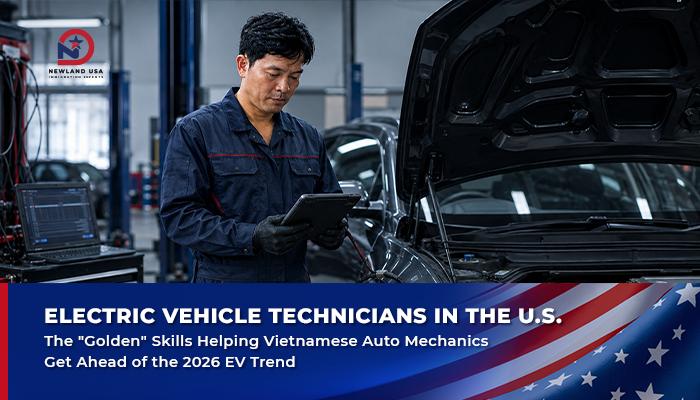
Electric Vehicle Technicians in the U.S.: The “Golden” Skills Helping Vietnamese Auto Mechanics Get Ahead of the 2026 EV Trend