Why Are U.S. Businesses “Hungry” for EB3 Skilled Workers?
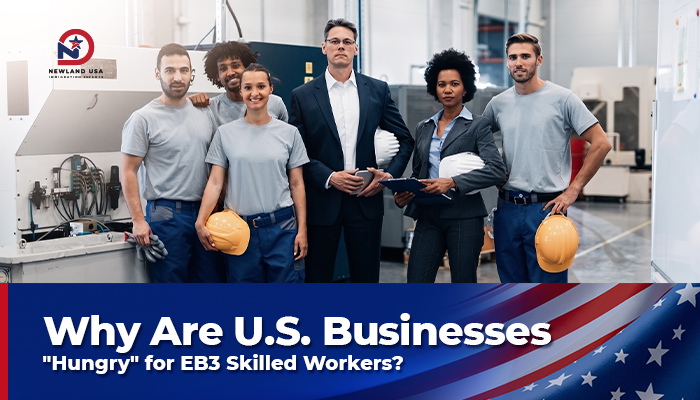
The U.S. labor market is entering a notable demographic shift: the native-born workforce is gradually shrinking while hiring demand across many industries remains high. Against this backdrop, EB3 Skilled Workers has become one of the channels many employers choose to fill their skilled labor needs. The article below from Newland USA looks at why U.S. businesses are increasingly turning their attention to EB3 skilled labor, based on the U.S. skilled labor shortage in 2026 and data from trusted sources such as the U.S. Bureau of Labor Statistics (BLS), the U.S. Chamber of Commerce, and a number of reliable workforce reports.
1. What is EB3 Skilled Workers and why is it getting so much attention in 2026?
EB3 Skilled Workers is a group of skilled workers under the third employment-based preference category for U.S. immigration (Employment-Based Third Preference). According to U.S. Citizenship and Immigration Services (USCIS), a candidate in this group must take on a job that requires at least two years of training or experience, and the job must be permanent, full-time, and non-seasonal. A skilled worker is someone capable of performing a job that requires skill, in a position requiring a minimum of two years of training or experience. (USCIS)
Together with the professionals group and the “other workers” (unskilled/general labor) group, this third preference category receives about 28.6% of the total annual employment-based immigrant visa quota, which works out to roughly 40,000 slots per year for the whole group. The core requirement of the EB3 Skilled Workers visa is that a U.S. employer must sponsor the applicant and complete the PERM Labor Certification process with the U.S. Department of Labor, to prove that no qualified U.S. worker is available for the position. This is exactly why the U.S. skilled labor category is so closely tied to a business’s actual workforce needs: only when the domestic market cannot find someone does the door open to hiring from abroad. The applicant’s spouse and unmarried children under 21 can also receive a green card together with them, which is why the program is seen as a path to settle the whole family in the U.S.

2. The picture of the U.S. skilled labor shortage in 2026
The U.S. skilled labor shortage in 2026 is not a short-term blip but the result of several long-running trends compounding one another. According to a report from reputable recruitment organizations, about three out of every four U.S. businesses struggle to find qualified staff, and four out of ten adults lack basic IT skills needed for today’s work environment.
Taking a longer view, Georgetown University’s Center on Education and the Workforce (CEW) has released a notable forecast. Between 2024 and 2032, about 18.4 million experienced workers with postsecondary education are expected to retire, far outpacing the 13.8 million younger workers with comparable qualifications entering the workforce. The same report also states that the U.S. will need to add about 5.25 million workers with postsecondary qualifications by 2032. This gap between the number of people leaving and the number of people replacing them is exactly the root cause behind the rising demand for EB3 skilled labor.
Short-term data reflects the same trend. According to Bureau of Labor Statistics figures, the number of job openings in April 2026 was adjusted to around 7.6 million. At the state level, the picture is even more uneven: the U.S. Chamber of Commerce reports that some states, such as South Dakota, have only about 41 available workers for every 100 open positions, while nationwide only 10 states have a labor surplus. This data helps explain why the U.S. labor market in 2026 is still described as tight in many regions, even though the overall unemployment rate isn’t high.
3. The retirement wave and an aging population are driving hiring demand higher
One of the underlying causes of the U.S. skilled labor shortage in 2026 is the aging population. According to an analysis by the Economic Policy Institute (EPI) based on Congressional Budget Office data, the share of the population over age 65 rose from 12.4% in 2007 to 17.9% in 2024, and is projected to reach 21.2% by 2035. As this population segment grows, the labor force participation rate tends to decline along with it.
Even more striking is the retirement wave among “Baby Boomers.” According to research published by the Retirement Income Institute, the “Peak Boomers” group — about 30.4 million people born between 1959 and 1964 — will all turn 65 sometime before 2029. The same study estimates that U.S. businesses will need to hire more than 240,000 people per month on average over the next five years just to replace the positions left behind by retirees.
This pressure isn’t spread evenly — it’s concentrated in a handful of industries that rely heavily on the U.S. skilled labor category. Looking at the expected retirement rate as a share of each industry’s current workforce, the sectors most affected include public utilities (16.7%), manufacturing (11.8%), construction (10.5%), transportation and warehousing (9.6%), and healthcare and social assistance (9.6%). As experienced workers leave and the domestic pipeline of replacements can’t keep up, expanding recruitment through programs like EB3 Skilled Workers has become an option many businesses are considering.

4. The industries “hungriest” for EB3 skilled labor
Not every industry faces the same level of shortage. The data shows some sectors have a clearly higher demand for EB3 skilled labor than others.
Healthcare faces the greatest pressure in sheer numbers. Forecasts suggest the healthcare sector will lose about 2.135 million workers — the largest figure of any sector — right at a time when demand for healthcare services is rising due to the rapidly growing elderly population. Reports also indicate that healthcare and social assistance will face the largest number of open positions, particularly among nurses, healthcare service managers, and personal care aides; construction and transportation are also facing shortages as their workforces age.
Technical trades and skilled trade occupations are also short-staffed. One analysis of U.S. Department of Labor data shows that the manufacturing sector alone could be short 200,000 to 250,000 workers over the coming decade, spanning positions such as welding, machining, and management, while 27% of the industry’s workforce is already 55 or older. Positions such as welders, electricians, maintenance technicians, and production workers are among the occupations facing labor shortages in the U.S. that are commonly filled through the U.S. skilled labor category, because they require specific hands-on skills that are hard to replace with automation in the short term.
Beyond that, a number of high-tech industries are also short on staff. Reports point to the sectors most affected as including semiconductor manufacturing, the defense industry, energy, and artificial intelligence. This range of industries shows that demand for EB3 skilled labor isn’t limited to manual labor — it also extends to positions requiring technical expertise.
5. Why do U.S. businesses choose to hire foreign workers through EB3?
The question is: when facing a labor shortage, why don’t U.S. businesses simply raise wages to attract domestic workers, rather than turning to a skilled worker sponsorship program to the U.S.? The answer lies in the specific nature of the hiring process itself.
Before a business can sponsor a foreign national under EB3 Skilled Workers, it must first complete PERM Labor Certification. At this stage, the employer must request a prevailing wage determination, advertise the position publicly, and prove to the Department of Labor that it made a genuine effort to find a qualified and willing U.S. worker but could not. In other words, hiring through the U.S. skilled labor category is not a substitute for hiring domestic workers — it’s the next step only after the domestic labor pool has already been exhausted. It is precisely the context of the U.S. skilled labor shortage in 2026 that makes this certification step increasingly reflect the real situation in many industries.
Another reason is stability and the ability to retain staff. Unlike short-term work visas, EB3 Skilled Workers leads directly to a green card — meaning the worker can settle permanently. For industries tied to long investment cycles, such as manufacturing, healthcare, or infrastructure, having staff who can stay for many years is exactly what businesses want. In addition, for occupations the Department of Labor has already identified as being in constant shortage — such as nursing and physical therapy, which fall under Schedule A — employers benefit from a simplified labor certification process, making it easier to sponsor EB3 skilled labor.
Lastly, many research organizations argue that expanding immigration is one of the key solutions to the labor shortage, alongside investment in education and technology adoption. For businesses, hiring through the U.S. skilled labor category is a way to build a sustainable workforce rather than just chasing a short-term fix.

6. Opportunities for Vietnamese workers under the U.S. skilled worker category
For Vietnamese workers, the strong hiring demand from U.S. businesses opens up a realistic path forward. Compared with countries that have large application backlogs, such as India or China, the waiting time for Vietnamese applicants is typically shorter. According to Newland USA, the gap between a Vietnamese applicant’s Priority Date and the current cutoff date in the Visa Bulletin is usually around 2 to 3 years, depending on quota availability at any given time.
In terms of process, an EB3 Skilled Workers case goes through the following main steps: the employer completes PERM Labor Certification, files an I-140 petition, waits for the priority date to become current according to the Visa Bulletin, and then proceeds with a consular interview or adjustment of status. According to 2026 data, the PERM labor certification step alone currently takes about 16 months for a standard case that isn’t flagged for additional review, so applicants should be mentally prepared for a process that can take several years overall. This is an important point to understand about how to apply for the EB3 Skilled Workers visa: being proactive and having a well-prepared file from the start will help shorten the timeline.
One important thing to note is that EB3 Skilled Workers does not allow self-petitioning — the applicant must have a U.S. employer sponsor them. That’s why choosing an experienced consulting firm, one that’s connected with businesses that have genuine demand for EB3 skilled labor and understands the process well, plays a decisive role. For many Vietnamese families, this isn’t just a job opportunity — it’s a path for the whole family to settle in the U.S. and work toward a green card through employment, legally and securely.
7. Conclusion
U.S. businesses’ demand for EB3 Skilled Workers stems from real shifts happening in the labor market: an aging population, the Baby Boomer retirement wave, skills gaps, and the U.S. skilled labor shortage in 2026 affecting many key industries. It is precisely the nature of the PERM Labor Certification process that ensures hiring through the U.S. skilled labor category reflects a genuine, unmet need for workers, rather than competing with domestic labor. For Vietnamese workers, understanding this context along with the application process, EB3 skilled labor is one of the immigration paths worth considering for building a long-term life in the United States.
Learn more:
- The Electric Vehicle (EV) Wave in the U.S. and the Retraining Challenge for EB3 Auto Mechanics
- EB3 Program – The Safest and Most Transparent Pathway to U.S. Permanent Residency for Vietnamese Workers in 2026
- EB3 Visa Interview Experience at the U.S. Consulate in 2026: The Most Frequently Asked Questions
- U.S. Immigration Through the EB3 Visa in 2026: Reasonable Costs, Green Cards for the Entire Family
News Categories



Related news

From Motorcycle Mechanic to Automotive Technician in the U.S.: Skills and Qualifications to Prepare in 2026
AI in Auto Repair in the U.S. 2026: How Artificial Intelligence Diagnoses Vehicle Problems Faster and More Accurately
7 Key Technologies Every Industrial Maintenance Technician in the U.S. Needs to Know in 2026
PLC & Automation Skills: A Launchpad for Maintenance Technicians in the United States in 2026

What Is the ASE Certification? Requirements, Exam Roadmap, and Its Importance for Auto Technicians in the U.S. in 2026

EB5 Capital Recovery Time: How Long It Takes and the Key Milestones
Electric Vehicle Technicians in the U.S.: The “Golden” Skills Helping Vietnamese Auto Mechanics Get Ahead of the 2026 EV Trend
US Engineering & Maintenance Labor Shortage 2026: The Driving Force Behind the EB3 Skilled Workers Visa Policy
Industrial Maintenance Technician: Job Duties, Requirements & U.S. Immigration Opportunities in 2026