The Daily Work of an Auto Mechanic in the US
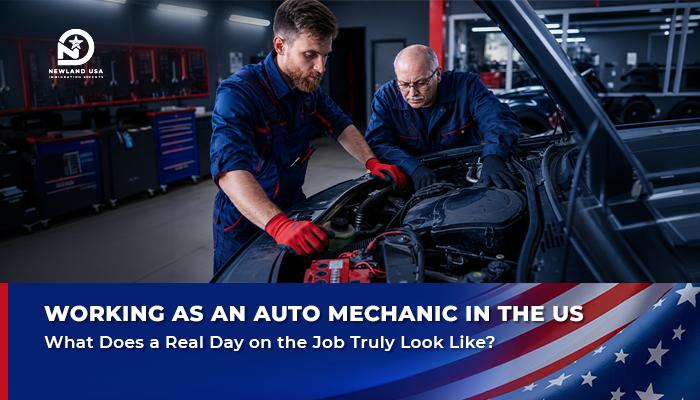
The US currently has over 290 million vehicles on the road, and behind this massive machine is an army of auto technicians working tirelessly every day in garages and service shops spread across all 50 states. For many Vietnamese workers seeking a legal path to settle in the US through the EB3 program, working as an auto mechanic in the US is becoming one of the most attractive options thanks to steady hiring demand, good income, and a clear career advancement path. However, the actual job isn’t simply about taking apart engines or changing oil like many people imagine.
This article by Newland USA will walk you through a real day in the life of an auto mechanic on American soil, from opening the shop early in the morning to turning off the lights at the end of the day, giving readers the most complete and honest picture of this profession.
1. Overview of Auto Mechanic Careers in the US
According to the latest data from the Bureau of Labor Statistics (BLS), as of 2025 there are roughly 794,600 auto technicians in the US working at car dealerships, independent repair shops, quick service stations, and trucking fleets. The median annual wage for this occupation is $49,670, which comes out to about $23.87 per hour. The top 10% of earners make over $80,850 per year, while those just starting out are still guaranteed a minimum of around $33,660 per year. BLS projections show that workforce demand for this position will grow about 4% between 2024 and 2034, with nearly 70,000 new job openings each year.
What makes working as an auto mechanic in the US unique is the wide variety of tasks and vehicles you’ll deal with. A single service shop may take in all kinds of vehicles, from newer sedans, pickup trucks, and SUVs to modern electric vehicles like Tesla, Rivian, or Ford Lightning. Because of this, mechanics have to constantly update their knowledge to keep up with automotive technology that’s changing by the day.
2. Morning: Opening the Shop and Getting Ready for the Day
Most auto service shops in the US start operating between 7:30 and 8:00 AM. This means that auto mechanics in the US usually show up at least 30 to 60 minutes early to handle the start-of-day prep work. The time before official opening is often compared to “the calm before the storm” — it’s the best moment to take care of administrative tasks that will be nearly impossible to fit in for the rest of the day.
The first thing in a day in the life of an auto mechanic is usually checking emails, messages from customers, and updates from parts suppliers. The mechanic will go through the list of cars that customers dropped off the afternoon before, carefully read repair order forms with descriptions of the problems, and confirm whether the parts that were ordered have arrived at the shop. As many industry sources have noted, even one missing replacement part can disrupt the entire repair process and push back a customer’s appointment.
Next, the technician coordinates with the service manager to organize the day’s schedule, setting aside buffer time for walk-in customers or unexpected breakdowns. Some shops assign each technician to a specific service bay, while others let mechanics pick vehicles in order of priority from the work list.

3. Mid-Morning: Peak Hours and Troubleshooting
From around 9 AM to noon, the shop really starts buzzing. This is the peak period when customers begin bringing in cars in large numbers, and the auto mechanic in the US hits the highest work tempo of the day. According to industry research, the 8–10 AM and 4–6 PM windows tend to be the busiest since customers take advantage of the time before and after their own work hours to get their vehicles serviced.
The first task with each car is usually diagnosing the cause of the problem. This process now requires a combination of hands-on experience and the help of modern technology. The mechanic will listen to the customer describe the symptoms, read Diagnostic Trouble Codes (DTC) through an OBD-II scanner, and sometimes take the car for a test drive to directly feel engine sounds or unusual vibrations. For trickier cases, the technician may need to disassemble parts step by step to pinpoint the exact cause.
Once the problem is identified, the actual repair work begins. An auto technician in the US during this phase may handle multiple tasks at the same time: changing oil for car A, rotating tires for car B, replacing brake pads for car C, while still running diagnostics on the transmission for car D. The ability to multitask and prioritize effectively is a crucial factor that helps mechanics stay productive in this kind of high-pressure environment.
It’s worth noting that not every repair job goes smoothly. When dealing with “stubborn” issues — for example, intermittent electrical problems, error codes that don’t match the actual symptoms, or replacement parts that aren’t compatible — the mechanic has to rely on experience to come up with the best solution. Sometimes this means fabricating a replacement part on the spot, applying a temporary fix, or huddling with coworkers to figure out the best way forward.
4. Lunch Break
From around 12 PM to 1 PM, most service shops give their mechanics a lunch break. This isn’t just a time to refuel, but also a chance for coworkers to share tips, discuss tough cases they’re dealing with, or simply unwind after a non-stop morning. For auto mechanics in the US, lunch is usually pretty laid-back — a sandwich, a burger, or sometimes a homemade boxed meal brought from home.
Some technicians use the break to browse new technical documents, watch instructional videos from manufacturers, or take short online training courses. The auto industry keeps evolving with the emergence of hybrid vehicles, electric cars, and autonomous driving systems, so continuous learning has become an essential part of the profession.
5. Afternoon: Wrapping Up Work and Talking with Customers
As the afternoon rolls in, the pace at the shop slows down a bit between 2 PM and 4 PM, then picks up again as customers start arriving to pick up their cars toward the end of the day. The auto mechanic in the US at this stage focuses on finishing the tasks started in the morning, running test drives to confirm the car was repaired correctly and that no new issues have come up.
Test driving is an essential step after a repair is completed. The technician will take the car out in the testing area or on nearby streets to evaluate its performance. Only when all readings meet the standards will the vehicle be handed back to the customer.
Beyond repair skills, communication also plays an important role in a day in the life of an auto mechanic. Mechanics regularly need to explain complex technical issues to customers in everyday language, recommend maintenance items that should be done in the future, and sometimes persuade customers to approve repairs for hidden problems that could affect driving safety. Being transparent and sincere in their advice is what helps technicians build a loyal customer base over time.

6. End of Day: Cleaning Up, Updating Records, and Prepping for Tomorrow
When the clock hits around 5 PM to 6 PM, most service shops get ready to close. Before wrapping up the shift, the auto mechanic in the US spends time cleaning the work area, putting tools back in their proper places, wiping down the shop floor to remove any spilled oil and grease, and maintaining the specialized equipment used during the day.
Updating repair records is also done at this time. Every completed vehicle needs detailed notes on what was done, what parts were replaced, any remaining issues (if any), and recommendations for the next service visit. These records are important for helping coworkers pick up where things left off when needed, and they also provide transparency for both customers and management.
Some shops even hold short end-of-day meetings to go over the day’s operations, plan for the next day, and assign upcoming tasks.
7. Work Environment and Unique Challenges
Working as an auto mechanic in the US takes place in a pretty unique environment. As described by many industry sources, a typical repair shop is a large space with multiple service bays running side by side, sometimes open to the outside and therefore not fully air-conditioned. The constant background noise comes from air compressors, pneumatic impact wrenches, power tools, and engines being tested. Summer temperatures can get extremely high, while winter in the northern states brings bitter cold since garage doors frequently need to stay open for cars to come and go.
On top of that, the profession comes with certain workplace safety risks. The BLS classifies auto technicians in the US as having a higher-than-average injury rate compared to other occupations. Mechanics face the risk of exposure to corrosive chemicals, hot vehicle components, heavy machinery, as well as awkward working positions like bending over, crouching under cars, or reaching into tight engine compartments. Strictly following safety rules — wearing protective goggles, heat-resistant gloves, steel-toed boots, and using proper jack stands — is a mandatory requirement in a professional auto mechanic’s workday.
8. Income, Benefits, and Career Advancement
Income is a factor that many Vietnamese workers care about when exploring opportunities to work as an auto mechanic in the US. Beyond the median wage of $49,670 per year according to the BLS, mechanics have several ways to boost their earnings:
- Flat-rate pay system: Many shops pay based on the volume of work completed. Skilled mechanics who work quickly and accurately can earn significantly more than a standard hourly wage.
- Overtime pay: Working beyond regular hours, on weekends, or handling emergency repair orders typically pays 1.5 times the normal rate.
- Bonuses and commissions: Some large dealerships offer bonuses based on service revenue or customer return rates.
The states with the highest pay for this occupation include the District of Columbia, California, Washington, and Massachusetts. Major metro areas like San Jose, Seattle, Boston, Anchorage, and Denver tend to offer more competitive pay compared to rural areas. Additionally, auto technicians in the US who hold ASE (Automotive Service Excellence) certifications or specialize in electric and hybrid vehicles are typically paid noticeably more than the industry average.
The career advancement path in this field is also fairly clear. Starting from a mechanic assistant position, a worker can move up to general service technician, senior technician, lead mechanic, service manager, and eventually open their own shop. Each level comes with increased responsibilities and corresponding pay raises.

9. Skills and Requirements for Success
To work as an auto mechanic in the US effectively and build a sustainable career, workers need to equip themselves with several skill sets:
Hard skills: Knowledge of automotive mechanics, electrical and electronic systems, proficiency with modern diagnostic equipment, and the ability to read circuit diagrams and technical documents in specialized English.
Soft skills: Good communication with customers, effective teamwork with colleagues, time management, and the ability to prioritize in an environment where multiple tasks are happening at once.
Personal qualities: Attention to detail, patience, logical thinking ability to trace the root cause of breakdowns, and good physical health to handle the demanding and continuous workload.
Willingness to learn: The auto industry is undergoing major changes with the rise of electric vehicles and self-driving technology. Auto technicians in the US who want to maintain their long-term career value need to regularly update their knowledge through manufacturer training programs and professional certifications.
10. Why Is the Auto Mechanic Profession a Good Fit for Vietnamese Workers Through the EB3 Program?
Based on the analysis above, working as an auto mechanic in the US is one of the ideal career choices for Vietnamese workers who want to settle legally in the US through the EB3 Skilled Workers program. There are several reasons for this:
- First, there is stable and sustainable hiring demand with nearly 70,000 positions opening up each year.
- Second, the income level is enough to maintain a quality life and save for the future.
- Third, there is a clear career advancement path, and the job isn’t limited by high-level language barriers like some other service industries — most of the work focuses on hands-on skills rather than complex communication.
- Fourth, the workplace often includes coworkers from many different nationalities, which makes it easier for Vietnamese workers to fit in during the early stages of settling abroad.
11. Conclusion
A day in the life of an auto mechanic in the US is a blend of fast-paced work, high technical demands, and customer interaction. With competitive income, high hiring demand, and a transparent career advancement path, working as an auto mechanic in the US is truly a worthwhile option for Vietnamese workers looking for a sustainable path to settle in the US. Understanding the reality of the job before making a decision not only helps you prepare mentally, but also serves as a solid foundation for building a long-term career in the land of opportunity.
Learn more:
- U.S. Immigration Through the EB3 Visa in 2026: Reasonable Costs, Green Cards for the Entire Family
- How Long Is a U.S. Green Card Valid? The Complete 2026 Renewal Guide
- Securing the Green Card and Getting Your Money Back: How to Build an Effective EB5 Visa Exit Strategy
- What Is an EAD Card? Latest 2026 Regulations for the EB3 Category
News Categories



Related news

Who Is the ESTA Program For? How to Assess Your Fit Before Applying in 2026

Who Is the ESTA Program For? How to Assess Your Fit Before Applying in 2026

From Motorcycle Mechanic to Automotive Technician in the U.S.: Skills and Qualifications to Prepare in 2026

AI in Auto Repair in the U.S. 2026: How Artificial Intelligence Diagnoses Vehicle Problems Faster and More Accurately

7 Key Technologies Every Industrial Maintenance Technician in the U.S. Needs to Know in 2026

PLC & Automation Skills: A Launchpad for Maintenance Technicians in the United States in 2026

What Is the ASE Certification? Requirements, Exam Roadmap, and Its Importance for Auto Technicians in the U.S. in 2026

EB5 Capital Recovery Time: How Long It Takes and the Key Milestones
Electric Vehicle Technicians in the U.S.: The “Golden” Skills Helping Vietnamese Auto Mechanics Get Ahead of the 2026 EV Trend