Paying Taxes and What EB5 Investors Need to Know
The EB5 investment program opens up attractive opportunities for U.S. residency, but it comes with a complex financial obligation system that many people don’t fully understand. Paying taxes in the U.S. isn’t just about reporting domestic income—it also includes assets and worldwide income. This article from Newland USA will help investors clearly understand important tax obligations, allowing them to proactively plan their finances and comply with U.S. laws.
1. Tax Obligations of EB5 Investors in the U.S.
When participating in the EB5 investment program, questions about financial obligations are always a top concern. According to regulations from U.S. Citizenship and Immigration Services (USCIS) and the Internal Revenue Service (IRS), the tax responsibility of EB5 investors depends on their legal residency status.
During the period when their application is being processed and they haven’t received their green card, investors are still classified as foreign nationals. In this status, they are not subject to worldwide tax obligations in the U.S. However, if they generate income from U.S. sources such as returns from invested capital or assets located here, filing and paying taxes is still mandatory under current regulations.
The situation changes completely when the investor officially becomes a permanent resident through the green card. From this point, they are recognized by the IRS as a U.S. tax resident and must report all worldwide income regardless of its source. This includes all income from salaries, real estate, business activities, bank interest, or dividends—whether generated inside or outside U.S. territory.
2. Main Types of Taxes EB5 Investors Must Pay
After obtaining permanent resident status, EB5 investors not only enjoy rights regarding residency, work, and education but also bear comprehensive financial obligations. The U.S. tax system is designed with multiple tiers and various types, requiring investors to understand clearly to comply properly.
2.1. Federal Individual Income Tax
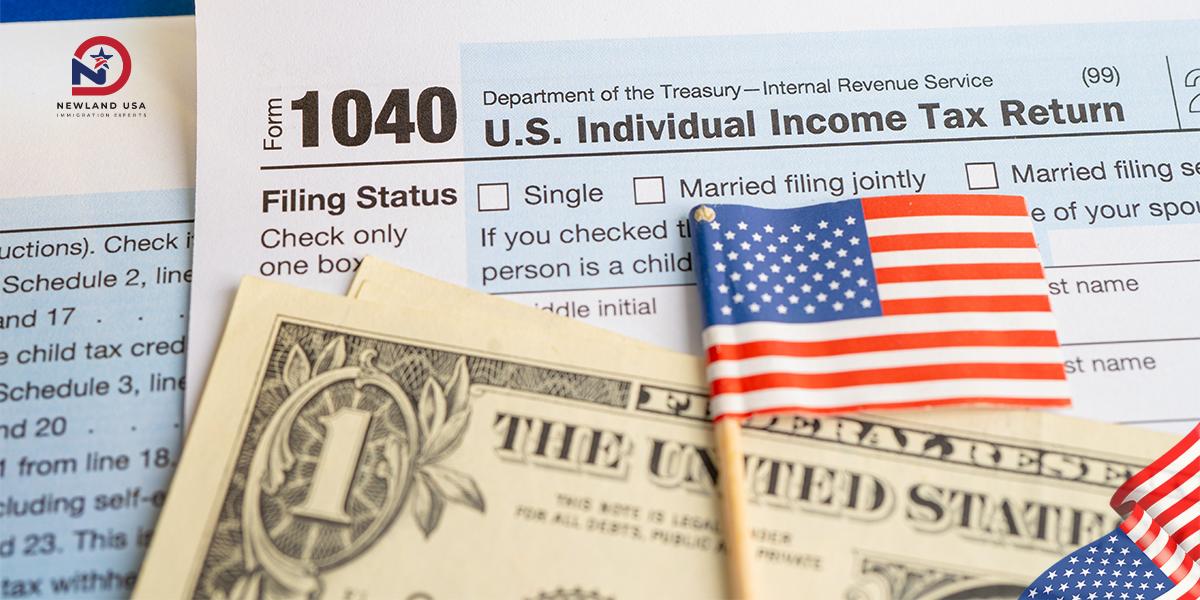
This is the main and mandatory tax for all permanent residents. EB5 investors must report all worldwide income through Form 1040 annually. Income includes salaries, dividends, interest, rental income from real estate, as well as business profits both domestically and abroad.
The tax rate system applies a progressive principle, ranging from 10% to 37% depending on taxable income level. The higher the income, the higher the tax rate increases according to specific brackets. This requires investors to calculate carefully to plan their finances appropriately.
2.2. State Income Tax
In addition to federal taxes, investors must also pay taxes to the state where they reside. Tax rates vary significantly between states, creating large differences in financial burden.
States like California apply the highest rate of up to 13.3%, while New York collects about 10.9%. Conversely, some states like Florida, Texas, Nevada, and Washington do not collect personal income tax at all. This difference makes choosing a place to settle an important factor in the long-term financial strategy of EB5 investors.
2.3. Capital Gains Tax
When selling assets like stocks, real estate, or businesses, the difference between the selling price and purchase price (capital gain) will be taxed at two different rates:
Short-term gains (assets held for less than 12 months) are taxed at ordinary income tax rates, from 10% to 37%. This is significantly higher than the long-term capital gains rate.
Long-term gains (assets held for more than 12 months) receive preferential rates from 0% to 20%, depending on total taxable income and filing status. Holding assets long enough can help investors save considerably on tax costs.
2.4. Estate and Inheritance Tax
EB5 investors with large asset portfolios need to pay special attention to this type of tax. The tax applies to assets transferred upon death or gifted to others during one’s lifetime.
In 2025, the exemption is expected to be around $13 million for each individual. The value exceeding this threshold will be subject to tax rates up to 40%. This figure has a significant impact on asset transfer plans for future generations, requiring investors to have a thoughtful asset management strategy.
3. Income in Vietnam and Tax Obligations in the U.S.
One of the most complex issues that Vietnamese EB5 investors face is how to handle income generated in Vietnam. Many people still maintain business activities, rent real estate, or have profitable investments in Vietnam after settling in the U.S.
According to IRS regulations, upon becoming a permanent resident, investors are obligated to report all worldwide income on Form 1040, regardless of where that income originates. This means profits from companies, rental income, dividends, or deposit interest in Vietnam must all be fully reported.
The biggest challenge comes from the fact that Vietnam and the U.S. have not yet signed a Double Taxation Agreement (DTA). This creates a risk of income being taxed in both countries, significantly increasing the financial burden.
However, the U.S. tax system has a Foreign Tax Credit (FTC) mechanism that allows deduction of taxes paid in Vietnam from U.S. tax obligations. To apply FTC, investors need to prepare complete documentation proving they have paid taxes in Vietnam, such as tax payment receipts or confirmation from tax authorities. Using this mechanism requires support from international tax experts to ensure proper compliance with procedures.

4. Foreign Asset Reporting Obligations
In addition to paying taxes annually, EB5 investors must also fulfill international financial reporting obligations under two important regulations:
4.1. FBAR – Report of Foreign Bank Accounts
FBAR (Report of Foreign Bank and Financial Accounts) is a mandatory form if the total balance of accounts at foreign banks exceeds $10,000 at any time during the tax year. Failure to report or incomplete reporting can lead to severe penalties.
4.2. FATCA – Foreign Account Tax Compliance Act
FATCA (Foreign Account Tax Compliance Act) requires investors to report detailed information about accounts, securities, and financial assets abroad if they exceed the statutory threshold. This regulation is designed to prevent tax evasion through hiding assets abroad.
Both of these regulations have severe penalties for non-compliance, including civil penalties and potentially criminal prosecution in serious cases. Investors need to clearly understand and fully fulfill these obligations to avoid legal trouble.

5. Tax Management Advice for EB5 Investors
Settling in the U.S. through the EB5 investment program brings many opportunities but also requires thorough financial preparation. Below are important recommendations to help investors optimize tax obligations and avoid legal risks:
5.1. Build a Comprehensive Tax Strategy from the Start
Right from the decision to participate in the program, investors should begin planning a long-term tax strategy. This includes appropriately allocating assets between Vietnam and the U.S., restructuring investments, and choosing a state to settle that fits personal financial circumstances.
Planning ahead helps minimize surprises and makes it easier to control finances after becoming a permanent resident. Investors need to carefully consider the timing of asset transfers, how to structure investments, and income distribution strategies to achieve the best tax efficiency.
5.2. Fully Comply with Reporting Regulations
The obligation of paying taxes doesn’t stop at submitting money annually but also includes mandatory reports on foreign assets. Investors must ensure timely submission of FBAR and FATCA forms, along with complete supporting documentation.
Omission or inaccurate reporting can lead to heavy fines, affect permanent resident status, and create a poor record with tax authorities. Transparency and full compliance are key to maintaining stable legal status in the U.S.
5.3. Work with International Tax Experts
The U.S. tax system has many fundamental differences from Vietnam’s, from tax calculation methods to reporting regulations. EB5 investors should work with international tax experts or CPAs (Certified Public Accountants) experienced in immigration and cross-border tax issues.
These experts can help implement tax planning before transferring large assets to the U.S., optimize investment structures, and ensure full compliance with all regulations. The cost of professional consulting services is a necessary investment to protect assets and avoid unnecessary legal risks.
6. Conclusion
The EB5 investment program opens up an attractive path to U.S. residency, but it comes with a complex financial obligation system that all investors need to master. From worldwide income tax, state taxes, capital gains tax to foreign asset reporting obligations—all require deep understanding and strict compliance.
Newland USA, with a team of experienced experts and the motto “Stable settlement—Lifelong prosperity,” is ready to advise and support clients with information related to the EB5 investment program. Contact Newland USA today via hotline 0785591988 or email: newsletter@newlandusa.asia for detailed and free consultation.
Learn more: Is Native Language Proficiency a Mandatory Requirement for EB5 Investment?
Learn more: 5 Most Common Misconceptions of EB5 Program Investors
News Categories



Related news

Who Is the ESTA Program For? How to Assess Your Fit Before Applying in 2026

Who Is the ESTA Program For? How to Assess Your Fit Before Applying in 2026

From Motorcycle Mechanic to Automotive Technician in the U.S.: Skills and Qualifications to Prepare in 2026

AI in Auto Repair in the U.S. 2026: How Artificial Intelligence Diagnoses Vehicle Problems Faster and More Accurately

7 Key Technologies Every Industrial Maintenance Technician in the U.S. Needs to Know in 2026

PLC & Automation Skills: A Launchpad for Maintenance Technicians in the United States in 2026
What Is the ASE Certification? Requirements, Exam Roadmap, and Its Importance for Auto Technicians in the U.S. in 2026
EB5 Capital Recovery Time: How Long It Takes and the Key Milestones

Electric Vehicle Technicians in the U.S.: The “Golden” Skills Helping Vietnamese Auto Mechanics Get Ahead of the 2026 EV Trend