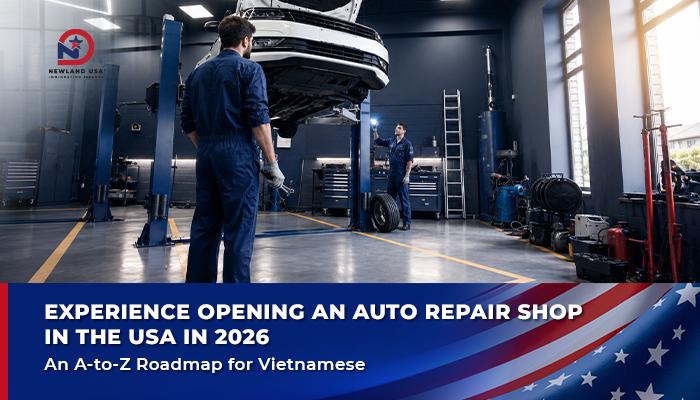
Experience Opening an Auto Repair Shop in the USA in 2026: An A-to-Z Roadmap for Vietnamese
With more than 280 million vehicles on the road and the average age of cars getting older every year, demand for vehicle maintenance and auto repair in the United States has never cooled down. For the Vietnamese community — a community known for being skillful, hardworking, and already familiar with a “be-your-own-boss” culture — this is an attractive but also challenging business opportunity. This article from Newland USA gathers the experience of opening an auto repair shop in the USA in a structured way, covering everything from preparing your technical skills, your capital, and your legal paperwork all the way to running the day-to-day operation, helping you picture the whole roadmap clearly before laying down the first bricks.
1. The big picture of the auto repair industry in the USA in 2026
Before deciding to invest, getting a clear sense of the market’s “health” is a must. The vehicle maintenance and auto repair service industry in the US is a massive and stable sector. The current size of the auto repair industry in the US is around 89.6 billion USD, with more than 303,000 active businesses, which shows that actual demand is enormous but at the same time the level of competition is far from small.
What is worth noting is that this market is still growing steadily. The global value of vehicle maintenance and repair services in 2026 is estimated at around 860 billion USD, and it is projected to keep growing thanks to record-high average vehicle age along with the spread of diagnostic technologies. The older the car, the more frequent the breakdowns, which feeds a stable revenue stream for service shops.
One factor that gives a special advantage to new entrants is the shortage of skilled technicians. The industry is expected to be short by about 15% of its technical workforce by 2027, which pushes labor costs up and opens a market gap for anyone with solid hands-on skills. In other words, a skilled technician who decides to open their own shop is sitting on a very real opportunity right now.
2. Why Vietnamese should consider opening an auto garage in the USA
For the Vietnamese-American community, opening an auto garage in the USA is not just a business model but also a sustainable path to settle down and build a long-term career. The auto mechanic trade falls into the group of skilled labor that is highly valued, and it ties closely to an important immigration pathway: the EB3 Skilled Workers category.
According to USCIS regulations, the Skilled Workers group under EB3 requires applicants to have at least two years of experience or training, along with a full-time and permanent job offer from a US employer. USCIS defines a “skilled worker” as someone performing a job that requires at least two years of training or experience, and is not seasonal or temporary in nature. An auto technician with certification and real working experience fits these criteria perfectly.
That creates a full circle of value: a Vietnamese person arrives in the US under a skilled labor pathway, accumulates experience and capital over a few years, and then gradually transforms themselves into the owner of an auto repair shop in the USA. Once they hold a green card, the worker is free to work for any employer or strike out on their own without having to apply for an additional work permit. This is precisely why many Vietnamese families choose the auto mechanic industry as the anchor for their American dream.
3. Building technical skills and ASE certification: the foundation of any shop
Even though not every state requires it, a professional certification is an invaluable asset when you want to build your reputation. In the United States, the gold standard of the industry is the ASE (Automotive Service Excellence) certification. Although ASE certification is not legally required to operate a shop, it is a widely recognized industry standard that proves the technician’s competence and helps build trust with customers.
For exam eligibility, candidates need two years of actual working experience, or one year of experience plus a two-year vocational associate degree in auto repair. The cost is also quite reasonable compared to the value it brings: the registration fee is around 34 USD, and each standard exam costs about 62 USD. To earn the Master Technician title — the level that customers and dealerships trust the most — a technician needs to pass the full A1 through A8 exam series for cars and light trucks.
One important note is that the certification is not valid forever. Each ASE certification is valid for five years, after which technicians must re-test to keep the title. Investing in your craft is therefore an ongoing journey, not a one-time destination.
In addition to ASE, if your shop offers services related to air conditioning systems, the technician is required to hold a separate certification. The Environmental Protection Agency (EPA) requires any technician working on a vehicle’s air conditioning system to be certified under Section 609 of the Clean Air Act (CAA).
4. Financial planning and capital budgeting
This is the part that makes many people hesitate, because the initial investment for an auto repair shop is no small amount. However, the figure varies widely depending on the size and the area. According to summaries from financial consulting sources, the realistic minimum capital to start a small shop falls in the range of 75,000 – 150,000 USD, while a comfortable budget for a standard shop ranges from 200,000 to 350,000 USD.
A lesson that almost every successful shop owner emphasizes is the importance of working capital. Reserve capital that can cover 3 to 6 months of operation is a life-or-death factor, because most shops that fail run out of cash right in their first year. In other words, do not throw all your money into equipment and forget the financial “cushion” you need for the months when there are no profits yet.
Fixed monthly costs also need to be calculated carefully. Rent is usually the biggest burden, followed by electricity. The electricity bill is the largest utility expense, averaging from 500 to 2,000 USD per month, because lifts, air compressors, and diagnostic equipment all consume a lot of energy.
When it comes to profitability, you should set realistic expectations. The profit margin of auto repair shops typically ranges from 10% to 30%, with many well-run shops landing around 20%. More importantly, most shops need several years to recover their initial startup costs and reach the break-even point. This is a long game, one that demands patience and disciplined cash flow management.
5. Choosing a business structure and registering legally
Once you have the skills and a capital plan in place, the next step in the experience of opening an auto repair shop in the USA is to make your business legally official. The majority of Vietnamese shop owners choose the LLC (Limited Liability Company) model because it helps separate personal assets from business risk — an important legal choice in this industry because you regularly deal with machinery and warranty liability.
After picking your structure, you need to register the business with the state authority, usually the Secretary of State’s office. Next is applying for the Employer Identification Number (EIN) from the Internal Revenue Service (IRS). An EIN is required if you have employees or operate as an LLC/corporation; it is issued free of charge by the IRS and can be completed right away through online registration.
One item that is often overlooked is the sales tax permit. A Sales Tax Permit is necessary if you sell parts or charge for services. Since auto repair shops both sell parts and provide services, this paperwork is virtually unavoidable.

6. Mandatory permits, certifications, and environmental regulations
This is the most complicated part, but also the one most likely to cause serious consequences if you get it wrong. The rules for auto repair shops in the USA are not uniform across the country and vary from state to state. To get started, you typically need a motor vehicle repair license, a general business license, and possibly additional state or local permits depending on where you are.
Some states are noticeably stricter. In California, for example, shops must register with the BAR (Bureau of Automotive Repair) as an Automotive Repair Dealer. In New York, every motor vehicle repair shop is required to register with the competent authority. On the other hand, in many other states you can open a shop with just a standard business license and local permits.
Environmental regulations are absolutely not something to take lightly. Auto repair shops generate waste oil, coolant fluids, and many types of hazardous waste. Facilities that generate waste oil, antifreeze, or other hazardous waste must register with the EPA as a hazardous waste generator, and most auto repair shops fall into the Small Quantity Generator (SQG) category. The consequences of non-compliance can be severe: failing to comply with environmental regulations can result in fines of up to 10,000 USD.
In addition, you also need to pay attention to several local documents such as: a fire safety certification from the fire department (because the shop stores flammable liquids and compressed gases), a zoning permit confirming the location is approved for commercial business, and a Certificate of Occupancy. In Los Angeles, auto repair shops must obtain a Certificate of Occupancy and zoning clearance, with the permitted zones usually being Commercial-Manufacturing (CM) zones or M zones.
7. Choosing a location, investing in equipment, and getting insurance
The location largely determines both your costs and your customer flow. A useful money-saving tip is to look for places that used to be auto repair shops. Finding facilities that were formerly repair shops can let you take advantage of existing lifts, compressors, and drainage systems that have already been installed, which significantly reduces the initial investment.
When it comes to equipment, the essential list includes vehicle lifts, electronic diagnostic machines, tool sets, and several specialized devices. As newer cars come packed with more and more technology, investing in modern diagnostic equipment is no longer optional if you want to stay competitive.
Insurance is an indispensable shield for anyone planning to open an auto garage in the USA. Insurance types such as workers’ compensation, general liability, garagekeepers insurance, and commercial auto insurance are typically required, helping protect the shop from costly lawsuits. This is also a fixed expense you should factor into your financial plan from the very beginning.
8. Marketing and building a loyal customer base
Getting the shop open is only half the story; keeping customers coming back is what determines long-term success. One truth that few people pay attention to is that most of the industry’s revenue comes from repeat customers. The customer retention rate in the auto repair industry averages 76–83% per year, and ideally 70–80% of revenue comes from returning customers. That is why building trust and providing decent after-sales service matters even more than constantly running ads to bring in new customers.
For the Vietnamese community, the biggest advantage is the network of fellow Vietnamese. Starting from the Vietnamese-American customer base in your area, combined with review platforms like Google Reviews and Yelp, is an effective way to build a reputation. Hanging the ASE (Blue Seal) certification sign right at the door is also a credibility signal that American consumers trust. Gradually, consistent quality of auto repair service will create a word-of-mouth effect on its own — the cheapest and most sustainable marketing channel of all.
9. Common mistakes and things to keep in mind
To wrap up this overview of the experience of opening an auto repair shop in the USA, here are some common things to be aware of. The biggest mistake is underestimating working capital and expanding too fast. Most successful shop owners have worked as employees in the industry first before going out on their own, saving up for 2–3 years, then starting small and gradually growing — for example, from 2 bays to 6 bays — rather than investing too heavily right from the start.
The second mistake is loosening control over parts costs — which is the most expensive line item. Parts and supplies make up the largest share of costs, around 30–40% of revenue, so every error in invoicing or pricing directly eats into your profit. Managing suppliers tightly and reconciling invoices carefully is something that should be focused on and handled thoroughly.
Finally, do not take environmental and legal procedures lightly. Many new shop owners, in their rush, skip zoning permits or waste management regulations, only to face fines and the risk of being shut down. Doing things right from the very beginning is always cheaper than fixing them later.
10. Conclusion
The journey of opening an auto garage in the USA is a combination of technical skill, capital, legal knowledge, and the resilience needed for long-term business. With a vast market, stable demand, and a shortage of skilled technicians, this really is fertile ground for Vietnamese people who know how to seize the opportunity. However, success does not come from haste — it comes from thorough preparation. A well-run auto repair shop in the USA not only provides sustainable income but also stands as a solid anchor for the whole family on foreign soil. Most importantly, for those laying down the foundation for permanent residency through the skilled labor pathway, the auto repair trade is the door that opens to a promising future of settling down and building a career in the land of the stars and stripes.
Learn more:
- U.S. International Students Switching from H1B Visa to Green Card: An Increasingly Difficult Journey in 2026?
- U.S. Immigration Through the EB3 Visa in 2026: Reasonable Costs, Green Cards for the Entire Family
- How Long Is a U.S. Green Card Valid? The Complete 2026 Renewal Guide
- Securing the Green Card and Getting Your Money Back: How to Build an Effective EB5 Visa Exit Strategy
News Categories



Related news

Who Is the ESTA Program For? How to Assess Your Fit Before Applying in 2026

Who Is the ESTA Program For? How to Assess Your Fit Before Applying in 2026

From Motorcycle Mechanic to Automotive Technician in the U.S.: Skills and Qualifications to Prepare in 2026
AI in Auto Repair in the U.S. 2026: How Artificial Intelligence Diagnoses Vehicle Problems Faster and More Accurately
7 Key Technologies Every Industrial Maintenance Technician in the U.S. Needs to Know in 2026

PLC & Automation Skills: A Launchpad for Maintenance Technicians in the United States in 2026
What Is the ASE Certification? Requirements, Exam Roadmap, and Its Importance for Auto Technicians in the U.S. in 2026

EB5 Capital Recovery Time: How Long It Takes and the Key Milestones
Electric Vehicle Technicians in the U.S.: The “Golden” Skills Helping Vietnamese Auto Mechanics Get Ahead of the 2026 EV Trend