Guide to Completing the DS-260 Form for U.S. Immigration
The DS-260 form is a critical legal step in the U.S. immigration journey for all immigrants. According to data from the National Visa Center (NVC), over 75% of delayed case processing stems from incorrect or incomplete information in this form. This article from Newland USA will provide a comprehensive guide to completing the DS-260 form, helping you master the process from A to Z and avoid costly mistakes that could affect your chances of receiving a U.S. immigrant visa.
1. What is the DS-260 and Why is it Important in the U.S. Immigration Process?
DS-260 (Immigrant Visa Electronic Application) plays a key role in the U.S. immigrant visa application process. It’s the next step after your I-130, I-140, or I-526E petition has been approved by U.S. Citizenship and Immigration Services (USCIS). This is an electronic form that collects all personal information about the visa applicant and accompanying family members.
This form acts as a bridge between the initial approval stage and the consular interview. According to January 2025 updates from the U.S. Department of State, the DS-260 requires detailed disclosure of personal background, family information, educational qualifications, work experience, travel history, and questions related to national security. Consular officers will base their assessment of the applicant’s eligibility on this information along with supporting documents.
Every individual in the U.S. immigration application, including young children, must complete a separate form. This applies to all family-sponsored visa categories (CR1, IR1, IR5), employment-based visas (EB1, EB2, EB3, EB5), and the Diversity Visa Lottery (DV Lottery) program. Visa applicants will complete the form after receiving notification from the NVC with their case number (NVC Case Number) and Invoice ID Number.
2. Preparing Documents and Information Before Starting
Thorough preparation before beginning the DS-260 form completion will help reduce the time from 3-4 hours down to about 90-120 minutes. You need to gather four main groups of documents to ensure the process goes smoothly.
2.1. Personal Identification and Legal Documents
First, prepare your passport with at least 6 months validity remaining, birth certificate translated and notarized into English, national ID card, marriage certificate or divorce decree (if applicable). Additionally, you need to create a list of residential addresses from age 16 to present with no gaps exceeding 30 days.
2.2. Employment and Educational Information
Employment history for the past 10 years needs to be recorded in detail including company name, specific address, employment dates, and job title. Information about educational qualifications from high school onward also needs to be thoroughly prepared with school name, dates of attendance, and degrees obtained.
2.3. Family Information and Relatives
Information about parents, spouse, children, and siblings including full name, date of birth, and place of birth needs to be listed completely. Notably, even if parents are deceased, they still must be declared.
2.4. Travel History and Social Media Accounts
You must provide information about previous trips to the U.S., visas that were issued or denied, along with a list of all social media accounts used in the past 5 years according to U.S. immigrant visa regulations.
2.5. Instructions for Obtaining NVC Case Number
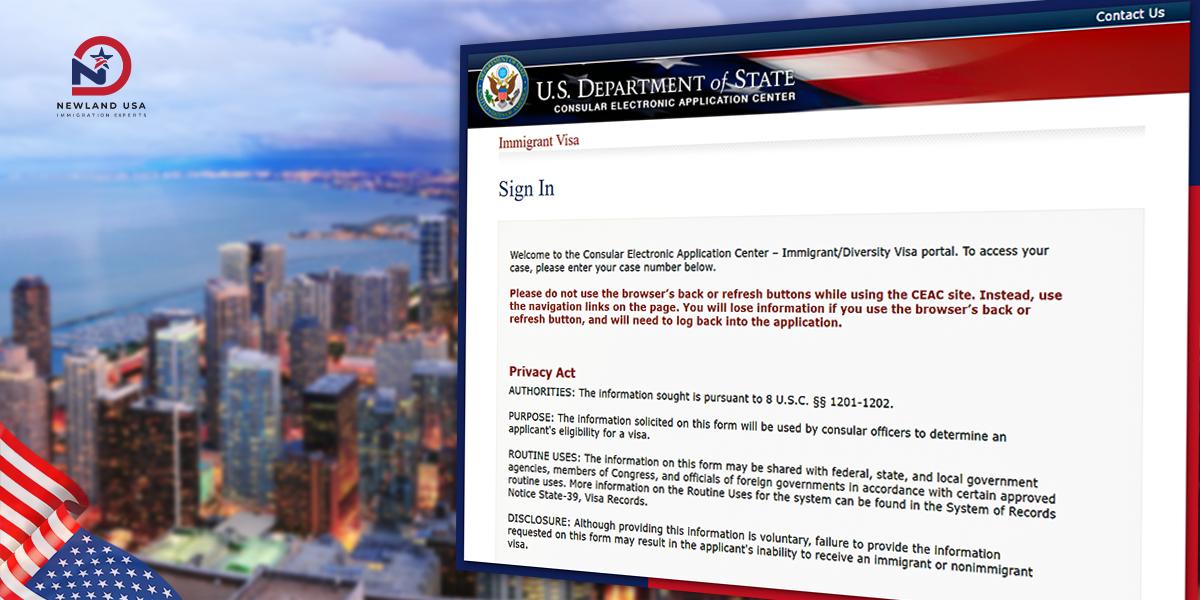
The NVC case number has the format HCMxxxxxxxxxx and the Invoice ID has the format IVSCAxxxxxxxxxxx, which will be sent via email after USCIS transfers the case to NVC. To access the DS-260 completion system, you need to visit https://ceac.state.gov/IV/Login.aspx, enter these two codes, then set up an account with security questions and a strong password.
If you can’t find the notification email, check your spam folder or contact NVC at nvcinquiry@state.gov with complete personal information. If the person who filed the petition has received the notification, you can confirm with them.
3. Login Process and Initiating the DS-260 on the CEAC System
3.1. Browser and Connection Requirements
To begin the DS-260 form completion guide, you need to access the official website of the Consular Electronic Application Center (CEAC) and ensure you’re using a compatible browser like Chrome, Firefox, or Edge. The system requires JavaScript and cookies to be enabled for normal operation.
Enter your NVC case number and Invoice ID accurately, avoiding unnecessary spaces or special characters. If you have difficulty logging in, recheck the format and refresh the webpage.
3.2. Account Setup and Security
After successfully logging in, the system will ask you to select the form type “DS-260 Immigrant Visa Application” and confirm basic information. You need to set up a security question with an answer that’s easy to remember but hard to guess, create a strong password with at least 8 characters including uppercase, lowercase, numbers, and special characters. This login information needs to be carefully stored as you’ll need to access it multiple times during the U.S. immigration process.
3.3. Save and Continue Later Feature
The CEAC system automatically saves data after each page you complete, but you should manually save using the “Save” button before moving to another section. The session will automatically end after 20 minutes of inactivity, so frequent saving is essential.
To continue with a saved draft, simply log back in with your NVC case number and Invoice ID, and the system will return you to the last page you were working on. Drafts are stored for 30 days from the last access.
4. Detailed Information Sections in the DS-260 Form
The DS-260 form includes 8 main sections with over 200 questions, of which 85% are required information. Each section has its own complexity and requirements.
4.1. Section 1: Personal Information and Passport
This section requires basic identity information. Your name must be entered exactly as shown on your passport, in all capital letters without Vietnamese diacritical marks. Date of birth must follow the MM/DD/YYYY format and must match your passport exactly.
Passport details including passport number, issue date, expiration date, and issuing authority must be recorded accurately. If you’ve ever changed your name, you need to declare all names used in the past to ensure transparency in your U.S. immigration application.
4.2. Section 2: Address and Contact Methods
Your current address needs to be written in international format with house number/street name, ward/commune, province/city, and postal code if available. Especially, you need to update according to the latest address information after administrative unit mergers.
Five-year residence history must list all addresses from age 16 to present, with no periods omitted. Email and phone number must be current information that you can access throughout the U.S. immigrant visa processing.
4.3. Section 3: Family Data
Information about parents includes full name, date of birth, place of birth, and occupation, even if they are deceased or you’ve lost contact. For your spouse, you need to declare complete information and marriage history, including previous marriages if any.
Information about children must include all biological children, stepchildren, and legally adopted children, even those not immigrating to the U.S. Incomplete disclosure can lead to delays or case denial.
4.4. Section 4: Education and Professional Experience
Education history from high school onward needs to clearly state school name, address, dates of attendance, and degree type. Employment history for the past 10 years, including company name, specific address, position, job description, employment dates, and supervisor information.
If there were periods of unemployment, study, or self-employment, these need to be clearly declared without leaving any time gaps. This is an important section for assessing the applicant’s capabilities in the U.S. immigrant visa application process.
4.5. Section 5: Security Questions and Legal Background
This is an important section with many questions about criminal record, law violations, membership in prohibited organizations, substance use, and other security issues. You need to answer all questions truthfully, even minor violations.
If you’ve ever had a criminal record, even a minor one, you need to prepare documents proving completion of rehabilitation and social reintegration. False declarations or concealing information can lead to permanent entry bans, seriously affecting your U.S. immigration chances.
4.6. Section 6: Sponsor Information
Information about the sponsor or employer must match the documents previously submitted to USCIS. Any inconsistencies can raise concerns and cause processing delays.
4.7. Section 7: Travel History
U.S. travel history needs to accurately declare all trips, entry/exit dates, and purposes. For U.S. visa history, declare both approved and denied applications, including the reason for denial if known.
4.8. Section 8: Financial Capability
Financial information needs to reflect your ability to be self-sufficient or support from a sponsor. This is a factor in assessing your ability to support yourself after immigrating to the U.S.
5. Golden Rules When Completing the DS-260
Data from U.S. consulates shows that 68% of DS-260 forms are requested for revision due to violations of basic rules. Here are the important principles to follow.
5.1. Rules for Language and Format
The entire form must be completed in English without diacritical marks. Names must be written in all capital letters in the order of Last Name – Middle Name – First Name. Vietnamese addresses need to be converted to international format: house number + street name, ward/commune, province/city, Vietnam.
Example: “132-134 Dien Bien Phu Street, Tan Dinh Ward, Ho Chi Minh City, Vietnam”. This is the standard requirement for U.S. immigrant visas.
5.2. Handling Unavailable or Non-Applicable Information
Use “N/A” (Not Applicable) when a question doesn’t apply to your situation and “UNKNOWN” when you genuinely don’t have the information. Never leave required fields blank.
For information about deceased parents or those you’ve lost contact with, declare what you know and write “UNKNOWN” for parts you don’t know clearly. Avoid using “NONE” or other words besides “N/A” and “UNKNOWN” according to standard DS-260 form completion guidelines.
5.3. Absolute Honesty
Truthfully declare all law violations, even minor ones like traffic tickets. Clearly distinguish between criminal, civil, and administrative violations. Prepare documents proving completion of penalties if you have a criminal record.
False declarations can be detected through screening systems and lead to U.S. immigrant visa denial or entry bans.
5.4. Declaring Travel History
Check your U.S. travel history through old passports and the online I-94 system. Fully declare all trips, including transits through the U.S. For denied visa history, declare truthfully and briefly explain the reason if known.
Ensure information matches records at U.S. immigration agencies as they can cross-reference when reviewing your DS-260 application.
6. Completing and Confirming the DS-260
The final stage determines 95% of the DS-260 form’s success, including three important steps.
6.1. Comprehensive Error Checking
Before submitting, recheck each completed section and ensure there are no system-reported errors. Commonly overlooked errors include incorrect date format, missing required information, name not matching passport, and inconsistent information between sections.
Use the “Review” function to review the entire form before electronic signature. This is an important step in the DS-260 form completion guide to ensure application quality.
6.2. Electronic Signature
The final confirmation process requires you to carefully read the statement about accuracy and sign electronically by typing your full name in the designated box. The electronic signature has the same legal value as a handwritten signature, and you are responsible for the accuracy of all information.
After signing, the DS-260 form will be officially submitted and cannot be edited.
6.3. Saving the Confirmation Page
After successful submission, the system will generate a confirmation page with a code. Download and print this page as it’s a mandatory document to bring to the interview.
Store both the electronic and printed versions for safety. The confirmation page contains a summary of your DS-260 information and will be used by consular officers during the U.S. immigrant visa interview.
7. 10 Common Errors and Solutions
Based on analysis of thousands of processing cases and statistics from NVC, there are 10 common errors accounting for the majority of mistakes in DS-260 forms.
Error 1: Incorrect Date Format
Especially birth dates and employment dates not following MM/DD/YYYY format. Solution: Carefully check the format before moving to another section.
Error 2: Inconsistent Information
Name, date of birth, address different from previously submitted I-130/I-140/I-526. Solution: Carefully cross-reference with old documents before completing DS-260.
Error 3: Incorrect Travel History
Missing or incorrect information about previous U.S. trips. Solution: Check the I-94 system online and review old passports.
Error 4: Missing Family Information
Not declaring all children, siblings, or parent information. Solution: Create a complete list before starting the form.
Error 5: Confusing N/A and UNKNOWN
Confusing “not applicable” with “don’t know information”. Solution: Clearly understand the meaning of each term before using.
Error 6: False Declaration
Hiding traffic violations or other minor offenses. Solution: Truthfully declare all violations, even minor cases.
Error 7: Spelling Errors
Especially when converting from Vietnamese to English. Solution: Carefully check spelling and use support tools if needed.
Error 8: Missing Social Media Accounts
Not fully declaring accounts used in the past 5 years. Solution: Create a list of all accounts before completing DS-260.
Error 9: Not Updating Changes
Address, job changes after submitting the petition. Solution: Contact NVC to update information when changes occur.
Error 10: Incorrect Contact Format
Not including country code or incorrect email format. Solution: Check phone number format (+84) and email before submitting.
Handling Discovered Errors
If you discover errors after submitting DS-260, you need to contact NVC immediately via email at nvcinquiry@state.gov to request reopening the form. Provide your NVC case number, specifically describe the error to be corrected, and attach supporting documents if needed.
NVC will review and decide whether to allow editing, depending on the nature of the error. Processing time for requests typically takes 2-4 weeks. Some serious errors may require complete resubmission.
Handling Technical Issues
When the system freezes or loses connection, first check your internet and try refreshing the page. If that doesn’t work, wait 10-15 minutes then log back in. The system usually automatically saves entered data, but may lose information from the last page not yet saved.
To prevent this, save frequently and record important information. If you encounter serious technical errors, contact Technical Support via email at tech.support@ceac.state.gov.
8. Frequently Asked Questions About DS-260
8.1. Can I Edit After Submission?
Yes, you can edit, but only necessary changes with supporting documents. You need to contact NVC via email at nvcinquiry@state.gov to request reopening the DS-260. This process typically takes 2-4 weeks.
For example, changes to address, new job, birth of a child will be accepted, but changing basic information like date of birth or place of birth will be difficult to approve as it affects the entire U.S. immigration application.
8.2. Validity Period of DS-260
The DS-260 form is valid for 1 year from when NVC receives the case from USCIS. According to U.S. Department of State regulations updated in 2024, if you don’t complete the interview within this period without notification or contact with the Consulate, the case will be terminated and you must start over from the beginning.
This period can be extended in special circumstances such as pandemics, natural disasters, or other force majeure events with supporting evidence.
8.3. When Do I Need to Complete a New DS-260?
You need to complete a new DS-260 when there are major changes to family status or the case is closed due to expiration. Specifically: marriage or divorce after submitting the form, birth of a new child, case closed due to not interviewing within the 1-year period, or switching from consular processing to adjustment of status (I-485).
Resubmission can extend processing time by an additional 3-6 months, affecting your U.S. immigration timeline.
8.4. What to Do If You Forget Login Information
Contact NVC immediately via email at nvcinquiry@state.gov with complete personal information. You need to provide: full name as on passport, date of birth, passport number, sponsor’s name, and reason for lost information.
9. Conclusion
Completing the DS-260 accurately and completely is a decisive step in the successful U.S. immigrant visa application process. With this detailed DS-260 form completion guide, you now have all the necessary knowledge from preparing documents, accessing the CEAC system, completing each form section, to handling arising situations.
Newland USA, with an experienced team of experts and the motto “Stable settlement – Lifelong prosperity”, is ready to consult and support in preparing applications and accompany you throughout the EB3 U.S. immigration process. Contact Newland USA now via hotline 0785591988 or email: newsletter@newlandusa.asia for detailed and free consultation.
Learn more:
News Categories

Related news

From Motorcycle Mechanic to Automotive Technician in the U.S.: Skills and Qualifications to Prepare in 2026
AI in Auto Repair in the U.S. 2026: How Artificial Intelligence Diagnoses Vehicle Problems Faster and More Accurately
7 Key Technologies Every Industrial Maintenance Technician in the U.S. Needs to Know in 2026
PLC & Automation Skills: A Launchpad for Maintenance Technicians in the United States in 2026
What Is the ASE Certification? Requirements, Exam Roadmap, and Its Importance for Auto Technicians in the U.S. in 2026
EB5 Capital Recovery Time: How Long It Takes and the Key Milestones
Electric Vehicle Technicians in the U.S.: The “Golden” Skills Helping Vietnamese Auto Mechanics Get Ahead of the 2026 EV Trend
US Engineering & Maintenance Labor Shortage 2026: The Driving Force Behind the EB3 Skilled Workers Visa Policy
Industrial Maintenance Technician: Job Duties, Requirements & U.S. Immigration Opportunities in 2026