What should you prepare to increase your pass rate for EB3 Visa interview?
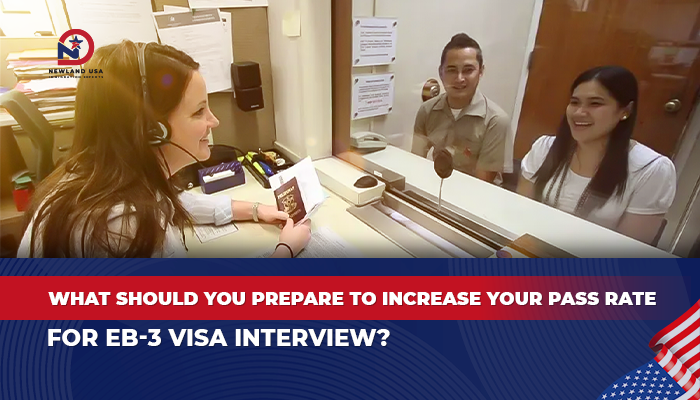
The EB3 visa interview is the final and extremely important step on your journey to settle in the U.S. This is not just a formal conversation, but an opportunity for consular officers to verify the authenticity of your entire application and your immigration intentions. Many applicants have successfully completed previous steps but still encounter difficulties at this stage. Today’s article from Newland USA will help you understand how to prepare comprehensively to maximize your chances of success from the very first attempt.
1. Critical Stage: When does the EB3 visa interview take place?
Before discussing how to prepare, it’s important to understand when you’ll enter this stage. The EB3 visa interview is the final step after completing a long process of previous stages.
The interview only takes place after:
- Your I-140 petition has been officially approved by USCIS.
- The Visa Bulletin for the EB3 program has been updated and shows “current” status, meaning your priority date number has reached processing.
- The National Visa Center (NVC) has completed administrative procedures and officially sent you an interview invitation.
This means the EB3 visa interview is the deciding step before you receive your U.S. immigration Visa.
2. Main objectives of the interview
The consulate doesn’t conduct this interview randomly. Every question and every detail they request has a clear purpose.
To verify the applicant’s true identity and family relationships, officers will cross-check personal information with the identification documents you provide. They examine the transparency and consistency of information submitted in your application, which can reveal any inconsistencies.
Another extremely important aspect is assessing your immigration motives. The consulate wants to ensure you intend to work legally according to your signed contract, rather than just focusing on the green card or any other ulterior purpose. Finally, they need to confirm that you will fully comply with U.S. immigration law requirements.

3. Who needs to attend the EB3 Visa interview?
A common mistake many applicants make is only preparing for themselves. In reality, not only the principal applicant but all family members must be present at the interview.
Specifically, the following family members must attend:
- The principal worker (applicant)
- Spouse (if applicable)
- Children under 21 years old accompanying you
Consular officers typically ask questions separately to each member to check the consistency of information between individuals. For example, they may ask each person about the address where they’ll live in the U.S., what the parent’s job will be, or what their long-term plans are. If the answers aren’t consistent, this could raise concerns for the consular officer.
4. Key differences between EB3 interviews and other Visa interviews
You may have heard about other visa types like F-1 (student) or B-1/B-2 (tourist). However, the EB3 program has completely different characteristics that applicants need to understand clearly.
For student or tourist visas, the consulate mainly wants to verify that you’ll return to Vietnam after your trip ends. They focus on checking whether your personal finances are sufficient to cover study or travel expenses, along with evidence showing you have ties to Vietnam (family, property, job) that will bring you back.
In contrast, the EB3 category is completely different. The interview focus is on verifying the legality of the employment contract and the relationship between you and your employer sponsor.
5. Common reasons for rejection at EB3 interviews
To avoid unnecessary mistakes, you need to clearly understand the reasons that commonly lead to applicant rejection.
First, not understanding or not being clear about job-related information. If you answer questions about your job position, daily duties, or work schedule vaguely or unclearly, officers will suspect that you’re not truly prepared or don’t even know what you’ll be doing.
Second, the information you provide directly doesn’t match what was submitted in your application. This is a major warning signal and can lead to immediate rejection.
Third, missing necessary documents or applications containing many errors – any inconsistency between documents is a major problem.
Finally, if you have a criminal record or have previously violated U.S. immigration laws, your chances will be seriously affected.

6. Questions you can expect to encounter
No one wants to be surprised during the interview. Therefore, preparing to answer questions that are likely to appear is a smart strategy.
Consular officers will ask you “What do you know about the job in the U.S.?” – specifically the position, specific daily duties, and what your work schedule will be like.
Another very common question is “Where will you work? What will your salary be? Do you have a signed employment contract?” – These are details that officers need to confirm directly from you.
You’ll also be asked about your sponsor: “Who is your employer sponsor? How long has the company been operating? What kind of company is it?“
Don’t forget questions about family and long-term plans: “Will your family go with you? What are your long-term plans for settling in the U.S.?“
And finally: “Do you have any relatives or friends living in the U.S.?” – This question helps officers better understand your connections.
7. Checklist of documents to prepare
To avoid difficult situations, you need to prepare complete and properly organized documents according to the following list:
Basic documents: Official interview invitation from NVC along with form DS-260, valid passport, passport photos (standard size), and medical examination from a hospital designated by the Consulate General.
Employment documents: Employment contract signed between you and the U.S. company, job offer letter from the company, and any confirmation letters from HR or attorneys if you have them.
Personal documents: Birth certificate, marriage certificate (if applicable), household registration book, and criminal background check to prove you have no criminal record.
All these documents should be prepared in neat condition, arranged in order, and you should bring both originals and copies in case verification is needed.
8. Optimal response strategies to increase success rate
How you answer is very important to fully convey what you intend to say. Below are golden rules when attending an EB3 visa interview:
Always tell the truth, never lie or embellish information. If you don’t know the answer, it’s better to be straightforward rather than guess or create false information.
Answer briefly, clearly, and stick to the question. Avoid long-winded irrelevant answers or unnecessary information.
Know all information about the job thoroughly, including exact position, job details, salary, work address, and company name. You need to review the job offer many times before the interview.
Affirm your legal purpose – You’re going to the U.S. to work according to the contract, not to overstay illegally or abandon the job.
Maintain calm, confident, and natural composure. Avoid memorized or artificial answers, as officers will easily detect this.
9. When can you apply for a second interview?
Not all rejection cases are the end. If you’re unfortunately rejected, you still have a chance.
Depending on the specific reason the Consulate provides, you can supplement your application according to their requirements or, in cases where the rejection reason isn’t too serious, resubmit a new application with all documents fully updated.
However, you should seek support from a professional immigration company to analyze the rejection reason and build a next action plan. The waiting time for a second EB3 visa interview will range from a few months to over a year, depending on the current status of the EB3 program and the Visa Bulletin schedule.
10. Conclusion
The EB3 visa interview is not an overly difficult step, but rather an opportunity for USCIS to confirm the transparency and legality of your U.S. immigration application. If you prepare complete documents, know every detail about the job, maintain a confident spirit, and answer honestly, your chances of success will be very high.
Newland USA, with a team of experienced experts and the motto “Stable settlement — Lifelong prosperity”, is ready to advise and support you in preparing documents and accompanying you throughout the EB3 U.S. immigration process. Contact Newland USA immediately via hotline 0785591988 or email: newsletter@newlandusa.asia for detailed and free consultation.
Learn more: https://newlandusa.asia/phong-van-dien-eb3-tang-ti-le-dau/
News Categories

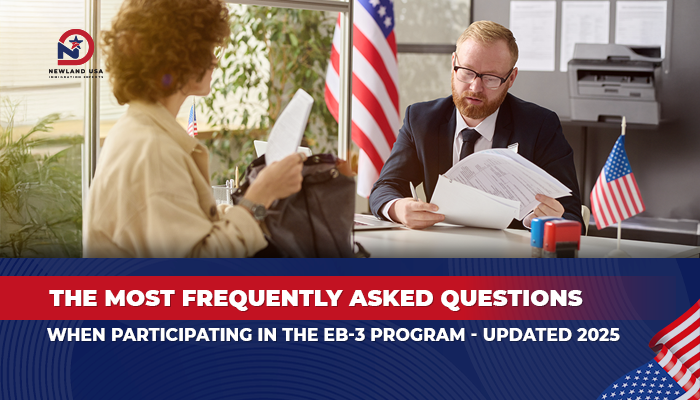
Related news
Who Is the ESTA Program For? How to Assess Your Fit Before Applying in 2026

Who Is the ESTA Program For? How to Assess Your Fit Before Applying in 2026

From Motorcycle Mechanic to Automotive Technician in the U.S.: Skills and Qualifications to Prepare in 2026

AI in Auto Repair in the U.S. 2026: How Artificial Intelligence Diagnoses Vehicle Problems Faster and More Accurately
7 Key Technologies Every Industrial Maintenance Technician in the U.S. Needs to Know in 2026
PLC & Automation Skills: A Launchpad for Maintenance Technicians in the United States in 2026
What Is the ASE Certification? Requirements, Exam Roadmap, and Its Importance for Auto Technicians in the U.S. in 2026
EB5 Capital Recovery Time: How Long It Takes and the Key Milestones
Electric Vehicle Technicians in the U.S.: The “Golden” Skills Helping Vietnamese Auto Mechanics Get Ahead of the 2026 EV Trend