What Benefits Do Children Receive When Parents Immigrate Through EB-3?
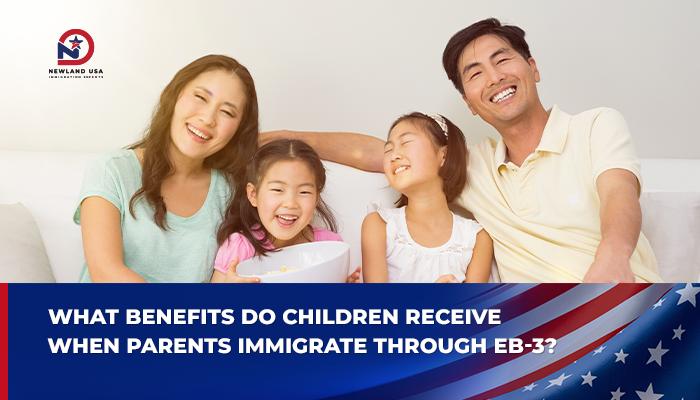
The EB-3 immigration program not only provides opportunities for workers to settle in the United States but also creates a solid foundation for their children’s future. Children in EB-3 immigrant families receive outstanding benefits ranging from education and healthcare to career development opportunities. This article by Newland USA will analyze in detail the EB-3 immigration benefits that children can receive when their parents successfully obtain a US green card.
1. Overview of EB-3 Immigration and Derivative Beneficiary Status
EB-3 immigration is one of the most common pathways for foreign workers to legally live and work in the United States. The EB-3 US immigration program is designed for three main groups: skilled workers with at least two years of experience, professionals with bachelor’s degrees, and unskilled workers in industries where the US market faces labor shortages.
One of the notable advantages of EB-3 immigration is the ability to include family members in the application. The spouse and unmarried children under 21 of the EB-3 applicant can be listed as “derivative beneficiaries.” This means children do not need separate applications and will receive permanent resident status along with their parents.
In the EB-3 US immigration process, after the I-140 petition is approved and a visa becomes available, the entire family can proceed with adjustment of status or consular interview. Children in EB-3 immigrant families will receive green cards as derivative family members, opening doors to extremely valuable opportunities and children’s benefits in the United States.
2. Permanent Residency Rights – The Foundation of All Benefits
The first and most important EB-3 immigration benefit that children receive is legal permanent resident status in the US. When parents complete the EB-3 immigration process, children under 21 and unmarried will automatically receive green cards as derivative beneficiaries.
The green card from the EB-3 US immigration program is not a temporary document but permanent resident status. This provides long-term stability for children in EB-3 immigrant families, allowing them to live, study, and develop in the US without worrying about visa expiration or the risk of having to leave the country. Unlike temporary visas, the green card from EB-3 immigration has no expiration date for residency rights – only the physical card needs renewal every 10 years.
Permanent resident status from EB-3 US immigration also allows children to freely move, live, and study in any state in the United States. They are not tied to a specific location like some other visa types. This children’s benefit is especially important as they grow up and need to seek the best educational or employment opportunities that match their abilities and goals.
3. Outstanding Educational Benefits for EB-3 Immigrant Children
3.1. Access to Free Public Education System
One of the greatest EB-3 immigration benefits for children is the right to free education at public schools from kindergarten through 12th grade. The US public education system is tax-funded and open to all children with permanent resident status, including those in EB-3 immigrant families.
Children from EB-3 US immigrant families can enroll immediately upon arrival in the US without waiting or paying any tuition for K-12 education. This children’s benefit ensures they receive quality education, access to modern technology, advanced teaching methods, and a multicultural learning environment.
3.2. In-State Tuition at University Level
When reaching college age, children in EB-3 immigrant families receive in-state tuition rates at public universities. This is an EB-3 immigration benefit of tremendous financial value. The difference between in-state and international or out-of-state tuition can reach tens of thousands of dollars per year.
To illustrate, at many top public universities, in-state tuition for students with green cards from EB-3 US immigration is typically only around $6,000-12,000 USD per year, while international students must pay $25,000-40,000 USD for the same program. Over four years of college, this children’s benefit can help families save $80,000 to $150,000 USD.
3.3. Access to Scholarships and Financial Aid
Children from EB-3 immigrant families qualify to apply for federal scholarships and financial aid reserved for US citizens and permanent residents. Many prestigious scholarship programs, low-interest student loans, and government aid packages require applicants to have a green card or be citizens.
This EB-3 immigration benefit opens up thousands of scholarship opportunities from universities, private organizations, and the government that international students cannot access. Children in EB-3 US immigrant families can apply for scholarships based on academic merit, financial need, or special talents in sports, arts, or leadership. Federal Student Aid, Pell Grants, and other important support are all available to those with green cards from EB-3 immigration.
3.4. Increased Admission Opportunities at Top Universities
Prestigious US universities often have strict quotas for international students, sometimes accepting only 5-10% of applications from this group due to fierce competition. In contrast, children in EB-3 immigrant families are considered like domestic students, with significantly higher acceptance rates.
This children’s benefit not only increases the chances of getting into top schools but also allows them to freely choose their majors. Some programs like medicine, law, and aerospace engineering have very strict limits for international students or require green cards. Thanks to EB-3 US immigration, children can pursue any field matching their abilities and passion without barriers based on their birth country.
4. Healthcare and Social Security Benefits
4.1. Access to Health Insurance
Children in EB-3 immigrant families qualify to participate in public and private health insurance programs with permanent resident status. This EB-3 immigration benefit includes the right to purchase insurance through the Health Insurance Marketplace established under the Affordable Care Act (ACA), with the possibility of receiving income-based subsidies.
After having a green card from EB-3 US immigration for five years, children may qualify for Medicaid – the public health program for low-income individuals. Children under 21 in EB-3 immigrant families can also be covered through CHIP (Children’s Health Insurance Program), helping low and middle-income families access quality healthcare for their children without financial burden.
4.2. Nutrition and Food Assistance Programs
Children’s benefits from EB-3 immigration also include the right to participate in nutrition support programs. After meeting residency time requirements, families can register for SNAP (Supplemental Nutrition Assistance Program) if income qualifies. Notably, the WIC (Women, Infants, and Children) program provides supplemental food, nutrition counseling, and support for children under 5 in EB-3 US immigrant families regardless of income.
Children in EB-3 immigrant families also receive free or reduced-price meals at school through the National School Lunch Program and School Breakfast Program if the family has low income. This EB-3 immigration benefit ensures children have adequate nutrition to develop healthily and focus on learning.

5. Employment and Career Development Opportunities
5.1. Unlimited Work Rights
One of the most important EB-3 immigration benefits for children as they mature is the right to work completely legally in the US without needing separate work permits. Right after receiving green cards from EB-3 US immigration, children can work part-time while studying, intern at companies, and after graduation can apply for full-time jobs at any company.
Unlike international students who are limited in job types and working hours, children’s benefits from EB-3 immigration allow them to freely choose careers and change jobs without worrying about legal status. They can work in any field, including positions requiring security clearance or government work – opportunities that international students almost never access.
5.2. No Dependence on Employer Visa Sponsorship
Children in EB-3 US immigrant families have a huge competitive advantage in the labor market because they don’t need employer visa sponsorship. Many companies, especially small and medium businesses, hesitate to hire international students due to the cost and complex procedures of H-1B visa applications. This EB-3 immigration benefit gives children more job opportunities right after graduation.
During internships, children from EB-3 immigrant families are also more flexible. International students can only intern under CPT or OPT programs with many restrictions, while children’s benefits with green cards allow internships anywhere, anytime during their studies. This helps them accumulate valuable practical experience, build professional networks, and increase chances of good employment after graduation.
5.3. Labor Rights Protection
Children in EB-3 US immigrant families enjoy full labor rights under US law like American citizens. This EB-3 immigration benefit includes the right to minimum wage as legally defined, work in safe environments, unemployment insurance, and protection from workplace discrimination.
When they have sufficient tax payment time, children can receive Social Security benefits upon retirement – a long-term children’s benefit from EB-3 immigration. They also qualify for 401(k) programs and other retirement savings plans provided by employers, building financial security for the future.
6. The Path to US Citizenship
6.1. Eligible to Apply for Naturalization After 5 Years
One of the most important EB-3 immigration benefits for children is the clear path to US citizenship. After becoming permanent residents through the EB-3 US immigration program, children only need to wait five years (or three years if married to a US citizen) to qualify to apply for naturalization.
This children’s benefit has profound meaning: citizenship allows voting in elections, running for public office, working for the federal government in many important positions, applying for a US passport for easy international travel, and complete protection from deportation risk. Children from EB-3 immigrant families can become full US citizens, fully participating in the country’s politics and society.
6.2. Family Sponsorship Rights
Once they become US citizens, children in EB-3 US immigrant families can sponsor other relatives for legal immigration. This EB-3 immigration benefit extends benefits to multiple generations in the family, allowing adult children to sponsor their spouses, children, parents, and siblings. This is a long-term children’s benefit, creating opportunities for family reunification and building strong communities in the US.
7. Conditions and Requirements for Children to Receive Benefits
7.1. Age and Marital Status Requirements
To be listed as a derivative beneficiary in an EB-3 immigration application, children must meet specific conditions under US immigration law. The most important requirement is that they must be under 21 and unmarried at the time the I-140 petition is approved and throughout the waiting period for visa availability. EB-3 immigration benefits only apply to those meeting the definition of “child” under immigration law.
The definition of “child” in the EB-3 US immigration program includes biological children, legally adopted children, and stepchildren (if the parent-child relationship was established before the child turned 18). All children can receive equal children’s benefits, regardless of whether they are biological or adopted, as long as they meet age and marital status conditions.
7.2. Characteristics of Derivative Beneficiary Status
An important point to understand about EB-3 immigration benefits for children is that derivative beneficiary status is tied to the principal beneficiary’s (parent’s) status. Children cannot receive green cards from EB-3 US immigration before their parents receive them, and they must maintain valid status throughout the visa application process.
If during the waiting period children marry or reach age 21 without CSPA protection, they will lose derivative beneficiary status. However, EB-3 immigration benefits allow parents to file separate applications for children in these cases, although the waiting time may be longer due to placement in a different preference category.
A special note about children’s benefits from EB-3 immigration: if parents with green cards later naturalize to become US citizens, the visa application for children will automatically convert to immediate relative category, which may cause them to lose derivative status. In this case, parents need to file separate applications for children, but fortunately immediate relatives don’t have to wait for visa quotas so processing time is usually faster.

8. Child Status Protection Act (CSPA) – Shield Against Aging Out
8.1. What is CSPA and Why is it Important?
The EB-3 US immigration process can take many years due to waiting time for visa availability, especially for countries with high demand. During the waiting period, children may reach age 21 and technically “age out” of the “child” definition, losing children’s benefits as derivative beneficiaries.
Recognizing this problem, the US Congress passed the Child Status Protection Act (CSPA) in 2002 to protect children from aging out due to waiting time. CSPA is an extremely important EB-3 immigration benefit, allowing the “freezing” of children’s age according to a special calculation formula, helping many remain considered as “children” even after turning 21 in real age.
8.2. CSPA Age Calculation for Children in EB-3 Immigrant Families
For the EB-3 immigration program, the CSPA age calculation formula is as follows:
CSPA Age = Child’s actual age on visa availability date – Number of days I-140 petition was pending
Example illustrating EB-3 immigration benefits from CSPA: Mr. Minh filed an EB-3 US immigration application when his son was 18. The I-140 petition was filed in January 2022 and approved in June 2022 (6 months pending). The visa became available in September 2024, when his son was already 21 years and 3 months in actual age. Applying the CSPA formula:
CSPA Age = 21 years 3 months – 6 months = 20 years 9 months
Thanks to EB-3 immigration benefits from CSPA, Mr. Minh’s son is still considered under 21 and maintains derivative beneficiary status, receiving full children’s benefits.
8.3. “Seek to Acquire” Requirement Within One Year
To take advantage of EB-3 immigration benefits from CSPA, children must “seek to acquire” permanent resident status within one year from when the visa becomes available. This means they must file adjustment of status (Form I-485) or proceed with consular interview within the one-year timeframe.
If they miss the one-year deadline without special reasons, children may lose children’s benefits from CSPA even if their CSPA age is still under 21. However, USCIS may accept extraordinary circumstances cases such as serious illness, natural disasters, or problems beyond their control that prevented meeting the deadline.
8.4. CSPA Policy Changes in 2025
In August 2025, USCIS updated policy on CSPA age calculation for applications filed from August 15, 2025 onward. This change affects how to determine when a visa is considered “available” for CSPA age calculation purposes in the EB-3 US immigration program.
Under the new policy, USCIS uses “Final Action Dates” (Table A) in the Visa Bulletin instead of “Dates for Filing” (Table B) to determine visa availability. EB-3 immigration benefits from CSPA are still maintained, but families need to understand that using Final Action Dates may affect the timing of CSPA age calculation.
EB-3 immigration applications already filed and pending before August 15, 2025 will continue to be processed under the old policy, ensuring children’s benefits for families who relied on that policy when filing. This is USCIS’s effort to create consistency in CSPA age calculation between USCIS (for domestic adjustment of status) and Department of State (for overseas visa applications).
8.5. Visa Retrogression and Its Impact on CSPA
During the EB-3 immigration waiting process, “visa retrogression” may occur – when priority dates in the Visa Bulletin move backward instead of forward, causing visas to temporarily become unavailable. When visas retrogress after becoming available but before children file adjustment of status, EB-3 immigration benefits from CSPA are still protected.
Specifically, when visas become available again after retrogression, children have a new one-year “seek to acquire” period, and CSPA age is recalculated based on the new visa availability date. This children’s benefit is especially important for high-demand countries like India or China, where visa retrogression frequently occurs in the EB-3 US immigration program.
9. Long-term Financial Benefits from EB-3 Immigration for Children
9.1. Education Cost Savings
When calculating EB-3 immigration benefits financially, education cost savings is one of the greatest benefits. As analyzed in the education section, the difference between tuition for permanent residents and international students can reach $80,000-150,000 USD for four years of college, not including scholarships that children from EB-3 US immigrant families can receive.
If a family has two or three children, total children’s benefits for education from EB-3 immigration can reach hundreds of thousands of dollars. These savings can be reinvested in home purchases, retirement savings, or business startups, creating a solid financial foundation for the whole family.
9.2. Higher Income Throughout Career
Children in EB-3 US immigrant families tend to achieve higher income throughout their careers compared to those without green cards. EB-3 immigration benefits allow them to access more job opportunities, work in high-income industries that typically require “citizenship” or “permanent residency,” and are not limited by visa sponsoring employers.
Research shows people with green cards from EB-3 immigration typically have average incomes 15-25% higher than those with only temporary visas, due to better salary negotiation ability, freedom to change jobs to find better opportunities, and access to senior management positions. This children’s benefit for income accumulated over 40-50 working years can create a difference of millions of dollars.
9.3. Social Security and Retirement
When working and paying taxes in the US, children from EB-3 US immigrant families accumulate credits for Social Security benefits. After earning 40 quarters (about 10 years), they qualify to receive Social Security retirement benefits in old age. This EB-3 immigration benefit provides long-term financial security, ensuring they have stable income in retirement.
Besides Social Security, children’s benefits also include the right to participate in employer-sponsored retirement savings programs like 401(k). These long-term financial benefits from EB-3 immigration help children build assets and achieve financial independence in the future.
10. Comparison of Children’s Benefits Between EB-3 and Other Categories
10.1. EB-3 vs EB-5 – Equivalent Benefits at More Reasonable Cost
Both EB-3 immigration and EB-5 programs allow children to receive green cards as derivative beneficiaries, but there are differences in cost and time. EB-5 requires investment from $800,000 to $1,050,000 USD, while EB-3 US immigration only requires workers to pay much lower costs.
In terms of children’s benefits, both programs provide permanent green cards with full rights for education, healthcare, employment, and path to citizenship. However, EB-3 immigration has cost advantages, suitable for more working families. EB-3 immigration benefits for children are not fundamentally different from EB-5, but the path to achieve them is much more accessible.
10.2. EB-3 vs Temporary Visas (H-1B, L-1)
The difference between EB-3 immigration and temporary visas like H-1B, L-1 is very large in terms of children’s benefits. Children of H-1B or L-1 visa holders are issued H-4 or L-2 visas, which are only temporary status dependent on parents’ visas. They do not receive green cards and will lose legal status if parents lose jobs or visas expire.
In contrast, EB-3 immigration benefits provide permanent green cards for children. They are not dependent on parents’ employment status after receiving green cards, can work freely, and don’t worry about having to leave the US. Notably, children with H-4 visas are not allowed to work (except in special cases), while children’s benefits from EB-3 US immigration allow them to work as soon as they reach working age.
10.3. EB-3 vs F-1 Student Visa
Many families consider sending children to study in the US with F-1 visas instead of EB-3 immigration. However, children’s benefits from F-1 are very limited compared to green cards from EB-3 US immigration. F-1 students must pay international tuition (3-5 times higher than in-state tuition), don’t qualify for most federal scholarships, are limited in work (only on-campus or CPT/OPT), and have no clear path to green cards after graduation.
With EB-3 immigration, children receive green cards from the start, enjoy in-state tuition, access full scholarships, work freely, and already have green cards in hand. This EB-3 immigration benefit saves tens of thousands of dollars each year and creates a solid foundation for long-term careers in the US, while F-1 is only a temporary solution with much uncertainty.
11. Preparation Steps to Maximize Children’s Benefits
11.1. Apply Early to Protect Age
To maximize EB-3 immigration benefits for children, families should start the process as early as possible, especially when children are already teenagers. Since EB-3 US immigration processing time can extend 3-5 years or more depending on the country, filing when children are 15-16 years old or earlier will significantly increase the chances they remain under 21 (or under 21 according to CSPA) when receiving green cards.
Parents need to closely monitor the Visa Bulletin and children’s ages to ensure they don’t miss opportunities. Children’s benefits from EB-3 immigration depend heavily on the time factor, and a small delay can cause children to age out and lose derivative beneficiary status.
11.2. Prepare Complete Documentation for Children
During the EB-3 US immigration process, families need to prepare complete documentation for children including birth certificates, documents proving parent-child relationship, medical records, and other related documents. For adopted children, evidence is needed that adoption occurred before the child turned 16 (or 18 in some special cases).
EB-3 immigration benefits for children are only guaranteed when documentation is complete and valid. Families should work with experienced immigration attorneys or reputable immigration consulting firms to ensure all documents are properly prepared, avoiding rejection or delays due to missing or incomplete documentation.
11.3. Research Schools and Settlement Areas
To maximize children’s benefits for education from EB-3 immigration, families should research states and areas with good education systems. Some states have excellent public schools and much lower public university tuition than other states. Choosing an appropriate settlement location can significantly increase EB-3 immigration benefits in terms of finances and education quality for children.
For example, states like California, Texas, Florida have many top public universities with reasonable in-state tuition. EB-3 US immigration benefits allow families to freely choose where to live, so this advantage should be used to find the best environment for children’s development.
12. Conclusion
The EB-3 immigration program provides a comprehensive picture of children’s benefits far beyond what many families imagine. Starting from permanent resident rights as a foundation, children in EB-3 US immigrant families access high-quality education systems at reasonable costs, full healthcare and social security services, unlimited employment opportunities, and a clear path to US citizenship.
EB-3 immigration benefits for children are not just immediate benefits but a foundation for their entire lives. They grow up in a stable environment, receive advanced education, develop careers freely, and build bright futures in one of the world’s largest economies. This children’s benefit has financial value of hundreds of thousands of dollars when calculating education costs, job opportunities, and higher income throughout careers.
For families considering EB-3 US immigration, clearly understanding children’s benefits is extremely important for making wise decisions. This is not just an immigration decision for themselves but also a long-term investment in the future of the younger generation. EB-3 immigration benefits bring life-changing opportunities, open new horizons, and create legacies for many generations to come.
Newland USA, with an experienced team of experts and the mission “Secure settlement – Lifelong prosperity,” is ready to consult and support in preparing applications and accompany customers throughout the EB-3 US immigration process. Contact Newland USA immediately via hotline 0785591988 or email: newsletter@newlandusa.asia for detailed and free consultation.
Learn more:
- How Important is Form I-140 in the EB3 Visa Process?
- Why Choose EB3 U.S. Immigration Through the Medical Glove Manufacturing Industry in 2026?
- What Factors Affect EB3 Immigration Processing Time to the United States?
- Why do many people give up on their EB3 application while it’s still being processed?
- 5 Common Misconceptions About the EB3 Program That Vietnamese People Often Make
News Categories


Related news
Who Is the ESTA Program For? How to Assess Your Fit Before Applying in 2026

Who Is the ESTA Program For? How to Assess Your Fit Before Applying in 2026

From Motorcycle Mechanic to Automotive Technician in the U.S.: Skills and Qualifications to Prepare in 2026
AI in Auto Repair in the U.S. 2026: How Artificial Intelligence Diagnoses Vehicle Problems Faster and More Accurately

7 Key Technologies Every Industrial Maintenance Technician in the U.S. Needs to Know in 2026
PLC & Automation Skills: A Launchpad for Maintenance Technicians in the United States in 2026
What Is the ASE Certification? Requirements, Exam Roadmap, and Its Importance for Auto Technicians in the U.S. in 2026
EB5 Capital Recovery Time: How Long It Takes and the Key Milestones
Electric Vehicle Technicians in the U.S.: The “Golden” Skills Helping Vietnamese Auto Mechanics Get Ahead of the 2026 EV Trend