Does the automotive repair profession through EB3 U.S. immigration require English? Important notes when using English in this industry
The automotive repair industry is one of the priority fields in the EB3 U.S. immigration program, opening up settlement opportunities for many Vietnamese auto mechanics. However, questions about English requirements in this profession are always a top concern for applicants. This article by Newland USA will analyze in detail the language requirements, necessary communication skills, and important notes to help auto mechanics in the US work effectively and develop a sustainable career.
1. Overview of the auto mechanic profession in the US
The automotive repair and maintenance profession in the US is considered one of the industries with stable labor demand and good income. According to statistics, the American automotive industry is experiencing a severe shortage of technical workers, especially those with practical experience in diagnosing and repairing mechanical and electronic vehicle systems.
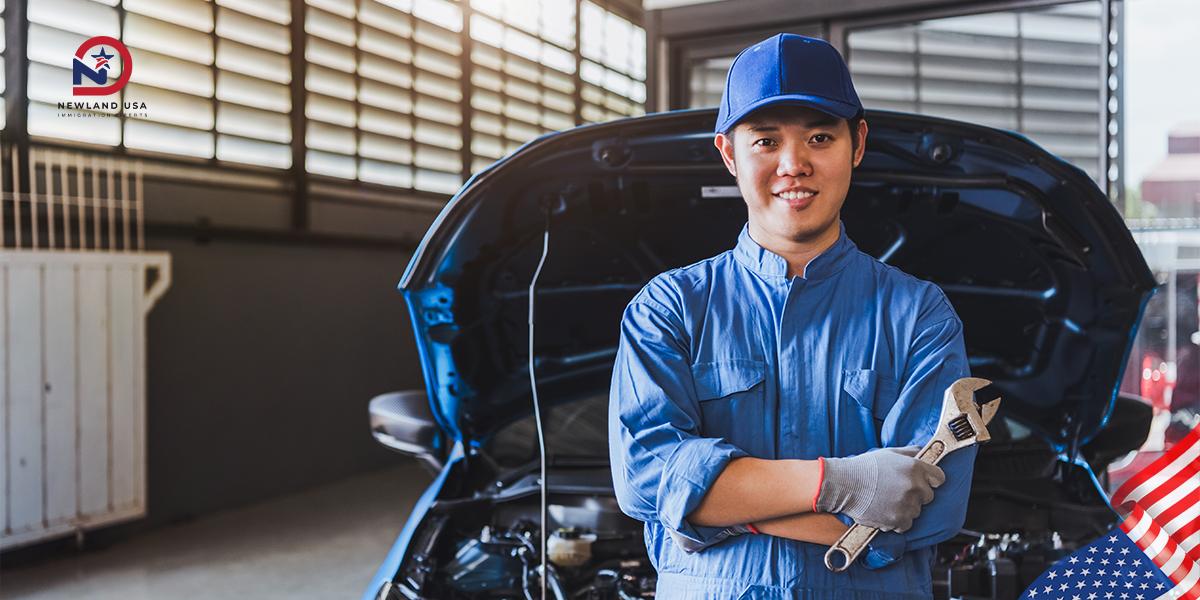
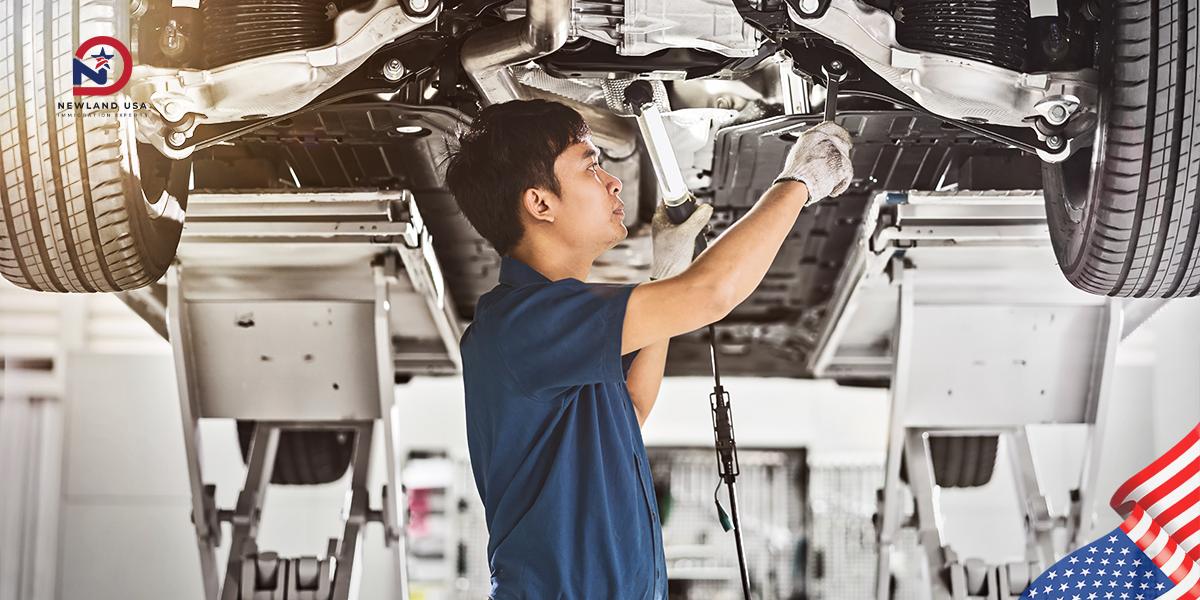
Auto mechanics work in workshop environments, garages, or automotive service centers, performing tasks from regular maintenance to repairing complex damage. The average salary for this position ranges from $40,000 to $65,000 per year, depending on skill level, experience, and geographic location.
This labor shortage has created favorable conditions for the EB3 U.S. immigration program, helping skilled auto mechanics from other countries, including Vietnam, have the opportunity to settle and stabilize their lives in the US.
2. English requirements for auto mechanics in the US
2.1. No mandatory English proficiency requirement
Good news for applicants is that auto mechanics in the US do not need high-level English certificates or international language certifications. The EB3 U.S. immigration program for skilled workers does not require applicants to have specific entry-level English proficiency or pass any language tests.
This means that even if you only have basic English knowledge or almost no English at all, you can still submit your application and be accepted into the program. American employers in the auto repair industry typically prioritize professional skills and practical experience over English communication ability.
2.2. Basic English is a big advantage
Although not mandatory, having basic English knowledge will bring many significant advantages for auto mechanics during work and living in the US. Simple communication ability helps you:
- Understand instructions from management and colleagues
- Read technical manuals and electrical diagrams
- Communicate basically with customers about vehicle conditions
- Integrate faster into the work environment
- Access advanced skill training courses
3. Level of English needed at each stage
3.1. Job application and interview stage
During the EB3 U.S. immigration program registration process, many employers may conduct video or phone interviews. However, these interviews typically focus on evaluating professional skills through simple technical questions or requests to present work experience.
Some employers accept using interpreters during interviews, which helps auto mechanics fully present their capabilities without language barriers. The most important thing is that you need to prove your practical experience and professional skills.
3.2. Initial work stage
When first starting work in the US, auto mechanics in the US are usually assigned to work in teams or have a mentor. Workshop environments typically have support from colleagues, especially in areas with large Vietnamese communities or many immigrant workers.
During this stage, you need to master some basic industry-specific English vocabulary such as vehicle parts names, repair tools, commonly used technical operations. Learning professional vocabulary will be much easier than learning general communication because they are repeated frequently in daily work.
3.3. Career development stage
After becoming familiar with the work environment, auto mechanics who want to advance or increase income need to improve their English ability. Being able to communicate better will help you:
- Participate in advanced training courses on modern vehicle technology
- Obtain ASE (Automotive Service Excellence) certification
- Access management positions or senior technical specialist roles
- Expand job opportunities in different states
4. Situations requiring English in auto repair work
4.1. Communication with colleagues and management
In the repair shop, auto mechanics in the US need to communicate daily with colleagues and managers about work progress, technical issues that arise, and replacement parts requirements. Most of these exchanges use fixed professional terminology, combined with body language and practical illustrations.
Many repair shops have electronic work assignment systems, which minimize the need for verbal communication. Auto mechanics can receive information about vehicles needing repair and work lists through computer screens or handheld devices.
4.2. Reading technical documents
An important part of the job is reading and understanding technical diagrams, repair manuals, and error descriptions from diagnostic systems. These documents typically use standardized technical terminology, international symbols, and detailed illustrative images.
Many immigrant auto mechanics have shared that reading technical documents in English is much easier than daily communication because the terminology is repeated and can be looked up and memorized. Moreover, many modern vehicle diagnostic software now support multiple languages, making the work process more convenient.
4.3. Customer interaction
This is the aspect that requires the highest English skills for auto mechanics in the US. However, in many repair shops, consulting and explaining to customers is typically handled by service advisors.
Auto mechanics working in the shop usually have little direct contact with customers. When necessary, you only need to explain simply about technical issues or repair progress using short sentences combined with pointing to specific parts.
5. How to prepare English for auto mechanics
5.1. Learn industry-specific vocabulary
Instead of trying to learn general conversational English, auto mechanics should focus on learning professional vocabulary. The priority vocabulary list includes:
- Vehicle parts names: engine, transmission, brake, suspension…
- Repair tools: wrench, socket, screwdriver, jack…
- Action verbs: remove, install, replace, tighten, loosen…
- Descriptive adjectives: worn, damaged, loose, tight…
Learning industry vocabulary can be done through English car repair instructional videos on YouTube, online training materials, or vocabulary learning apps.
5.2. Practice basic listening and speaking
Auto mechanics preparing for the EB3 U.S. immigration program should spend time practicing listening and pronouncing basic work-related conversational phrases such as:
- “I need this part”
- “The brake system is not working”
- “How long will it take?”
- “I will finish it by tomorrow”
- …
Practicing these fixed sentence patterns helps you feel more confident in work communication from the early days.
5.3. Participate in ESL courses
After arriving in the US, many communities and organizations offer free or low-cost ESL (English as a Second Language) courses for immigrants. This is a great opportunity for auto mechanics in the US to improve their English while maintaining their jobs.
These courses are usually held in the evenings or on weekends, suitable for technical staff work schedules. In addition to learning the language, you also have the opportunity to interact with other immigrant communities, share experiences, and build your network in the US.
6. Important notes when working in the US
6.1. Occupational safety
The auto repair industry in the US has strict occupational safety regulations. Auto mechanics need to clearly understand rules about protective equipment, chemical handling, and equipment operation. Safety signs in workshops typically use both words and international symbols, making it easy for foreign workers to recognize.
Employers are responsible for providing safety training, often accompanied by multilingual materials or instructional videos. Strict compliance with these regulations not only ensures personal safety but also demonstrates professionalism at work.
6.2. Work culture
The work environment in the US has some differences compared to Vietnam. Auto mechanics in the US need English to understand cultural rules such as punctuality, respecting personal space, and direct but polite communication.
Workers are encouraged to ask questions when unclear about work, report issues promptly, and proactively suggest improvements. This differs from the “silence is golden” culture in some Asian work environments. However, auto mechanics don’t need to worry too much about this because colleagues and management usually understand cultural differences and are willing to support.
6.3. Career development
The auto repair industry is continuously developing with new technology, especially the trend of electric and hybrid vehicles. Auto mechanics who want to maintain competitiveness need to continuously learn and update skills.
ASE certifications are highly valued in the industry and can help significantly increase income. Although these exams are conducted in English, they focus on technical knowledge and many immigrant auto mechanics have successfully passed after accumulating enough experience and improving professional English.
7. Benefits of the EB3 US immigration program for auto mechanics
The EB3 U.S. immigration program brings many outstanding benefits for auto mechanics:
Permanent Green Card: Applicants are granted a Green Card from the start, allowing long-term living and working in the US without time limits like other temporary visas.
Bring family along: Spouse and unmarried children under 21 can accompany the applicant, receive Green Cards together, and enjoy the same rights as natives.
Stable and high income: The salary of auto mechanics in the US is much higher than in Vietnam, along with health insurance, retirement, and vacation benefits guaranteed by law.
Opportunity to become a US citizen: After 5 years with a Green Card, you have the right to apply for US citizenship, opening opportunities for future generations.
Professional work environment: Work with modern equipment, learn new technology, and improve skills in an international environment.
8. Conclusion
The auto mechanic profession through the EB3 U.S. immigration program is a very attractive path for skilled people who want to settle in the US. English requirements are not a major barrier — the most important thing is still professional skills and practical experience.
However, having basic English knowledge, especially industry-specific vocabulary, will help auto mechanics in the US integrate faster, work more effectively, and have more career development opportunities. With effort in learning the language alongside improving skills, you can completely build a stable and successful life in the land of opportunity.
Newland USA, with a team of experienced experts and the motto “Stable settlement – Lifelong prosperity,” is ready to consult and support in preparing documents and accompany customers throughout the EB3 US immigration process. Contact Newland USA now via hotline 0785591988 or email: newsletter@newlandusa.asia for detailed and free consultation.
Learn more:
- Auto Repair Technician Shortage in the U.S.: A Golden Opportunity for EB3 Green Card Applicants
- Understanding ETA 9089 Form in the US EB3 Employment-Based Immigration Program
- EB3 Immigration Program – The Key to Unlocking a Bright Future for Young Vietnamese Generations
- EB3 Visa and 6 Other Legal Visa Types for Living and Working in the United States
News Categories


Related news
Who Is the ESTA Program For? How to Assess Your Fit Before Applying in 2026

Who Is the ESTA Program For? How to Assess Your Fit Before Applying in 2026

From Motorcycle Mechanic to Automotive Technician in the U.S.: Skills and Qualifications to Prepare in 2026
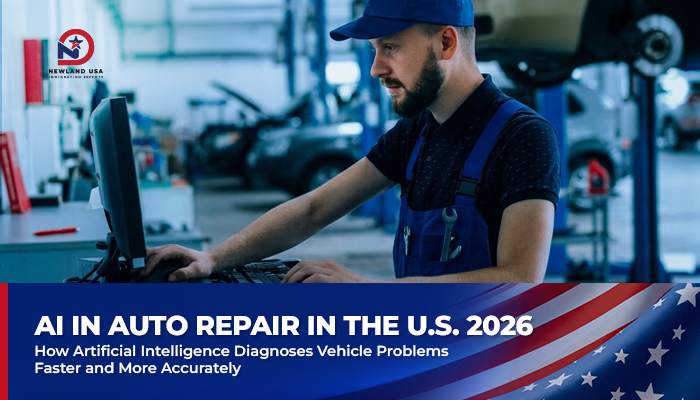
AI in Auto Repair in the U.S. 2026: How Artificial Intelligence Diagnoses Vehicle Problems Faster and More Accurately
7 Key Technologies Every Industrial Maintenance Technician in the U.S. Needs to Know in 2026
PLC & Automation Skills: A Launchpad for Maintenance Technicians in the United States in 2026
What Is the ASE Certification? Requirements, Exam Roadmap, and Its Importance for Auto Technicians in the U.S. in 2026

EB5 Capital Recovery Time: How Long It Takes and the Key Milestones
Electric Vehicle Technicians in the U.S.: The “Golden” Skills Helping Vietnamese Auto Mechanics Get Ahead of the 2026 EV Trend