Understanding ETA 9089 Form in the US EB3 Employment-Based Immigration Program
The ETA 9089 form plays a foundational role in the EB3 employment-based immigration journey, serving as a crucial first step that helps foreign workers access US green card opportunities. This article from Newland USA will help you clearly understand this form, the process of completing the application, and important points to note to optimize your chances of success in the EB3 program.
1. What is the ETA 9089 form and why is it important for EB3?
Within the US employment-based immigration system, the ETA 9089 form (Application for Permanent Employment Certification) is a legal document issued by the US Department of Labor (DOL). This is the mandatory first step that every employer and foreign worker must complete when participating in the PERM (Program Electronic Review Management) process.
The main purpose of this form is to confirm that hiring international workers will not negatively impact job opportunities or wages for US workers. In other words, the ETA 9089 form helps protect the rights of the domestic workforce while still allowing businesses to seek global talent.
For those who are currently working or will be working under EB3 category, understanding and thoroughly preparing the ETA 9089 form is a very important factor. EB3 is an immigration category for skilled workers, professionals with college degrees, or unskilled workers. Each approved application will become the legal basis for US Citizenship and Immigration Services (USCIS) to review and grant permanent residence (Green Card).
Accuracy and completeness in information and supporting documents are the keys to shortening processing time and avoiding the risk of application rejection.
2. The position of ETA 9089 form in the EB3 immigration roadmap
The EB3 program operates through a clear three-stage process, in which the ETA 9089 form plays a crucial role from the very first step:
Stage 1: Labor Certification
At this stage, the employer files the ETA 9089 form with the US Department of Labor to prove they have fully completed the process of searching for domestic candidates but could not find qualified local workers. This is the foundation step of the entire EB3 employment-based immigration process.
Stage 2: I-140 Sponsorship Petition
After receiving labor certification from DOL, the company proceeds to file Form I-140 (Immigrant Petition for Alien Worker) with USCIS. This document confirms that the company is ready to sponsor the foreign worker for long-term employment in the US.
Stage 3: I-485 Permanent Residence Registration or Consular Interview
The final step is filing the I-485 application to adjust status (if in the US) or participating in an interview at the US consulate (if abroad) to receive the official green card.
Thus, you can see that the ETA 9089 form is the first and most important brick in the entire EB3 category immigration process. If this stage is not done correctly, the entire application and plan could encounter major problems or, worse, the entire application could be cancelled and the worker would have to start over from the beginning.
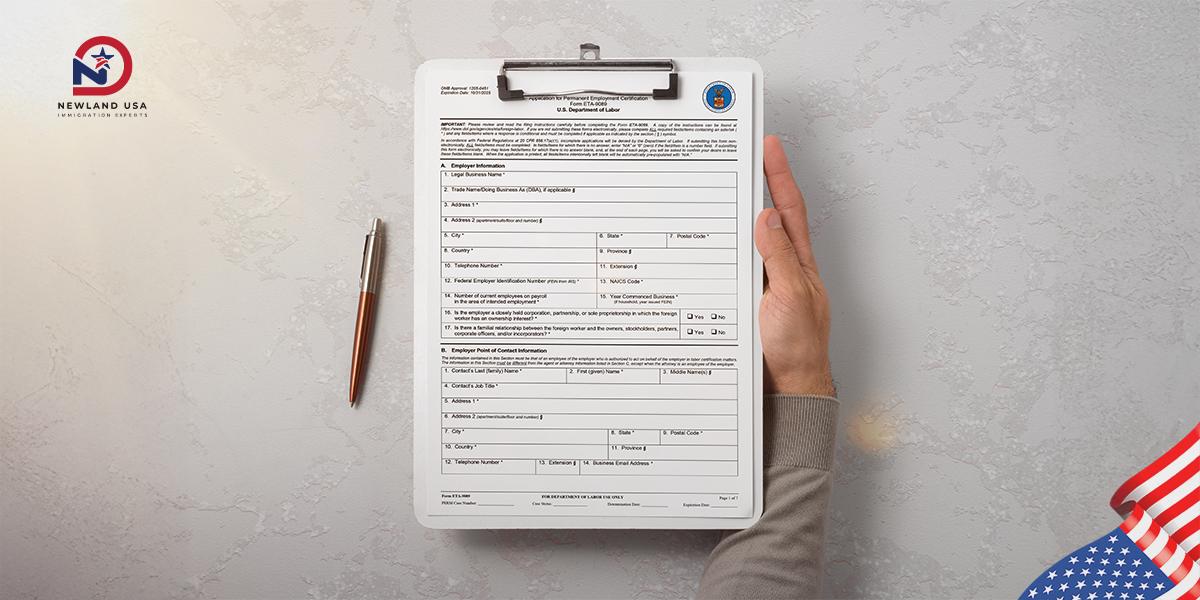
3. Required preparation steps before filing ETA 9089 form
Before officially completing and submitting the ETA 9089 form to the US Department of Labor, employers need to complete three essential preliminary steps. These are steps that cannot be skipped if you want your EB3 employment-based immigration application to be approved quickly and avoid additional review risks later.
Step 1: Determine the Prevailing Wage (Prevailing Wage Determination)
The Prevailing Wage (PWD) is the minimum income level that the employer must commit to paying the foreign worker, based on geographic area, industry sector, and job level. The purpose of this requirement is to ensure that international candidates are not paid less than Americans in equivalent positions.
To complete this, the company needs to file form ETA 9141 through the FLAG (Foreign Labor Application Gateway) system. DOL will review and issue an official PWD determination within approximately 60 to 90 days.
Step 2: Determine the accurate occupational code (SOC Code)
Each job in the US labor system is assigned an identification code according to the Standard Occupational Classification (SOC) system. Selecting the correct SOC code is an extremely important factor that directly affects the approval results of the EB3 program.
Employers should look up on the O*NET Online platform provided by DOL, compare actual job duty descriptions with standards in the SOC catalog, then select the code with the highest similarity in skill requirements, education level, and professional responsibilities.
Step 3: Complete the recruitment file
This is the required evidence to prove that the employer has conducted the process of searching for US candidates legally and transparently before deciding to hire foreign workers.
The file must include: copies of job postings (newspapers, websites, state employment agencies…), list of US candidates who applied, interview records, specific reasons for rejection for each case, and a summary report of the entire recruitment process.
Note: The ETA 9089 form must be filed within 180 days from the first day of job posting. If this deadline is exceeded, the entire recruitment process must be repeated from the beginning.
4. Detailed guide on how to complete and file ETA 9089 form online
After completing the preparation steps, employers proceed to complete and submit the ETA 9089 form through the US Department of Labor’s electronic system. This is the first step in the PERM labor certification process, creating a solid foundation for applying for a green card under EB3 category.
4.1. Official filing portal – FLAG System
Since 2021, all ETA 9089 forms are filed through the Foreign Labor Application Gateway (FLAG) platform at https://flag.dol.gov.
Employers need to register a business account with a valid Federal Employer Identification Number (FEIN), set up information for the representative or immigration attorney (if any), and check for consistent linkage between ETA Form 9141 (PWD) and the ETA 9089 form to avoid data conflicts.
The FLAG system supports online data entry, draft saving, and electronic filing, helping to minimize technical errors and shorten approval waiting time.
4.2. Important sections in the ETA 9089 form
The ETA 9089 form includes many sections, but there are three sections most prone to errors that filers need to pay special attention to:
Part A – Employer Information
Company name, headquarters address, and FEIN number must completely match the information in tax records and the approved PWD. If the business has multiple branches, clearly state the exact work location for the hiring position.
Part B – Job Opportunity Information
This section requires detailed description of job title, job duties, degree requirements, and professional skills. All content must be compatible with information in recruitment advertisements and the wage level stated in ETA 9141. Avoid setting overly restrictive or personally specific requirements, as this easily makes DOL suspect discriminatory behavior against US candidates.
Part F – Alien Information
Record full name, date of birth, nationality, and complete work and education history. Specifically, degrees, certificates, and professional experience must be obtained before the recruitment campaign begins. DOL often rejects applications if they discover inaccurate information about degree timing or experience.
4.3. Review, sign, and complete the filing
After completing all information, employers need to carefully check to ensure consistency between PWD – recruitment file – ETA 9089 form. Download the Preview PDF to check for spelling errors or formatting discrepancies.
Next, perform an Electronic Signature using the account of the company’s legal representative, then store a PDF copy and confirmation email from FLAG for at least 5 years as required.
Upon successful filing, DOL will issue a Case Number so employers can conveniently track processing progress online.

5. Challenges and risks to note when filing ETA 9089 form
The process of filing the ETA 9089 form requires meticulousness and absolute accuracy, as even a small error can cause the EB3 employment-based immigration application to take longer than expected. Below are important factors that both employers and workers need to understand clearly to increase their chances of success.
5.1. Processing time and impacting factors
Currently, the US Department of Labor typically needs about 6 to 18 months to review and approve the ETA 9089 form, depending on the backlog of pending applications, the degree of information consistency between forms, and the quality and transparency of the recruitment file.
5.2. Risk of supplementary inspection (Audit)
Each year, DOL may randomly select 20% to 40% of applications for supplementary inspection (Audit). Common reasons leading to this situation include: job description or education requirements being assessed as too specific, the company having a history of labor regulation violations, or signs of mismatch between data in ETA 9141 and the ETA 9089 form.
When audited, the company must provide all original documents including the recruitment file, PWD, advertisement samples, and records of US candidate rejections. If no response is provided within the specified timeframe, the application may be denied.
5.3. Common errors leading to application rejection
Technical errors: entering the wrong occupational code (SOC code), recording incorrect wage, or inaccurate company information.
Advertisement-related errors: lacking recruitment evidence, incorrect timing, or job posting format not meeting regulations.
Recruitment process errors: invalid reasons for rejecting US candidates or no recruitment report.
Specifically, all reasons for rejecting US candidates must be based on objective criteria such as lacking degrees, experience, or professional skills, not personal factors.
5.4. Advice to increase success rate
Prepare the application following the correct three-stage sequence: PWD → Recruitment → ETA 9089 form.
Collaborate with an immigration attorney experienced in PERM, especially in determining occupational codes and drafting job descriptions.
Carefully store files for at least 5 years, ready to provide upon inspection request.
Regularly track processing status through the FLAG portal to not miss any important notifications.

6. Conclusion
The ETA 9089 form is an indispensable step in the EB3 employment-based immigration journey, playing a pivotal role in opening green card opportunities for foreign workers. The process from preparing PWD, determining occupational code, conducting recruitment to completing and filing the ETA 9089 form requires meticulousness, accuracy, and strict compliance with US Department of Labor regulations.
Newland USA, with an experienced team of experts and the motto “Stable residence — Lifelong prosperity,” is ready to consult and support in preparing applications and accompany customers throughout the EB3 US immigration process. Please contact Newland USA immediately via hotline 0785591988 or email: newsletter@newlandusa.asia for detailed and free consultation.
Learn more:
- EB3 Immigration Program – The Key to Unlocking a Bright Future for Young Vietnamese Generations
- EB3 Visa and 6 Other Legal Visa Types for Living and Working in the United States
- How EB3 Workers Are Contributing to Solving the Labor Crisis in America
- Don’t Let Your PERM Get Rejected When Applying for EB3 Visa
News Categories



Related news

Who Is the ESTA Program For? How to Assess Your Fit Before Applying in 2026

Who Is the ESTA Program For? How to Assess Your Fit Before Applying in 2026

From Motorcycle Mechanic to Automotive Technician in the U.S.: Skills and Qualifications to Prepare in 2026

AI in Auto Repair in the U.S. 2026: How Artificial Intelligence Diagnoses Vehicle Problems Faster and More Accurately

7 Key Technologies Every Industrial Maintenance Technician in the U.S. Needs to Know in 2026

PLC & Automation Skills: A Launchpad for Maintenance Technicians in the United States in 2026

What Is the ASE Certification? Requirements, Exam Roadmap, and Its Importance for Auto Technicians in the U.S. in 2026

EB5 Capital Recovery Time: How Long It Takes and the Key Milestones

Electric Vehicle Technicians in the U.S.: The “Golden” Skills Helping Vietnamese Auto Mechanics Get Ahead of the 2026 EV Trend