Can Family Members of the Applicant Accompany to the U.S. Under EB3 Category?
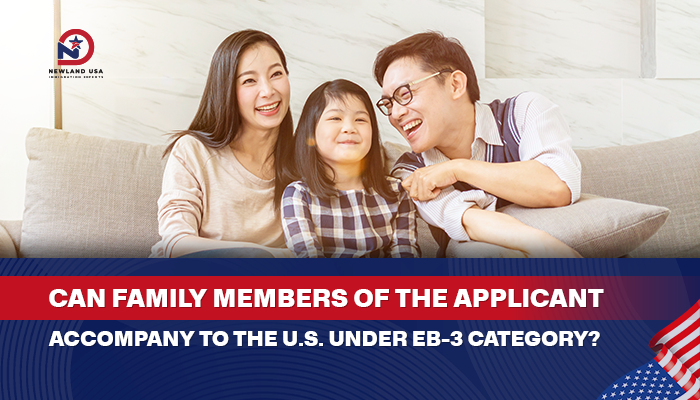
When approved for U.S. immigration under EB3 category, the biggest question for many principal applicants is whether their family members can come to the U.S. together. According to the latest 2025 regulations from USCIS, family members including legal spouse and unmarried children under 21 years old have the full right to accompany the principal applicant to receive permanent resident green cards. This article from Newland USA will help you understand who qualifies, what benefits they receive, and the process for preparing documents according to USCIS standards so that the entire family’s U.S. immigration journey goes smoothly.
1. Who is eligible to accompany when applying for EB3 category?
According to the latest regulations from U.S. Citizenship and Immigration Services (USCIS) announced in 2025, those permitted to accompany the principal applicant under EB3 category include two groups: legal spouse and children under the age requirement who have not established their own families.
1.1. Spouse of the principal applicant
The legally recognized wife or husband of the principal applicant for U.S. immigration under EB3 category will receive a Visa appropriate to the occupational group of the sponsor:
- If the applicant belongs to the Skilled Workers or Professionals group with code E31 or E32, the spouse will be issued an E-34 Visa.
- If the principal applicant belongs to the Other Workers category with code EW3, the spouse will receive an EW-4 Visa.
After entering U.S. territory legally, the spouse is immediately granted a permanent resident green card equivalent to the principal applicant, with full rights to live and work in any state without restrictions on occupational field.
Important note: The marriage relationship must be legally verified before the U.S. immigration Visa is issued or before Form I-485 is approved (applicable for adjustment of status cases in the U.S.). Marriages registered after these time points will not meet the criteria to accompany the principal applicant under EB3 category.
1.2. Children under 21 years old and unmarried
The legally recognized children of the principal applicant in the U.S. immigration EB3 category application include:
- Biological children
- Children adopted according to U.S. Immigration Law
- Stepchildren of the spouse legally adopted before the child turns 16 years old
After entering the U.S., the children also become permanent residents, enjoying free education benefits at public educational institutions and many other privileges similar to U.S. citizens.
Important note about age: Only children under 21 years old and unmarried at the time of Visa issuance or I-485 approval are eligible to accompany. In situations where children are about to turn or have just passed 21 years old, families should consider applying the Child Status Protection Act (CSPA) to accurately recalculate immigration age. This is an important step to ensure children’s rights in applications with extended processing times.

2. Benefits for family members accompanying under EB3 category
When spouse and children under 21 are permitted to accompany the principal applicant, they immediately become Lawful Permanent Residents in the U.S. alongside the principal applicant, and can fully enjoy the following essential benefits:
2.1. Legal living and working rights immediately in the U.S.
After completing entry procedures, the spouse receives a permanent green card, no longer subject to temporary visa limitations like H-1B or J-1. They are completely free to work for any employer on U.S. territory without needing separate sponsorship or waiting for visa conversion. Children aged 16 and older can also participate in part-time work according to state labor regulations, right from arrival in the U.S.
2.2. Education and healthcare benefits like U.S. citizens
Accompanying children will receive completely free education at public schools, from kindergarten through high school completion. Additionally, they have the right to apply for scholarships or receive tuition reduction benefits at public universities. At the same time, all family members can use healthcare services designated for green card holders, including participation in health insurance according to federal or state government regulations.
2.3. Eligible to apply for citizenship after 5 years
According to current U.S. law, after 5 years of continuous permanent resident status, the entire family including spouse and eligible children can file for U.S. naturalization if they meet conditions such as stable residence, no serious legal violations, and basic English communication ability.
2.4. Simple family accompaniment procedure, time-saving
Accompanying family members will use the same Priority Date and the same EB3 category Visa type as the principal applicant. This significantly shortens waiting time and avoids having to go through a sponsorship process after the principal applicant has successfully immigrated to the U.S.
3. Process for preparing documents for spouse and children accompanying under EB3 category
When the principal applicant under EB3 category is approved by USCIS, bringing spouse and children under 21 can be done through two routes: filing from abroad (Consular Processing) or adjustment of status in the U.S. (Adjustment of Status).
3.1. Case of residing outside U.S. territory (Consular Processing)
The family will accompany by filing Form DS-260 – Immigrant Visa Application simultaneously with the principal applicant. Each person must complete a separate DS-260, along with:
- Valid personal documents (valid passport)
- Documents certifying relationships (marriage certificate, children’s birth certificates)
- Medical examination results according to standards and original medical records from a doctor designated by the U.S. Consulate
- Attend an interview at the Consulate – usually scheduled on the same day as the principal applicant
After DS-260 is approved and the Visa is issued, family members will enter the U.S. together and receive the green card (Permanent Resident Card) at the port of entry or complete procedures afterward.
3.2. Case of residing in the U.S. and eligible for adjustment (Adjustment of Status)
In situations where you and your family are living in the U.S. with legal Visas, you can file Form I-485 – Application to Register Permanent Residence or Adjust Status. This is a common method when the principal applicant’s EB3 category Visa is approved but still waiting for visa availability according to the Visa Bulletin.
According to USCIS guidance updated on January 20, 2025, each person (spouse, children) will file separate Form I-485, accompanied by:
- Copy of approved Form I-140 (or Receipt Notice)
- Evidence of legal relationship (marriage certificate or birth certificate)
- Proof of current legal resident status in the U.S.
- Supporting documents: medical examination results (Form I-693), photos, passport copy, entry document (I-94)
Families can file concurrently I-140 and I-485 if the Visa is available according to the Visa Bulletin. After filing I-485, family members can include Form I-765 to apply for Employment Authorization and I-131 to apply for advance parole.

4. Important notes when bringing family members under EB3 category
Bringing spouse and children under EB3 category is a legal right regulated by USCIS. However, to ensure the application is approved and family rights are not affected, there are several important points you need to understand clearly.
4.1. Must clearly prove family relationships
For USCIS to approve U.S. immigration Visas for accompanying family members, you must submit complete documents proving legal relationships with dependents:
- Spouse: Must have a legal marriage certificate
- Children: Need valid birth certificates or legal adoption documents according to U.S. immigration law
All documents must be properly notarized and translated into English to ensure USCIS and Consulate acceptance.
4.2. Children aging out at 21 may lose accompanying rights
Only children under 21 years old and unmarried are eligible to accompany the U.S. immigration EB3 category application of parents. However, because Visa processing time can be lengthy, many children will “age out” while waiting for application processing.
To protect children’s rights, families need to apply the Child Status Protection Act (CSPA). This law allows “freezing age” during the period when Form I-140 is being processed, helping children not lose benefits even though they have passed their 21st birthday in reality.
CSPA age calculation needs to be based on the Priority Date and the time when Form I-140 is approved, combined with the monthly Visa Bulletin.
4.3. Cases with stepchildren and adopted children need careful examination of each file
Not all stepchildren and adopted children automatically qualify to accompany. USCIS requires:
- Must prove legal custodial relationship according to U.S. immigration regulations
- Adoption must be completed before the child turns 16 years old (or 18 years old if spouse’s adopted child)
- USCIS may require additional documents such as court decisions, documents proving actual relationship and level of financial dependence
If not qualified, the child will have to file separate sponsorship after parents successfully immigrate to the U.S.

5. Conclusion
Obtaining a U.S. immigration EB3 category Visa not only provides work and long-term living opportunities for the principal applicant but also opens the door to U.S. immigration for spouse and unmarried children under 21 years old. Qualified family members can simultaneously receive permanent green cards, enjoy full education, healthcare, work benefits and later can apply for U.S. citizenship.
However, to best protect the entire family’s rights, applicants need to pay attention to important factors such as: clearly proving legal relationships, accurately tracking children’s age according to CSPA regulations, and preparing complete documents following proper procedures according to USCIS’s latest updated guidance.
Newland USA, with a team of experienced experts and the motto “Stable settlement — Lifelong prosperity”, is ready to advise and support in document preparation and accompany you throughout the EB3 U.S. immigration process. Contact Newland USA immediately via hotline 0785591988 or email: newsletter@newlandusa.asia for detailed and free consultation.
News Categories

Related news

From Motorcycle Mechanic to Automotive Technician in the U.S.: Skills and Qualifications to Prepare in 2026
AI in Auto Repair in the U.S. 2026: How Artificial Intelligence Diagnoses Vehicle Problems Faster and More Accurately
7 Key Technologies Every Industrial Maintenance Technician in the U.S. Needs to Know in 2026
PLC & Automation Skills: A Launchpad for Maintenance Technicians in the United States in 2026
What Is the ASE Certification? Requirements, Exam Roadmap, and Its Importance for Auto Technicians in the U.S. in 2026
EB5 Capital Recovery Time: How Long It Takes and the Key Milestones
Electric Vehicle Technicians in the U.S.: The “Golden” Skills Helping Vietnamese Auto Mechanics Get Ahead of the 2026 EV Trend
US Engineering & Maintenance Labor Shortage 2026: The Driving Force Behind the EB3 Skilled Workers Visa Policy
Industrial Maintenance Technician: Job Duties, Requirements & U.S. Immigration Opportunities in 2026