The KISS Principle in EB5: A Practical Guide to Selecting Safe Projects for Investors
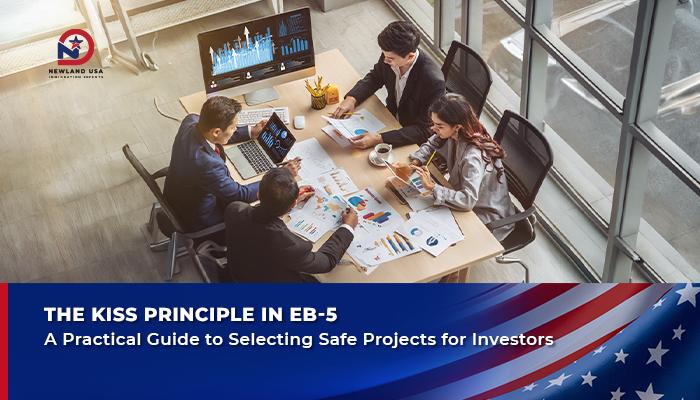
On the journey to obtaining a green card through the EB5 investment immigration program, every investor has to deal with a huge amount of paperwork: legal documents, financial analyses, economic reports, job creation forecasts, USCIS processing timelines, and so on. This level of complexity can easily push participants into a state of information overload, leading to emotional decision-making. This is exactly when the KISS principle — a classic philosophy in design and management — becomes a guiding compass to help investors cut out the unnecessary, focus on the true nature of a project, and make smarter choices.
The following article by Newland USA will explain why the KISS principle is such an important key in EB5 investing, while also offering practical approaches to choosing a safe EB5 project — even for investors who don’t have a deep background in finance.
1. What Is the KISS Principle and Why Has It Become a Guiding Compass in Investing?
The KISS principle stands for “Keep It Simple, Stupid” — a design philosophy proposed by American aeronautical engineer Kelly Johnson in the mid-20th century while working at Lockheed’s Skunk Works division. The core idea behind this principle is that a system works best when it is designed to be simple, easy to understand, and operable by people who don’t necessarily have highly specialized expertise.
From the field of engineering, the KISS principle has spread across many other industries, including product design, software development, marketing communications, and especially the world of finance and investing. In the investment world, this philosophy encourages participants to prioritize business models that are transparent, easy to verify, and have clear operating mechanisms — rather than getting swept up in complex financial products that hide underlying risks.
Charlie Munger — the right-hand man of legendary investor Warren Buffett — once shared that many investors tend to calculate too much while thinking too little, when the truth is that a simple, easy-to-understand investment portfolio often delivers more sustainable results. This mindset is perfectly aligned with EB5 investing.
2. Why Does EB5 Investing Need the KISS Principle?
The EB5 program, managed by USCIS, is one of the fastest and most stable legal pathways to U.S. residency currently available for Vietnamese citizens. However, EB5 investing is not simply a financial transaction — it’s also tied to immigration paperwork, job creation timelines, federal regulations, and many hard-to-predict variables.
In this context, the volume of documents an investor needs to process is typically enormous: Private Placement Memorandums (PPMs), market research reports, Regional Center I-956F filings, job creation models, exit strategies, construction budgets, capital structures, and more. For most participants — who are not financial experts — analyzing this entire chain of information is nearly impossible.
This is precisely where the KISS principle shows its most practical value. Instead of trying to decode every technical detail, investors can simply ask themselves one question: “Do I understand what this project is doing, where it makes money, and how it will return my capital?” If the answer is “yes,” the project meets the spirit of KISS. If the answer is “no,” that could be a warning sign that the project’s complexity is hiding risks the investor hasn’t yet identified.
A simple business model, clear market demand, and flexible operations will minimize unexpected failure scenarios. On the other hand, projects based on unrealistic growth assumptions, unproven experimental technology, or multi-layered financial structures often carry significant risks — both financially and from an immigration standpoint. This is why the KISS principle is increasingly seen by international EB5 experts as a foundational mindset for making smart EB5 investment decisions.

3. Applying the KISS Principle to Choose a Safe EB5 Project
Applying the KISS principle doesn’t mean eliminating all technical factors — it means focusing on the core criteria that help investors accurately evaluate the true nature of a project. Below are five key pillars in the spirit of KISS for choosing a safe EB5 project.
3.1. A Simple, Verifiable Business Model
A trustworthy project must have a business model that investors can explain in a few short sentences: what the project is building, who it serves, where the revenue comes from, and how the capital will be returned to investors. For example, a residential subdivision real estate project is much easier to verify than a high-tech industrial complex that requires full-capacity operations from day one in order to turn a profit.
Residential real estate has the advantage of allowing development in phases. If the market slows down, the developer can reduce the pace of construction; if demand rises, they can scale up. This operational flexibility makes residential real estate a choice that fits well with the spirit of the KISS principle in EB5 investing.
3.2. A Transparent and Secure Financial Structure
One of the most effective ways to choose a safe EB5 project is to carefully examine the project’s capital structure. According to EB5 experts, a sustainable project typically has the developer’s equity at a high level — ideally between 30% and 40% of the total project capital. When developers put a significant amount of their own money into the project, they have a much stronger motivation to ensure the project is completed on time and effectively.
In addition, investors should evaluate where EB5 capital sits within the capital structure. Capital placed in a senior loan position with full collateral creates a much stronger layer of protection compared to investments in a subordinate position. This is a factor investors should seriously consider before signing any agreement.
Furthermore, the project should be fully funded before opening for subscription. A project that depends entirely on EB5 capital to break ground carries significant risk if fundraising doesn’t go smoothly. In contrast, a project backed by a bridge loan or reserve funding will continue moving forward even if EB5 capital arrives late or falls short.
3.3. Clear Legal Documentation Already Approved by USCIS
Under the EB5 Reform and Integrity Act of 2022 (RIA), all Regional Center projects must file Form I-956F for prior review by USCIS. When choosing a safe EB5 project, investors should prioritize projects that have already filed or received preliminary approval for the I-956F — this is a sign that the project has passed a thorough round of review by the federal immigration agency.
Additionally, offering documents, PPMs, and investment agreements should be reviewed by specialized attorneys. Any clause that is overly complex or vague regarding investor rights needs to be clarified before committing capital.
3.4. A Reputable Developer and Regional Center Team
One of the top ways to choose a safe EB5 project recommended by leading experts is to review the track record of the developer and the Regional Center. Specifically, investors should look into how many projects the Regional Center has completed, what the I-526E and I-829 approval rates are, how many investors have been repaid on time, and whether the leadership team has relevant experience in the project’s industry.
A Regional Center with a transparent track record, a string of successful projects, and a willingness to share real data — rather than just making promises about the future — is a reliable partner. The philosophy of “show, don’t tell” is the clearest expression of the KISS principle in EB5 investing.
3.5. Job Creation Capacity and Exit Strategy
The core requirement of the EB5 program is that each investor must create at least 10 jobs for American workers. When evaluating a project, investors should examine the job cushion — the ratio between the number of jobs a project is expected to create and the total number of jobs required to satisfy all EB5 investors.
A higher job cushion means lower immigration risk. In particular, projects that can meet the job creation requirement solely through construction spending (without relying on operational jobs after completion) are generally considered the safest from an immigration perspective.
At the same time, the exit strategy is a factor that cannot be overlooked. Investors need to clearly understand how their capital will be returned: through a project sale, refinancing, operational cash flow, or another method. A specific, feasible exit strategy with a clear timeline provides great peace of mind for participants.
4. Common Mistakes When Investors Ignore the KISS Principle
Failing to apply the KISS principle often leads to common mistakes in EB5 investing, and this is the root cause of most losses or immigration failures in the program’s history.
The first mistake is being attracted by unrealistically high promised returns. A project promising returns of 5–10% per year usually comes with a much higher level of risk compared to the traditional EB5 market interest rate (typically around 0.5–2% per year). When a financial product seems “too good to be true,” that’s usually a red flag that needs thorough investigation.
The second mistake is placing too much trust in sales pitches while skipping independent due diligence. In today’s EB5 market, there’s no shortage of advisory firms that use complex industry jargon to create an impression of professionalism, but behind the scenes lies a risky financial structure. Smart investors should hire independent legal and financial due diligence firms before making any decisions.
The third mistake is choosing a project solely because of visa advantages, such as projects located in rural areas or Targeted Employment Areas (TEA). While these projects may have faster I-526E processing times and reserved visa quotas, geographic location alone is not enough to guarantee project safety. The right way to choose a safe EB5 project must still revolve around core criteria: financial transparency, a reputable team, complete USCIS filings, and realistic job creation capacity.
The fourth mistake is failing to check the project’s current construction status. A project that has already broken ground, received permits, has contractors on-site, and has initial funding disbursed carries far less risk than a project that only exists on paper.

5. A Practical Process for Choosing a Safe EB5 Project in the Spirit of KISS
To help investors easily apply the KISS principle to the project selection process, it can be broken down into four simple yet comprehensive steps.
Step 1 – Screen using simple criteria: Investors start by eliminating any project whose business model they can’t explain within one minute. If the model is so complex that even the advisor needs to use a lot of specialized terms to explain it, that’s a sign to be cautious.
Step 2 – Evaluate three core risk layers: Every EB5 investment decision revolves around three aspects: immigration risk (whether the project meets USCIS requirements and creates enough jobs), financial risk (whether the project can return capital on time), and operational risk (whether the project can be completed on schedule). Investors need to assess all three layers independently.
Step 3 – Independent due diligence: This is the step where investors should not try to handle things alone. They need to hire an immigration attorney experienced in EB5, an independent financial due diligence expert, and if possible, conduct a site visit to the project. Meeting the developer team in person, observing construction progress, and speaking with local authorities will provide authentic information far beyond what marketing materials can offer.
Step 4 – Compare and select: Once all the information is in hand, investors should compare at least two to three projects for an objective perspective. Comparison criteria include capital structure, job cushion ratio, exit strategy, Regional Center history, and other investor protection measures such as guarantees, collateral, or escrow accounts.
This approach may sound simple, but that simplicity is the core spirit of the KISS principle — not because it’s easy to do, but because it removes distracting factors so investors can focus on what truly matters. This is also the way to choose a safe EB5 project recommended by many international EB5 experts.
6. Long-Term Benefits of Applying the KISS Principle in EB5 Investing
By following the KISS principle, investors not only reduce risk but also save time, effort, and mental energy throughout their EB5 investment journey. Choosing a transparent, easy-to-understand project helps investors proactively monitor progress, evaluate operational performance, and spot early warning signs if anything goes wrong.
Moreover, projects that follow the spirit of KISS tend to recover better in the face of market fluctuations. A mid-scale residential real estate model will be less affected by economic shocks compared to a specialized industrial complex. Operational flexibility serves as a cushion to protect investor capital during difficult market periods.
Finally, the KISS principle also helps build a relationship of trust between investors and immigration advisory firms. When both sides agree on criteria that are simple, transparent, and safe, the partnership runs more smoothly, effectively, and sustainably. This is the key factor that allows every Vietnamese family to confidently step into their journey toward U.S. residency with peace of mind.

7. Conclusion
In an investment immigration program as complex as EB5, simplicity does not mean being superficial or lacking depth. On the contrary, simplicity in the spirit of the KISS principle is a reflection of strategy — the ability to see through layers of technical packaging to identify the true nature of an investment opportunity. For every investor considering EB5 investing, applying this philosophy not only helps avoid risky projects but also opens up a safe, effective path to achieving U.S. residency.
Learn more:
- Securing the Green Card and Getting Your Money Back: How to Build an Effective EB5 Visa Exit Strategy
- What Is EB5 Source of Funds? The Simplest Explanation for New Investors
- Should EB5 Investors Accept Loans from Regional Centers? The Risk of I-526E Denial
- Why Is 2026 the Critical Time to Invest in EB5?
- Ways to Ensure Your EB5 Capital is Safe When Investing in a Project
News Categories


Related news

From Motorcycle Mechanic to Automotive Technician in the U.S.: Skills and Qualifications to Prepare in 2026

AI in Auto Repair in the U.S. 2026: How Artificial Intelligence Diagnoses Vehicle Problems Faster and More Accurately
7 Key Technologies Every Industrial Maintenance Technician in the U.S. Needs to Know in 2026
PLC & Automation Skills: A Launchpad for Maintenance Technicians in the United States in 2026
What Is the ASE Certification? Requirements, Exam Roadmap, and Its Importance for Auto Technicians in the U.S. in 2026
EB5 Capital Recovery Time: How Long It Takes and the Key Milestones

Electric Vehicle Technicians in the U.S.: The “Golden” Skills Helping Vietnamese Auto Mechanics Get Ahead of the 2026 EV Trend
US Engineering & Maintenance Labor Shortage 2026: The Driving Force Behind the EB3 Skilled Workers Visa Policy
Industrial Maintenance Technician: Job Duties, Requirements & U.S. Immigration Opportunities in 2026