How to Open a US Bank Account for EB-3 Immigrants in 2026
When you set foot in the United States with an EB-3 visa in hand, one of the first things to do during your very first days is open a U.S. bank account to receive your paycheck, manage spending, and gradually build up a U.S. credit history. That said, many Vietnamese families feel lost when facing the country’s enormous financial system and the paperwork requirements, which are quite different from those in Vietnam. The article below from Newland USA will walk you through in detail how to open a U.S. bank account as an EB-3 immigrant in 2026 — from the documents you need to prepare, to the step-by-step process, the most trusted banks, and how to get the most out of financial services right from your first days of settling in.
1. Why EB-3 immigrants should open a U.S. bank account early
After completing the EB-3 journey and officially becoming a lawful permanent resident of the United States, setting up an account with a U.S. bank is not just a daily-living need — it is also a long-term strategic move. First of all, most sponsoring companies require their employees to provide an account number so that wages can be paid through direct deposit, which is the most popular and safest way to receive a salary in the U.S. On top of that, essential expenses such as rent, utility bills, internet, health insurance, or school tuition for your children are typically paid automatically through your bank account, which helps your family avoid falling behind on payments.
A survey published by the FDIC (Federal Deposit Insurance Corporation) shows that roughly 40% of new immigrants have run into difficulties when trying to access banking services in their early days. As a result, they are often forced to use outside check-cashing services that come with high fees and considerable risk. That is why quickly opening a U.S. bank account as soon as you have settled on a residential address is a smart move to protect your cash flow and build a solid financial foundation for the whole family.
More importantly, a legitimate bank account is the first door that leads to a U.S. credit history — the key factor that affects your ability to rent a home, finance a car, take out a mortgage to buy a house, and even get hired at many large companies. For EB-3 permanent residents, establishing a relationship early on with a reputable financial institution opens up many important opportunities for the whole family in the years to come.
2. Common types of accounts at U.S. banks
The U.S. banking system offers a wide range of account types to meet everything from day-to-day spending to long-term saving needs. Before learning how to open a U.S. bank account, EB-3 immigrants should understand the basic products in order to choose the right fit for their family situation.
A Checking account (payment account) should be the first type of account you open. This is the tool you use for daily spending, and it comes with a debit card that lets you withdraw cash at ATMs, pay bills, receive your salary via transfer, and use fast domestic money-transfer apps like Zelle. Some U.S. banks even offer a small amount of interest on checking accounts if customers keep a minimum balance as required.
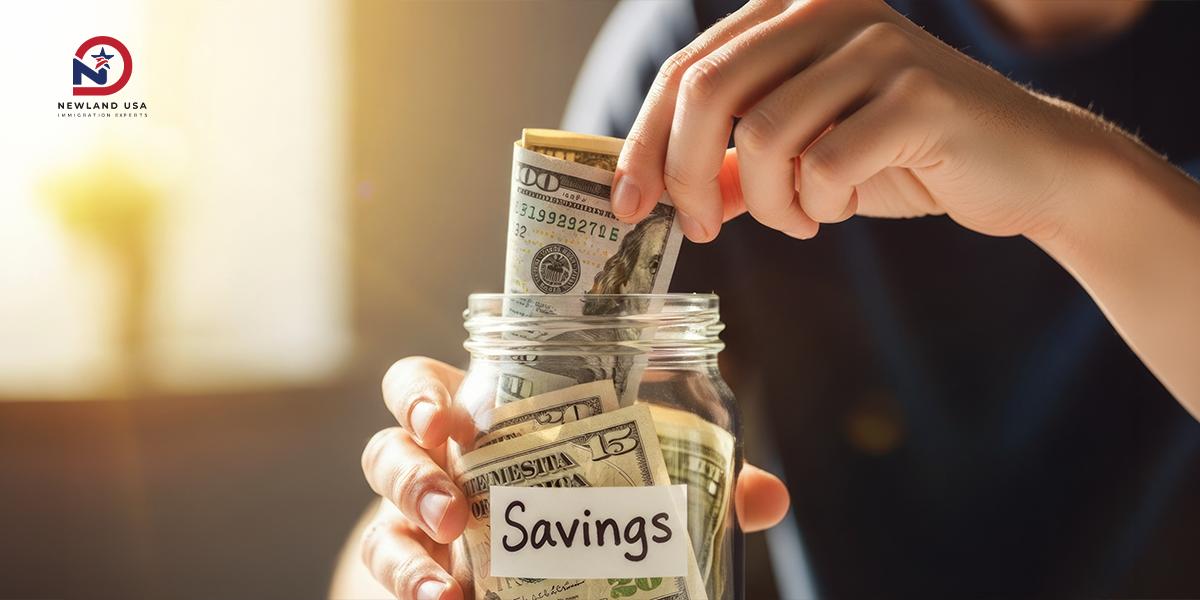
A Savings account is designed for long-term accumulation and is not meant for frequent transactions. This type of account offers a higher interest rate than a checking account, usually expressed as APY (Annual Percentage Yield). Some banks require you to maintain a minimum balance to waive the monthly maintenance fee.
Beyond those two basic types, permanent residents may also consider a Money Market Account, which offers a more attractive interest rate, or a Certificate of Deposit (CD) for funds that are not yet needed. For newly arrived EB-3 families, the smart strategy is to open both a checking account for daily life and a savings account to serve as an emergency fund, side by side.
3. Documents you need to prepare to open an account
Before heading to the teller, EB-3 permanent residents should have all their paperwork ready in order to shorten processing time and avoid multiple trips. Although each financial institution has its own policies, most U.S. banks ask for a fairly similar set of basic documents.
Personal identification documents are mandatory. Applicants need to bring a valid Vietnamese passport as their primary ID. In addition, the Permanent Resident Card (Green Card) serves as proof of lawful residency in the U.S. Some banks also ask for a second form of ID, such as a U.S. driver’s license (if you already have one), a health insurance card, or an international driving permit.
A personal tax identification number is an absolute must. For EB-3 immigrants, a Social Security Number (SSN) is the preferred choice. After entering the U.S., permanent residents usually receive their SSN by mail within the first few weeks. If you do not yet have an SSN, newcomers can use an Individual Taxpayer Identification Number (ITIN) — a personal tax number issued by the IRS — which many U.S. banks accept as a substitute for an SSN.
Proof of U.S. residential address is also a standard requirement. Commonly accepted documents include a rental agreement, a recent utility bill (electricity, water, internet), a bank statement, or a letter of residency from the landlord along with their own ID. Finally, permanent residents should prepare between $25 and $100 in cash for the initial deposit required to activate the account.
4. How to open a U.S. bank account – a detailed step-by-step guide
Knowing exactly how to open a U.S. bank account saves EB-3 immigrants a significant amount of time and helps avoid unnecessary mistakes. The procedure below is compiled from the guidelines of major financial institutions and applies to most cases of newly arrived permanent residents in 2026.
Step 1: Research and choose the right bank. Instead of picking a bank at random, EB-3 families should compare criteria such as monthly maintenance fees, minimum balance requirements, ATM network, the number of branches near their home, multilingual support capability, and international money-transfer features. Some major U.S. banks such as Bank of America, Chase, or Wells Fargo have the advantage of a network that spans all 50 states and offers multilingual customer service, which is a great fit for new immigrants.
Step 2: Prepare your full paperwork. As mentioned earlier, bringing all the necessary ID documents, proof of address, and tax identification will make the process go smoothly. Bank staff may ask for originals along with copies, so families should make photocopies of all documents in advance.
Step 3: Visit the nearest branch to apply in person. For new immigrants who do not yet have a U.S. credit history, most banks require you to open the account in person at the counter rather than online. This is also a good chance for the advisor to introduce a suitable service package and answer your questions in your native language, if the bank provides interpreter support.
Step 4: Complete the application and make the activating deposit. After your paperwork is approved, the permanent resident will sign the agreement to open the U.S. bank account and make the initial deposit. This amount typically ranges from $25 to $100, depending on the bank.
Step 5: Receive your debit card and set up online services. The physical card is usually mailed to your home within 7 to 14 days. While waiting, you should immediately sign up for online banking, install the mobile app, activate automatic bill pay, and link your account to services like Zelle for quick domestic transfers.
Step 6: Set up direct deposit with your employer. This is the final but extremely important step to make sure your paycheck goes straight into your account every pay period, and it also helps your family waive the monthly maintenance fee at many major U.S. banks.
5. Top U.S. banks that suit EB-3 immigrants
In the United States, EB-3 permanent residents have plenty of reputable U.S. bank options to choose from. Below are a few suggestions recommended by financial experts for newcomers in 2026.
Bank of America stands out with its vast branch network and, notably, accepts foreign passports and the ITIN for those who don’t yet have an SSN. The Advantage Banking account package offers flexible options, and the bank also provides interpreter services in over 200 languages — a major plus for the newly arrived Vietnamese community.
Chase Bank is highly regarded thanks to its user-friendly mobile app and huge ATM network. The Chase Total Checking account is a popular pick for newcomers, and the monthly maintenance fee can be waived when certain direct deposit conditions are met. Chase also accepts foreign passports when you go through the process of opening a U.S. bank account, which is very convenient for EB-3 worker families who do not yet have an SSN in those early days.
Wells Fargo has a long history of serving immigrant communities and offers multilingual support. The Everyday Checking account only requires $25 to open, and the monthly maintenance fee can be waived if you keep a minimum balance of $500 or set up direct deposit. The bank also has a presence in more than 20 countries, making international money transfers convenient when needed.
Capital One is worth considering for those who prioritize simplicity, with many accounts that don’t require a minimum balance. In addition, Citibank is a great fit for families who frequently send money internationally, thanks to its wide global network.
Beyond the big-name banks, local credit unions are also worth considering. These organizations usually charge lower fees, have more open-minded policies toward immigrants, and carry a stronger community-service spirit compared with commercial banks.
6. The connection between bank accounts and U.S. credit history
A common misunderstanding many EB-3 immigrants fall into is believing that simply having an account at a U.S. bank automatically gives them a U.S. credit history. In reality, ordinary checking and savings accounts do not directly affect your credit score. However, a bank account is the foundational building block that lets newly arrived permanent residents begin the journey of building a personal credit profile.
The U.S. credit score (FICO score) ranges from 300 to 850 and is tracked and evaluated by the three major credit bureaus: Experian, Equifax, and TransUnion. A score of 700 or above is considered good, and 800 or higher is excellent. For newcomers, the U.S. credit history usually starts at zero, and according to experts, it takes at least three months of steady financial activity before the system can calculate your first credit score.
To build up a U.S. credit history effectively after you have opened a U.S. bank account, EB-3 permanent residents can apply a few strategies. First is signing up for a secured credit card — a type of card that requires a cash deposit (typically $200 to $500) and uses that deposit as the credit limit. This is an ideal tool for people who do not yet have a U.S. credit history to start leaving a mark in the system.
The second strategy is to become an authorized user on the credit card of a family member or friend who has a good credit score in the U.S. This way, part of the cardholder’s positive history gets recorded in the new user’s personal profile. Another option is to use a service such as Experian Boost to have payments for electricity, internet, and streaming services counted toward your credit report.
On top of that, a credit builder loan from a credit union is also a useful tool. This loan works in the opposite way to a regular loan: the borrower makes monthly payments into a locked account, those payments are reported to credit bureaus, and once the loan is paid off, the borrower receives the full amount back along with a positive U.S. credit history.
7. Important notes when using a U.S. bank account
After completing the process of opening a U.S. bank account, EB-3 immigrants should keep a few things in mind to get the most out of the service and avoid unnecessary charges. First, pay attention to each bank’s fee structure. According to recent surveys, the average monthly maintenance fee on a checking account in the U.S. is about $13.95. Most U.S. banks allow this fee to be waived if customers set up direct deposit or keep the required minimum balance.
Next, users should watch out for hidden fees such as out-of-network ATM withdrawal fees, international wire transfer fees, foreign transaction fees (usually around 3%), and overdraft fees when your account goes negative. Setting up low-balance alerts through the app will help you avoid accidental overdrafts.
When it comes to security, users should absolutely never share their PIN, online banking login credentials, or OTP codes with anyone. Financial institutions in the U.S. will never ask customers to provide this information over the phone or by email. When using the mobile app, turn on two-factor authentication to add an extra layer of safety to your account.
Another point to note relates to tax filing: U.S. bank accounts that earn more than $10 in interest per year will receive a 1099-INT form from the bank, and this income must be reported when filing taxes. In addition, permanent residents who have bank accounts in Vietnam with a combined balance of $10,000 or more must file an FBAR annually as required by the U.S. Department of the Treasury.
Finally, after life has stabilized for 6 to 12 months, EB-3 worker families should review their current account and consider adding appropriate financial products such as a high-yield savings account, a 401(k) retirement account through their employer, or starting to invest in index funds. Each of these steps contributes to long-term financial stability in the U.S.
8. Conclusion
Opening a U.S. bank account is an essential first step on every EB-3 family’s settlement journey. Far more than just a place to store money, an account at a U.S. bank is also the key that unlocks the door to a U.S. credit history, helping your family access important financial services such as renting a home, buying a car, taking out a mortgage, and investing long-term. By mastering how to open a U.S. bank account, preparing complete paperwork, and choosing the right financial institution, EB-3 permanent residents can absolutely build a solid financial foundation from their very first days in America.
A successful immigration journey does not end with a green card — it is also measured by how well you integrate and by long-term financial stability. Think of opening a U.S. bank account as the very first investment in your family’s future in the United States.
Learn more:
- What Is an EAD Card? Latest 2026 Regulations for the EB3 Category
- EB3 Immigration to the US: Can Your Spouse and Children Come Along?
- Working at Medical Glove Factories in the USA: Salary, Benefits, and EB3 Green Card Opportunities
- How Much Does EB3 Skilled Worker Immigration to the US Cost? A Complete Financial Preparation Guide from A to Z
- Retrogression: What It Is and How It Affects Your EB3 Case
News Categories

Related news

Who Is the ESTA Program For? How to Assess Your Fit Before Applying in 2026

Who Is the ESTA Program For? How to Assess Your Fit Before Applying in 2026

From Motorcycle Mechanic to Automotive Technician in the U.S.: Skills and Qualifications to Prepare in 2026

AI in Auto Repair in the U.S. 2026: How Artificial Intelligence Diagnoses Vehicle Problems Faster and More Accurately

7 Key Technologies Every Industrial Maintenance Technician in the U.S. Needs to Know in 2026

PLC & Automation Skills: A Launchpad for Maintenance Technicians in the United States in 2026
What Is the ASE Certification? Requirements, Exam Roadmap, and Its Importance for Auto Technicians in the U.S. in 2026
EB5 Capital Recovery Time: How Long It Takes and the Key Milestones

Electric Vehicle Technicians in the U.S.: The “Golden” Skills Helping Vietnamese Auto Mechanics Get Ahead of the 2026 EV Trend