Why Choose EB3 U.S. Immigration Through the Medical Glove Manufacturing Industry in 2026?
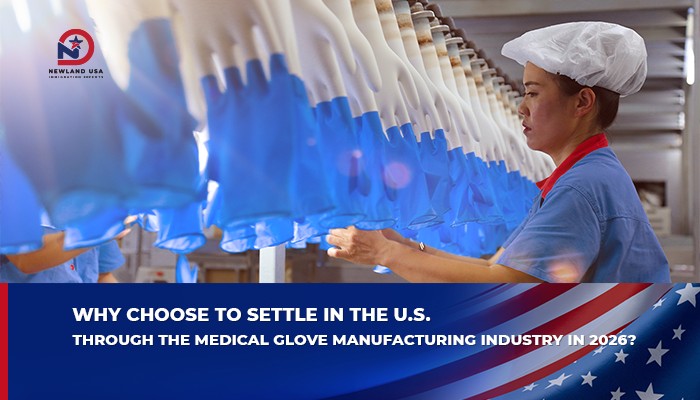
With the increased demand for medical gloves following the pandemic and the severe labor shortage in the U.S. medical equipment manufacturing industry, the EB3 U.S. immigration program through the medical glove manufacturing sector is opening up golden opportunities for Vietnamese workers. This article from Newland USA will provide a detailed analysis of this industry’s potential and the legal, stable immigration path through the EB3 program in 2026.
1. Overview of the Medical Glove Manufacturing Industry in the U.S.
The medical glove manufacturing industry in the U.S. is experiencing unprecedented strong growth. According to industry analysis data, the global medical glove market reached a value of over $10 billion and is expected to maintain sustainable growth over the next decade. The U.S. accounts for the largest consumption share with over 30% of the global market.
The COVID-19 pandemic completely changed the perception of medical safety and the importance of personal protective equipment. Demand for medical gloves not only surged during the crisis but has remained high afterward. Hospitals, clinics, medical facilities, laboratories, and even the food industry all require regular use of this product.
Notably, the U.S. government has recognized its excessive dependence on imported supplies, especially from Asian countries. The “reshoring” policy—bringing production back home—is being strongly promoted. Many new medical glove manufacturing plants are being built on U.S. soil, creating thousands of job positions that need to be filled urgently.
2. Why is the Medical Glove Manufacturing Industry a Golden Opportunity for EB3?
2.1. Massive Labor Demand
Medical glove manufacturing plants are facing severe labor shortages. According to the U.S. Bureau of Labor Statistics, the medical equipment manufacturing industry needs to add tens of thousands of workers in 2026. This is exactly why companies are actively seeking international labor through the EB3 program.
Unlike many other occupations that require advanced degrees or deep professional skills, the medical glove manufacturing field accepts workers with just 2 years of experience or equivalent qualifications. This suits the profile of many Vietnamese workers.
2.2. Attractive and Stable Wages
Workers in the medical glove manufacturing industry in the U.S. earn wages ranging from $20 to $29 per hour, equivalent to $3,500 to $5,200 per month. With overtime shifts, income can reach $6,000 – $6,500 per month. This figure is much higher than the average wage in Vietnam and is sufficient to cover living expenses, save money, and send remittances home.
In addition to base salary, workers enjoy benefits such as health insurance, dental insurance, vision insurance, paid vacation, paid holidays, and 401(k) retirement programs. Many companies also offer performance bonuses, year-end bonuses, and advancement opportunities for outstanding employees.
2.3. Standard Working Environment
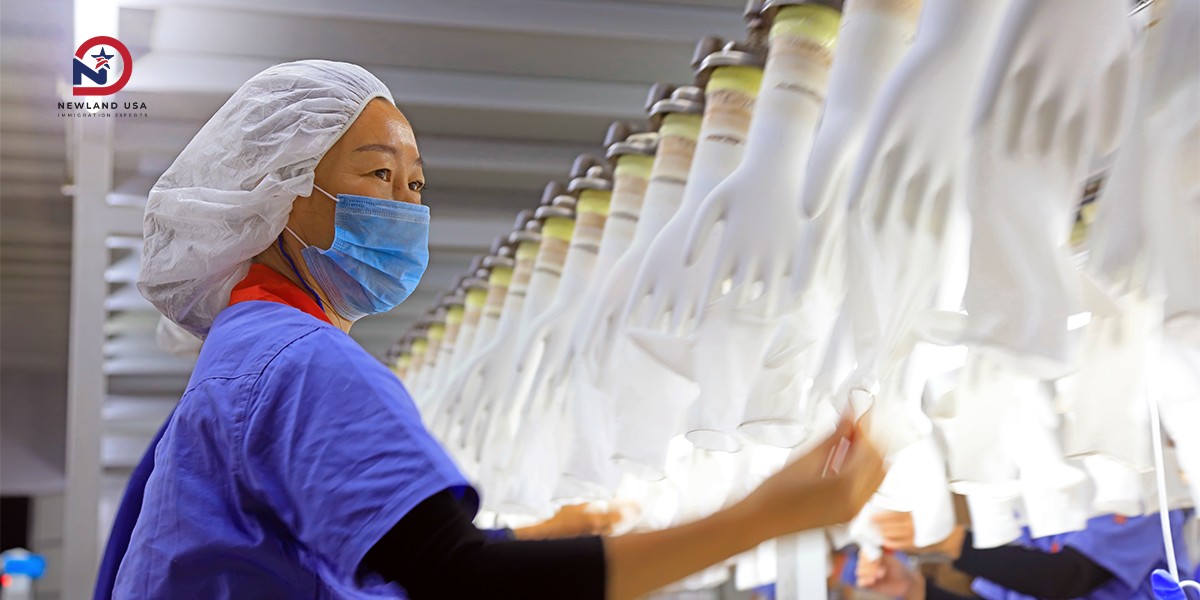
Medical glove manufacturing plants in the U.S. operate according to strict FDA (Food and Drug Administration) and ISO standards. The production environment must be clean, sterile, with tightly controlled temperature and humidity. Workers are fully equipped with protective gear and work in safe conditions.
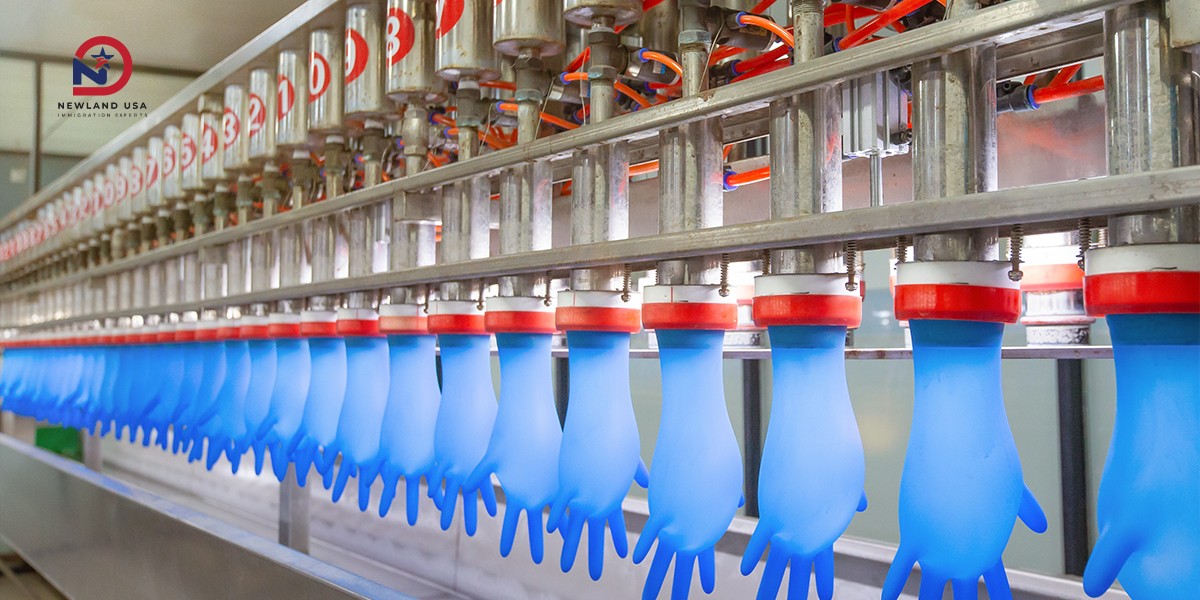
Unlike some heavy manufacturing industries, work in this field mainly involves operating machinery, quality inspection, packaging, and logistics. Many processes have been automated and don’t require excessive physical labor.
3. The EB3 Program – A Legal and Sustainable Immigration Path
3.1. What is the EB3 Program?
EB3 (Employment-Based Third Preference) is a U.S. employment-based immigration visa program under the third preference category. This is one of the most popular and feasible EB3 U.S. immigration paths for skilled workers.
The EB3 program is divided into three main categories: Skilled Workers, Professionals, and Other Workers. For positions in medical glove manufacturing, most fall under the skilled worker category, with minimum requirements of at least 2 years of relevant work experience or equivalent qualifications.
3.2. EB3 Application Process Through the Medical Glove Manufacturing Industry
Step 1: Find a Sponsoring Employer
The prerequisite for participating in the EB3 program is having a U.S. company willing to sponsor and commit to employment. Medical glove manufacturing companies are currently partnering with reputable immigration consulting firms to find international personnel. Newland USA is one of the leading organizations connecting Vietnamese candidates with U.S. employers in this field.
The employer will evaluate applications, interview candidates, and decide to sponsor the most suitable individuals. This process usually takes place remotely through video calls, so candidates don’t need to travel to the U.S. in the initial stage.
Step 2: Apply for Labor Certification (PERM)
After securing an employment commitment, the employer will apply for labor certification from the U.S. Department of Labor (DOL). This is an important step to prove that hiring foreign labor does not negatively impact the U.S. labor market and that no qualified U.S. citizens are available to take the position.
The PERM process requires the employer to conduct domestic recruitment steps according to regulations, including posting job advertisements, advertising in newspapers, posting notices at the workplace, and ultimately ensuring no qualified candidates are available in the area. PERM processing time typically ranges from 6 to 10 months.
Step 3: File Form I-140 (Immigrant Petition for Alien Worker)
Once the approved labor certification is obtained, the employer will file Form I-140 with U.S. Citizenship and Immigration Services (USCIS) to request a visa for the worker. Form I-140 proves the company’s financial capability and the legitimacy of the sponsored position.
Average I-140 processing time is 4 to 8 months. However, candidates can choose Premium Processing service with a higher fee to reduce the time to 15 business days.
Step 4: Wait for Priority Date
After I-140 approval, candidates will receive a priority date based on the PERM filing date. This factor determines when candidates can proceed with the next steps.
Good news is that according to the U.S. Department of State’s Visa Bulletin, waiting times for Vietnamese candidates have improved significantly. Many cases only need to wait 2 to 3 years.
Step 5: Interview at the Consulate and Receive Visa
When the priority date becomes current, candidates will receive notification from the National Visa Center (NVC) to submit Form DS-260 and necessary documents. After document review, candidates will be scheduled for an interview at the U.S. Consulate in Ho Chi Minh City.
The interview typically lasts 15 to 30 minutes, during which consular officers verify information, check document authenticity, and assess immigration intent. If approved, candidates will receive an immigrant visa and can enter the U.S. within 6 months.
Step 6: Entry and Receive Green Card
When entering the U.S. with an immigrant visa, candidates automatically become Lawful Permanent Residents. The Green Card will be mailed to the registered address within 2 to 4 weeks. From this point, workers officially start their jobs at medical glove manufacturing plants and build their new lives in the U.S.
4. Benefits of EB3 U.S. Immigration Through the Medical Glove Industry
4.1. Legal Stability
The EB3 U.S. immigration program provides permanent resident status from the beginning, without going through temporary visa stages. The Green Card allows candidates to live, work, and travel freely throughout U.S. territory. After 5 years as a permanent resident (or 3 years if married to a U.S. citizen), candidates have the right to apply for U.S. citizenship.
Unlike temporary visa programs like H-1B or L-1 with time limits and binding conditions, EB3 provides long-term peace of mind for both candidates and their families. There’s no worry about visa renewals, changing employers, or losing legal status.
4.2. Family Benefits
One of the greatest advantages of EB3 is that the primary applicant can bring their spouse and unmarried children under 21 years old. Spouses and children will also receive Green Cards like the primary applicant and don’t need separate work permits. Children will enjoy free public education from kindergarten through 12th grade and have opportunities to attend college with tuition rates similar to domestic students.
This is particularly meaningful for Vietnamese families who prioritize children’s education. The U.S. education system with world-class quality will open up bright futures for the younger generation.
4.3. Career Development Opportunities
Although EB3 candidates initially must work for the sponsoring employer, after a period (usually 1 to 2 years), they have the right to change jobs freely. With experience in medical glove manufacturing and related industries, workers can seek better positions, higher salaries, or even start businesses.
Many workers who started in production positions have advanced to supervisory roles, quality management, or equipment maintenance technicians with salaries ranging from $50,000 to $70,000 per year. Some entrepreneurial individuals have opened small businesses serving the community or participated in healthcare supply chains.
4.4. Social Security and Healthcare
As lawful permanent residents, EB3 program participants enjoy full U.S. social security benefits. They pay income taxes and social security taxes, in return receiving support programs when needed such as unemployment insurance, disability benefits, and social security retirement when elderly.
Although the U.S. healthcare system has high costs, through employer-provided health insurance, workers and their families don’t need to worry excessively about medical expenses. High-quality hospitals and clinics with modern equipment and skilled medical professionals will ensure everyone’s health.
5. Requirements and Conditions for Participating in EB3 Medical Glove Manufacturing
5.1. Education and Experience Requirements
For medical glove manufacturing worker positions, basic requirements typically include:
- High school diploma or equivalent
- At least 2 years of relevant work experience or related certificates
- Ability to work in shifts (including night and weekend shifts)
- Good health without serious conditions affecting work capacity
Some more specialized positions like quality inspection technicians or complex machinery operators may require vocational training certificates or specific experience. However, most employers are willing to provide internal training for new employees.
5.2. Health Requirements
All EB3 candidates must undergo health examinations by USCIS-designated facilities. The main requirement is not having dangerous infectious diseases like tuberculosis, syphilis, HIV, or other diseases that could endanger the community. Candidates also need all vaccinations required by the U.S. Centers for Disease Control and Prevention (CDC).
For the medical glove manufacturing industry, there are no special health requirements beyond the ability to stand and work for many consecutive hours. The temperature-controlled work environment is not overly harsh.
5.3. Language Requirements
Unlike many other visa programs, EB3 has no mandatory English proficiency requirements. However, basic English communication skills will be an advantage during interviews and adapting to the new work environment.
Many medical glove manufacturing companies have English learning support programs for international employees, helping them gradually improve language skills during work. Some factories have supervisors who speak Vietnamese or other languages to assist during the initial period.
5.4. Financial Requirements
EB3 candidates don’t need to prove personal finances since the employer will be responsible for sponsorship. However, candidates need to prepare funds for personal expenses such as:
- Immigration consulting service fees
- Document fees, notarization, translation
- Health examination costs
- Airfare and initial travel expenses
- Living expenses during the initial period in the U.S.
Total estimated costs range from $10,000 to $15,000 depending on the consulting company and specific situation.
6. Why Choose 2026 to Participate in EB3 Medical Glove Manufacturing?
6.1. Favorable Immigration Policies
2026 is predicted to be a favorable time for the EB3 U.S. immigration program due to immigration fluctuations in 2025. The U.S. administration is promoting programs to attract skilled workers to address labor shortages in many key industries, including medical manufacturing.
Administrative reforms are being implemented to shorten processing times and increase process transparency. This means candidates filing in 2026 may experience faster and more favorable processes compared to previous years.
6.2. Increased Industry Demand
The medical glove manufacturing industry is in a strong expansion phase. Many new factories are being built and production capacity is being upgraded to meet domestic and export demand. This trend is creating thousands of new job positions that need to be filled in 2026 and subsequent years.
Dependence on imported medical gloves from Asia has prompted the U.S. government to invest heavily in domestic production. Tax incentives, financial support, and protective policies are encouraging companies to expand operations, leading to high recruitment demand.
6.3. Less Intense Competition
Compared to some other industries in the EB3 program like agriculture or healthcare that already have many candidates, the medical glove manufacturing industry is still relatively new and not saturated. This means candidates have higher selection chances and faster processing.
Many companies are actively seeking immigration consulting partners to access quality international labor resources. This is a golden time for Vietnamese workers with immigration aspirations to seize opportunities before the program becomes more popular and fiercely competitive.

7. Important Considerations When Participating in EB3
7.1. Choose Reputable Consulting Partners
Choosing the right immigration consulting company is the determining factor for success. A reputable organization like Newland USA with many years of experience in EB3 and an extensive employer network will help candidates save time, costs, and avoid risks.
Be cautious of organizations making overly attractive promises, offering extremely low fees, or being unclear about processes. Request to see previous successful cases, clear contracts, and refund policies if unsuccessful.
7.2. Prepare Thorough Documentation
EB3 applications require many complex documents and certificates. Each error can lead to rejection or additional document requests, extending processing time. Investing time in preparing complete, accurate documents from the start will help the process go smoothly.
Important documents include degrees, certificates, employment contracts, pay stubs, reference letters from previous employers, passports, birth certificates, marriage certificates, and other legal documents. All must be notarized and translated into English by recognized translation agencies.
7.3. Be Patient with the Process
The EB3 U.S. immigration process can take 3 to 5 years depending on many factors. Candidates need patience and should maintain regular contact with the consulting company to update progress and provide information when needed.
During the waiting period, candidates should continue working steadily in Vietnam, accumulating experience and improving skills. Changing jobs too frequently or having long employment gaps can affect applications.
7.4. Mental Preparation
Immigrating to a new country is a major life turning point. Besides opportunities, candidates will also face challenges such as language barriers, cultural differences, and being away from family and friends. Strong mental preparation and concrete plans will make the adaptation process easier.
Joining Vietnamese community groups in the U.S., connecting with those who went before, learning English, and understanding American culture are good ways to prepare. Many large cities have large Vietnamese communities with restaurants, markets, temples, and support organizations.
8. Conclusion
The medical glove manufacturing industry is opening up golden opportunities for Vietnamese workers wishing to immigrate to the U.S. through EB3 in 2026. With massive labor demand, attractive wages, standard working conditions, and clear legal processes, the EB3 program through this field is a choice worth considering.
Newland USA, with the motto “Secure settlement – Choose prosperous life”, is ready to consult and support you in preparing documents and accompanying you throughout the EB3 U.S. immigration process through the medical glove industry. Contact Newland USA now via hotline 0785591988 or email: newsletter@newlandusa.asia for detailed and free consultation.
Learn more:
- What Factors Affect EB3 Immigration Processing Time to the United States?
- Why do many people give up on their EB3 application while it’s still being processed?
- 5 Common Misconceptions About the EB3 Program That Vietnamese People Often Make
- Long-Term Benefits of Settling in the US via EB3 Automotive Mechanic Visa
- Health Requirements for EB3 Immigration to the United States in the Medical Glove Manufacturing Industry
News Categories



Related news
Who Is the ESTA Program For? How to Assess Your Fit Before Applying in 2026

Who Is the ESTA Program For? How to Assess Your Fit Before Applying in 2026

From Motorcycle Mechanic to Automotive Technician in the U.S.: Skills and Qualifications to Prepare in 2026
AI in Auto Repair in the U.S. 2026: How Artificial Intelligence Diagnoses Vehicle Problems Faster and More Accurately
7 Key Technologies Every Industrial Maintenance Technician in the U.S. Needs to Know in 2026
PLC & Automation Skills: A Launchpad for Maintenance Technicians in the United States in 2026
What Is the ASE Certification? Requirements, Exam Roadmap, and Its Importance for Auto Technicians in the U.S. in 2026

EB5 Capital Recovery Time: How Long It Takes and the Key Milestones
Electric Vehicle Technicians in the U.S.: The “Golden” Skills Helping Vietnamese Auto Mechanics Get Ahead of the 2026 EV Trend