Should You Invest in an EB-5 Project Facing an RFE?
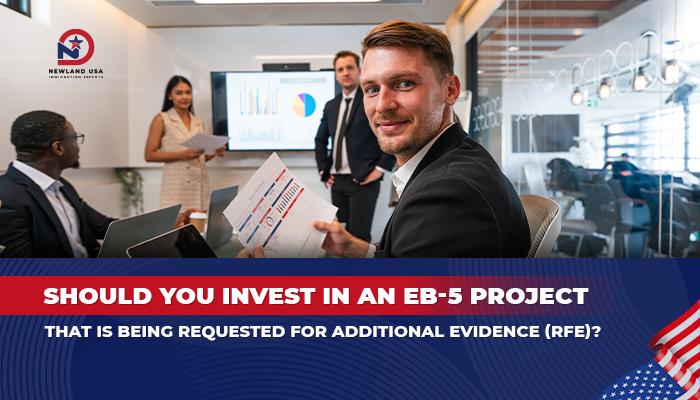
EB-5 projects offer international investors a fast path to U.S. residency. However, not all projects guarantee success in helping you obtain a U.S. green card. One of the most important factors to consider is whether the project is currently facing a Request for Evidence (RFE) from USCIS. This article from Newland USA will help you understand why an RFE is a warning sign and how to protect your investment and immigration goals.
1. What is RFE and why does it matter to EB-5 investors?
When participating in an EB-5 project, many people hope to obtain a U.S. green card in the shortest time possible. This program allows investors and their families to receive green cards faster than other current EB categories.
However, the success of your EB-5 application depends heavily on the quality and compliance of the EB-5 project you choose. If the project doesn’t fully meet USCIS standards, your application may be denied, which means losing your opportunity for U.S. residency.
RFE – short for “Request for Evidence” – is a document issued by USCIS requesting additional evidence when they discover deficiencies or have concerns about an EB-5 project’s application. This is not simply an administrative procedure but a warning signal indicating the project is facing documentation issues.
When an EB-5 project is facing an RFE, it means USCIS doesn’t yet trust the legality, feasibility, or transparency of that project. If you decide to invest in such a project, your EB-5 application will face the risk of prolonged delays or even complete denial.
2. Form I-956F: USCIS’s compliance control tool
To better understand RFEs for EB-5 projects, we need to learn about Form I-956F – a mandatory requirement following the EB-5 Reform and Integrity Act of 2022 (RIA).
The RIA was enacted to increase oversight and transparency for all EB-5 projects on U.S. territory. According to this law, each Regional Center must submit Form I-956F to obtain approval for each specific investment opportunity through an associated commercial enterprise.
The purpose of I-956F is to provide USCIS with a comprehensive picture of the EB-5 project, including:
- Detailed offering documents
- Partnership agreements and related contracts
- Business plan
- Projected economic impact analysis
- Background information on all individuals leading the project
- Disclosure of conflicts of interest (if any)
- Information about ongoing litigation
- Securities offering oversight policies
- Confirmation of full risk disclosure
Only after I-956F is submitted and approved by USCIS can an EB-5 project legally accept capital from international investors.
When you file Form I-526E (initial U.S. green card petition), the likelihood of approval depends largely on the status of I-956F. If the EB-5 project has had its I-956F approved by USCIS without any pending RFE, your investment and EB-5 application will be significantly safer.

3. When does USCIS issue an RFE for an EB-5 project?
USCIS may issue an RFE in various situations. Below are common reasons why an EB-5 project receives a request for additional evidence:
3.1. Project structure issues
According to regulations, the Job Creating Entity (JCE) must be completely separate from the Regional Center’s investment fund (New Commercial Enterprise – NCE). The business plan must demonstrate practical feasibility and how capital from investors will be used to create at least 10 jobs for each participant.
If the legal structure of an EB-5 project is too complex, lacks transparency, or cannot prove the ability to create sufficient jobs, USCIS will have legitimate grounds to issue an RFE.
3.2. Background check issues (I-956H)
Every individual with decision-making authority, control, or management of the fund must submit Form I-956H along with biometric fees. USCIS has a list of violations that disqualify someone from participating in an EB-5 project, including:
- Criminal or civil fraud convictions within the past 10 years
- Civil fraud violations with penalties exceeding $1 million
- Prison sentences exceeding one year
- Illegal activities such as drug trafficking, money laundering, terrorism
- Being on the Department of Justice’s disciplinary list or being penalized for securities fraud
Anyone with a criminal record within the past 10 years is not permitted to participate in Regional Center management under RIA.
3.3. Failure to file annual reports (I-956G)
Approved Regional Centers must submit Form I-956G – Annual Report – before December 29 each year to report all capital sources from the program. Failure to comply with this requirement may lead to an RFE.
3.4. Lack of transparency in cash flow oversight
USCIS requires EB-5 projects to have clear oversight mechanisms for how capital from investors is used. If the project cannot demonstrate transparent financial management or shows signs of misuse, an RFE will be issued.
RFEs are sent as Form I-797E, a variant of the I-797 Notice of Action. When an RFE is issued, the review process is suspended until the project submits all required documents.
Although an RFE doesn’t immediately mean denial, it reflects USCIS’s doubts about that application package. This raises major questions about the likelihood of success for your EB-5 application if you decide to invest in a project facing an RFE.
4. Risks of investing in an EB-5 project facing an RFE
Deciding to invest in an EB-5 project that is facing a request for additional evidence carries many serious risks that investors need to carefully consider.
4.1. Risk of losing U.S. green card opportunity
The primary goal of investors when joining the program is to obtain a U.S. green card for themselves and their family. However, if the EB-5 project cannot resolve the issues in the RFE, USCIS may deny I-956F approval.
The consequence is that your EB-5 application I-526E will face major difficulties in getting approved. Even if you’ve already filed, you may receive a denial notice, making your immigration plan impossible to continue and forcing you to start over from the beginning.
4.2. Loss of entire investment capital
If the EB-5 project doesn’t respond to the RFE within the deadline or cannot resolve the issues USCIS raised, the project may be removed from the program. In the worst-case scenario, investors not only lose the opportunity to receive a U.S. green card but also risk losing their entire invested capital.
Although you can reinvest in another EB-5 project, this process is time-consuming, effortful, and there’s no guarantee you’ll recover the money from the original project.
4.3. Prolonged delays
Even if the project eventually resolves the RFE, the process can take many months or even years. USCIS may issue multiple consecutive RFEs before making a final decision.
This means your immigration plan will be delayed indefinitely. If your child is approaching 21 years old, this delay could cause them to no longer qualify as a dependent on the U.S. green card petition.
4.4. Additional costs
While waiting for the RFE to be resolved, you may have to pay additional legal, consulting, and administrative fees. If your EB-5 application also encounters problems due to the project’s impact, the cost to remedy will increase even more.

5. Lack of transparency: The most dangerous sign
Among all the reasons why an EB-5 project receives an RFE, lack of transparency is considered the most dangerous sign that investors need to watch out for.
A reputable and fully compliant EB-5 project will always proactively disclose all important information. They’re willing to acknowledge any issues (if any) and explain in detail the risk mitigation measures to investors.
Conversely, if an EB-5 project hides information, avoids questions, or refuses to provide documents related to the RFE, this is a serious alarm signal. Such a project likely doesn’t have the ability to return capital to investors or help you achieve your goal of obtaining a U.S. green card.
If you directly ask the EB-5 project representative about the RFE status and they don’t respond immediately, evade, or provide vague reasons, you should reconsider your investment decision.
The reason is very simple: If a project isn’t willing to disclose the most basic information, how can they properly fulfill their fiduciary financial responsibility to you? And can you trust the quality of oversight and management from such a non-transparent project?
6. Important questions to ask before investing
To protect your investment and ensure your EB-5 application has the highest chance of success, ask the following questions before committing to any EB-5 project:
6.1. Is the project currently facing an RFE?
This is the most important question. Request written confirmation about the project’s RFE status. Written responses have much higher legal value than verbal statements.
6.2. If there is an RFE, what are the specific issues?
If the EB-5 project is facing an RFE, request a complete copy of the RFE document from USCIS. This document will clearly state the issues USCIS discovered and the explanations required.
6.3. How has the project responded to the RFE?
Request a complete copy of the RFE response that the project submitted to USCIS. An EB-5 project properly fulfilling its fiduciary duty will be willing to provide this information to prove they’re handling the issue seriously.
6.4. What is the deadline for responding to the RFE?
According to regulations, the EB-5 project is responsible for responding to the RFE within several days of receiving the notice. If the deadline is approaching and the project hasn’t responded or doesn’t have a clear plan, this is a warning sign.
6.5. Does the project have a history of previous RFEs?
An EB-5 project that has received multiple RFEs is a sign of systemic issues in management and compliance. Research the project’s history thoroughly before deciding.
6.6. How many investors have already joined this project?
If the EB-5 project already has many investors who joined before the RFE, find out what status their EB-5 applications are in. This will help you assess the actual impact of the RFE.
6.7. Does the project have a contingency plan?
A professional EB-5 project will have a contingency plan to protect investors’ interests in case the application is denied. Ask clearly about alternative options.

7. Conclusion
An RFE is not just an administrative procedure. It’s a signal that USCIS has doubts about the project’s compliance, feasibility, or transparency. Investing in an EB-5 project facing an RFE means accepting high risks regarding both immigration goals and finances.
However, if you still decide to proceed after careful evaluation, make sure that:
- The project is completely transparent and willing to provide all information in writing
- You have reviewed the complete RFE document and response
- You have independent legal counsel to assess the situation
- You fully understand and accept all possible risks
The ultimate goal of participating in the EB-5 program is to obtain a U.S. green card for yourself and your family safely and effectively. Don’t let haste or lack of information cause you to make wrong decisions that could affect your entire family’s future.
Newland USA, with our team of experienced specialists and the motto “Stable settlement – Lifelong prosperity,” is ready to advise and support clients on information related to the EB-5 investment program. Contact Newland USA immediately via hotline 0785591988 or email: newsletter@newlandusa.asia for detailed and free consultation.
Learn more:
- The Most Effective EB5 Visa Solution in the Context of Trump Launching Gold Card
- What is Form I-829? Guide to Filing a Petition to Remove Conditions on 2-Year Green Card for EB5 Immigrant Investor Program
- The Optimal Choice for EB5 Investors to Manage a Green Card Investment Project
- Paying Taxes and What EB5 Investors Need to Know
News Categories


Related news

From Motorcycle Mechanic to Automotive Technician in the U.S.: Skills and Qualifications to Prepare in 2026

AI in Auto Repair in the U.S. 2026: How Artificial Intelligence Diagnoses Vehicle Problems Faster and More Accurately
7 Key Technologies Every Industrial Maintenance Technician in the U.S. Needs to Know in 2026
PLC & Automation Skills: A Launchpad for Maintenance Technicians in the United States in 2026
What Is the ASE Certification? Requirements, Exam Roadmap, and Its Importance for Auto Technicians in the U.S. in 2026
EB5 Capital Recovery Time: How Long It Takes and the Key Milestones
Electric Vehicle Technicians in the U.S.: The “Golden” Skills Helping Vietnamese Auto Mechanics Get Ahead of the 2026 EV Trend
US Engineering & Maintenance Labor Shortage 2026: The Driving Force Behind the EB3 Skilled Workers Visa Policy
Industrial Maintenance Technician: Job Duties, Requirements & U.S. Immigration Opportunities in 2026