How Trump 2.0’s Tariff Policies Affect the EB-5 Program
The Trump administration’s new global tariff policies are creating waves of concern in the international investor community, especially those interested in immigration pathways through the EB-5 program. With tariffs widely applied to many countries, is the EB-5 Visa still a safe and viable option for families wanting to settle in the U.S.? This article from Newland USA will provide a comprehensive analysis of the potential impacts, opportunities, and challenges that investors need to understand before deciding to participate in EB-5 investment.
1. Current Tariff Policy Context Under the Trump Administration
The Trump administration has announced a series of tariffs applied to many trading partners globally. These measures are issued under the International Emergency Economic Powers Act (IEEPA), which grants the president authority to adjust trade transactions when facing national security threats.
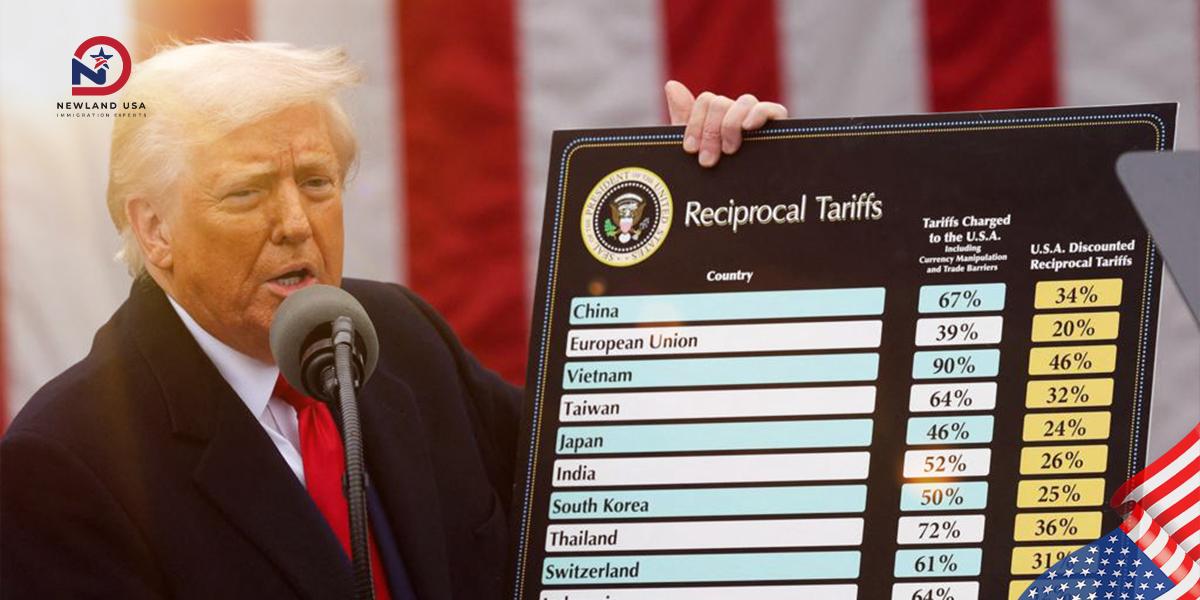
According to the White House statement, this policy aims to address imbalances in bilateral trade relations while dealing with issues such as drug trafficking, illegal immigration, and protecting domestic manufacturing. U.S. Trade Representative Jamieson Greer has publicly supported using IEEPA to rebalance economic relationships.
President Trump declared that these measures will generate trillions of dollars in tariff revenue over the next decade. Some experts have called these “immigration tariffs” because they are used as pressure tools to force countries to cooperate on border control.
The Brookings Institution predicts that by mid-May, additional tariff levels are likely to continue expanding to many other countries, creating a volatile global economic environment.
2. What is the EB-5 Program and Why Do Investors Care?
The EB-5 program is one of the most popular legal immigration pathways in the U.S., allowing foreign nationals and their families to obtain green cards through investment in job-creating projects in America. With a minimum EB-5 investment of $800,000 for Targeted Employment Areas (TEA), this program requires investors to create at least 10 full-time jobs for U.S. workers.
The EB-5 Visa offers many superior benefits compared to other visa types. Unlike employment visas that require employer sponsorship, the EB-5 program allows investors autonomy in their immigration decisions. Moreover, the green card from EB-5 investment opens doors for the entire family, including spouses and children under 21.
In the current unstable global economic context, many investors are seeking safety and stability for future generations. The EB-5 program not only provides legal residency rights but also opens opportunities to access world-class education, healthcare, and business environments.

3. Benefits of Tariffs for the EB-5 Program
Although the new tariffs create many challenges, they also bring some positive opportunities for the EB-5 program.
3.1. Increased Domestic Manufacturing Demand
The tariff policy is designed to protect domestic industry by making imported goods more expensive. This encourages businesses to shift manufacturing back to the U.S. or expand existing production facilities.
Since the core requirement of the EB-5 program is job creation, the boom in domestic manufacturing could lead to more attractive EB-5 investment projects, especially in rural areas or regions with high unemployment rates. These projects not only meet job creation criteria but also have better profit potential due to reduced competition from foreign goods.
3.2. Increased Attractiveness of the U.S. Market
International entrepreneurs and investors face higher costs when exporting to the U.S. due to tariffs. This may encourage them to consider relocating business operations to the U.S. through the EB-5 Visa.
Instead of bearing the tariff burden when exporting, entrepreneurs can establish businesses directly in the U.S., both taking advantage of the vast domestic market and achieving immigration goals for their families. This effect is particularly evident in countries subject to high tariffs such as China, Vietnam, and India.
3.3. Promoting Capital Source Diversification
In the volatile economic context, many Regional Centers have developed more flexible financial solutions to support investors. Some project sponsors are shifting to raising capital from the EB-5 program as supplementary financing to offset increased construction material costs due to tariffs.
This creates many new EB-5 investment opportunities for investors seeking suitable projects. However, investors need to be cautious with proposals that seem too attractive and always conduct thorough due diligence.
4. Potential Challenges EB-5 Investors Need to Note
Besides opportunities, the new tariffs also pose significant challenges for EB-5 program participants.
4.1. Project Cost Inflation
Most projects in the EB-5 program are related to real estate development. Applying tariffs to imported construction materials such as steel, aluminum, and other materials has significantly increased input costs.
Higher costs mean project budgets may exceed expectations, leading to delays. This directly affects the ability to meet job creation requirements on time for EB-5 investment, while reducing expected returns for investors.
Investors in the EB-5 program may face greater risks if projects don’t create the required number of jobs within the specified timeframe.
4.2. Reduced Liquidity
Global financial market volatility caused by tariffs has triggered stock market declines and currency devaluations in many countries, especially important markets like China, Vietnam, and India.
This economic environment erodes the net worth of many potential investors, making it more difficult for them to meet the minimum EB-5 investment of $800,000 plus related legal and administrative costs.
Unfavorable exchange rates can significantly increase the actual cost investors must pay when converting currency to U.S. dollars for EB-5 investment.
4.3. Project Sustainability Risks
EB-5 Visa projects that rely heavily on imported materials or have complex international supply chains may face serious difficulties. Tariffs not only increase costs but can also disrupt supply chains, affecting project completion timelines.
5. Can Trump Cancel the EB-5 Program?
A question many investors are concerned about is whether the EB-5 program could be suspended or replaced by new Trump administration initiatives.
In late February 2025, President Trump and Commerce Secretary Howard Lutnick publicly criticized the EB-5 program, arguing that the current investment level is too low relative to the value of a U.S. green card. They announced the idea of a “Golden Visa” – an alternative program requiring a $5 million direct contribution to the U.S. government.
However, legal experts believe the likelihood of the Golden Visa replacing the EB-5 program is extremely low. The main reason is that visa issuance and visa quota decisions fall under federal government authority, requiring Congressional approval through a lengthy and complex legislative process.
More importantly, the EB-5 Reform and Integrity Act of 2022 (RIA) established an important “grandfathering” clause. Under this, all EB-5 Visa applications filed before September 30, 2026, are guaranteed processing rights regardless of any future policy changes.
This means U.S. Citizenship and Immigration Services (USCIS) still has the responsibility to process these applications even if the EB-5 program is disrupted. Therefore, investors can confidently participate in EB-5 investment during this timeframe.
6. Strategies to Protect EB-5 Investor Interests
To minimize risks from tariff impacts and economic volatility, investors need to apply smart strategies when participating in the EB-5 program.
6.1. Diversify Project Capital Structure
Investors should avoid projects that depend entirely on EB-5 investment capital. Projects with various funding sources such as commercial bank loans, developer equity, or other funding sources will be less affected by tariffs and market volatility.
6.2. Choose Projects with Strong Financial Foundations
Thorough due diligence is the most important step. Investors need to verify that project sponsors have calculated scenarios for increased costs due to tariffs, raw material inflation, and other force majeure factors.
The best EB-5 Visa projects are those with clear contingency plans, adequate reserve capital, and experienced project development teams.
6.3. Focus on Recession-Resistant Industries
Prioritize projects in the EB-5 program belonging to industries focused on serving the domestic market, less affected by international trade. Sectors such as healthcare, education, community services, and infrastructure are typically less volatile than industries heavily dependent on imports and exports.
EB-5 investment projects with less dependence on imported materials or those with fixed-price material contracts are also safer choices in the context of volatile tariffs.
6.4. Seek Projects with Job Creation Buffer
Each investor in the EB-5 program must prove their investment creates at least 10 full-time jobs for U.S. workers. However, projects that create significantly more jobs than the minimum requirement will have a larger “safety buffer.”
For example, if an EB-5 Visa project is expected to create 15-20 jobs per investor instead of just 10, then even with delays or cost overruns due to tariffs, the project can still meet legal requirements.
6.5. Manage Exchange Rates and Capital Transfer Timing
Currency fluctuations due to tariffs and trade tensions can significantly increase the actual cost of EB-5 investment. Investors should closely monitor exchange rates and consider transferring capital when market conditions are favorable.
Using financial instruments such as forward contracts or structured money transfer services to lock in exchange rates can help protect investors from unforeseen volatility.

7. Future of the EB-5 Program Under Trump’s Term
Despite concerns about tariff impacts and controversial statements about the Golden Visa, the EB-5 program maintains its position as one of the most reliable legal immigration pathways to obtain a U.S. green card.
Many industry stakeholders, including project developers, Regional Centers, immigration attorneys, and business associations, fully understand the value that EB-5 investment brings to the U.S. economy. Capital from foreign investors not only creates jobs but also drives economic growth in areas needing development.
Concerns about fraud related to the EB-5 program have largely been addressed through the 2022 RIA Act, with more transparent regulations and stricter oversight. Completely canceling the EB-5 program would require a complex legislative process and is unlikely to pass in the current political context.
Experts predict that the EB-5 Visa will continue to be a viable option for families wanting to settle in the U.S. at least until June 30, 2026, when the RIA grandfathering clause remains in effect.
8. Conclusion
The Trump administration’s tariff policies create both challenges and opportunities for the EB-5 program. While project costs may increase and investor liquidity may be affected, increased domestic manufacturing demand and the attractiveness of the U.S. market open new opportunities.
With thorough preparation, smart project selection, and effective risk management strategies, EB-5 investment remains a reliable legal immigration pathway. The grandfathering clause until 2026 creates a safe timeframe for investors wanting to quickly secure their rights.
Newland USA, with a team of experienced experts and the motto “Stable settlement — Lifelong prosperity,” is ready to advise and support you with information related to the EB-5 investment program. Contact Newland USA today via hotline 0785591988 or email: newsletter@newlandusa.asia for detailed and free consultation.
News Categories


Related news

AI in Auto Repair in the U.S. 2026: How Artificial Intelligence Diagnoses Vehicle Problems Faster and More Accurately

7 Key Technologies Every Industrial Maintenance Technician in the U.S. Needs to Know in 2026
PLC & Automation Skills: A Launchpad for Maintenance Technicians in the United States in 2026

What Is the ASE Certification? Requirements, Exam Roadmap, and Its Importance for Auto Technicians in the U.S. in 2026

EB5 Capital Recovery Time: How Long It Takes and the Key Milestones

Electric Vehicle Technicians in the U.S.: The “Golden” Skills Helping Vietnamese Auto Mechanics Get Ahead of the 2026 EV Trend
US Engineering & Maintenance Labor Shortage 2026: The Driving Force Behind the EB3 Skilled Workers Visa Policy
Industrial Maintenance Technician: Job Duties, Requirements & U.S. Immigration Opportunities in 2026

Lương thợ sửa xe tại Mỹ: Cách tối ưu giờ công để nhân đôi thu nhập năm 2026