H1B Visa Program Changes and Opportunities for EB3 Program
With anticipated changes in the H1B Visa program under the new administration, thousands of skilled workers are seeking alternative solutions for US immigration. While the traditional lottery system of H1B Visa may be adjusted to prioritize salary levels, the EB3 program emerges as a stable and effective option for those looking to build a long-term future in the US.
1. H1B Visa Policy Changes
The H1B Visa program is facing fundamental changes that could have far-reaching impacts on the international workforce community. The new administration plans to comprehensively reform this temporary work permit mechanism, particularly focusing on changing the candidate selection method.
The current H1B Visa system relies on a completely random electronic lottery mechanism, without distinguishing skill levels or experience. Each year, USCIS receives over 700,000 registration applications against a quota of 85,000 visas, creating fierce competition.
The important adjustment expected in the coming period is that H1B Visa may apply priority criteria based on salary levels instead of random selection. This change aims to protect the interests of domestic workers and ensure only the most talented professionals receive work permits.
2. Impact of Reform on International Workers
2.1. Challenges for New Graduates
One of the groups most severely affected by the H1B Visa reform is international students and those newly entering the job market. According to the US Department of Labor’s salary classification, most new graduates only qualify for Level 1 or Level 2 – the lowest starting salary levels on the scale.
With a mechanism that prioritizes high salaries, these young candidates will face great difficulty competing with experienced professionals at Level 3 and Level 4. This creates a paradox: to get an H1B Visa, they need a high salary; to get a high salary, they need experience; but to get experience, they need a visa to work legally.
2.2. Impact on Businesses
Companies, especially startups and small to medium enterprises, will also face challenges when the H1B Visa program reform is implemented. These organizations often cannot afford to pay Level 3-4 salaries to new employees, despite having a need to recruit young talent with high development potential.
This could lead to large companies with abundant financial resources monopolizing the “supply” of H1B Visas, while small businesses lose opportunities to access international talent.

3. Economic and Social Consequences
3.1. Loss of STEM Human Resources
The H1B Visa program has long been the main supply source for STEM (Science, Technology, Engineering, Mathematics) workforce in the US. Limiting access for international students and young workers could cause shortages in these key sectors.
History has proven that many important scientific and technological breakthroughs were made by young immigrants. Reducing opportunities for this group could weaken America’s innovation capacity in the long term.
3.2. Global Talent Migration
As H1B Visa becomes harder to access, many international students and young professionals may turn to countries with more open immigration policies like Canada, Australia, or European nations. This could weaken America’s competitive position in the global talent race.
4. EB3 Program – A Sustainable Alternative Solution
4.1. Advantages of the EB3 Program
In the context where the H1B Visa program faces such important changes, the US immigration EB3 program emerges as a worthy consideration for workers. Unlike the temporary nature of H1B Visa, the EB3 program offers a long-term immigration path to the US through Green Card.
The EB3 program does not depend on lottery systems or specific salary levels, but focuses on meeting actual labor needs of the US market. This creates stability and certainty for both workers and employers.
4.2. Transparent and Fair Process
Another strength of US immigration EB3 is its transparent review process, based on clear criteria regarding education level, work experience, and hiring needs of US employers. Instead of relying on chance factors like the H1B Visa program, EB3 evaluates candidates based on actual capabilities.
4.3. Suitable for Many Industries
The EB3 program serves diverse fields from information technology, healthcare, education to manufacturing and services. This creates opportunities for many different groups, not just limited to STEM fields like H1B Visa.
5. Notes for International Workers
5.1. Reassess Immigration Strategy
The anticipated changes in the H1B Visa program require international workers to reassess their immigration strategy. Instead of focusing on just one path, exploring various options including US immigration EB3 will help increase chances of success.
5.2. Importance of Early Preparation
The EB3 program typically has longer processing times than H1B Visa, so starting preparation early is extremely important. Those interested should thoroughly research requirements, prepare complete documentation, and find suitable employers.
5.3. Professional Consultation
Due to the complexity of US immigration processes, seeking consultation from experienced professionals is necessary. Reputable immigration consulting companies can help assess individual situations and provide the most suitable roadmap.
6. Conclusion
Changes in H1B Visa do not mean the end of opportunities to work and immigrate to the US. On the contrary, this could be an opportunity for workers to learn more about the US immigration EB3 program – a more stable and sustainable path. The EB3 program with its diverse subcategories can meet the needs of many different groups, from professionals to general workers.
Newland USA, with a team of experienced experts and the motto “Secure settlement – Lifelong prosperity”, is ready to consult and support in preparing documents and accompany clients throughout the EB3 US immigration process. Contact Newland USA immediately via hotline 0785591988 or email: newsletter@newlandusa.asia for detailed and free consultation.
News Categories



Related news
Who Is the ESTA Program For? How to Assess Your Fit Before Applying in 2026

Who Is the ESTA Program For? How to Assess Your Fit Before Applying in 2026

From Motorcycle Mechanic to Automotive Technician in the U.S.: Skills and Qualifications to Prepare in 2026
AI in Auto Repair in the U.S. 2026: How Artificial Intelligence Diagnoses Vehicle Problems Faster and More Accurately
7 Key Technologies Every Industrial Maintenance Technician in the U.S. Needs to Know in 2026
PLC & Automation Skills: A Launchpad for Maintenance Technicians in the United States in 2026

What Is the ASE Certification? Requirements, Exam Roadmap, and Its Importance for Auto Technicians in the U.S. in 2026

EB5 Capital Recovery Time: How Long It Takes and the Key Milestones
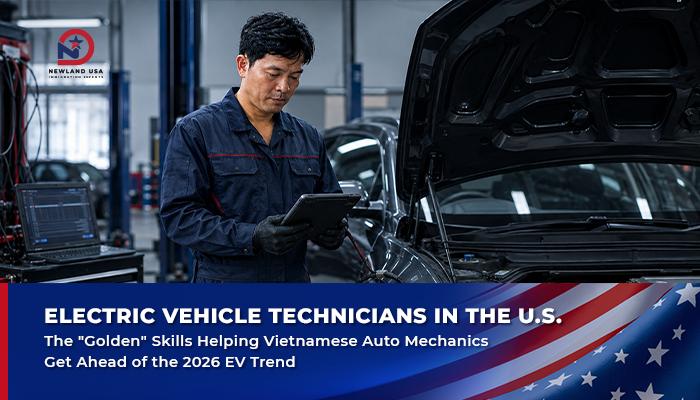
Electric Vehicle Technicians in the U.S.: The “Golden” Skills Helping Vietnamese Auto Mechanics Get Ahead of the 2026 EV Trend