Common Questions That Investors Face During EB-5 U.S. Immigration Interview
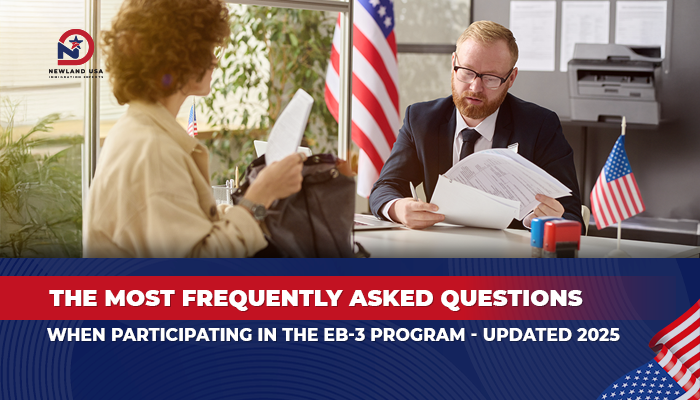
The EB-5 interview is a crucial stage in an investor’s U.S. immigration journey through EB-5. Mastering the common questions and preparing thoroughly will help investors confidently overcome this final challenge. This article by Newland USA will compile the most common questions that consular officers typically ask during EB-5 interviews, along with smart response suggestions to help you prepare optimally.
1. The Importance of the Interview in the EB-5 U.S. Immigration Process
The U.S. EB-5 immigration program is designed for foreign investors willing to contribute to the American economy by creating jobs for local workers. After the I-526E petition is approved and the priority date becomes current, the EB-5 interview at the consulate is the final step before receiving the green card.
Unlike other immigration categories, EB-5 interviews are particularly complex due to high requirements for financial transparency and the investor’s deep understanding of the EB-5 project they have chosen. Consular officers not only verify the authenticity of documents but also assess the applicant’s adaptability and genuine intention to immigrate.
According to statistics from EB-5 investment consulting centers, the success rate of EB-5 interviews can range from 85-95% depending on the investor’s level of preparation. This shows the importance of mastering information and practicing before the interview.
2. Questions About EB-5 Investment Projects
2.1. Basic Information About the Selected Project
Consular officers always begin with basic questions to assess the investor’s level of understanding about the EB-5 project they have chosen. Common questions include:
- “What specific EB-5 investment project are you participating in?” – This is a very important opening question. Investors need to answer with the exact project name, without confusion or vagueness.
- “Which regional center does this EB-5 project belong to and has it been approved by USCIS?” – This question checks understanding of the approved Regional Center and the project’s legality.
- “What is the specific geographic location of the project?” – Investors need to know clearly the state, city, and even specific address if possible.
- “What is the main business objective of the EB-5 project?” – Investors need to understand information about the project’s business sector.
To answer this group of questions well, investors should carefully review the Offering Memorandum (OM) and the I-526 filing submitted earlier. Consistency between statements and documents is the key factor.
2.2. Project Progress Status and Implementation
Officials are particularly concerned about the feasibility and implementation progress of EB-5 projects. They want to ensure that investors are not putting money into projects with high failure risks.
- “Have you completed transferring the EB-5 investment amount?” – This question verifies the fulfillment of financial obligations.
- “Where is your EB-5 investment currently being held?” – Usually, the money will be held in an escrow account until conditions are met.
- “Has the EB-5 project begun production and business operations?” – This is an important sign of the project’s viability.
- “What stage is the project’s current progress at?” – Investors need to update information from regular reports from the regional center.
Demonstrating understanding of project progress not only creates a good impression but also proves that the investor has conducted thorough research before deciding to make an EB-5 investment.
2.3. Job Creation Factor – Core of the EB-5 Program
One of the core requirements of the U.S. EB-5 immigration program is creating a minimum of 10 full-time jobs for local workers. Therefore, questions related to “job creation” are always prioritized in EB-5 interviews.
- “How many jobs is the EB-5 project expected to create?” – Investors need to know specific numbers from reports.
- “Are these jobs calculated using direct or indirect methods?” – Most EB-5 projects use indirect calculation methods through RIMS II or IMPLAN models.
- “Which entity will be responsible for auditing and verifying the number of jobs created?” – Usually reputable independent accounting firms.
- “In case the EB-5 project doesn’t achieve the job creation target, how will it be handled?” – This is a question about contingency plans and risk management.
To prepare for this group of questions, investors need to carefully study the economic impact report and clearly understand the job creation calculation method used in their EB-5 project.

3. Questions About Investment Capital Source
3.1. Origin and Legality of Capital Source
USCIS and U.S. consulates have strict requirements regarding the legality and transparency of EB-5 investment funds. This is the most thoroughly examined part of EB-5 interviews.
- “Can you describe in detail the source of the $800,000?” – This is an important question that every U.S. EB-5 immigration investor is asked.
- “How long did it take you to accumulate this money?” – The accumulation time needs to be reasonable and have clear evidence.
- “If the funds came from liquidating real estate, can you provide information about the transaction?” – Need purchase/sale contracts, property deeds, and documents proving legal transactions.
- “If this is inherited or gifted assets, what is the relationship between you and the giver?” – Need documents proving family relationship and legality of asset transfer.
The golden rule when answering this group of questions is to be completely honest and consistent with the I-526 filing submitted. Any contradiction could lead to requests for additional investigation.
3.2. Money Transfer Process to EB-5 Project
Tracking money flow from personal accounts to EB-5 projects is an important part of the verification process. Common questions include:
- “Through which banking system did you make the EB-5 investment?” – Need to list all intermediary banks if any.
- “How many money transfer transactions were there and what was the value of each transaction?” – Details of each money transfer need to be remembered accurately.
- “Has the EB-5 investment money been transferred to the project’s escrow account?” – Verify completion of financial obligations.
- “Did anyone else participate in the money transfer process?” – If there’s third-party assistance, need to clearly explain the reason and relationship.
Investors should prepare a detailed timeline of the money transfer process, including dates, amounts, banks, and purpose of each transaction.
3.3. Proof of Tax Obligations and Legal Income
An indispensable part of EB-5 interviews is proving that the income source used for EB-5 investment has been fully declared for tax purposes according to regulations.
- “What level of income tax have you paid in recent years?” – This figure needs to be commensurate with the ability to accumulate $800,000.
- “Do you have tax returns and confirmation from tax authorities about full tax payment?” – This is important evidence of income source legality.
- “What is your main source of income from?” – Could be salary, business, investment, or other sources.
- “Are there any documents proving income from work or business activities?” – Employment contracts, business financial reports, or other supporting documents.
Consistency between declared income levels and the ability to accumulate EB-5 investment money is the deciding factor for interview success.
4. Questions About Personal Information and Immigration Plans
4.1. Personal Information of the Main Investor
Besides financial and project issues, consular officers are also interested in the personal background of those wanting U.S. EB-5 immigration.
- “Can you introduce yourself and your current profession?” – This is an opening question to create a comfortable atmosphere.
- “Have you ever been to the U.S.? If so, under what type of visa?” – U.S. entry/exit history needs to be declared truthfully.
- “What is your educational background and work experience?” – This information helps assess adaptability in the U.S.
- “Have you ever been denied a U.S. visa?” – If yes, need to clearly explain the reason and changes in current circumstances.
Answering naturally and honestly will create a positive impression with the interviewing officer.
4.2. Information About Family and Accompanying Persons
The U.S. EB-5 immigration program allows investors to bring their spouse and unmarried children under 21. Therefore, family information is also given special attention.
- “How many people are in your U.S. EB-5 immigration application?” – This number must match the submitted DS-260.
- “What is your spouse’s profession?” – Information about the spouse’s occupation.
- “How old are your children and where are they studying?” – Particularly important for children approaching age 21.
- “Why do you want to bring your family for U.S. EB-5 immigration?” – Need to show positive aspects like education and development opportunities.
4.3. Immigration Plans and Development in the U.S.
The final part of EB-5 interviews usually focuses on future plans and the investor’s genuine intention to immigrate.
- “Why did you choose the U.S. EB-5 immigration path instead of other methods?” – Need to provide reasonable and convincing reasons.
- “When you come to the U.S., which state do you plan to live in?” – Should have specific plans about residence.
- “Do you plan to continue investing or doing business in the U.S.?” – Show commitment to contributing to the U.S. economy.
- “Do you have relatives or friends in the U.S.?” – If yes, this could be a positive supporting factor.
Showing clear immigration plans and long-term commitment will enhance the persuasiveness of the U.S. EB-5 immigration application.
5. Important Notes When Preparing for EB-5 Interviews
5.1. Thoroughly Research Project Information
Before the EB-5 interview, investors need to spend time meticulously researching the EB-5 project they have chosen. This includes mastering the project name, specific location, business objectives, implementation progress, and development entity. Moreover, clearly understanding the expected number of jobs to be created and calculation methods is also extremely important.
Investors should regularly follow update reports from the Regional Center to have the latest information about EB-5 project progress. This not only helps answer questions well but also demonstrates the concern and responsibility of a serious investor.
5.2. Prepare Transparent Financial Records
Proving the legal source of EB-5 investment funds is the deciding factor for success. Investors need to prepare complete documents such as bank statements, property purchase/sale contracts, tax returns, and other documents proving legal income sources.
Particularly, ensure consistency between information in the I-526 filing and what will be presented in the EB-5 interview. Any contradiction could cause suspicion and lead to undesirable results.
5.3. Practice Communication Skills
Although EB-5 interviews at the U.S. Consulate in Vietnam are usually conducted in Vietnamese with interpreter assistance, investors should still practice answering clearly and logically.
The important principle is to answer briefly, to the point, and avoid vague statements like “the lawyer handled everything” or “I don’t remember clearly.” Such answers could create a bad impression about the investor’s level of understanding and seriousness.
5.4. Appropriate Attitude and Attire
EB-5 interviews are formal occasions, so investors need to have a polite, confident but not arrogant attitude. Attire should be neat and formal, appropriate for the nature of the interview.
Arriving on time, bringing complete original documents, and showing cooperation throughout the process are also factors that contribute to creating a positive impression.
6. Post-Interview Process and Possible Outcomes
6.1. Possible Results
After the EB-5 interview, investors may encounter one of three situations:
Immediate Approval: This is the best result when all documents are complete and answers are convincing. The visa will be issued within a few business days.
Request for Additional Documentation (Administrative Processing 221g): In this case, the officer needs more information or documents to make a final decision. Investors need to cooperate quickly to provide what is requested.
Administrative Processing: Applied when security or financial checks are needed in more depth. This process can last from a few weeks to several months.
6.2. Monitoring Results and Responses
Investors should regularly check email and the CEAC (Consular Electronic Application Center) system to update application status. In case additional documents are requested, quick and complete responses will help shorten waiting time.
If results are not as expected, investors may consider re-filing after addressing the issues pointed out, or seeking advice from experienced U.S. EB-5 immigration specialists.
7. Conclusion
The EB-5 interview is an important milestone in each investor’s U.S. EB-5 immigration journey. Thorough preparation, clear understanding of the chosen EB-5 project, and proving the legality of EB-5 investment capital sources will be the key to success.
Newland USA, with an experienced team of specialists and the motto “Secure Settlement – Lifelong Prosperity,” is ready to advise and support clients with information related to the EB-5 investment program. Contact Newland USA immediately at hotline 0785591988 or email: newsletter@newlandusa.asia for detailed and free consultation.
News Categories


Related news
Who Is the ESTA Program For? How to Assess Your Fit Before Applying in 2026

Who Is the ESTA Program For? How to Assess Your Fit Before Applying in 2026

From Motorcycle Mechanic to Automotive Technician in the U.S.: Skills and Qualifications to Prepare in 2026

AI in Auto Repair in the U.S. 2026: How Artificial Intelligence Diagnoses Vehicle Problems Faster and More Accurately
7 Key Technologies Every Industrial Maintenance Technician in the U.S. Needs to Know in 2026
PLC & Automation Skills: A Launchpad for Maintenance Technicians in the United States in 2026
What Is the ASE Certification? Requirements, Exam Roadmap, and Its Importance for Auto Technicians in the U.S. in 2026
EB5 Capital Recovery Time: How Long It Takes and the Key Milestones
Electric Vehicle Technicians in the U.S.: The “Golden” Skills Helping Vietnamese Auto Mechanics Get Ahead of the 2026 EV Trend