US Engineering & Maintenance Labor Shortage 2026: The Driving Force Behind the EB3 Skilled Workers Visa Policy
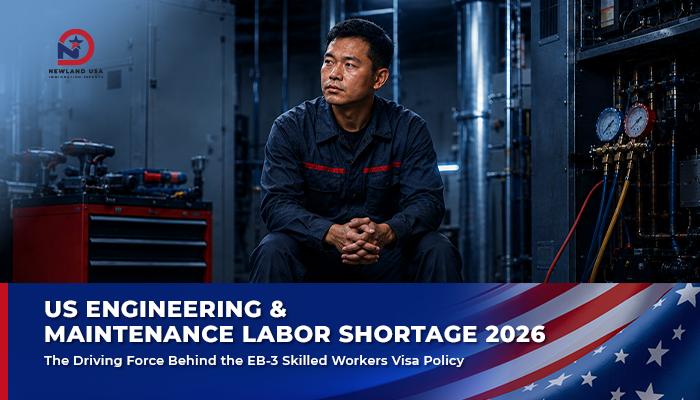
America is entering 2026 with a big paradox: more infrastructure, more factories, and more buildings than ever — but fewer and fewer people skilled enough to run and maintain them. The engineering labor shortage in the US and the maintenance worker shortage in the US are no longer distant forecasts; they’ve become a real economic pressure right now. Against this backdrop, the EB3 Visa — especially the EB3 skilled workers category — has emerged as one of the key legal tools helping American businesses fill their labor gaps, while also opening a path to US employment-based residency for thousands of international workers, including Vietnamese workers. This article from Newland USA breaks down the roots of this labor crisis and explains why it’s reshaping US labor visa policy.
1. The Big Picture: Just How Severe Is America’s Skilled Labor Shortage?
The scale of America’s skilled labor crisis is much bigger than most people realize. According to the latest research, by 2030 an estimated 2.1 million skilled labor positions could go unfilled. This number directly reflects how widespread the engineering labor shortage in the US has become.
Data from other sources reinforces this worrying picture. According to the Associated Builders and Contractors (ABC), the construction industry alone needs roughly 349,000 additional workers in 2026 alone. At the economy-wide level, the US Bureau of Labor Statistics (BLS) records about 649,300 openings per year in construction and extraction occupations — including retirements, career changes, and new positions created by growth.
The maintenance and manufacturing sector isn’t looking any brighter. There are currently over one million unfilled skilled labor positions nationwide, and this number is projected to triple by 2028. This is a clear sign of the maintenance worker shortage in the US, as factories, public utilities, and local governments all depend on technicians to keep operations running safely.
What’s notable is that demand isn’t shrinking — it’s actually growing. Projected job growth for key skilled trades is expected to hit 9.5% between now and 2034, far higher than the 3.1% average across all occupations. In other words, the US economy needs more skilled technicians while the supply keeps shrinking. This widening gap between supply and demand is exactly what’s driving growing interest in the EB3 Visa as a way to supplement the workforce.
2. Why Are Maintenance and Engineering Trades Facing a Labor Crisis?
The root cause of the engineering labor shortage in the US lies in demographics, not market demand. Three main factors are hitting at the same time.
The first is the wave of Baby Boomer retirements. According to the Population Reference Bureau, about 10,000 people from this generation reach retirement age every day, and an estimated 90% of them will have left the workforce by 2030. Long-tenured maintenance technicians largely belong to this group. Industry data shows more than 68% of operations and facility technicians are over 45, and 21% are still working past retirement age.
The second is the shrinking supply of young workers. The US birth rate has been below replacement level since 2007, thinning out the pipeline of workers coming up behind. The problem gets worse because young people tend to avoid skilled trades in favor of the traditional college path. The result is a serious mismatch: in 2025, roughly 600,000 major skilled-trade jobs were posted, but only 150,000 people entered the workforce through apprenticeship programs.
The third is a replacement rate that’s simply too low. A simple way to picture it, echoed by many sources: for every five workers who retire from construction, manufacturing, and skilled trades, only two new workers step in to replace them. McKinsey puts an even more alarming number on it, estimating up to 20 skilled job openings appear for every one new worker entering the field through 2032.
These three factors combine into what amounts to a “perfect storm.” This isn’t a problem that can be solved by raising wages or hiring more people domestically, because the labor supply itself has run dry at a structural level. It’s precisely this “can’t fix itself” nature that’s making legal labor import channels like the EB3 Visa a seriously considered option.

3. The Economic Cost of the Labor Gap
The labor gap doesn’t just create inconvenience for businesses — it creates measurable economic damage. According to a JLL report, the potential economic damage from the skilled labor shortage could reach $1 trillion per year. That’s an enormous figure, reflecting infrastructure that doesn’t get maintained on schedule, stalled projects, and eroding operational capacity.
Research by Deloitte and the Manufacturing Institute points in a similar direction specifically for manufacturing: the skills gap in US manufacturing could leave 2.1 million jobs unfilled by 2030, with potential damage to the economy reaching $1 trillion. Looking further out, Deloitte and the Manufacturing Institute forecast that manufacturing will need 3.8 million new workers by 2033.
At the company level, the costs are also significant. Constant staff turnover is costing companies over $5.3 billion a year in recruiting and training. On top of that, when companies are short-staffed, they’re forced to delay preventive maintenance, which leads to worse breakdowns and more expensive emergency repairs. Hiring time for specialized technical positions can now stretch to 60 days, and new hires need more than a year to reach full productivity.
With the cost equation this clear, recruiting skilled foreign workers through employment-based US immigration programs is no longer a backup plan — it’s becoming part of a long-term HR strategy. This context helps explain why the number of EB3 skilled workers sponsorship applications has been rising sharply in recent years.
4. What Is the EB3 Visa, and Why Has It Become the Answer to the Labor Shortage?
To understand why this policy is so closely tied to the labor crisis, you need to understand how the program actually works. The EB3 Visa (Employment-Based Third Preference) is an employment-based immigrant visa category, established under the Immigration Act of 1990, that allows US employers to sponsor foreign workers to become lawful permanent residents — in other words, to get a green card.
The program is split into three main categories. The Skilled Workers category is for people with at least two years of relevant experience or training; the Professionals category is for people with a US bachelor’s degree or a foreign equivalent; and the Other Workers category is for positions requiring less than two years of training or experience. Of these three, EB3 skilled workers is the segment most closely tied to the needs of the engineering and maintenance trades.
The key reason this visa type fits so well with the labor crisis lies in how it’s structured. Unlike EB-1 or EB-2 NIW, the EB3 Visa always requires an employer sponsor, a specific job offer, and a PERM labor certification in every case. In other words, the very process of applying for an EB3 Visa forces the employer to prove they genuinely couldn’t find a qualified American worker. This is exactly what makes the program a natural “fit” for the maintenance worker shortage in the US: wherever there’s a legally proven labor gap, the EB3 Visa can step in.
5. EB3 Skilled Workers: The Most Sought-After Group in Engineering & Maintenance
Among the three categories, EB3 skilled workers holds a particularly important place for the engineering trades. This category is for foreign workers with at least two years of relevant experience, education, or training, in jobs that are not temporary or seasonal in nature. Trades like electricians, automotive technicians, and industrial maintenance technicians all fall squarely into this group.
The fit between the EB3 skilled workers category and market demand is very clear. The most severely understaffed roles in manufacturing right now include CNC machine operators, maintenance technicians, and industrial electricians — all jobs that require skills built up over years, matching exactly the “at least two years of experience” threshold this category requires.
This creates a double advantage for skilled international workers. On one hand, they already have exactly the kind of skills the US market needs. On the other hand, they aren’t required to have a college degree the way the Professionals category demands, which significantly widens the pool of eligible candidates. For Vietnamese workers who already have a solid professional foundation in mechanics, electrical work, or maintenance, the EB3 skilled workers path is a practical route to an employment-based US green card.
That said, it’s worth being honest that “lower skill requirement” doesn’t mean “easier process.” Even though the training requirement is lower, the immigration process is still far from simple: the employer still has to complete the full labor certification procedure and meet prevailing wage standards. This is exactly why choosing an experienced consulting firm plays such a decisive role in a case’s success rate.

6. The PERM Process: Legal Proof of the Labor Shortage
If the EB3 Visa is the bridge, then PERM (Program Electronic Review Management) is its foundation. This is the mandatory first step, and it’s also where the connection between visa policy and the labor crisis shows up most clearly.
In essence, before filing a sponsorship petition, the employer must prove to the Department of Labor that no qualified, willing, and available American worker exists for that position — a process handled through the Department of Labor’s FLAG system. In other words, every approved EB3 Visa case is itself an official, legally valid piece of evidence that the engineering labor shortage in the US is real for that specific position. The employer has to publicly advertise the job, wait out the required time period, and only then file Form ETA-9089.
As for timing, workers need to mentally prepare for a long journey. As of early 2026, the Department of Labor is reviewing PERM applications filed about 16 to 17 months earlier, with average processing time around 503 days for standard cases. Once PERM is approved, the case moves on to filing Form I-140 and waiting for a priority date. Total time, by general estimates, ranges from 18 months to several years depending on various factors.
Precisely because the PERM process requires employers to “honestly declare” their labor gaps, the deeper the labor crisis gets, the more positions become eligible for sponsorship through the EB3 Visa. This is a direct cause-and-effect relationship: the labor shortage is the cause, and the flow of employment-based immigration cases is the result.
7. Opportunities for Vietnamese Workers in the EB3 Hiring Wave
For Vietnamese workers, one relatively good piece of news is that Vietnam falls under the “Rest of World” category in the Visa Bulletin system, meaning it doesn’t face the decades-long backlogs that countries like India or China deal with. Vietnamese workers have a priority date wait time similar to other countries in this group — roughly 18-24 months for the Skilled Workers category, counted from when the labor certification is approved.
More specifically, March 2026 Visa Bulletin data shows that the priority date for the EB3 Skilled Worker category for Vietnam is currently processing applications filed around January 2024, while the Other Worker category is running significantly slower. This shows that the EB3 skilled workers category not only matches market demand but also moves through the pipeline faster than the general labor category.
The total time for the entire EB3 Visa journey for Vietnamese workers, from filing PERM to receiving the green card, falls in the range of roughly 24-48 months. This is a stretch of time that requires patience and careful preparation, but in return you get a permanent resident card with long-term value, along with benefits extended to a spouse and children.
Given that America is still struggling with the maintenance worker shortage in the US and demand for technicians shows no sign of cooling down, the window of opportunity for skilled Vietnamese workers is fairly wide open right now. Workers with a solid professional background, basic English communication skills, and a well-prepared application will have a clear competitive advantage.

8. Policy Outlook and What Workers Need to Keep in Mind
Looking ahead, the demographic issues driving this crisis aren’t going to reverse anytime soon. With the US workforce projected to shrink by about 3.7% — nearly 5.9 million people — between 2025 and 2032, mainly due to the wave of older workers retiring, the need to bring in outside labor will likely continue for years to come. Immigration, as history has shown, has long been a stable supplementary source for the domestic workforce.
That said, workers should keep in mind that the US immigration policy environment is always shifting, and regulations can change from one period to the next. Priority dates in the Visa Bulletin can move forward, stay still, or even move backward (retrogression) depending on demand relative to quotas. So instead of chasing rumors, anyone interested in the EB3 Visa should stay closely tuned to monthly Visa Bulletin updates and consult a reputable advisory firm before making decisions.
Conclusion
The 2026 labor crisis in America’s engineering and maintenance trades isn’t a short-term blip — it’s the result of demographic shifts that have been building for decades. As the Baby Boomer generation leaves the workforce faster than young workers can replace them, the gap left behind is too large for the domestic market to fill on its own. The engineering labor shortage in the US and the maintenance worker shortage in the US have become, and continue to be, objective driving forces behind legal labor import policies — and EB3 skilled workers visas are one of the most prominent channels for that.
For skilled Vietnamese workers, now is a worthwhile time to look into this seriously. America’s labor gap is an immigration opportunity for those bold enough to prepare. What matters most is starting with accurate information and a clear roadmap, rather than pinning hopes on promises with no real basis.
Learn more:
- Industrial Maintenance Technician: Job Duties, Requirements & U.S. Immigration Opportunities in 2026
- Salary and Benefits of Automotive Technician Career in the USA through EB-3 Program
- Auto Repair Technician Shortage in the U.S.: A Golden Opportunity for EB3 Green Card Applicants
- Why Must You File Your EB5 Petition Before September 30, 2026? What Is the “Grandfathering” Benefit?
News Categories



Related news
AI in Auto Repair in the U.S. 2026: How Artificial Intelligence Diagnoses Vehicle Problems Faster and More Accurately
7 Key Technologies Every Industrial Maintenance Technician in the U.S. Needs to Know in 2026
PLC & Automation Skills: A Launchpad for Maintenance Technicians in the United States in 2026

What Is the ASE Certification? Requirements, Exam Roadmap, and Its Importance for Auto Technicians in the U.S. in 2026

EB5 Capital Recovery Time: How Long It Takes and the Key Milestones
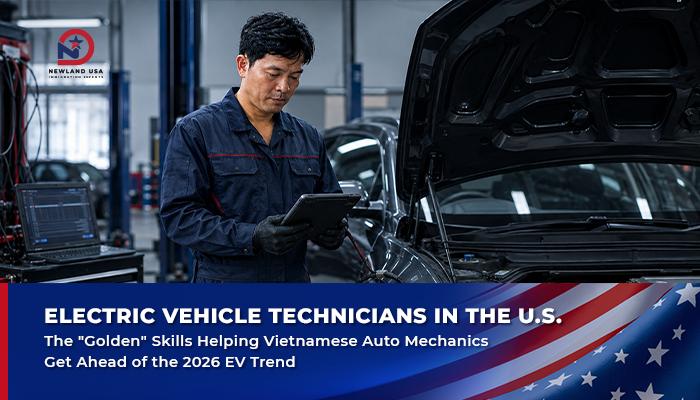
Electric Vehicle Technicians in the U.S.: The “Golden” Skills Helping Vietnamese Auto Mechanics Get Ahead of the 2026 EV Trend
US Engineering & Maintenance Labor Shortage 2026: The Driving Force Behind the EB3 Skilled Workers Visa Policy
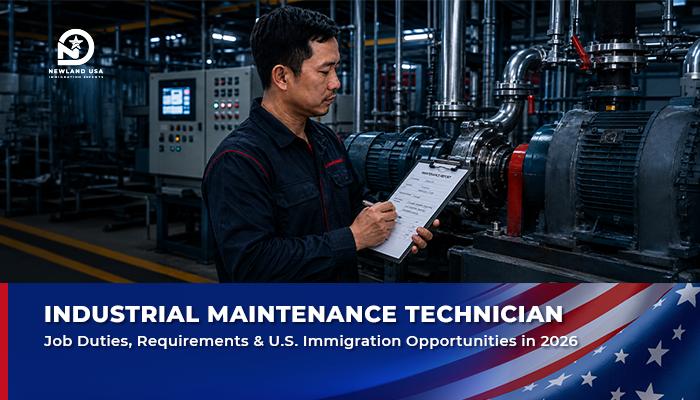
Industrial Maintenance Technician: Job Duties, Requirements & U.S. Immigration Opportunities in 2026

Lương thợ sửa xe tại Mỹ: Cách tối ưu giờ công để nhân đôi thu nhập năm 2026