Top US Supermarkets for Newly Settled Vietnamese in 2026: Where to Shop for the Best Prices and Convenience?
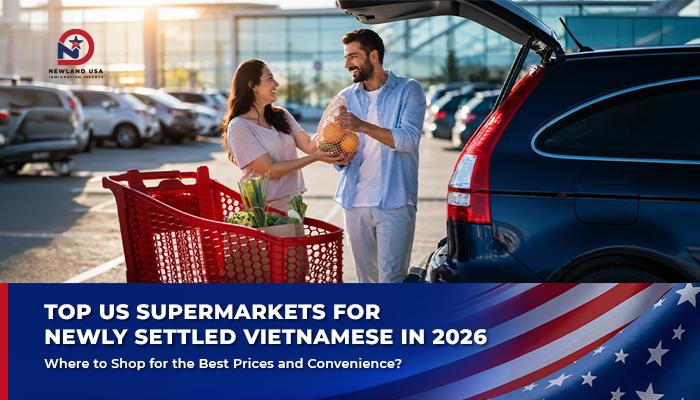
Setting foot in a new country, finding a place to buy daily food and essentials is one of the very first concerns for any family. The retail landscape in the US is incredibly diverse, ranging from budget-friendly chains spread across all 50 states to Asian markets brimming with the flavors of home. Understanding the characteristics of each model will help newly settled Vietnamese in the US optimize their living costs from the very first days. The following article from Newland USA will compile the most worthwhile US supermarkets to consider in 2026, sorted by price and convenience, to make your shopping in the US journey easier and more economical.
1. An overview of the US supermarket system
Unlike the traditional market model so familiar in Vietnam, food retail in the US is organized into clearly defined segments. Each chain serves a different customer group and a different spending need, so there isn’t a single “best” destination for everyone.
Broadly speaking, US supermarkets can be divided into four main groups. The first is the mainstream discount chains such as Walmart, Aldi, or Lidl, known for their low prices and wide coverage. The second is the warehouse clubs such as Costco and Sam’s Club, where goods are sold in bulk packages at attractive prices. The third includes mid-range and regional chains such as Kroger, Trader Joe’s, or Publix. Finally, there are the Asian markets and US supermarkets specializing in Asian goods, which have long been the familiar destination for the Asian-American community.
Choosing where to shop in the US depends on family size, budget, means of transportation, and especially taste preferences. A single person living in a small apartment will make very different choices from a four-person family with a car and a large refrigerator. Understanding the logic behind this segmentation is the first step for newly settled Vietnamese in the US to spend wisely.
2. Budget-friendly mainstream US supermarkets: Walmart, Aldi, Lidl
This is the segment many immigrant families turn to first, thanks to its affordable prices and nearly ubiquitous presence.
Walmart is the most familiar name and also the largest food retailer in the US, with about 4,600 stores covering every state. This is why professional reporting outlets chose Walmart as the benchmark for comparison in their 2026 price surveys. Walmart’s appeal lies in its “one-stop shop” model — where you can buy everything from vegetables, meat, and fish to household goods and clothing in a single trip. Thanks to its massive scale, the chain maintains consistently low prices and even offers curbside pickup, saving a significant amount of time.
Aldi tells a different story — one of streamlined efficiency. This German-origin brand is famous as one of the top affordable US supermarkets thanks to its strategy of cutting operating costs to the minimum. Aldi hardly sells major brand-name goods, instead focusing on its own private labels, and it maintains a minimal staff to keep prices low. According to a 2025 Consumer Checkbook survey, prices at Aldi are typically 30% to 40% lower than the market average. Items such as eggs, cheese, canned goods, or fresh herbs are particularly cheap here, making them well suited to the limited budget of the first days after arriving in the US.
Lidl, another discount chain also from Germany, is a worthwhile option for those living on the East Coast. According to a Consumer Reports price survey, a shopping basket at Lidl is on average about 8.5% cheaper than at Walmart, placing the chain among the lowest-priced retailers nationwide. Lidl’s strengths lie in fresh produce and essential goods. However, since its store network is concentrated mainly on the East Coast, consumers in other regions may not find a branch near home. In addition to the three names mentioned above, chains such as WinCo Foods or Save-A-Lot also frequently appear in lists of affordable US supermarkets in certain localities.
3. Wholesale clubs: Costco, Sam’s Club, and options for large families
If your family has three or more members and you have plenty of storage space, the wholesale club model is the most powerful “weapon” for saving money. These clubs charge an annual membership fee in exchange for some of the lowest unit prices on the market.
Costco consistently leads this segment. In the 2026 Consumer Reports survey, the average price at Costco was 21.4% cheaper than at Walmart, propelling it to the top spot for competitive pricing. Costco’s appeal also lies in its Kirkland Signature private label, known for high quality at a reasonable price. As for membership fees, the Costco Gold Star card costs $65 per year, while the Executive card is $130 and offers 2% cash back on eligible purchases. This cash-back amount is capped at $1,250 per twelve-month cycle. Beyond groceries, the membership card unlocks discounts at gas stations, pharmacies, and many other services — practical perks for a family just starting to settle in.
Sam’s Club, the wholesale chain owned by Walmart, is a direct competitor with a slightly “softer” membership fee. On May 1, 2026, Sam’s Club raised its basic Club card fee to $60 and the Plus card to $120 — the first adjustment in five years. The Plus card comes with perks such as 2% cash back on eligible purchases, early shopping hours, and free delivery for some membership tiers. A popular plus point is the Scan & Go feature, which lets you scan and pay with your phone, avoiding checkout lines. Overall, Costco is generally rated highly for its product selection and customer satisfaction, while Sam’s Club holds the advantage among customers who prioritize value and a lower entry-level fee. On the East Coast, you might also consider BJ’s Wholesale Club.
A tip for newcomers: try estimating your monthly spending before signing up for a card. Shopping in the US through the wholesale model is only truly “worth it” when you buy enough and use everything up before it spoils.
4. Mid-range and regional supermarket chains
Alongside the national brands, each region of the US has its own distinctive chains that newly settled Vietnamese in the US should get to know. This group strikes a balance between price, quality, and shopping experience.
Kroger is one of the largest systems, operating under many subsidiary brands such as Ralphs, Fred Meyer, or Smith’s across about 35 states. Kroger’s appeal lies in its fuel points loyalty program — earning rewards redeemable for gas discounts — along with many affordable private labels.
Trader Joe’s, on the other hand, is beloved by younger shoppers and those who enjoy discovering new things. Almost every product here carries the chain’s own label, which is why prices are kept reasonable. Trader Joe’s only raises prices when input costs truly rise, and it keeps costly advertising campaigns to a minimum.
In addition, depending on where you live, you’ll come across Publix in the Southeast, the well-known H-E-B in Texas, or Safeway and Albertsons in the West. Target is also a flexible option, selling food alongside household goods and clothing. These chains may not always be the cheapest, but they make up for it with clean spaces, fresh products, and frequent weekly promotions. Taking good advantage of weekly ads is a smart way to turn these mid-range US supermarkets into affordable places for shopping in the US.
5. Asian and Vietnamese markets: Preserving the flavors of home
For the Vietnamese-American community, no mainstream chain can replace the feeling of stepping into an Asian market filled with fish sauces, fresh herbs, noodles, and tropical fruits. This is at once a place to shop and a space of comfort for those feeling “homesick.”
99 Ranch Market is the leading name that newly settled Vietnamese in the US should remember. It is the largest Asian supermarket chain in the US. The first store opened in 1984 right in the Little Saigon community of Westminster, California, and today it has expanded to more than 50 branches stretching across many states including California, Nevada, Texas, Washington, New Jersey, and Oregon. Although strong in Chinese products, 99 Ranch still serves the diverse needs of East Asian communities, including the Vietnamese. Here, you can find purely Vietnamese ingredients such as water spinach, lotus root, and fermented sauces, along with a food court and bakery right inside the supermarket.
Beyond the two big chains, every area with a sizable Vietnamese community has its own invaluable local markets such as Viet Hoa, Hong Kong Market, Saigon Market, Seafood City, or Great Wall. Among them, some stores like Lion Supermarket mainly serve the Vietnamese community with fresh and diverse stock. The big advantage of these markets is that fresh herbs, fresh fish, and tropical fruits are typically much cheaper than at Western supermarkets, making them a distinctive group of affordable US supermarkets for people of Asian descent. For many families, shopping in the US is most fulfilling when combining Vietnamese markets for fresh food with the large chains for dry goods and household items.
6. Smart shopping tips for new immigrants
Knowing how to choose the right US supermarket is only half the story; knowing how to shop smartly is what brings lasting savings. Here are some practical pieces of advice.
First, prioritize store brands (also called private labels). Products carrying the supermarket’s own brand often have quality comparable to name brands but at noticeably lower prices, because they don’t carry the burden of elaborate advertising and packaging costs. Costco’s Kirkland or Walmart’s Great Value are classic examples.
Second, don’t overlook apps and loyalty programs. Walmart has Walmart Cash, Kroger has fuel reward points, and most large chains issue apps integrated with digital coupons. Comparing unit prices printed on shelf tags is also an important habit, helping you recognize which item is truly the cheapest. In addition, low-income families should look into the SNAP food assistance program (the EBT card); most major US supermarkets accept this form of payment.
Finally, buy dry goods and non-perishable essentials in bulk at wholesale clubs, while buying vegetables, fresh meat, and fish on a short-term basis at Vietnamese markets or discount chains. This allocation helps newly settled Vietnamese in the US take advantage of wholesale pricing while avoiding food waste.
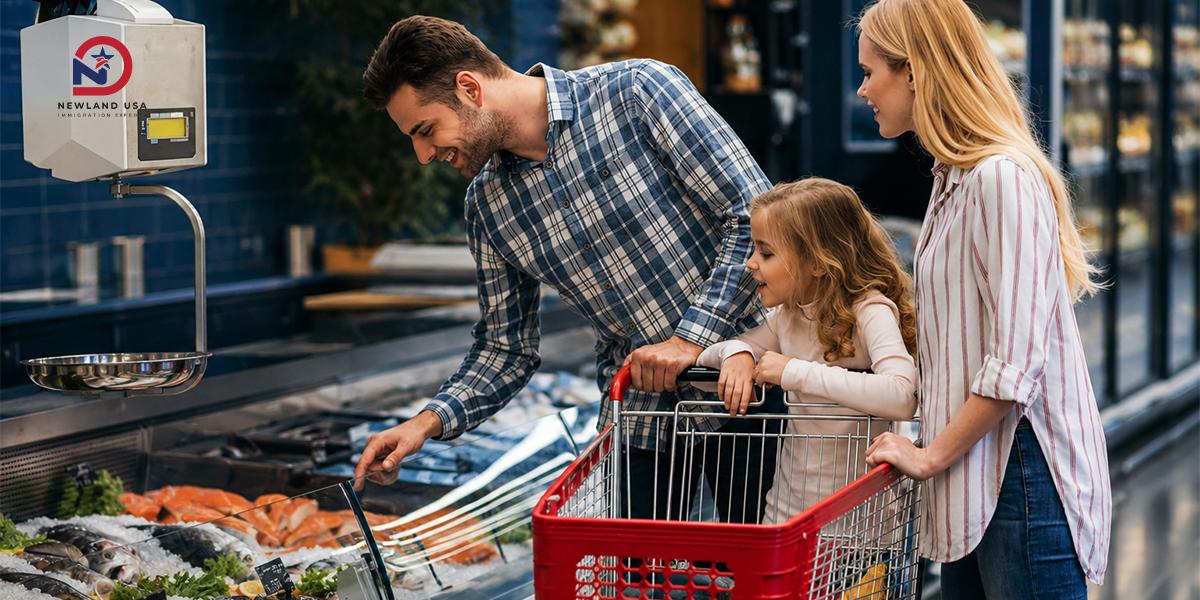
7. Choosing the right supermarket for each need
Once you’ve grasped the big picture, what’s left is figuring out the shopping in the US formula best suited to each family’s circumstances. There’s no one-size-fits-all answer, but here are a few directions to consider.
For singles or newly arrived couples, chains such as Aldi, Lidl, or Trader Joe’s are a sensible starting point thanks to their smaller portion sizes and friendly prices. For large families, combining a Costco or Sam’s Club membership with weekend trips to the Vietnamese market will deliver the greatest financial efficiency. And if you prioritize the flavors of home and fresh ingredients, 99 Ranch, H Mart, and local markets are always indispensable choices.
The most important thing is not to be afraid to experiment. In your first few months, try visiting different US supermarkets, jot down the prices of items your family frequently uses, and build your own optimal shopping routine. That’s how affordable US supermarkets and convenient local markets gradually become a familiar part of your new daily rhythm.
8. Conclusion
The US retail system, though vast and unfamiliar, is by no means difficult to navigate once you understand the characteristics of each store group. From mainstream discount chains like Walmart, Aldi, and Lidl, to the wholesale model of Costco and Sam’s Club, and of course the familiar Asian markets. When you know how to flexibly combine different US supermarkets together with simple money-saving tips, newly settled Vietnamese in the US can fully take control of their living costs while still preserving the flavors of home in every meal. See each shopping trip in the US not just as an act of spending, but as another steady step on the road to integrating into your new life.
Learn more:
News Categories



Related news
Who Is the ESTA Program For? How to Assess Your Fit Before Applying in 2026

Who Is the ESTA Program For? How to Assess Your Fit Before Applying in 2026

From Motorcycle Mechanic to Automotive Technician in the U.S.: Skills and Qualifications to Prepare in 2026

AI in Auto Repair in the U.S. 2026: How Artificial Intelligence Diagnoses Vehicle Problems Faster and More Accurately

7 Key Technologies Every Industrial Maintenance Technician in the U.S. Needs to Know in 2026

PLC & Automation Skills: A Launchpad for Maintenance Technicians in the United States in 2026

What Is the ASE Certification? Requirements, Exam Roadmap, and Its Importance for Auto Technicians in the U.S. in 2026

EB5 Capital Recovery Time: How Long It Takes and the Key Milestones

Electric Vehicle Technicians in the U.S.: The “Golden” Skills Helping Vietnamese Auto Mechanics Get Ahead of the 2026 EV Trend