7 Key Technologies Every Industrial Maintenance Technician in the U.S. Needs to Know in 2026
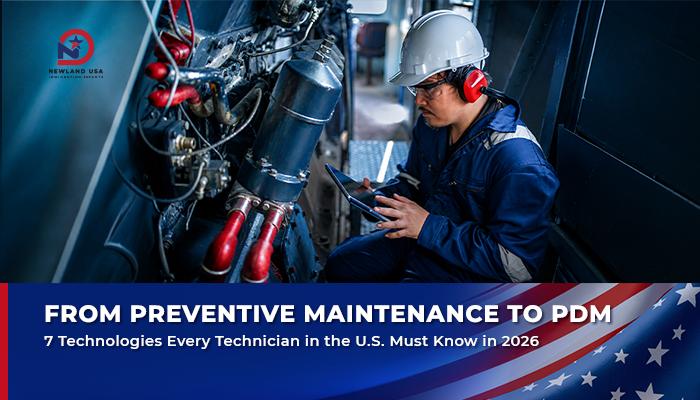
In factories, service shops, and commercial buildings across the U.S., the way machinery is maintained is changing much faster than before. The break-fix model and fixed maintenance schedules are gradually giving way to real-time monitoring of equipment condition and forecasting failures before they happen. For skilled workers — especially technicians in the U.S. in the automotive and industrial maintenance fields — this is both a challenge and a clear career opportunity. The article below from Newland USA sums up the journey from preventive maintenance to predictive maintenance (PdM) and the seven technologies a technician in the U.S. needs to master in 2026.
1. From reactive maintenance to PdM: why technicians in the U.S. need to keep up
To understand where predictive maintenance fits, it helps to look back at the four levels of maintenance. Reactive maintenance means fixing equipment after it has already broken down — the most costly approach, since it leads to unplanned downtime. Preventive maintenance schedules part replacement based on time or run-hours, for example changing oil every three months regardless of the machine’s actual condition. Condition-based maintenance and predictive maintenance go further: they rely on data generated by the equipment itself, stepping in only when a part actually shows signs of degrading. At the highest level, prescriptive maintenance doesn’t just flag when a machine will fail — it recommends a specific action, such as reducing load by 15% before scheduling a replacement.
In short, predictive maintenance is a method that uses real condition data to determine when maintenance is needed, instead of following a fixed schedule. The core concept here is the window of time between when a hidden fault first starts to show and when the equipment actually stops working. Condition monitoring technologies are very good at supporting this window, giving the maintenance team anywhere from several weeks to several months to prepare, while also estimating the equipment’s Remaining Useful Life (RUL).
The labor market backdrop makes this skill even more valuable. According to the BLS, the group covering industrial machinery mechanics, machinery maintenance workers, and millwrights is projected to grow 13% between 2024 and 2034, much faster than the average across all occupations, with about 54,200 openings needed each year. The median pay for this group was $63,510 per year as of May 2024. Per the report, the BLS states that employment is expected to grow by about 8% through 2034, with roughly 40,100 new openings a year, while most of the demand comes from the wave of retirements. A report from Deloitte and The Manufacturing Institute estimates that U.S. manufacturing will need about 3.8 million workers by 2033, of which nearly 1.9 million positions are at risk of going unfilled, and roughly three-quarters of that demand comes from replacing retiring workers. This gap is exactly the opportunity for a technician in the U.S. who has the skills and knows how to work with data.
2. Skill #1: IoT sensors and real-time condition monitoring
The foundation of predictive maintenance is data, and data starts with IoT sensors. Sensors mounted on motors, pumps, compressors, or gearboxes continuously measure vibration, temperature, pressure, and current, then send that data to an analysis system. As a result, equipment is no longer checked only during periodic manual rounds — it’s monitored continuously, even outside working hours.
One point worth noting for technicians in the U.S. is that you don’t need to replace all your machinery to get started. Many industry reports note that the average age of U.S. industrial equipment is around two decades, and add-on sensors can be fitted to older machines without needing replacement. Edge computing processes data right at the source, enabling very fast response times — ideal for critical assets where every millisecond counts. For an industrial maintenance technician, reading and understanding sensor data streams is becoming just as fundamental a skill as knowing how to use a multimeter.

3. Skill #2: Vibration Analysis
Vibration analysis is one of the oldest and most effective techniques for catching early-stage faults in rotating equipment. Every running machine produces vibration; when a shaft becomes misaligned, unbalanced, when bearings wear down, or gears develop abnormal behavior, the vibration signature changes. By measuring vibration amplitude and frequency, a technician can pinpoint which component is having trouble and how serious the issue is.
This is a non-invasive technique that can cover most of the machinery in a plant, and it’s usually the first step when a technician in the U.S. rolls out a condition monitoring program, since it can catch many different types of mechanical faults. Based on a roundup of technical sources, vibration analysis can typically flag bearing failures about one to six months in advance. Its limitation is that it becomes less effective on slow-turning equipment, where the fault signal is weaker and easier to misread. Mastering this industrial maintenance technician skill helps workers shift from reactive repair work to proactive planning.
4. Skill #3: Infrared Thermography
Infrared thermography uses a thermal camera to read the heat distribution across the surface of equipment and spot unusual hot spots. Rising temperature is often an early warning sign of a loose connection, overload, phase imbalance, corrosion, or poor lubrication. Because it’s a non-contact method, a technician can scan equipment while it’s still running, without needing to shut down production.
This technology is especially useful for electrical systems: a single camera scan can cover an entire electrical panel in a few seconds, instead of placing a contact probe at each point individually. For an industrial maintenance technician working in a plant, on distribution panels, or with motors, this is the first line of defense against fire hazards and unplanned downtime.
5. Skill #4: Ultrasonic Analysis and Lubricant Oil Analysis
Ultrasonic analysis detects high-frequency sounds produced by friction, leaks, or electrical arcing that the human ear can’t hear. Its strength is very early warning: this technique can pick up on poor lubrication — the leading cause of failure — even before any actual mechanical damage occurs. Because of this, ultrasonic testing is often regarded as one of the earliest-warning condition monitoring technologies.
Complementing ultrasonic testing is lubricant oil analysis. By sampling and testing the oil, a technician can infer what’s happening inside the machine: an increase in the size and quantity of metal particles in the oil indicates internal wear, while the analysis also reveals contaminants that reduce lubrication effectiveness. Industry data suggests oil analysis can detect signs of failure three to twelve months in advance. When vibration, thermal, ultrasonic, and oil analysis are combined, a predictive maintenance program can catch most mechanical and electrical faults many months before a serious failure occurs. This group of industrial maintenance technician skills carries high value in the labor market.

6. Skill #5: Artificial Intelligence and Machine Learning in Predictive Maintenance
If sensors are the senses, then artificial intelligence and machine learning are the brain of predictive maintenance. Machine learning models compare live readings against a baseline for the equipment, flag anomalies, and automatically identify the likely type of fault. Unlike earlier solutions that could only detect anomalies, today’s models can forecast failures weeks in advance.
The numbers show just how mature this technology has become. One industry guide notes that forecast accuracy has risen from around 70% in 2020 to 94% in 2026. That said, there’s still plenty of room for adoption: according to MaintainX’s 2026 maintenance trends report, about two-thirds of maintenance teams plan to adopt AI this year, but only 32% have implemented it partially or fully. The next step is prescriptive maintenance, where the system doesn’t just tell you a machine will fail but recommends what to do about it. For a technician in the U.S., knowing how to interpret AI-generated results and tell real alerts apart from false alarms is becoming a direct competitive advantage.
7. Skill #6: CMMS Maintenance Management Software
Data and forecasts are only useful once they’re turned into action, and that’s the role of CMMS (Computerized Maintenance Management System). This software takes in sensor signals, applies analysis, automatically generates work orders, manages spare parts, assigns technicians, and produces reports. When a predictive maintenance alert comes in, the CMMS can generate a repair order complete with diagnosis, the person responsible, needed parts, and an estimated timeframe — replacing what used to be a manual process.
Market trends reflect just how important this role has become. The CMMS market was valued at about $1.38 billion in 2024 and is projected to reach $3.55 billion by 2034, with a growing share of work orders being created and processed on mobile devices. For this reason, many sources consider CMMS proficiency an essential industrial maintenance technician skill, on par with traditional mechanical skills. An industrial maintenance technician who can read CMMS analytics and log data thoroughly directly improves the accuracy of the entire program.
8. Skill #7: Digital Twins and Augmented Reality
Two technologies shaping the near future are digital twins and augmented reality (AR). A digital twin is a virtual model that mirrors a real piece of equipment in real time, allowing teams to simulate how the machine behaves under different operating conditions and run failure scenarios even before the equipment has ever actually failed. This lets maintenance teams test out an approach before touching the real machine.
Augmented reality brings digital information directly into a technician’s field of view. Through a tablet or smart glasses, a worker can see diagrams, step-by-step instructions, repair history, and sensor readings displayed right on the equipment itself. According to PTC’s industry benchmark, AR-guided instructions cut task completion time by about 32% and reduce operational errors by about 40% compared to paper documentation. Amid the labor shortage, AR also allows remote experts to provide direct support, helping a new technician in the U.S. handle complex procedures and shortening training time.

9. The industrial maintenance technician skill set needed for 2026
These seven technologies paint a picture of a profession in transformation. The successful worker today is no longer just someone who turns a wrench, but someone who solves problems using data. The industrial maintenance technician skill set for 2026 therefore spans three layers: a solid foundation in mechanical and electrical fundamentals; digital capabilities such as reading sensor data, using a CMMS, and interpreting analytical results; and a mindset of continuous learning to keep up with new technology.
10. Conclusion
The journey from preventive maintenance to predictive maintenance isn’t a sudden replacement — it’s a process of layering on new capabilities one at a time. Sensors, vibration analysis, thermal imaging, ultrasonic testing, oil analysis, AI, CMMS, digital twins, and augmented reality all come together into a single, unified ecosystem, one in which people still play the central role. High demand for labor combined with a wave of retirements is opening up a clear gap, and the people equipped to fill that gap are technicians who have both the hands-on skills and the ability to work with data. For a technician in the U.S. in the automotive and industrial maintenance fields, 2026 is the right time to proactively build up these technologies and turn that skill set into a lasting career advantage.
Learn more:
- PLC & Automation Skills: A Launchpad for Maintenance Technicians in the United States in 2026
- US Engineering & Maintenance Labor Shortage 2026: The Driving Force Behind the EB3 Skilled Workers Visa Policy
- Industrial Maintenance Technician: Job Duties, Requirements & U.S. Immigration Opportunities in 2026
- What Is the ASE Certification? Requirements, Exam Roadmap, and Its Importance for Auto Technicians in the U.S. in 2026
News Categories



Related news

AI in Auto Repair in the U.S. 2026: How Artificial Intelligence Diagnoses Vehicle Problems Faster and More Accurately
7 Key Technologies Every Industrial Maintenance Technician in the U.S. Needs to Know in 2026
PLC & Automation Skills: A Launchpad for Maintenance Technicians in the United States in 2026
What Is the ASE Certification? Requirements, Exam Roadmap, and Its Importance for Auto Technicians in the U.S. in 2026

EB5 Capital Recovery Time: How Long It Takes and the Key Milestones
Electric Vehicle Technicians in the U.S.: The “Golden” Skills Helping Vietnamese Auto Mechanics Get Ahead of the 2026 EV Trend
US Engineering & Maintenance Labor Shortage 2026: The Driving Force Behind the EB3 Skilled Workers Visa Policy
Industrial Maintenance Technician: Job Duties, Requirements & U.S. Immigration Opportunities in 2026

Lương thợ sửa xe tại Mỹ: Cách tối ưu giờ công để nhân đôi thu nhập năm 2026