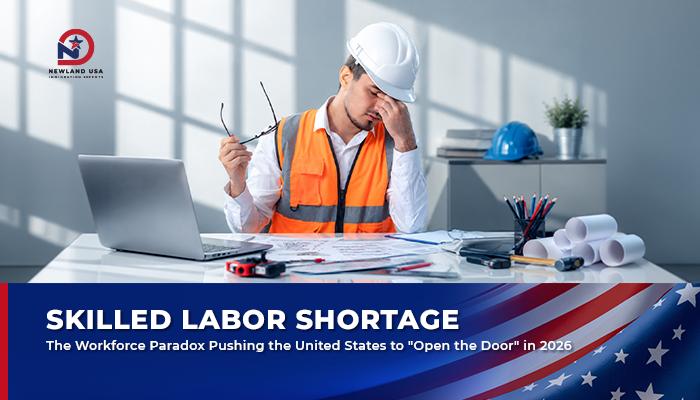
Skilled Labor Shortage: The Workforce Paradox Pushing the United States to “Open the Door” in 2026
The United States is facing a striking paradox: unemployment stays low, yet millions of job openings still can’t find anyone to fill them. The skilled labor shortage in the U.S. is no longer a distant forecast — it has become a reality shaping many key sectors of the economy in 2026. As the domestic skilled workforce shrinks due to an aging population and falling birth rates, the fact that the U.S. is short on workers is forcing businesses and policymakers to look abroad to fill the gap. This is also the backdrop that’s making skill-based U.S. immigration pathways — including the EB3 Skilled Workers program — increasingly attractive to Vietnamese workers. The article below from Newland USA breaks down the roots of this paradox and explains why skilled immigration is now seen as part of the answer.
1. The Paradox of the U.S. Labor Market in 2026
Conventional wisdom holds that low unemployment is a good sign for an economy. But the current U.S. labor market tells a more complicated story. According to the U.S. Chamber of Commerce, over the past two decades the number of job openings has climbed while the number of unemployed people has fallen — to the point where open positions now outnumber job seekers, creating a widespread labor crunch that ultimately results in a shortage, since there are simply more empty seats than people looking for work.
Here’s the paradox: even if every unemployed person found a job in their own field, plenty of positions would still sit empty. Thousands of people join the workforce every month, yet many industries still struggle to hire — even if every unemployed worker landed a job in their own field, there would still be unfilled positions left over. In other words, the problem behind the U.S. worker shortage isn’t simply a shortage of people in general — it’s a shortage of the right people with the right skills for the right jobs.
This is exactly why the idea of skilled labor has become so central. The gap between the skills new workers bring to the table and the skills companies actually need keeps widening. When that gap can’t be closed with domestic talent alone, businesses are forced to weigh other options — automation, retraining existing staff, and hiring workers from abroad.

2. The Skilled Labor Shortage in the U.S.: The Numbers You Should Know
Recent research paints a fairly clear picture of just how big the U.S. skilled labor shortage really is. According to Georgetown University’s Center on Education and the Workforce, the U.S. will need roughly 5.25 million additional workers with education beyond high school by 2032, and about 4.5 million of them will need at least a bachelor’s degree. The root cause is a mismatch between the number of people retiring and the number available to replace them: between 2024 and 2032, an estimated 18.4 million experienced workers with post-secondary education are expected to retire — far outpacing the 13.8 million younger workers entering the market with comparable qualifications.
The gap is even wider among highly skilled trades that don’t necessarily require a college degree. One analysis of 12 key trade groups — including welders, electricians, and construction workers — found that only about 26,000 new workers enter these fields each year, while demand runs to roughly 584,000 openings, meaning there are about 20 “seats” for every one trained worker. Added up, the U.S. is short about 1.7 million skilled workers every year.
From a business perspective, the picture isn’t any brighter. One report found that three out of every four U.S. companies are struggling to find sufficiently qualified workers, and four out of ten adults lack the basic digital skills needed for today’s jobs. In manufacturing specifically, a 2026 survey found that 79% of manufacturing executives ranked the skilled labor shortage as their biggest challenge. These figures show that the shortage of skilled talent isn’t confined to a handful of niche industries — it’s spread across the whole economy.
3. Why Is the U.S. Short on Workers? Three Main Causes
The question of why the U.S. is short on workers comes down to three structural causes with long-term effects — not just short-term fluctuations.
The first is the wave of Baby Boomer retirements. People born between 1946 and 1964 are retiring at an unprecedented pace. 2025 marked the peak of what’s being called “Peak 65,” when roughly 11,400 Americans turned 65 every week. At the same time, the share of the population over 65 has been climbing fast — from 12.4% in 2007, to 17.9% in 2024, and a projected 21.2% by 2035. As this large generation leaves the workforce, it takes decades of accumulated experience and expertise with it.
The second cause is a declining birth rate. The generations that followed simply aren’t large enough to replace all those retirees. The U.S. saw about 76 million births between 1946 and 1964, but only about 55 million births between 1965 and 1980, once birth rates started falling. That gap naturally shrinks the labor supply, no matter how employment policy is adjusted. According to the Economic Policy Institute (EPI), even the most ambitious policies aimed at boosting labor force participation are unlikely to meaningfully reverse this trend — and the only real path to workforce growth is through immigration.
The third cause is the skills gap and the decline of vocational training. For years, the U.S. education system leaned heavily toward four-year college paths, leaving vocational training programs undervalued. As a result, the supply of skilled labor in technical fields hasn’t kept pace with demand. Notably, training a skilled tradesperson simply can’t happen quickly — apprenticeship programs typically take five to seven years to produce a fully qualified worker, so the gap keeps growing as experienced workers exit the workforce faster than they can be replaced.

4. The Industries Under the Most Pressure
This labor shortage isn’t spread evenly — it’s concentrated in a handful of industries that form the backbone of the economy.
Manufacturing is a prime example. According to the Manufacturing Institute, U.S. manufacturers could face around 2.1 million unfilled positions by 2030 due to the skilled labor shortage. Many companies have shifted investment toward machinery and automation to compensate, but this is only a short-term fix — machines still need skilled people to operate and maintain them.
Construction is in a similar spot. The industry will need to bring in roughly 349,000 new workers in 2026 just to keep up with current demand, and that number is expected to rise to 456,000 by 2027. The pressure is coming from multiple directions at once: an aging workforce, surging demand for construction, and a pace of training new tradespeople that simply can’t keep up.
Healthcare is where the U.S. worker shortage shows up most starkly. Projections suggest the U.S. could be short roughly 86,000 doctors and more than 200,000 nurses by 2036. In fact, immigrant workers have long played a critical role in this field: immigrants make up about 18% of the healthcare workforce, with roughly 1 in 4 doctors, 1 in 5 nurses, and 1 in 3 home care workers being foreign-born. This shows that as the population ages and demand for care grows, foreign-born workers are becoming ever more essential to the U.S. healthcare system.
5. Skilled Immigration — The Path Many Experts Keep Pointing To
With domestic fixes like retraining, automation, or retaining older workers all having their limits, skilled immigration has emerged as one of the most widely discussed solutions. The logic is fairly simple: if the domestic labor supply is being shaped by demographic forces, then bringing in workers from outside the country is a direct way to rebalance the market.
Immigrants have a trait that fits this need well: they tend to be younger than the general population and are currently the main driver of U.S. population growth. While the U.S.-born workforce is projected to shrink over the next decade, immigration helps slow the aging process and keeps the overall size of the workforce stable. That’s why so many research organizations — from academia to industry associations — keep pointing to expanding and adjusting legal immigration channels for skilled workers as part of a long-term solution.
It’s worth noting that U.S. immigration policy in 2026 remains a hotly debated topic, with adjustments moving in both directions — tightening for some groups, easing for others — depending on the category. So “opening the door” here should be understood as economic and demographic pressure creating genuine demand for foreign skilled labor — not as a blanket policy loosening across the board. Within that landscape, employment-based immigration programs that have been law for a long time, most notably EB3 Skilled Workers, remain a legal and stable pathway for foreign workers to enter the U.S. labor market.
6. EB3 Skilled Workers: An Immigration Path for Skilled Labor
The EB3 Skilled Workers program falls under the Employment-Based Third Preference visa category, which grants green cards to foreign workers sponsored by a U.S. employer. According to U.S. Citizenship and Immigration Services (USCIS), the EB3 category covers three main groups, suited to different skill levels.
The first group is Skilled Workers — people capable of performing jobs that require at least two years of training or experience, and that aren’t temporary or seasonal in nature. This group typically includes mechanics, maintenance technicians, production line operators, technicians, and many other technical trades. The second group is Professionals, which requires a U.S. bachelor’s degree or its foreign equivalent. The third group is Other Workers, for jobs requiring less than two years of training or experience.
All three groups share one thing in common: the PERM labor certification process. Every EB3 case requires labor certification from the U.S. Department of Labor, confirming that no qualified, willing, and available U.S. worker exists for the position, and that hiring a foreign worker won’t undercut the wages or working conditions of domestic workers. This mechanism is what directly ties the EB3 program to the reality of the skilled labor shortage in the U.S.: a company can only sponsor a worker if it can prove the hiring need is genuine.
As for benefits, once the case is approved, the worker receives a green card as a permanent resident, and their spouse along with any unmarried children under 21 can accompany them or later reunite with them to settle permanently in the U.S. This is what makes the EB3 skilled worker visa so appealing to many Vietnamese families — it opens the door to settlement for the whole family, not just one individual.
That said, workers should also understand the wait times involved. Because of high demand and per-country visa caps, EB3 processing times can be long and depend on the priority date, which is tracked through the monthly Visa Bulletin. Preparing an accurate application from the start and closely monitoring the process are key to making the immigration journey go more smoothly.
7. Quick Answers: Frequently Asked Questions
Why is the U.S. short on skilled labor in 2026? The main cause comes down to three structural factors: the wave of Baby Boomer retirements, a declining birth rate leaving the next generation too small to fill the gap, and a skills gap caused by years of undervaluing vocational training.
What is EB3 Skilled Workers? It’s the third preference employment-based immigrant visa category, granting green cards to skilled workers with at least two years of experience or training, through sponsorship by a U.S. employer and the PERM labor certification process.
Can Vietnamese workers apply under the EB3 category? Yes. Vietnamese workers who meet the experience or training requirements, have a sponsoring U.S. employer, and receive labor certification can all apply. This is one of the 2026 U.S. immigration opportunities available to skilled workers without requiring a college degree.
8. Conclusion
The workforce paradox facing the U.S. in 2026 reflects a hard truth: the economy needs workers, but the domestic supply is shrinking due to demographic forces that are very difficult to reverse. The U.S. skilled labor shortage isn’t a passing fluctuation — it’s a long-running trend, one that’s making the role of foreign skilled labor increasingly hard to ignore. With no complete domestic solution to the U.S. worker shortage in sight, employment-based immigration programs like EB3 Skilled Workers remain a legal bridge connecting the needs of American businesses with the aspirations of international workers seeking a stable life. For Vietnamese workers, understanding this landscape correctly and preparing thoroughly is the first step toward seizing this opportunity proactively.
Learn more:
- Why Are U.S. Businesses “Hungry” for EB3 Skilled Workers?
- The Electric Vehicle (EV) Wave in the U.S. and the Retraining Challenge for EB3 Auto Mechanics
- EB3 Program – The Safest and Most Transparent Pathway to U.S. Permanent Residency for Vietnamese Workers in 2026
- EB3 Visa Interview Experience at the U.S. Consulate in 2026: The Most Frequently Asked Questions
News Categories



Related news

From Motorcycle Mechanic to Automotive Technician in the U.S.: Skills and Qualifications to Prepare in 2026
AI in Auto Repair in the U.S. 2026: How Artificial Intelligence Diagnoses Vehicle Problems Faster and More Accurately
7 Key Technologies Every Industrial Maintenance Technician in the U.S. Needs to Know in 2026
PLC & Automation Skills: A Launchpad for Maintenance Technicians in the United States in 2026
What Is the ASE Certification? Requirements, Exam Roadmap, and Its Importance for Auto Technicians in the U.S. in 2026

EB5 Capital Recovery Time: How Long It Takes and the Key Milestones
Electric Vehicle Technicians in the U.S.: The “Golden” Skills Helping Vietnamese Auto Mechanics Get Ahead of the 2026 EV Trend
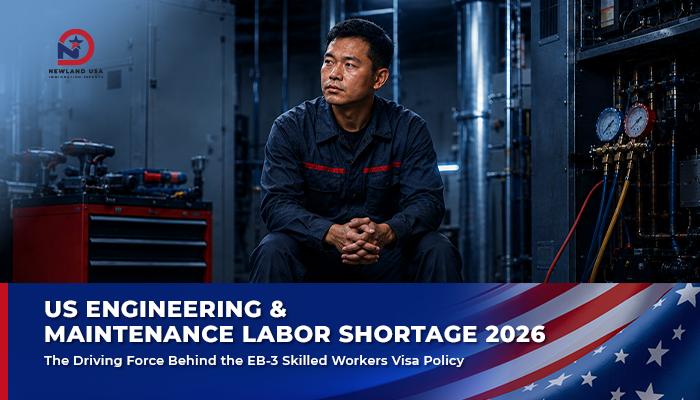
US Engineering & Maintenance Labor Shortage 2026: The Driving Force Behind the EB3 Skilled Workers Visa Policy
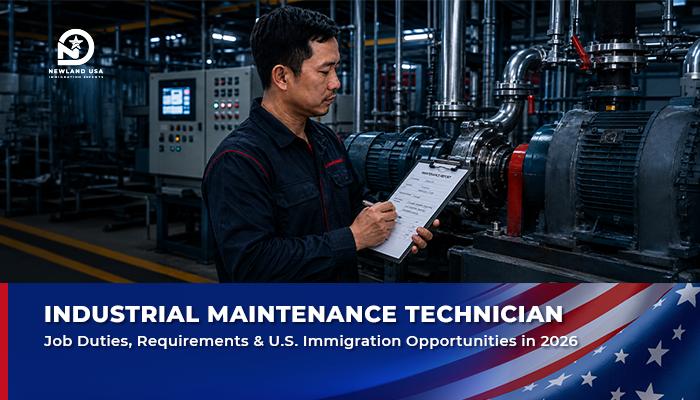
Industrial Maintenance Technician: Job Duties, Requirements & U.S. Immigration Opportunities in 2026