Complete Guide to Getting a Driver’s License in the U.S. – Most Detailed 2026
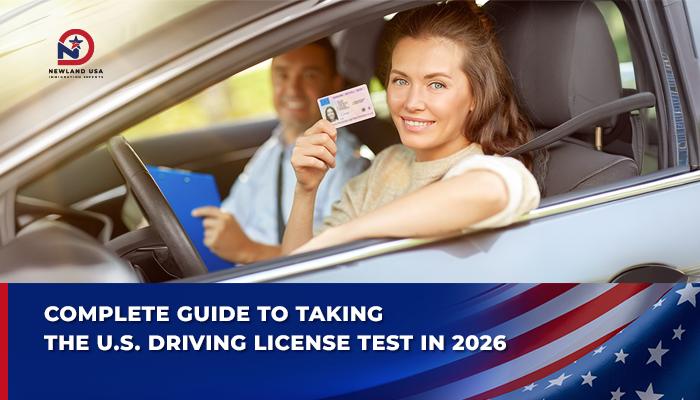
For the Vietnamese community newly settled in the U.S., owning a driver’s license is considered a gateway to freedom of movement, career opportunities, and the ability to blend into a new way of life. However, the process of getting a driver’s license in the U.S. differs significantly from Vietnam — from paperwork and test content to driving style. This article from Newland USA provides a complete overview of the 2026 U.S. driving test, along with the most practical tips for taking the driving test in the U.S. to help you pass the exam with confidence on your very first try.
1. Overview of Getting a Driver’s License in the U.S.
Unlike Vietnam, the U.S. does not have a single nationwide system for issuing driver’s licenses. Each state sets its own rules through different agencies, the most common being the Department of Motor Vehicles (DMV). In Massachusetts, this agency is called the Registry of Motor Vehicles (RMV), while in Texas it’s the Department of Public Safety. Hawaii is the only state where license issuance is handled at the county level rather than by the state government.
Despite these differences between states, the process of getting a driver’s license in the U.S. generally includes four core components: a vision test, a written knowledge test on traffic laws, a supervised practice driving period, and finally a behind-the-wheel road test. Once issued, a driver’s license not only allows you to legally operate a vehicle but also serves as a widely recognized form of identification for administrative, banking, and employment purposes.
An important note: starting May 7, 2025, under the REAL ID Act, standard driver’s licenses can no longer be used for domestic flights or to enter certain federal buildings. Therefore, when registering for your driver’s license test, you should consider applying for a REAL ID-compliant license to save time and effort down the road.
2. Requirements and Documents to Prepare Before Taking the 2026 U.S. Driving Test
Having all your paperwork ready from the start is key to avoiding multiple trips to the DMV office. According to general requirements in most states, anyone taking the 2026 U.S. driving test must meet certain basic conditions.
Regarding age, the minimum age to get a learner’s permit usually ranges from 15 to 16 depending on the state. In California, the minimum age is 15 and a half, while in Florida it’s 15. For a full unrestricted driver’s license, most states require the driver to be at least 18 years old.
Regarding identification and residency status, a standard set of documents for Vietnamese people living in the U.S. typically includes: a valid Vietnamese passport with a valid Visa, a Green Card (Form I-551) if you’re a permanent resident, or an Employment Authorization Document (Form I-766) if you’re on a temporary Visa. Additionally, a Social Security Number (SSN) is required in most states. If you’re not yet eligible for an SSN, you can request a letter of ineligibility (Form SSA-L676) from the Social Security Administration to submit as a substitute.
Regarding proof of residency, two separate documents showing your name and address in your current state of residence will be accepted — such as a lease agreement, utility bills, bank statements, or vehicle registration. Consistency in name and address across all documents is very important, because any discrepancy could result in your application being rejected when you register for the driver’s license test.
Regarding test fees, the fees vary by state. For example, in California, the learner’s permit fee is $33, which already covers the written test and vision test. You should check the official fee schedule on your local DMV’s website before submitting your application.

3. Step-by-Step Process of Getting a Driver’s License in the U.S.
To give you a clear and comprehensive picture, Newland USA has broken down the U.S. driver’s license test process into five clear steps that apply to most states.
Step 1: Apply for a Learner’s Permit
This is a permit that allows you to practice driving under the supervision of a licensed adult. To get one, you need to visit the DMV with all the documents listed above, take a vision test, and pass the written knowledge test. In many states, adults over 18 may have this phase shortened or waived if they already hold a license from another country or another U.S. state.
Step 2: Written Knowledge Test
The knowledge test is the first hurdle to clear in the U.S. driver’s license test process. The exam consists of multiple-choice questions covering traffic laws, road sign meanings, right-of-way rules, hazard response skills, and alcohol-related regulations.
The number of questions and passing rates differ between states. In California, the test has 46 multiple-choice questions and you need to answer at least 38 correctly (about 83%) to pass. Florida requires 50 questions with an 80% passing rate, while New York has only 20 questions but requires at least 14 correct answers (70%), including at least 2 out of 4 questions about road signs. Official study materials are available for free on each state’s DMV website, known as the Driver Handbook. You should read this material carefully and combine it with online practice tests for the best preparation.
The good news is that in many large states like California and Texas, the DMV allows test-takers to choose Vietnamese as the language for the written test. This is a significant advantage that helps the Vietnamese community feel more confident during their first driver’s license test.
Step 3: Practice Driving and Complete Required Driving Courses
After receiving your learner’s permit, you enter the supervised practice driving phase. Each state has different minimum practice driving hour requirements, usually ranging from 30 to 50 hours, with some hours required to be completed at night or in complex traffic conditions.
For those under 18, most states require completing a driver’s education program before being allowed to take the road test. Starting January 2026, under updated DMV regulations, online driving courses must last a minimum of 8 hours and students are required to have their cameras on throughout the entire course to ensure continuous participation. This is an important change within the 2026 U.S. driving test framework that you should be aware of.
Step 4: Road Test (Behind-the-Wheel Test)
The road test is the most important component and also the part that makes many test-takers the most nervous in the U.S. driver’s license test process. The test usually lasts 10 to 20 minutes, during which the examiner will sit in the passenger seat and evaluate your skills using a standardized scoring sheet.
Common areas tested include: safe vehicle start, lane changes using signals, stopping at stop signs and red lights, making left/right turns in the correct lane, reversing in a straight line, parallel parking, three-point turns, and highway driving in some states.
The scoring system typically works on a point-deduction basis. For example, in New York, test-takers start with 0 penalty points and will fail if they accumulate more than 30. Some critical errors that result in immediate failure include: hitting the curb during parallel parking, running a red light, causing an accident, or forcing the examiner to intervene with the vehicle controls for safety reasons.
A notable new change for the 2026 U.S. driving test in New York State is that test-takers will no longer receive a paper score sheet right after the test. The examiner will announce the result on the spot, while detailed scores will be posted online after 6:00 PM the same day.
Step 5: Receive Your Official Driver’s License
After passing the road test, you’ll receive a temporary license (interim license) right at the DMV, while the official license card will be mailed to you within one to several weeks. Some states in 2026 have rolled out the mobile driver’s license (mDL) — a digital version of the license stored on your phone — allowing users to present their license quickly in many situations without having to wait for the physical card.
4. Notable Changes in the 2026 U.S. Driving Test
The year 2026 marks many important updates in how states administer the driving test. Knowing about these changes will help you avoid unnecessary obstacles when registering for the driver’s license test.
First, the requirement to complete a safety awareness program (DMV safety awareness program) before being allowed to take the road test has officially taken effect since January 1, 2026 in many states. This program focuses on awareness of dangerous road situations, especially high-risk scenarios like nighttime driving or highway driving.
Second, oversight of online driving courses has been tightened. Students are required to keep their cameras on throughout the entire session to prove their presence and participation. Completion certificates should be kept carefully, as the DMV may request them at any time.
Third, due to increased demand combined with the implementation of new regulations, DMV appointments have become harder to get. You should book online appointments as early as possible, and also consider choosing DMV offices in suburban or less crowded areas to reduce wait times.
Finally, the mobile driver’s license is being rolled out widely across many states as part of the 2026 U.S. driving test framework, making identification and license use simpler in everyday transactions.

5. Tips for the Vietnamese Community Taking the U.S. Driving Test
For Vietnamese people who have just arrived in the U.S., getting used to the traffic system in a new country takes quite a bit of time. Below are valuable tips for taking the driving test in the U.S., compiled from the experiences shared by the Vietnamese diaspora and those who have successfully obtained their licenses in various states.
First, invest seriously in studying for the written test. Most Vietnamese people who fail the written test do so because they underestimate it, assuming that what they learned for the B1 or B2 license in Vietnam is enough. In reality, the road sign system, right-of-way rules, and state-specific laws in the U.S. are quite different. Spend at least two to three weeks thoroughly reading the Driver Handbook and taking at least 15–20 practice tests before signing up for the real exam.
Second, choose the language that matches your ability. If your English isn’t strong yet, don’t hesitate to take the test in Vietnamese. In states with large Vietnamese populations like California, Texas, or Florida, this is a benefit that the DMV has already prepared to support immigrants. One of the most valuable tips for taking the driving test in the U.S. is not to pressure yourself into testing in English just to prove your proficiency — the ultimate goal is still to get a legal license.
Third, practice parallel parking thoroughly. This is the part where many Vietnamese test-takers lose points or fail, especially since driving lessons in Vietnam rarely include comparable real-world scenarios. Practice parallel parking in different lots with different space sizes. The golden rule is that it’s better to park 30–50 cm (about 12–20 inches) away from the curb than to hit it.
Fourth, get familiar with the car and the test route before exam day. A very useful tip for taking the driving test in the U.S. is to spend time driving around the area near the DMV office where your test will be held. Examiners typically use a few fixed routes within a 5–10 km (3–6 mile) radius, so knowing the terrain will help you stay calm and handle situations better.
Fifth, manage your nerves and prioritize safe driving techniques. Vietnamese people new to the U.S. often have the habit of only checking the rearview mirror, while U.S. examiners place great importance on turning your head to check the blind spot before changing lanes or starting to drive. Make sure to perform this action clearly so the examiner can see it.
Sixth, don’t skimp on hiring a professional driving instructor. One or two sessions with an instructor who has experience with DMV tests typically costs about $60–$100 per hour, but in return, you’ll have a significantly higher chance of passing. For those who have never driven in the U.S., this is an investment that’s absolutely worth it.
6. Common Mistakes During the Driving Test and How to Avoid Them
Beyond the positive tips, you should also recognize common mistakes so you can proactively avoid them during the U.S. driver’s license test process.
The first common mistake is not checking the blind spot before changing lanes or turning. Make turning your head to check blind spots a natural reflex, even when the road is empty. The next mistake is exceeding the speed limit in residential or school zones — even going over by just 1–2 mph (1.6–3.2 km/h) can cost you points. Another frequent error is performing a rolling stop, also known as a “California stop” — slowing down but not coming to a complete stop. This is an automatic fail in most states.
Additionally, gripping the steering wheel too tightly will cause the car to wobble and not go straight, especially when you’re nervous. A small tip is to relax your hands and hold the steering wheel at the 9 o’clock and 3 o’clock positions. Many Vietnamese test-takers also struggle with staying in their lane: focus on the left lane marking and keep an even distance from it instead of trying to center yourself between both lines at the same time.

7. Key Differences to Note Between States
Because each state has its own rules, the driver’s license test experience can differ significantly depending on where you live. In California, the DMV is known for being very strict about blind spot checks and right-of-way rules at four-way stop intersections. In Texas, they’re particularly tough on parallel parking and parking on hills. In New York, especially in the city area, heavy traffic pressure makes the test considerably more challenging.
You should also pay attention to your license’s expiration. For permanent residents (Green Card holders), a driver’s license is typically valid for 4 to 8 years depending on the state. For those on temporary Visas, the license expiration will match their Visa or legal immigration status. Checking your state’s DMV website directly before submitting your application is an essential step you can’t skip.
8. Conclusion
Getting a driver’s license in the U.S. may seem complicated for newly settled Vietnamese people, but with thorough preparation, a solid understanding of the U.S. driver’s license test process, and the right tips for taking the driving test in the U.S. from those who have gone before, you can absolutely pass the exam on your first try. The year 2026 brings many positive changes — from mandatory safety education, mobile driver’s license (mDL) technology, to improved online registration processes — all aimed at raising driver quality and ensuring road safety. Think of the 2026 U.S. driving test not just as an administrative procedure, but as an opportunity to build a strong foundation for an independent life, freedom of movement, and broader career opportunities in your new country.
Learn more:
- How to Calculate Overtime Pay in the U.S. 2026 – The Latest Overtime Pay Regulations Every New Immigrant Should Know
- How to Open a US Bank Account for EB-3 Immigrants in 2026
- Workers’ Compensation Insurance in the U.S.: Important Things Immigrant Workers Need to Know
- EB3 Immigration to the US: Can Your Spouse and Children Come Along?
- How Much Does EB3 Skilled Worker Immigration to the US Cost? A Complete Financial Preparation Guide from A to Z
News Categories

Related news

From Motorcycle Mechanic to Automotive Technician in the U.S.: Skills and Qualifications to Prepare in 2026
AI in Auto Repair in the U.S. 2026: How Artificial Intelligence Diagnoses Vehicle Problems Faster and More Accurately

7 Key Technologies Every Industrial Maintenance Technician in the U.S. Needs to Know in 2026
PLC & Automation Skills: A Launchpad for Maintenance Technicians in the United States in 2026
What Is the ASE Certification? Requirements, Exam Roadmap, and Its Importance for Auto Technicians in the U.S. in 2026

EB5 Capital Recovery Time: How Long It Takes and the Key Milestones
Electric Vehicle Technicians in the U.S.: The “Golden” Skills Helping Vietnamese Auto Mechanics Get Ahead of the 2026 EV Trend
US Engineering & Maintenance Labor Shortage 2026: The Driving Force Behind the EB3 Skilled Workers Visa Policy
Industrial Maintenance Technician: Job Duties, Requirements & U.S. Immigration Opportunities in 2026