What Is a PERM Audit? Reasons EB3 Cases Get Delayed and How to Respond to the DOL
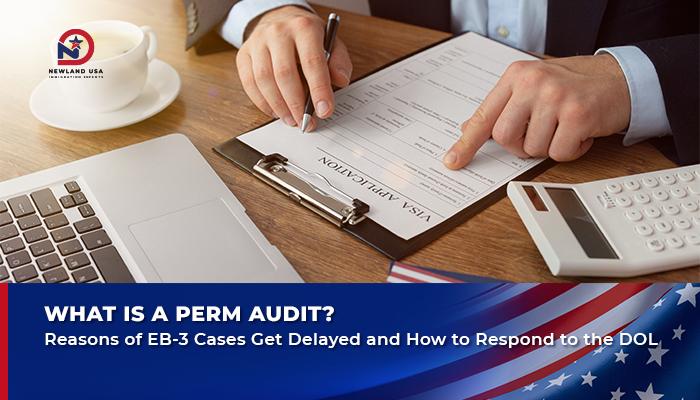
On the journey to settle in the U.S. through the EB3 category, the PERM Audit is considered one of the most concerning “bottlenecks” for both employers and foreign workers. Once a case is placed under review, processing time can stretch by nearly another year, along with the risk of denial if the employer fails to prepare sufficient documentation. This article from Newland USA will help applicants clearly understand the nature of the PERM Audit, the reasons why an EB3 case gets audited, and offer guidance on how to respond to a PERM Audit in a methodical way with the U.S. Department of Labor (DOL).
1. What Is a PERM Audit?
The PERM Audit is an official review process conducted by the U.S. Department of Labor (DOL) on Labor Certification applications submitted through the ETA Form 9089. During this stage, the Certifying Officer (CO) will ask the employer to provide all documentation proving that they have fully complied with the rules of the Program Electronic Review Management.
A key point to note is that when ETA 9089 is filed through the FLAG system (Foreign Labor Application Gateway), the employer only declares information without attaching evidence. Therefore, the PERM Audit is the mechanism the DOL uses to verify the truthfulness of what was declared, especially the recruitment process for U.S. workers before hiring foreign workers. According to reliable sources, the historical audit rate has hovered around 30%, and in the 2025 economic climate this figure may reach 33%.
For EB3 cases, which must go through the Labor Certification step, having a clear grasp of the PERM Audit EB3 is a key factor in preparing thoroughly and limiting legal risks.
2. Two Common Types of PERM Audit in PERM Audit EB3
The U.S. Department of Labor carries out audits through two parallel mechanisms. Correctly identifying the type of audit will help employers shape an appropriate response strategy.
2.1. Random Audit
This is a type of audit that does not stem from any “red flags” in the case. The DOL proactively selects a certain proportion from the total number of applications submitted to ensure the fairness and integrity of the entire PERM system. In the case of a random PERM Audit EB3, the employer has done nothing wrong but is still required to provide full recruitment evidence as requested.
2.2. Targeted Audit
This is a more worrying scenario. When the CO detects unusual signs in the case, they will launch a formal review. An EB3 case gets audited in this manner typically due to factors such as: unreasonable job requirements, a family relationship between the employer and the applicant, or a history of layoffs within six months before the filing date.

3. Why Do EB3 Cases Get Audited and “Stuck” at the DOL?
A reality that worries many applicants is the unusually long processing time when a case falls into audit. According to the latest updates, by early 2026 a standard PERM case takes 16–18 months to receive a decision. If an EB3 case gets audited, this time can be extended by another 9–12 months, sometimes more. Below are the most common reasons why a Labor Certification application for the EB3 category ends up under review.
3.1. Layoffs Within the Past Six Months
The ETA-9089 form requires the employer to disclose any layoff history within the 180 days before filing. If the company has laid off employees in the same position or a related one, the DOL will almost certainly open a review. The reason is simple: the core purpose of PERM is to protect U.S. workers, so cutting domestic staff and then hiring foreign workers for an equivalent position creates a logical contradiction.
3.2. Unusual Job Requirements
When a job description sets criteria that exceed O*NET standards or go beyond the typical SVP (Specific Vocational Preparation) level, the DOL will suspect that the employer is “tailoring” the job description to fit the foreign applicant’s profile. For positions in the Skilled Workers or Other Workers groups within PERM Audit EB3, such deviations are even more likely to draw scrutiny.
3.3. Unreasonable Foreign Language Requirements
If the job requires the applicant to know a foreign language other than English without a convincing business reason, the case is usually flagged automatically. This is one of the most common reasons why an EB3 case gets audited.
3.4. Family Relationships or Ownership Interests
If the applicant is related by blood or marriage to the business owner, or holds shares in the sponsoring company, the DOL will question the objectivity of the recruitment process. This is a situation in which an EB3 case gets audited with a very high probability.
3.5. Errors in the Recruitment Process
A small typo in the posting date, or failure to fully comply with the 30-day “quiet period” before filing, can also cause the FLAG automated system to trigger a PERM Audit.
3.6. Other Factors
In addition, an EB3 case may be audited for other reasons such as: refiling after a denial within the same year, cases from public schools, jobs that do not require a college degree, or companies with a history of violations in their foreign worker recruitment.
4. How Does the PERM Audit Process Work?
Understanding the audit process clearly will help applicants and employers avoid panic when they receive notice from the DOL.
Step 1 – Receive the Audit Notification: When the case is selected for review, the employer will receive a notice through the FLAG system and by email. This document lists in detail the materials required and the specific deadline, typically 30 days from the date of issuance.
Step 2 – Gather Documentation: The employer must compile all records related to the recruitment process carried out, including: the PWD result, evidence of posting with the State Workforce Agency (SWA), two newspaper advertisements, the applications from U.S. candidates, the reasons those candidates were rejected, and a signed Recruitment Report.
Step 3 – Submit the Response: All documents must be sent to the DOL within the required timeframe. Missing the deadline means the application is treated as abandoned and is automatically denied.
Step 4 – Review and Decision: After receiving the response, the CO will conduct the re-evaluation. This process usually takes 3–6 months, sometimes longer. The final outcome may be approval, denial, or a request for additional information.

5. How to Effectively Respond to a PERM Audit with the DOL
This is the most important section that sponsoring employers need to master. Responding to a PERM Audit is not simply about submitting enough paperwork — it is a methodical strategy with systematic arguments.
5.1. Read the Audit Notice Carefully and Identify the Scope of Requests
The first step in responding to a PERM Audit is to read the DOL’s notice very carefully. Each request in the document should be turned into a checklist. Missing even a single item can lead to denial, so the employer should review every line and cross-check against the internal records.
5.2. Compile Full Documentation Proving Recruitment
A standard response package should include: the final PWD, the ETA Form 9089 signed by all three parties (employer, worker, and attorney), the Notice of Posting along with evidence of posting and taking down the internal notice, a copy of the 30-day SWA job order, two newspaper tear sheets from major papers, and additional recruitment channels for specialty positions.
The Recruitment Report should clearly state the number of applications received, the reasons each U.S. candidate was rejected based on objective criteria, along with proof of communication such as dated emails, interview notes, call recordings, or certified mail receipts.
5.3. Write a Clear and Logical Cover Letter
A factor often overlooked in responding to a PERM Audit is the Cover Letter. This document guides how the CO reads the response package. A well-written cover letter summarizes each DOL request, points out which documents answer which request, and provides concise legal reasoning for any points that might be misread.
5.4. Demonstrate Business Necessity When Needed
In cases where the audit is triggered by special job requirements (such as a foreign language or uncommon skills), the employer must prepare “business necessity” documentation — proving that the requirement comes from the nature of the job itself, not from an intent to exclude U.S. workers. This is an important part of responding to a PERM Audit for cases in this category.
5.5. Address Layoff History If Any
If the company has previously laid off workers in an equivalent position, the response package must include: a list of the laid-off employees, the notices sent to them about the new job opportunity, and evidence that they did not reapply or are no longer eligible. This is a critical point in PERM Audits EB3 related to economic factors.
5.6. Strictly Comply with the 30-Day Deadline
The 30-day deadline is mandatory. While the CO has the authority to grant an extension in special circumstances, the extension request must be submitted before the original deadline and include a valid reason. Any delay without a legitimate reason will result in automatic denial.
5.7. Work with an Experienced Immigration Attorney
An immigration attorney does more than check the completeness of documentation — they help build the legal arguments, especially when the case falls into the targeted audit category. This is an investment worth considering for any EB3 case in a sensitive stage.
6. Possible Outcomes After Responding to a PERM Audit
After the employer has carried out the response to the PERM Audit, three main scenarios may occur. First, the case is approved and the applicant can move on to filing the I-140 with USCIS. Second, the case is denied, and the employer has 30 days to file a Motion for Reconsideration with the CO or request review by the Board of Alien Labor Certification Appeals (BALCA). Third, the DOL may order supervised recruitment — meaning the employer must redo the entire recruitment process under the direct supervision of the CO, which is considered the most stringent measure.
According to VisaNation, the denial rate after audit is around 40%, showing that the quality of the response package plays a very important role in the entire immigration plan.

7. Advice for Vietnamese Workers Joining the EB3 Category
For Vietnamese workers, the key thing to remember is that the full responsibility for handling the PERM Audit lies with the U.S. employer. However, applicants should not stay on the sidelines. Proactively staying updated on the case status through the immigration consulting firm, keeping copies of every personal document (degrees, work experience, prior employment contracts), and being ready to sign paperwork when needed will help the response process go more smoothly.
Equally important, applicants should choose reputable consulting firms with a strong network of experienced immigration attorneys in the U.S., to avoid having their case “stuck” for a long time due to an unprofessional audit response. A well-organized document set from the very beginning will significantly reduce risk and shorten the overall waiting time on the road to the American settlement dream.
8. Conclusion
In summary, a PERM Audit is not the end of an EB3 case, but rather an opportunity for the sponsoring employer to prove their transparency and legal compliance to the U.S. Department of Labor. Understanding why an EB3 case gets audited, recognizing the common reasons, and mastering how to respond to a PERM Audit is the key for applicants to safely get through this stage. Against the backdrop of the DOL tightening its oversight process, thorough preparation and partnership with a professional consulting firm is no longer an option but a must for any EB3 case that wants to go far on the U.S. immigration journey.
Learn more:
- ASE and OSHA Certifications for Auto Mechanics Under the EB3 Visa Program in the U.S. 2026
- The Medical Glove Industry in the U.S.: Market Analysis & EB3 Job Opportunities in 2026
- EB3 Skilled Workers Wait Time: Comprehensive Analysis of the Latest 2026 Movement
- What Is an EAD Card? Latest 2026 Regulations for the EB3 Category
News Categories


Related news

From Motorcycle Mechanic to Automotive Technician in the U.S.: Skills and Qualifications to Prepare in 2026
AI in Auto Repair in the U.S. 2026: How Artificial Intelligence Diagnoses Vehicle Problems Faster and More Accurately
7 Key Technologies Every Industrial Maintenance Technician in the U.S. Needs to Know in 2026
PLC & Automation Skills: A Launchpad for Maintenance Technicians in the United States in 2026
What Is the ASE Certification? Requirements, Exam Roadmap, and Its Importance for Auto Technicians in the U.S. in 2026

EB5 Capital Recovery Time: How Long It Takes and the Key Milestones

Electric Vehicle Technicians in the U.S.: The “Golden” Skills Helping Vietnamese Auto Mechanics Get Ahead of the 2026 EV Trend
US Engineering & Maintenance Labor Shortage 2026: The Driving Force Behind the EB3 Skilled Workers Visa Policy
Industrial Maintenance Technician: Job Duties, Requirements & U.S. Immigration Opportunities in 2026