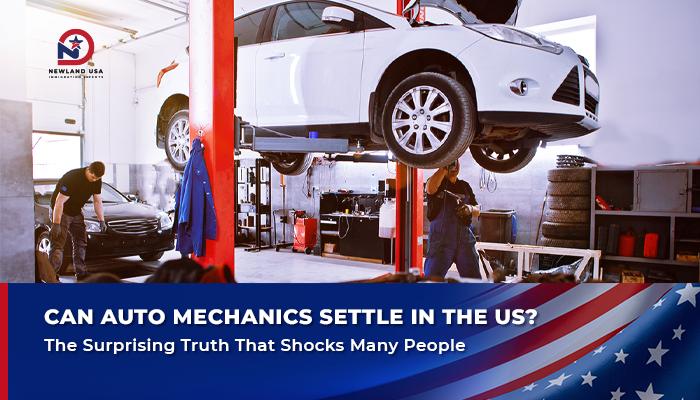
Can Auto Mechanics Settle in the US? The Surprising Truth That Shocks Many People
Many people still think that only those with advanced degrees, large investment capital, or exceptional talent can make the American Dream come true. But the truth is, even skilled workers in the automotive repair industry have a real chance to get a Green Card and build a new life in the United States. So how can auto mechanics settle in the US? This article by Newland USA will break down the legal pathway in detail, the requirements you need to meet, and the practical benefits that auto repair jobs in the US offer — helping you get the full picture before making an important decision for your family’s future.
1. Auto Mechanics Settling in the US – No Longer a Pipe Dream
In the minds of most Vietnamese people, auto mechanics settling in the US sounds far-fetched. However, US immigration law isn’t just reserved for intellectuals or wealthy businesspeople. The US Employment-Based Immigration system is designed with multiple categories, some of which are perfectly suited for workers with practical skills — including automotive repair technicians.
Specifically, according to the regulations of the US Citizenship and Immigration Services (USCIS), the EB3 program allows US employers to sponsor foreign workers to come work in the US and receive lawful permanent resident status. What’s special about the EB3 program is that applicants don’t need a college degree, don’t need hundreds of thousands of dollars in investment capital — they just need to meet the criteria related to work experience, health, and criminal background.
In practice, automotive repair technicians fall under the Skilled Workers category of the EB3 program, since this job requires a minimum of two years of training or hands-on experience. This is a solid legal basis to confirm that auto mechanics settling in the US is completely achievable, as long as the worker meets the requirements and is sponsored by a US employer.
2. Why Is the Auto Repair Industry in the US So Desperate for Workers?
One of the key factors making it more feasible than ever for auto mechanics to settle in the US is the severe labor shortage in the US auto repair industry. According to data from the US Bureau of Labor Statistics (BLS), the automotive service technician field is projected to grow 4% from 2024 to 2034, with about 70,000 positions needing to be filled each year U.S. Bureau of Labor Statistics due to the need to replace workers who retire or switch careers.
Currently, the US has approximately 652,141 people working in the automotive repair industry ConsumerAffairs, and that number still isn’t enough to meet market demand. The Baby Boomer generation is gradually leaving the workforce due to age, creating a labor gap that younger generations haven’t been able to fill in time.
On top of that, the rapid growth of electric vehicles, hybrid cars, and Advanced Driver Assistance Systems (ADAS) has made auto repair jobs in the US more complex. Repair shops, authorized dealerships, and maintenance centers need technicians who can diagnose issues using software, understand high-voltage battery systems, and are proficient with digital tools. This shortage is exactly why many US businesses have had to look for workers from abroad through employer-sponsored programs.
3. Attractive Income – A Big Motivation for Auto Mechanics Settling in the US
Beyond the abundant job opportunities, auto repair jobs in the US also offer income levels that are truly enviable compared to the average in Vietnam. The average salary for auto technicians in the US is around $55,260/year (based on 2024 figures) U.S. News & World Report. Depending on experience, specialization, and work location, income can vary significantly.
Specifically, entry-level technicians typically start with salaries ranging from $35,000 to $45,000/year. After 3 to 5 years of experience, that figure can rise to the $45,000–$60,000 range. For mechanics with over 5 years of experience or who specialize in areas like diesel repair, hybrid vehicles, or luxury cars, salaries can reach $60,000–$85,000 per year. In certain specialized industries, auto technicians can even earn close to $92,000/year.
With such stable income, auto mechanics who settle in the US can absolutely build a strong financial foundation, buy a home, purchase a car, and provide the best educational opportunities for their children.
4. The EB3 Program – A Gateway for Skilled Workers
As mentioned, the EB3 program is the most suitable legal pathway for those who want to immigrate to the US through the skilled work route without needing advanced degrees or large investment capital. According to USCIS regulations, the EB3 program is divided into three main subcategories:
The first is the Skilled Workers group, for those with at least two years of experience or specialized training in a specific field. Common occupations in this group include professional chefs, mechanics, factory technicians, glove manufacturing workers, and especially automotive repair technicians. This is the exact subcategory for auto mechanics settling in the US.
The second is the Professionals group, which requires applicants to hold at least a bachelor’s degree and have experience in highly specialized fields such as engineering, accounting, or programming.
The third is the Other Workers group, for job positions requiring less than two years of experience, such as packaging workers, farm laborers, or restaurant or casino employees.
Each year, the US government issues approximately 40,000 EB3 Visas for foreign workers, creating real opportunities for thousands of families worldwide to live and work legally in the United States.
5. Requirements for Auto Mechanics to Settle in the US Under EB3 Skilled Workers
To participate in US immigration through the skilled work route via the EB3 program Skilled Workers category, applicants need to meet several basic requirements:
Regarding work experience, applicants must prove they have at least two years of work experience or specialized training in the automotive repair field. This experience can be accumulated from different workplaces and must be documented with employment verification letters, vocational certificates, or diplomas from technical training programs.
Regarding the sponsoring employer, this is the most critical factor. Applicants must have a US-based company willing to act as their sponsor, provide a full-time job offer, and take responsibility for filing the PERM Labor Certification with the US Department of Labor.
Regarding health, applicants must pass a medical examination according to the standards of the US Centers for Disease Control and Prevention (CDC), ensuring they are free from communicable diseases that could affect public health.
Regarding criminal background, applicants must have a clean record with no criminal history or immigration violations in any country.
Overall, the requirements for US immigration through the skilled work route via the EB3 program are not overly strict compared to other immigration categories. The most important thing is finding a reputable employer and preparing a complete and accurate application from the start.
6. The Immigration Process for Auto Mechanics Through the Skilled Worker Route
The process for auto mechanics to settle in the US under the EB3 Skilled Workers category involves multiple steps that require close coordination between the applicant, the US employer, and the immigration consulting firm. Here’s an overview of the main stages:
Step 1: Prevailing Wage Determination (PWD). The employer submits a request to the US Department of Labor (DOL) to determine the minimum wage for the position being hired. This wage reflects the average income level for the corresponding occupation in the area where the work will be performed. This stage typically takes 5 to 8 months.
Step 2: Domestic labor market recruitment. After receiving the PWD, the employer must conduct a domestic recruitment campaign to prove that no US citizen is qualified or willing to take the position. This process includes posting job ads in newspapers, listing the job on the state’s employment system for a minimum of 30 days, and displaying the posting at the workplace.
Step 3: Filing the PERM Labor Certification (Form ETA-9089). Once the test recruitment is completed without finding a suitable domestic candidate, the employer files the PERM application with the DOL. The filing date becomes the “Priority Date” — the timestamp that determines the order in which the applicant’s case is processed.
Step 4: Filing the sponsorship petition (Form I-140). After PERM is approved, the employer must file the I-140 petition with USCIS within 180 days. This petition confirms that the applicant meets the qualifications for the employment-based Visa and that the employer has sufficient financial capacity to pay the required wage.
Step 5: Waiting for Visa availability and interview. The applicant monitors the monthly Visa Bulletin to know when a Visa number becomes available. When their turn comes, the applicant completes the medical exam, attends an interview at the US Consulate, and receives an entry Visa. After arriving in the US, the Green Card will be mailed to the registered address.
The entire US immigration process through the skilled work route via EB3 typically takes 3 to 5 years, depending on the processing speed of government agencies and the Visa backlog situation for each country.
7. Benefits When Auto Mechanics Successfully Settle in the US
Upon receiving a Green Card through the US skilled work immigration pathway, the auto mechanic and their family will enjoy numerous practical benefits.
First of all, the applicant’s spouse and unmarried children under 21 will also receive Green Cards without any additional sponsorship costs. This means the entire family gets to enjoy social security benefits equivalent to those of US citizens.
Regarding education, Green Card holders’ children receive free education in the public school system from elementary through high school. When entering college, they qualify for in-state tuition — significantly lower than what international students pay — and are also eligible for federal financial aid and scholarships.
Regarding finances, Green Card holders can buy homes, purchase cars, and take out bank loans at preferential interest rates for permanent residents, opening up opportunities for long-term wealth building.
Regarding career freedom, after completing the committed work period with the sponsoring employer (typically 6 to 12 months), permanent residents have the freedom to change jobs or even start their own business in any state.
And after 5 years of continuous residence, the entire family becomes eligible to apply for US citizenship — becoming official citizens with full voting rights and the freedom to travel to most countries around the world without needing a Visa.
8. Newland USA – The Pioneer Paving the Way for Auto Mechanics to Settle in the US
In the context of growing demand for auto repair jobs in the US and the EB3 program opening up real opportunities for Vietnamese workers, Newland USA has proactively launched the EB3 Skilled Workers program specifically for the automotive repair technician field.
Notably, the Prevailing Wage Determination (PWD) for the EB3 automotive repair technician program launched by Newland USA has been officially approved by the US Department of Labor. This is an important milestone, proving that the recruiting partner in the US has fully met the requirements regarding wages, working conditions, and the work environment for foreign employees.
This success by Newland USA not only strengthens the company’s position in the immigration consulting field in Vietnam but also opens the door for experienced repair technicians, mechanics, and garage owners in Vietnam who dream of settling in the US.
9. Tips for Those Who Want to Settle in the US With Their Current Auto Repair Skills
If you’re an auto technician, mechanic, or repair shop owner in Vietnam and are considering the US skilled work immigration pathway, here are some practical tips:
Prepare your experience documentation properly. Employment verification letters, vocational training certificates, labor contracts, and recommendation letters from previous employers will play an extremely important role in proving your abilities to US employers and reviewing authorities.
Improving your English skills is also something to keep in mind. Although the EB3 program doesn’t require a specific language proficiency level, basic communication skills will help you adapt faster to the work environment and daily life in the US.
Updating your knowledge of modern automotive technology, especially electric vehicles and digital diagnostic systems, will make your application stand out to employers — and also boost your chances of career advancement once you arrive in the US.
And most importantly, choose a reputable immigration consulting firm that has practical experience and has proven its capabilities through successful cases. A good firm will walk with you from the initial application assessment stage all the way until your entire family sets foot in America.

10. Conclusion
Auto mechanics settling in the US is not a pipe dream — it’s a completely achievable pathway, protected by US law through the EB3 program for skilled workers. With the severe labor shortage in the US auto repair industry, attractive income levels, and a full range of social security benefits for the whole family, now is the golden opportunity for those with skills in the automotive repair field to seriously consider the US skilled work immigration route. Every journey of a thousand miles begins with a single step — and that step can start today.
Learn more:
- How Much Does EB3 Skilled Worker Immigration to the US Cost? A Complete Financial Preparation Guide from A to Z
- Retrogression: What It Is and How It Affects Your EB3 Case
- Why is the EB3 Visa waiting time for skilled workers faster than for other workers?
- ROI Analysis When Settling in the US Through EB3 Skilled Workers
- Does the EB3 Skilled Worker Immigration to the U.S. Really Cost Billions of VND?
News Categories



Related news
AI in Auto Repair in the U.S. 2026: How Artificial Intelligence Diagnoses Vehicle Problems Faster and More Accurately
7 Key Technologies Every Industrial Maintenance Technician in the U.S. Needs to Know in 2026
PLC & Automation Skills: A Launchpad for Maintenance Technicians in the United States in 2026
What Is the ASE Certification? Requirements, Exam Roadmap, and Its Importance for Auto Technicians in the U.S. in 2026

EB5 Capital Recovery Time: How Long It Takes and the Key Milestones
Electric Vehicle Technicians in the U.S.: The “Golden” Skills Helping Vietnamese Auto Mechanics Get Ahead of the 2026 EV Trend
US Engineering & Maintenance Labor Shortage 2026: The Driving Force Behind the EB3 Skilled Workers Visa Policy
Industrial Maintenance Technician: Job Duties, Requirements & U.S. Immigration Opportunities in 2026
Lương thợ sửa xe tại Mỹ: Cách tối ưu giờ công để nhân đôi thu nhập năm 2026