Essential Information About Dependents When Applying for EB3 Visa
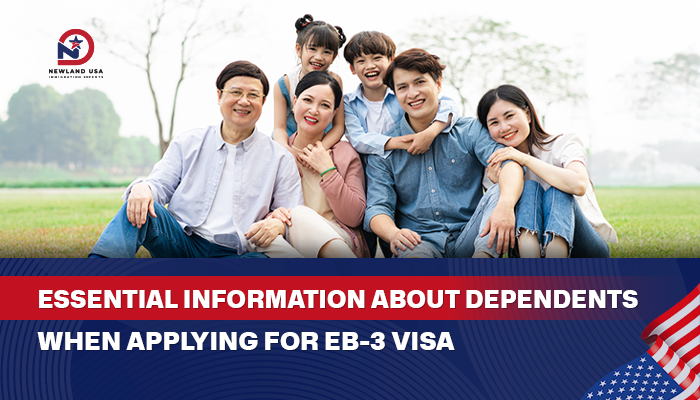
When pursuing the EB3 US immigration program, understanding dependents and their rights in the application process is extremely important. This article by Newland USA will provide detailed information about family members in EB3 Visa applications, helping you make the most suitable decision for your family.
1. Understanding Dependents in the EB3 Program
Dependents in the EB3 program are defined as immediate family members of the main applicant. According to regulations by the US Citizenship and Immigration Services (USCIS), two groups are recognized as EB3 program dependents including:
- First, the spouse of the main applicant must have a legally recognized marriage relationship. This means the marriage must be legally registered in the country where the wedding took place and recognized under US law.
- Second, unmarried children under 21 years old at the time of application submission are also considered dependents. This group includes both biological children and adopted children who were adopted through proper legal procedures.
Clearly identifying these individuals helps ensure the entire family can pursue the EB3 US immigration dream together in the most complete and smooth way possible.
2. The Importance of Including Family Members in the Application
The decision to include dependents in the EB3 Visa application brings undeniable practical benefits. First and foremost, this helps maintain family unity throughout the immigration journey.
Moreover, having EB3 program dependents helps everyone avoid loneliness and provides mutual support during the initial period after arriving in the US. The process of adapting to a new society is always challenging, and the presence of loved ones will help significantly reduce psychological pressure.
From a legal perspective, all dependents included in the application will receive similar benefits as the main applicant. This includes the right to legal residence (green card), access to the education system, and opportunities to participate in the US job market.

3. Process of Including Family Members in EB3 Application
To include dependents in the EB3 US immigration application, the main applicant needs to prepare complete information, documents, and follow these steps:
The initial step is completing Form I-140 (Petition for Nonimmigrant Worker), and note that you must be very careful because the information declared in this form will directly affect whether your application succeeds or not.
In Form I-140, the applicant must clearly declare having accompanying dependents and provide detailed information about each member. This requires thorough preparation of documents and necessary proof papers.
Next, you must prove family marital status and children. For spouses, you need a notarized and valid marriage certificate. For children, you need original birth certificates or certified copies.
When Form I-140 is approved by USCIS and your priority date becomes current, both the main applicant and dependents must file Form I-485 to adjust their residence status.
Finally, all family members may be required to attend fingerprinting, biometric photography, and personal interviews at the local USCIS office.
4. Eligibility Criteria for Dependents
Dependents who want to be included in the EB3 Visa application must meet strict standards set by US law. For the spouse of the main applicant, the marriage relationship must be monogamous and performed according to proper law.
Particularly important, the marriage must be recognized where it took place and must not violate any US federal regulations. Temporary or informal marriages will not be accepted.
For children, age and marital status are two decisive factors. Children must be under 21 years old at the time of filing Form I-140 and maintain unmarried status until receiving permanent residence. If children marry or reach 21 years old during the waiting process, they may lose their EB3 program dependent status.
Additionally, all dependents must pass medical and security checks similar to the main applicant, ensuring no factors that could harm the security or health of US citizens.

5. Practical Benefits of Including Family Members
Including dependents in the EB3 US immigration application brings a series of practical and long-term benefits for the entire family. One of the most outstanding advantages is access to America’s high-quality education system.
Children in the family can attend public schools at tuition rates equivalent to local students, instead of having to pay high fees for international students. This creates development opportunities for children while saving significant costs for the family.
For spouses of EB3 Visa holders, they can completely apply for an Employment Authorization Document (EAD) immediately after receiving their green card. This allows them to freely seek job opportunities suitable to their qualifications and experience, contributing to the family’s financial stability.
The US healthcare system also becomes more accessible to dependents. They can participate in health insurance programs, receive high-quality medical treatment, and ensure comprehensive health for the entire family.
6. The Connection Between Family Members
Dependents play a very important role in the family’s EB3 US immigration journey. Their presence is not just simply accompanying the main applicant, but also creates support for other members during the integration process.
Economically, the ability to have dual income from both the main applicant and spouse creates solid financial stability. This is particularly important in the early stages when the family is still getting familiar with the new country.
The process of integrating into the local community also becomes easier when the whole family participates together. Dependents can participate in social activities, create new relationships, and contribute to building the community in that area.
7. Important Considerations During Application Preparation
First and foremost, all documents proving family relationships must be fully prepared.
Marriage certificates need to be translated and notarized into English. Similarly, children’s birth certificates must also go through similar translation and notarization processes to ensure legality.
Strict compliance with USCIS regulations and guidelines is mandatory to avoid errors that could lead to application delays or denials. Every small change in regulations can affect the final outcome.
Consulting with experienced immigration experts is a wise decision. They can provide in-depth advice, help avoid common mistakes, and ensure applications are prepared to the highest standards.
8. Conclusion
Understanding dependents and their rights in the EB3 US immigration program benefits the entire family. Including family members not only brings legal benefits but also creates long-term emotional and economic value.
Newland USA, with our team of experienced experts and motto “Stable Settlement — Lifelong Prosperity,” is ready to consult and support in application preparation and accompany you throughout the EB3 US immigration process. Contact Newland USA immediately at hotline 0785591988 or email: newsletter@newlandusa.asia for detailed and free consultation.
News Categories


Related news
Who Is the ESTA Program For? How to Assess Your Fit Before Applying in 2026

Who Is the ESTA Program For? How to Assess Your Fit Before Applying in 2026

From Motorcycle Mechanic to Automotive Technician in the U.S.: Skills and Qualifications to Prepare in 2026
AI in Auto Repair in the U.S. 2026: How Artificial Intelligence Diagnoses Vehicle Problems Faster and More Accurately
7 Key Technologies Every Industrial Maintenance Technician in the U.S. Needs to Know in 2026
PLC & Automation Skills: A Launchpad for Maintenance Technicians in the United States in 2026
What Is the ASE Certification? Requirements, Exam Roadmap, and Its Importance for Auto Technicians in the U.S. in 2026

EB5 Capital Recovery Time: How Long It Takes and the Key Milestones
Electric Vehicle Technicians in the U.S.: The “Golden” Skills Helping Vietnamese Auto Mechanics Get Ahead of the 2026 EV Trend