Who Is the ESTA Program For? How to Assess Your Fit Before Applying in 2026
Many Vietnamese technicians have spent years in repair shops or on factory production lines, or have worked on thousands of cars, yet still aren’t sure whether those skills are enough to open up a career path in the U.S. The ESTA program, developed by Newland USA, was created to answer that question with clear criteria instead of vague promises. This article explains who ESTA is for, walks you through the ESTA program eligibility requirements, and shows you how to use the Profile Self-Assessment tool on the official website, so you can see where you stand before starting your journey toward EB-3 immigration to the U.S.
1. What is the ESTA program, and why should you understand it properly before assessing yourself?
Before asking whether you’re a good fit, you need to understand what the ESTA program actually is. So, what is the ESTA program? ESTA stands for EB-3 Skilled Trade America. It’s the name of an ecosystem of products, processes and partners that Newland USA has built around the EB-3 Skilled Workers category, made specifically for technical and skilled trades. In other words, the ESTA program is a structured, well-organized pathway to EB-3 immigration to the U.S. for skilled workers.
There are three things to clear up right away:
- It’s not a new type of visa: The ESTA program runs entirely on the legal foundation of the EB-3 Skilled Workers category under U.S. immigration law. It does not replace any legal requirement.
- It’s not a U.S. government program: It’s a strategy developed by Newland USA, based on information cross-checked from USCIS, the U.S. Department of State, the U.S. Department of Labor and the U.S. Bureau of Labor Statistics.
- It’s not the travel ESTA: The name is easy to confuse with the U.S. Electronic System for Travel Authorization, but the two are completely different.
What makes the ESTA program different is how it looks at EB-3. Instead of treating the job as just a “vehicle” to get a green card, ESTA puts skills first: Vietnamese workers go to the U.S. as people the labor market actually needs, and green cards for the whole family come as the result. That’s why the ESTA program’s operating principle comes down to one word, “real”: a real job, a real sponsoring employer and real professional skills.
Once you understand this, you’ll see that self-assessment isn’t about “passing” or “failing.” It’s a way to check whether those three real elements clearly show up in your profile.
Learn more:
- Who Is the ESTA Program For? How to Assess Your Fit Before Applying in 2026
- From Motorcycle Mechanic to Automotive Technician in the U.S.: Skills and Qualifications to Prepare in 2026
- AI in Auto Repair in the U.S. 2026: How Artificial Intelligence Diagnoses Vehicle Problems Faster and More Accurately
- 7 Key Technologies Every Industrial Maintenance Technician in the U.S. Needs to Know in 2026
2. Who is ESTA for? The ideal candidate profile in 2026
The short answer to who ESTA is for: Vietnamese people who are currently doing hands-on technical work, have at least 3 years of real experience in the right field, have documents that prove that experience, and have a financial plan for a journey of about 24–36 months. At this stage, the ESTA program is accepting applications for two main trade groups.
Automotive Maintenance Technician
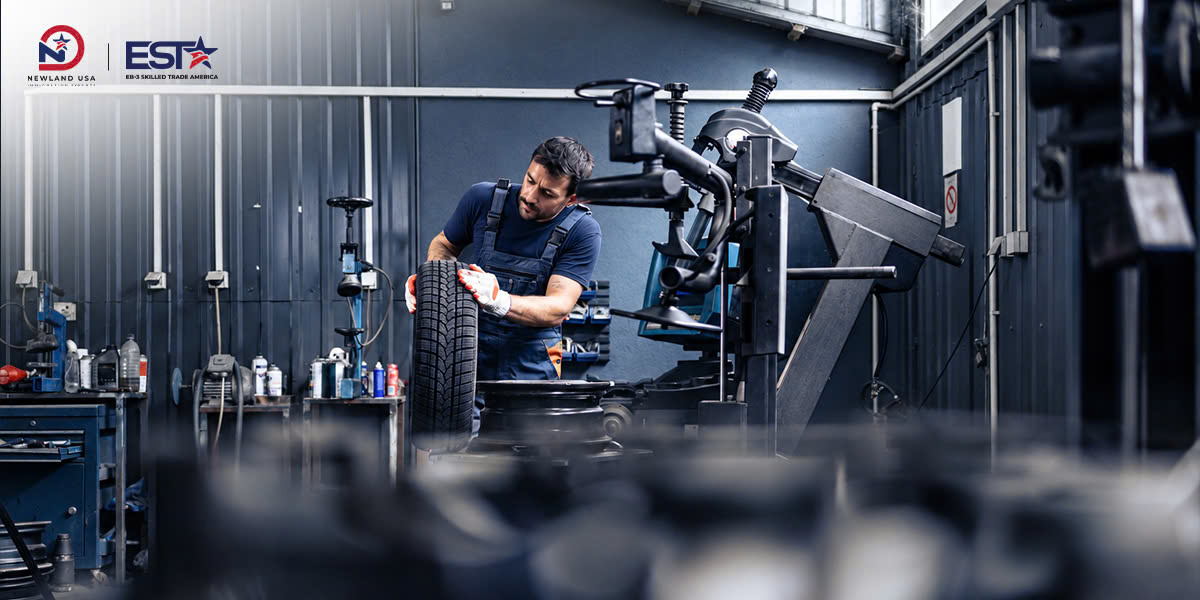
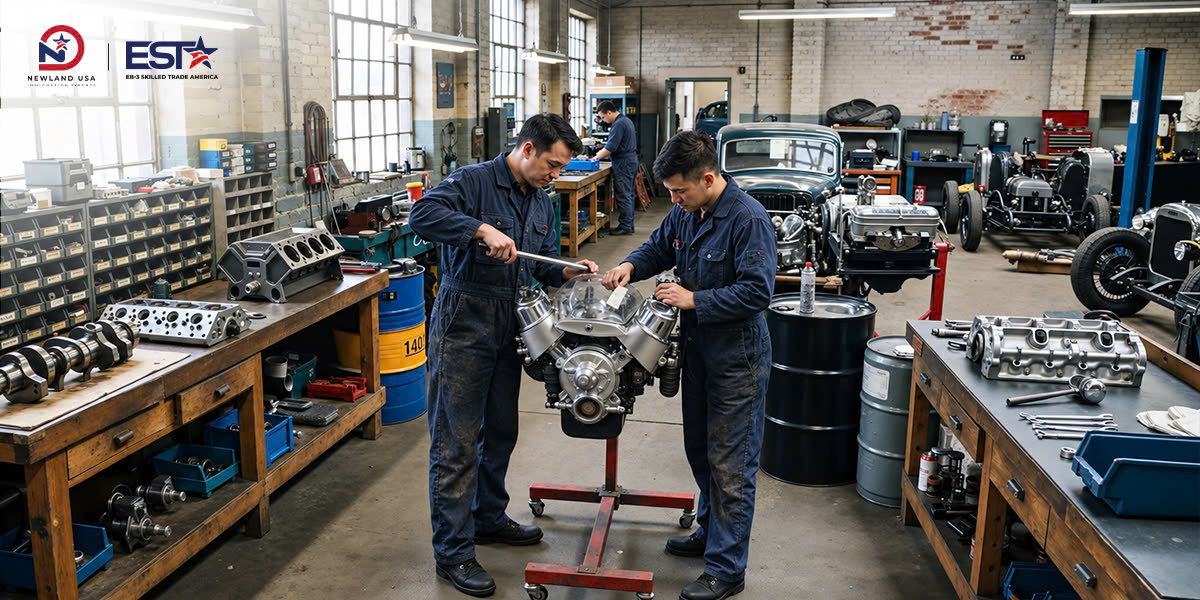
This group is for people who diagnose, adjust, repair and overhaul cars at service shops or dealerships. The position in the ESTA program comes with a base salary of USD 52,000 per year and requires at least 2 years of experience. Demand in the U.S. is fairly steady: according to the BLS, the market needs about 70,000 new automotive technicians every year over the next decade, mostly to replace workers who retire or change careers.
Industrial Maintenance Technician
This group fits people who keep production lines and distribution centers running nonstop: reading circuit diagrams, fixing faults in inverters (VFDs), sensors, pneumatic and hydraulic systems, and planning preventive maintenance. The base salary for this position in the ESTA program is USD 45,000 per year, and it also requires at least 3 years of experience. Also according to the BLS, industrial machinery maintenance jobs in the U.S. have about 54,200 openings each year.
In addition, the HVACR Technician group (commercial and industrial heating, ventilation, air conditioning and refrigeration) is already on the ESTA program’s list but is not yet accepting applications.
In reality, the job title on your Vietnamese employment contract may well not match the job title used in the U.S. What U.S. authorities look at is the actual work you do, not your title. So when you ask yourself who ESTA is for, look at what you do every day. Here are some common jobs that can still be matched to the ESTA program:
- Automotive group: garage mechanics, technicians at authorized dealerships, diagnostic technicians, fleet maintenance mechanics for transport companies, auto garage owners.
- Industrial maintenance group: electromechanical technicians at FDI factories, PLC automation technicians, industrial electricians, maintenance staff on food and beverage lines, textile and garment maintenance, SMT equipment maintenance, warehouse and logistics equipment maintenance.
Of these, electromechanical technicians at FDI factories are seen as an almost perfect match for industrial maintenance positions in the U.S.
3. Cases that aren’t a fit for the ESTA program at this stage
Knowing you’re not a fit is just as important as knowing you are, because it saves you time and money. The line the ESTA program draws is quite clear: the job must fall under “maintenance and repair,” meaning the worker must personally find the cause of a breakdown and fix it.
Based on this, the following jobs are not currently on the list:
- Welders, machinists, steel and metal fabricators: these jobs make products or structures; they don’t maintain machines.
- Machine operators: people who run machines by following procedures but don’t diagnose problems.
- Residential electricians, plumbers: not open at this stage.
- General cooks, warehouse workers, janitors, patient caregivers: not on the ESTA program’s trade list.
Also, people who only work as helpers, only do simple repetitive tasks, or have less than 3 years of experience don’t yet meet the entry standard. Some “borderline” cases can still be considered if they can prove the repair side of their work, for example a CNC lathe/milling operator who has gradually moved into machine maintenance, or someone who both operates and repairs equipment. This is also why the question of who ESTA is for should be answered with a specific profile, not just a job title.
4. ESTA program eligibility requirements: three layers you must meet together
To fully answer who is eligible for ESTA, you need to look at two levels: the legal standard of the EB-3 category and the specific standard set by the ESTA program.
At the legal level, USCIS classifies someone as a Skilled Worker when the position requires at least 2 years of training or experience, and the job is not seasonal or temporary. The ESTA program raises this to 3 years to give applications a bigger safety margin during review. In general, the ESTA program eligibility requirements also include:
- A full-time, permanent job offer from a U.S. employer; part-time or seasonal positions don’t qualify.
- The employer must prove it couldn’t find enough qualified U.S. workers for the position, through the PERM labor certification process.
- Health that meets the immigration medical exam requirements and a clean criminal record.
In practice, the ESTA program eligibility requirements are split into three layers, and an application only moves forward when all three are met:
- Real skills: You must be the person who directly diagnoses, repairs, maintains and troubleshoots equipment, replaces parts and uses testing and measuring tools. People who only operate machines by procedure or only work as helpers won’t qualify.
- Proof you can show: An experience verification letter on company letterhead, with a signature, company stamp and contact details so U.S. authorities can verify it; it must clearly state your employment period by month and year, and your hours per week. Along with that: your employment contract, social insurance book, payslips or bank statements showing salary, and your degrees and trade certificates.
- Finances and commitment: Enough financial capacity for a 24–36 month journey, plus a commitment to go to the U.S. and do the right job for the right sponsoring employer.
As for English, the requirement for skilled workers pursuing EB-3 immigration to the U.S. is much lower than for professional categories. You need enough English to understand technical instructions, read equipment manuals and communicate at work – something you can definitely prepare for while waiting on your application.
5. Five questions to help you assess yourself before applying
Before filling out any form, ask yourself the five questions below. These are also the same areas a consultant will ask about when comparing your profile against the ESTA program eligibility requirements.
- What do I do every day at work? Be specific: what tools do you use to diagnose faults, which systems do you repair, what kinds of equipment do you work with? If you spend most of your time just operating machines or helping out, that’s a sign to think carefully.
- How long have I worked in the right field, and was it full-time? The 3-year mark is counted by actual, full-time work directly related to the U.S. position.
- Do I have documents to prove it? Your verification letter, contract, social insurance and payslips must match each other on company name, job title and dates. If you own a garage or workshop, you’ll also need a business license, invoices and photos of the workshop.
- Are my finances enough for 24–36 months? The EB-3 immigration to the U.S. journey is long and includes application fees, translation, medical exams and initial settling-in costs in the U.S.
- Are my family and I ready? Are you willing to work long-term for one employer in a specific state, and does your family agree with this plan?
If you can answer all five clearly, there’s a good chance you’re in the group that can go far with the ESTA program. If you’re unsure about a few of them, those are exactly the areas you need to prepare more.
6. How to use the Profile Self-Assessment tool on the ESTA program website
To make sure self-assessment isn’t just a gut feeling, Newland USA built a Profile Self-Assessment tool right on the official ESTA program website at esta.newlandusa.asia/tu-danh-gia-ho-so. The tool has ten short questions and takes about 2 to 3 minutes to complete, giving you a first answer to who ESTA is for as it applies to your own situation.
The process is simple:
- Step 1 – Enter your contact details: Full name and phone number or Zalo are required; email, province or city, and the name of your organization or partner are optional.
- Step 2 – Answer ten questions: The questions cover your trade, experience and how ready you are. You can go back to previous questions to edit them before finishing.
- Step 3 – Get your result: When you’re done, the system shows your result along with a profile code, which makes it easier to talk with a consultant. If you want, you can choose “Start over” to redo the assessment from the beginning.
A few tips to get a more accurate result:
- Answer based on your real work: Don’t pick answers based on the job title in your contract if what you actually do is different.
- Don’t “dress up” your answers: The result is only useful if it reflects your real profile, because all information will later have to be backed by documents.
- Treat the result as a screening step: The tool’s result is only for initial screening, not a conclusion about your immigration eligibility.
Besides the main tool, the ESTA program website has three supporting tools worth using alongside it. The Similar Trades page helps you match your job in Vietnam to the ESTA program’s trade groups. The Document Checklist page lists 19 types of documents you should prepare early and lets you mark your progress. The Processing Time Estimate page helps you picture the timeline for each stage.
If you’d like an expert opinion, you can leave your details in the Free Profile Review section. A Newland USA advisor will compare your skills against the ESTA program eligibility requirements and get back to you within 24 hours.
7. Understanding your result: eligible, needs more documents, or not accepted?
After the self-assessment and review, ESTA program profiles usually fall into one of three groups:
- Eligible: Your trade is on the list, you have at least 3 years of experience, clear proof, stable finances and a serious intention to work. Your profile moves on to a skills interview and legal review.
- Needs more documents: Your trade is a fit, but your proof is thin, your job title is unclear, you’re self-employed, or your financial plan isn’t complete yet. Your profile is put on hold, with guidance on what to add, and then reviewed again.
- Not accepted: No proof of experience, a trade that doesn’t match the list, or no real intention to work. In this case, you’ll get a clear response, along with suggestions for other options if there are any.
Many Vietnamese candidates first land in the “needs more documents” group, and that’s nothing to worry about. It usually comes from common work habits in Vietnam: contracts with vague job titles, verification letters only a few lines long, or experience at a family garage with no social insurance record. These issues can definitely be fixed if your experience is real.
The most important rule when adding documents is “one story.” Every document – from your CV, verification letter, job offer letter, ETA-9089 form and I-140 petition to your interview at the consulate – must tell the same story about who you are and what your skills are. At the same time, the ESTA program only helps collect, standardize, translate and explain real evidence, and never creates fake evidence.

8. The roadmap and timeline to picture before applying
Assessing your fit also means assessing your own patience, because EB-3 immigration to the U.S. takes a lot of time. The ESTA program roadmap has eight steps, which can be grouped into five main stages:
- PERM preparation (9–12 months): Define the position, request the prevailing wage and run public recruitment as required by the U.S. Department of Labor.
- Labor certification approval (about 12 months): The date the PERM application is filed becomes your priority date.
- I-140 filing and approval (about 3–5 months): The employer files the sponsorship petition with USCIS and can choose Premium Processing for a fee of USD 2,805.
- DS-260 filing and waiting for the interview (about 10–20 months): Your file moves to the National Visa Center, waits its turn based on the Visa Bulletin, then goes through the medical exam and interview.
- Entering the U.S. and receiving your green card: The whole family enters the U.S., you start working, and your permanent resident card is mailed to your U.S. address within about 30–90 days.
How long you wait for the interview depends directly on the U.S. Department of State’s monthly Visa Bulletin. According to the October 2026 bulletin, the EB-3 Final Action Date for countries not listed separately, including Vietnam, is May 24, 2024, and the Dates for Filing is August 1, 2024. These numbers change every month, so you should check them regularly on the Visa Bulletin page of the ESTA program website.
In return for the wait, the value of EB-3 immigration to the U.S. isn’t just for one person. Your spouse and unmarried children under 21 can be included in your application, the whole family receives green cards, and after 5 years as a permanent resident, if you meet the requirements, you can apply for U.S. citizenship.
9. Frequently asked questions about the ESTA program
What is the ESTA program?
The ESTA program (EB-3 Skilled Trade America) is a strategy developed by Newland USA that helps skilled Vietnamese technicians grow their careers and pursue EB-3 immigration to the U.S. through the EB-3 Skilled Workers category. It’s not a new type of visa and has nothing to do with the U.S. travel ESTA.
Who is ESTA for?
The ESTA program is currently for Automotive Technicians and Industrial Maintenance Technicians with at least 3 years of real experience. The HVACR Technician group is already on the list but is not yet accepting applications.
Who is eligible for ESTA?
People who directly diagnose, repair and maintain equipment in the automotive or industrial maintenance trades, with at least 3 years of full-time experience, supporting documents, health and background that meet the requirements, and a financial plan for 24–36 months. That’s the shortest answer to who is eligible for ESTA.
Can I join the ESTA program if my English isn’t good?
Yes, you can. The English requirement for skilled workers is just enough to use in technical work, and you can prepare for it while waiting on your application.
How long does the ESTA program take?
Usually about 3–4 years from the start of PERM to entering the U.S., depending on how fast U.S. authorities process cases and the Visa Bulletin at the time.
Does the Profile Self-Assessment cost anything?
No. Both the Profile Self-Assessment tool and the Free Profile Review service on the ESTA program website are free of charge.
Conclusion
Who ESTA is for isn’t a question you can answer by gut feeling. It depends on the work you actually do every day, how many years you’ve spent in your trade, the documents you can provide and how prepared your whole family is. The ESTA program doesn’t promise results; it creates a transparent process that connects real skills with real hiring needs in the U.S. If you’re considering EB-3 immigration to the U.S., start with the smallest step: spend 3 minutes on the Profile Self-Assessment, match your trade on the Similar Trades page, and go over the ESTA program eligibility requirements. Knowing exactly where you stand is the first step toward a solid journey.
Learn more:
- PLC & Automation Skills: A Launchpad for Maintenance Technicians in the United States in 2026
- What Is the ASE Certification? Requirements, Exam Roadmap, and Its Importance for Auto Technicians in the U.S. in 2026
- Electric Vehicle Technicians in the U.S.: The “Golden” Skills Helping Vietnamese Auto Mechanics Get Ahead of the 2026 EV Trend
- What Is the ASE Certification? Requirements, Exam Roadmap, and Its Importance for Auto Technicians in the U.S. in 2026
News Categories


Related news
Who Is the ESTA Program For? How to Assess Your Fit Before Applying in 2026

Who Is the ESTA Program For? How to Assess Your Fit Before Applying in 2026

From Motorcycle Mechanic to Automotive Technician in the U.S.: Skills and Qualifications to Prepare in 2026
AI in Auto Repair in the U.S. 2026: How Artificial Intelligence Diagnoses Vehicle Problems Faster and More Accurately
7 Key Technologies Every Industrial Maintenance Technician in the U.S. Needs to Know in 2026
PLC & Automation Skills: A Launchpad for Maintenance Technicians in the United States in 2026
What Is the ASE Certification? Requirements, Exam Roadmap, and Its Importance for Auto Technicians in the U.S. in 2026

EB5 Capital Recovery Time: How Long It Takes and the Key Milestones
Electric Vehicle Technicians in the U.S.: The “Golden” Skills Helping Vietnamese Auto Mechanics Get Ahead of the 2026 EV Trend