What Does “At Risk” in EB-5 Program Investment Mean?
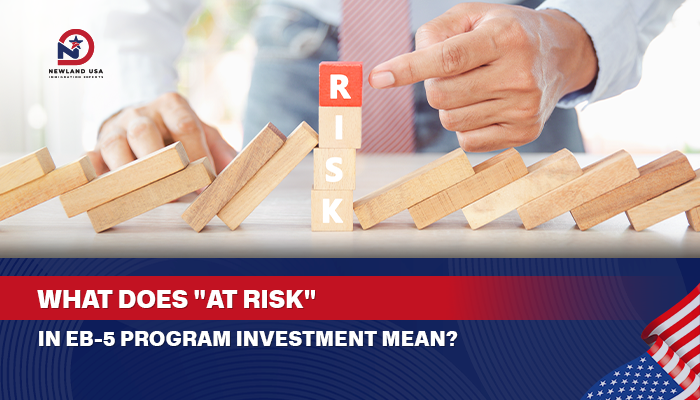
In the journey to seek a green card through the EB-5 investment pathway, many investors often wonder about the concept of “at risk” – a mandatory requirement of the EB-5 program. Unlike what many people think, EB-5 risk doesn’t mean choosing dangerous or unstable projects. Instead, this is an important legal criterion designed to ensure the legitimacy and effectiveness of this entire immigration program.
1. Overview of EB-5 Program and Investment Requirements
The EB-5 program was established in 1990 with a dual mission: creating permanent residency opportunities for foreign nationals while stimulating U.S. economic growth. To participate in this program, investors must meet minimum capital requirements depending on the project location.
Specifically, EB-5 investment requires a minimum capital of $1,050,000 USD for areas outside TEA regions and $800,000 USD for areas within TEA (Targeted Employment Area) regions. TEA areas are typically rural regions or localities with high unemployment rates, where the U.S. government encourages investment attraction.
However, meeting the minimum capital requirement is just the beginning. The EB-5 program also sets many other strict criteria, with the “at risk” requirement playing a key role in determining the success or failure of immigration applications.
2. The Nature of “At Risk” Requirement in EB-5
2.1. The Real Definition of “At Risk”
Many investors mistakenly believe that EB-5 risk means accepting highly unstable projects. In reality, this concept has a different meaning.
“At risk” in EB-5 investment means that the contributed capital must actually participate in business activities with real potential for both profit and loss. This prevents investors from simply “buying” green cards through fake transactions that don’t bring real economic value.
2.2. Purpose of Risk Requirement
USCIS established this requirement to ensure the EB-5 program achieves two core objectives:
First, stimulate the U.S. economy by creating real job opportunities for local workers. Each EB-5 investment must demonstrate the ability to create at least 10 full-time jobs.
Second, ensure investors are truly committed to the project and ready to take responsibility for business results. Capital return guarantees or fixed profits would eliminate the true investment nature of the EB-5 program.

3. Detailed Legal Framework on Risk Standards
3.1. Principles from Matter of Izummi
The Matter of Izummi decision established fundamental principles about EB-5 risk, including three key elements:
Full capital transfer: Investors must prove complete transfer of committed capital to the new commercial enterprise (NCE). Any portion of capital not transferred is not considered to meet EB-5 risk requirements.
Property ownership and usage rights: If EB-5 investment includes granting ownership or usage rights of property to investors, the corresponding value will be deducted from the total capital considered “at risk.” This ensures no property is used as a “cushion” to protect the investment.
Contractual obligations: EB-5 investment agreements cannot contain any guarantees about financial results. Investors must accept the possibility of significant losses as well as opportunities for profit.
3.2. Addition from Matter of Ho
The Matter of Ho decision added another important criterion for EB-5 risk: the project must have actual ongoing business activities.
Simply establishing a business on paper or signing lease agreements is not enough to prove the “at risk” nature of EB-5 investment. USCIS needs to see specific business activities taking place to confirm that the capital is actually contributing to the U.S. economy.
4. Review Process and Risk Assessment
4.1. Role of Form I-526E
Investors participating in the EB-5 program through regional centers must file Form I-526E to prove compliance with EB-5 risk requirements. This is an important step in the entire process.
Unlike the previous period when Form I-526 was used for all cases, Form I-526E is now specifically designed for regional center projects.
4.2. Important Questions in the Review Process
To assess the level of EB-5 risk compliance of a project, investors should consider the following questions:
- Does the business plan clearly show both profit potential and loss possibility? Do the offering documents transparently present the actual EB-5 risks the project faces?
- Does the EB-5 investment agreement give investors real ownership in the business or just nominal commitments? Is profit sharing based on actual business results?
- Does the new commercial enterprise (NCE) have a legal obligation to transfer all EB-5 investment capital to the job-creating entity (JCE)? Are there any fees or costs that could reduce the actual amount used for production and business activities?

5. Real Cases of Violating Risk Requirements in EB-5 Program
5.1. Lack of Real Profit Opportunity
USCIS has rejected many Form I-526E applications because EB-5 investment agreements didn’t give investors the right to receive profits. Contracts that only commit to returning principal without profit-sharing mechanisms are considered violations of EB-5 risk principles.
However, it’s important to note that USCIS doesn’t evaluate the quality or profitability of projects. As long as profit opportunity exists – however small – EB-5 investment is still considered legally compliant.
5.2. Capital Not Fully Transferred
Another typical case is investors transferring money to escrow accounts but the business has no obligation to use this money for production and business activities. In a specific situation, a construction project was completed while EB-5 investment capital remained in escrow accounts, proving there was no real need for this capital.
6. Importance and Benefits of Complying with Risk Requirements
6.1. Ensuring Program Transparency
The EB-5 risk requirement plays an important role in maintaining the credibility and effectiveness of the EB-5 program. It prevents abuse of the program to simply “buy” green cards without truly contributing to the U.S. economy.
For legitimate investors, complying with these regulations actually brings many benefits. It ensures capital is invested in projects with real profit potential, rather than unsustainable plans.
6.2. Path to Permanent Residency
Investors who properly comply with EB-5 risk requirements will receive conditional permanent resident status within 24 months after Form I-526E approval. This is an important stepping stone before being able to file Form I-829 for permanent resident status.
During this time, investors and their families can live, work, and study freely in the U.S. Children receive in-state tuition rates at universities, bringing significant economic benefits.

7. Smart Investment Strategies
7.1. Choosing Suitable Projects
Understanding EB-5 risk clearly helps investors make wise decisions when choosing projects. Instead of seeking absolutely safe commitments, they should focus on projects with solid business plans and sustainable job creation potential.
Many successful investors have chosen projects that allow capital contribution in phases while still ensuring compliance with EB-5 risk requirements. This approach helps distribute financial risk while maintaining the legality of EB-5 investment.
7.2. Importance of Professional Consultation
Due to the complexity of EB-5 program regulations, seeking support from reputable immigration consulting companies becomes extremely important. These experts can help investors understand every aspect of EB-5 risk and provide advice suitable for specific situations.
Professional guidance not only helps avoid mistakes that could lead to application rejection but also optimizes success opportunities in the immigration journey. For investors serious about the EB-5 program, this is a necessary investment to protect large capital amounts and dreams of settling in the U.S.
8. Conclusion
The “at risk” requirement in the EB-5 program is not a barrier but a mechanism to ensure transparency and effectiveness of the entire system. Investors who clearly understand and properly comply with EB-5 risk regulations will have higher success opportunities in their investment immigration journey.
Newland USA, with an experienced team of experts and the motto “Secure Settlement — Lifelong Prosperity,” is ready to consult and support customers on information related to the EB-5 investment program. Please contact Newland USA immediately at hotline 0785591988 or email: newsletter@newlandusa.asia for detailed and free consultation.
News Categories


Related news

Who Is the ESTA Program For? How to Assess Your Fit Before Applying in 2026

Who Is the ESTA Program For? How to Assess Your Fit Before Applying in 2026

From Motorcycle Mechanic to Automotive Technician in the U.S.: Skills and Qualifications to Prepare in 2026

AI in Auto Repair in the U.S. 2026: How Artificial Intelligence Diagnoses Vehicle Problems Faster and More Accurately
7 Key Technologies Every Industrial Maintenance Technician in the U.S. Needs to Know in 2026
PLC & Automation Skills: A Launchpad for Maintenance Technicians in the United States in 2026
What Is the ASE Certification? Requirements, Exam Roadmap, and Its Importance for Auto Technicians in the U.S. in 2026
EB5 Capital Recovery Time: How Long It Takes and the Key Milestones

Electric Vehicle Technicians in the U.S.: The “Golden” Skills Helping Vietnamese Auto Mechanics Get Ahead of the 2026 EV Trend