Pros and Cons of Consular Processing and Adjustment of Status for EB-3 Visa
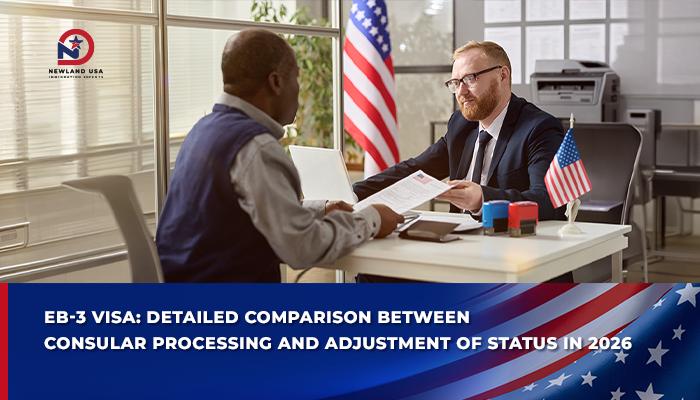
For applicants pursuing their dream of settling in the U.S. through the EB-3 Visa, the final step to complete the green card journey is often the most confusing one: should you go with Consular Processing or Adjustment of Status? Each route has its own characteristics, requirements, and processing timelines that directly affect your experience and the outcome of your case. In this article, Newland USA provides a detailed analysis of both options, updated with 2026 policy changes, and also explains what Form DS-260 is — so Vietnamese applicants can make the best decision for their individual situation.
1. Overview of the EB-3 Visa and the Green Card Application Stage
The EB-3 Visa (Employment-Based Third Preference) is a U.S. immigration program under the employment-based category, open to three main groups: Skilled Workers, Professionals, and Other Workers. It’s one of the most popular and accessible legal pathways in the Vietnamese market, largely because the eligibility requirements are relatively flexible and there’s no large investment requirement like in EB-5 programs.
The EB-3 Visa journey has three major stages: obtaining PERM labor certification from the U.S. Department of Labor, filing the I-140 petition with USCIS, and finally attending the interview and receiving the green card. At this last stage, applicants have two options: going through Consular Processing at a U.S. consulate abroad (for those living outside the U.S.), or filing for Adjustment of Status (for those already lawfully present in the U.S.).
Both paths lead to the same destination — a U.S. green card — but the process, timeline, and risks involved are quite different. Understanding the specifics of the EB-3 consular process and the Adjustment of Status option will help applicants prepare their paperwork more effectively and avoid unnecessary time and money spent along the way.
2. What Is Consular Processing? The EB-3 Consular Process in 2026
Consular Processing is the method of completing an immigrant visa application at a U.S. diplomatic mission abroad — typically the U.S. Embassy or Consulate in the country where the applicant currently lives. This is the required route for anyone living outside the U.S. at the time they complete their green card application.
The standard EB-3 consular process follows these steps:
- Step 1: After USCIS approves the I-140 petition, the entire case is transferred to the National Visa Center (NVC).
- Step 2: The NVC assigns a Case Number and Invoice ID, and instructs the applicant to pay the relevant immigrant visa fees.
- Step 3: The applicant completes Form DS-260 online and submits civil documents such as a birth certificate, passport, police clearance certificate, marriage certificate (if applicable), and educational credentials.
- Step 4: Once the NVC confirms the case is Documentarily Qualified (DQ), an interview is scheduled at the U.S. Consulate in the applicant’s country of residence.
- Step 5: The applicant undergoes a medical examination with a physician authorized by the U.S. Department of State.
- Step 6: The applicant attends the official interview, presents original documents, and answers questions related to the job offer and sponsorship.
- Step 7: If the case is approved, the applicant receives an immigrant visa stamped in their passport and must enter the U.S. within the allowed timeframe to finalize the green card issuance.
According to 2026 updates, processing time after I-140 approval for Consular Processing typically ranges from 3 to 8 months, depending on the consulate’s workload and interview scheduling. For applicants in Vietnam, the EB-3 consular process is handled at the U.S. Consulate General in Ho Chi Minh City — a location very familiar to Vietnamese families going through the employment-based immigration program.

3. What Is Adjustment of Status?
Adjustment of Status (AOS) is the process of applying for a green card for applicants who are already lawfully present in the United States on a valid nonimmigrant visa, such as H-1B, L-1, F-1, or O-1. Rather than leaving the U.S. to apply for a visa at a consulate abroad, they can file Form I-485 (Application to Register Permanent Residence or Adjust Status) directly with USCIS to switch from nonimmigrant to permanent resident status.
The typical Adjustment of Status process includes:
- Filing Form I-485 along with supporting documents such as a medical examination (Form I-693), financial sponsorship letter (Form I-864), and certified copies of personal documents.
- Attending a biometrics appointment at a USCIS Application Support Center.
- Attending an interview at a local USCIS field office (in some cases, the interview may be waived).
- Waiting for the approval decision and receiving the green card by mail.
In 2026, processing time for Form I-485 under the EB-3 Visa category typically takes 9 to 13 months — longer than Consular Processing. However, applicants who go this route enjoy some notable advantages, which will be covered in more detail in the comparison section below.
4. What Is Form DS-260? Its Role in the EB-3 Consular Process
The question “what is Form DS-260” comes up frequently among Vietnamese applicants exploring employment-based immigration. Simply put, Form DS-260 is the Immigrant Visa Electronic Application used by the U.S. Department of State to collect personal information, background history, and family details from applicants before issuing an immigrant visa.
This form is completed online through the CEAC (Consular Electronic Application Center). Form DS-260 has 8 main sections that cover:
- Personal information: full name, date of birth, nationality, passport number.
- Family information: parents, spouse, children.
- Residential history and international travel history.
- Educational background and work experience.
- Information about the U.S. petitioner/sponsor.
- Security and background questions.
- Medical information (relevant health history).
- Declaration and electronic signature.
When filling out Form DS-260, applicants should be aware that every accompanying family member — including a spouse and unmarried children under 21 — must complete a separate form. The current filing fee is approximately $325–$345 USD per person, depending on the time of submission. Once submitted, information cannot be edited directly in the system; any corrections must be raised with the consular officer at the time of the interview.
In summary, Form DS-260 is a mandatory document that kicks off the interview scheduling stage in the EB-3 consular process, serving as the link between the I-140 approval and the face-to-face meeting with a U.S. consular officer.
5. Detailed Comparison: Consular Processing vs. Adjustment of Status
To help EB-3 Visa applicants make the right choice, here is a breakdown of the key differences between the two pathways:
5.1 Location
- Consular Processing takes place at a U.S. Embassy or Consulate abroad.
- Adjustment of Status is handled entirely within the U.S. by USCIS.
5.2 Forms and Processing Agencies
- Consular Processing uses Form DS-260, handled by the NVC and consular offices.
- Adjustment of Status uses Form I-485, handled by USCIS.
5.3 Processing Time in 2026
- Consular Processing: typically 3–8 months after I-140 approval and once the priority date becomes “current.”
- Adjustment of Status: approximately 9–13 months, depending on the workload at the local USCIS office.
From a timing perspective, Consular Processing is generally faster; however, interview scheduling at the U.S. Consulate in Vietnam may fluctuate due to high case volumes.
5.4 Costs
- Consular Processing: Form DS-260 filing fee (approximately $325 per person), affidavit of support fee ($120), and medical exam costs at an approved facility.
- Adjustment of Status: Form I-485 filing fee (approximately $1,440 for applicants over 14 years old), medical exam costs in the U.S., plus additional fees if filing concurrently for an Employment Authorization Document (EAD) and Advance Parole.
Overall costs for Consular Processing are spread across different stages, while Adjustment of Status fees must be paid in full at the time of filing.
5.5 Work Authorization and Travel During the Waiting Period
- With Adjustment of Status, applicants can file Form I-765 (for an EAD — work permit) and Form I-131 (for Advance Parole — travel permission) alongside their I-485. This allows them to work legally and travel in and out of the U.S. while waiting for a decision.
- With Consular Processing, applicants must remain in Vietnam or a third country until they receive their visa and enter the U.S. as permanent residents.
5.6 Flexibility and Risk
- Adjustment of Status lets applicants continue their life, work, and studies in the U.S. throughout the entire waiting period. If a case is denied, there are options to appeal or refile.
- Consular Processing depends on consulate scheduling and the judgment of the interviewing officer. If denied, the appeal options are more limited since the consular process does not follow the same USCIS review procedures.
5.7 Medical Exam
- Consular Processing: conducted by a physician authorized by the U.S. Department of State in the applicant’s home country.
- Adjustment of Status: conducted by a USCIS-designated civil surgeon in the U.S. using Form I-693.
6. Pros and Cons of Consular Processing
6.1 Pros
- Processing time is generally faster than Adjustment of Status.
- Fees are significantly lower, making it a better fit for applicants based in Vietnam.
- The process is straightforward with a clear interview schedule.
- Does not require the applicant to have maintained lawful immigration status in the U.S. beforehand.
6.2 Cons
- Applicants cannot work or live in the U.S. until the visa is issued.
- Risk of being placed in “Administrative Processing” — an extended review with no set timeline.
- Dependent on the consulate’s workload and scheduling capacity.
- Limited recourse if the case is denied.
7. Pros and Cons of Adjustment of Status
7.1 Pros
- Applicants can live, work, and travel (with Advance Parole) in the U.S. while waiting for approval.
- If the priority date is already “current,” applicants may be able to file I-140 and I-485 at the same time (concurrent filing), which saves significant time.
- Denial appeal process is clearer and more structured.
- Lawful status is maintained even after the original nonimmigrant visa expires.
7.2 Cons
- Filing fees are significantly higher.
- Processing time is longer.
- Not available to those who have violated immigration laws or overstayed a visa.
- If the applicant leaves the U.S. without Advance Parole, the case will be considered abandoned.
8. Which Option Should EB-3 Visa Applicants in Vietnam Choose?
For the majority of EB-3 Visa applicants who currently live in Vietnam and have never been to the U.S., Consular Processing is essentially the only option. The EB-3 consular process at the U.S. Consulate General in Ho Chi Minh City is specifically designed for this group, with standardized procedures and relatively consistent processing times.
On the other hand, individuals who are currently in the U.S. on a lawful work visa (H-1B), student visa (F-1), or intra-company transferee visa (L-1) may want to consider Adjustment of Status. This is especially relevant for people whose children are currently enrolled in U.S. schools.
Key factors to weigh before deciding include:
- Current immigration status.
- Need to work and travel during the waiting period.
- Financial situation and budget for filing fees.
- Immigration history, including any prior visa denials.
- Family situation, including dependent children.
9. Important Notes for the EB-3 Consular Process in 2026
To ensure the EB-3 consular process runs smoothly, EB-3 Visa applicants should keep the following in mind:
- Monitor the monthly Visa Bulletin: The U.S. Department of State publishes a Visa Bulletin each month showing which priority dates have become “current.” Only once a priority date opens can the applicant move forward with next steps.
- Prepare complete civil documents: This includes originals and certified English translations of birth certificates, marriage certificates, police clearance certificates, diplomas, and academic transcripts.
- Be fully honest on Form DS-260: Any false information can result in a permanent denial. Accuracy and consistency are the most important principles.
- Schedule the medical exam at an approved facility: Only clinics authorized by the U.S. Department of State are accepted.
- Prepare thoroughly for the interview: Bring all original documents, dress professionally, and be ready to clearly answer questions about your job and plans to settle in the U.S.
Working with a professional immigration consulting firm will also help applicants avoid common mistakes and optimize the overall processing timeline for their EB-3 Visa case.

10. Conclusion
The journey to settle in the U.S. through the EB-3 Visa program is a major milestone for many Vietnamese families. Consular Processing is the familiar, typically faster route for applicants living abroad, while Adjustment of Status offers greater flexibility for those already lawfully present in the U.S.
By understanding the EB-3 consular process, knowing what Form DS-260 is, and weighing the pros and cons of each option, applicants can make a confident, well-informed decision suited to their personal situation. It’s always best to consult with experienced immigration professionals to ensure the case is handled as efficiently as possible — minimizing risks and reducing wait times. The road to a U.S. green card may be long, but with careful preparation and the right strategy, the dream of building a life in America is absolutely within reach.
Learn more:
- What Is an EAD Card? Latest 2026 Regulations for the EB3 Category
- EB3 Immigration to the US: Can Your Spouse and Children Come Along?
- Working at Medical Glove Factories in the USA: Salary, Benefits, and EB3 Green Card Opportunities
- How Much Does EB3 Skilled Worker Immigration to the US Cost? A Complete Financial Preparation Guide from A to Z
- Retrogression: What It Is and How It Affects Your EB3 Case
News Categories



Related news
Why Must You File Your EB5 Petition Before September 30, 2026? What Is the “Grandfathering” Benefit?

Why U.S. Manufacturers Wait More Than a Year for PERM to Hire High-Skilled Workers in 2026

Skilled Labor Shortage: The Workforce Paradox Pushing the United States to “Open the Door” in 2026

Why Are U.S. Businesses “Hungry” for EB3 Skilled Workers?
2026 EB-5 Visa Adjudication Progress Update: Realistic Waiting Times for Vietnamese Investors

How to Negotiate Flat-Rate Pay for Auto Mechanics in the U.S. in 2026
The Electric Vehicle (EV) Wave in the U.S. and the Retraining Challenge for EB3 Auto Mechanics

EB5 Investment Loans: What Investors Should Note in 2026

Calling 911 in the U.S.: When to Call and How to Work with the Police