401(k): The Retirement Plan for Workers in the United States
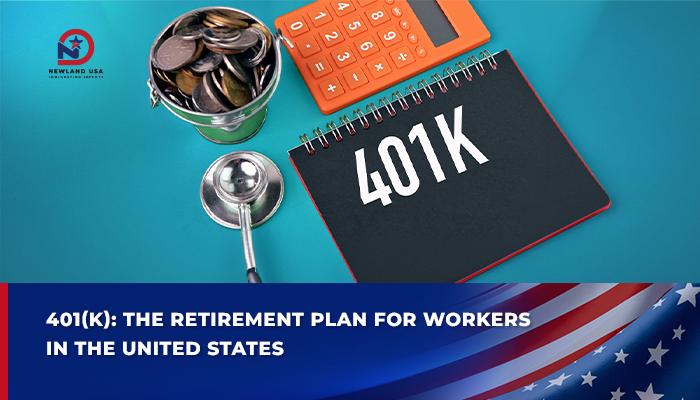
For workers living in the United States, planning financially for old age is one of the top priorities. Within the U.S. benefits system, 401(k) is widely considered the most popular and effective wealth-building tool to help employees build a secure retirement future. So how does a 401(k) retirement fund in the U.S. actually work? Who can participate? And why is it a benefit that anyone living and working in the U.S. should take full advantage of? This article from Newland USA provides comprehensive, detailed information to help you fully understand this important savings program.
1. What is a 401(k)?
A 401(k) is an employer-sponsored retirement savings plan, named after Section 401(k) of the U.S. Internal Revenue Code. Under this plan, workers in the U.S. can set aside a portion of their pre-tax income from each paycheck and invest it into a personal account within the plan. The contributed funds grow over time through the investments chosen by the participant, while also receiving significant tax advantages from the federal government.
This is not an ordinary savings account. The 401(k) retirement fund in the U.S. is specifically designed to encourage working individuals to proactively build long-term financial resources for their retirement years. With its tax-deferral mechanism and growth potential through compound interest, the 401(k) has been a cornerstone of the U.S. social security system for decades.
2. How the 401(k) Retirement Fund Works
When a worker in the U.S. is hired by a company that offers a 401(k) plan, they will be invited to enroll. The basic process works as follows:
First, the participant chooses the percentage of their income they want to contribute to the 401(k) account each pay period. This amount is automatically deducted before federal income tax is calculated, which lowers the participant’s taxable income for that year. Next, the contributed funds are allocated into investment options that the participant selects themselves — these can include mutual funds, index funds, target-date funds, bonds, stocks, or exchange-traded funds (ETFs). Returns from these investments are continuously reinvested and grow through compound interest without being taxed until the money is withdrawn.
Notably, many U.S. employers also offer an employer match — meaning the company will add extra money into the employee’s 401(k) account based on how much the employee contributes. According to data from Fidelity Investments, as of the end of 2025, approximately 88% of employees participating in a 401(k) program received an employer match, with an average match of 4.7% of salary. This is essentially “free money” that every worker in the U.S. should make the most of.

3. 401(k) Contribution Limits for 2025 and 2026
Each year, the Internal Revenue Service (IRS) sets the maximum contribution limit for 401(k) retirement funds in the U.S., and this figure is typically adjusted upward for inflation. For 2025, the individual contribution limit is $23,500 for those under age 50. Individuals aged 50 and above are allowed to make additional catch-up contributions of $7,500, bringing their total maximum to $31,000. For those specifically aged 60–63, under new provisions from the SECURE 2.0 Act, the catch-up contribution is increased to $11,250, allowing a total possible contribution of $34,750.
Moving into 2026, the IRS has announced a new base contribution limit of $24,500, while the catch-up contribution for those over 50 increases to $8,000. The combined limit — including employer contributions — for 2025 is $70,000 or 100% of compensation, whichever is lower. These figures reflect the U.S. government’s ongoing effort to encourage workers to save more for retirement through the 401(k) program.
4. The Two Main Types: Traditional 401(k) and Roth 401(k)
When participating in a 401(k) retirement fund in the U.S., workers generally get to choose between two types: Traditional and Roth. Each offers different tax advantages suited to different financial situations.
With a Traditional 401(k), contributions are made from pre-tax income, which immediately reduces the amount of tax the participant owes in the current year. However, when funds are withdrawn at retirement, the entire amount withdrawn — including both principal and earnings — is subject to income tax. In other words, you defer taxes now but pay them later.
On the other hand, a Roth 401(k) requires contributions to be made from after-tax income. This means you don’t get an immediate tax break, but in return, when you reach retirement age and make qualified withdrawals, the entire amount — including years of accumulated earnings — is completely tax-free. This is a significant advantage for those who expect to be in a higher tax bracket in the future.
One important note: both types share the same annual contribution limits, and workers in the U.S. can split their contributions between both types of accounts, as long as the combined total does not exceed the allowed limit. Additionally, since the SECURE 2.0 Act took effect, Roth 401(k) accounts are no longer subject to Required Minimum Distributions (RMDs) during the account owner’s lifetime — adding considerable flexibility to retirement asset management.
5. Withdrawal Rules and Penalties
The 401(k) retirement fund in the U.S. is designed for long-term goals, so the IRS enforces strict rules around withdrawals. Generally, to withdraw funds without penalty, a participant must meet at least one of the following conditions: be at least 59½ years old, have separated from employment, become permanently disabled, or have their plan terminated.
If withdrawals are made before age 59½, the worker in the U.S. will face a 10% penalty on the total amount withdrawn, in addition to ordinary income tax. For example, if you withdraw $10,000, you will lose $1,000 to the penalty — before factoring in income tax based on your individual tax rate. Some cases of financial hardship (hardship withdrawals) may be approved, but the 10% penalty still applies unless specific exceptions are met.
In addition, starting at age 73 (increasing to 75 in 2033), owners of Traditional 401(k) accounts are required to take annual Required Minimum Distributions (RMDs). Failure to comply can result in a penalty of up to 25% on the amount that should have been withdrawn, on top of applicable income taxes.
Some 401(k) plans also allow participants to borrow from their account, with a maximum of $50,000 or 50% of the account value (whichever is less), and the loan must be repaid within 5 years. However, if the loan is not repaid on time, the remaining balance will be treated as a taxable withdrawal.
6. Real-World 401(k) Data — The Retirement Landscape in the U.S.
According to the latest analysis by financial analysts, based on nearly 25 million accounts, the average 401(k) balance as of the end of 2025 reached approximately $146,100 — an 11% increase compared to the end of 2024 and the third consecutive year of double-digit growth. The average total savings rate for participants was 14.2%, made up of 9.5% from employee contributions and 4.7% from employer matching contributions.
Notably, for workers in the U.S. who have participated in a 401(k) plan continuously for at least 15 years at the same company, the average balance jumped to approximately $304,200. This figure demonstrates the power of disciplined long-term saving combined with the effects of compound interest. Among women who saved consistently for 15 or more years, the average balance exceeded $500,000 for the first time in 2025.
However, the median balance — which more accurately reflects the savings level of the majority — stood at just $34,400, highlighting a significant gap between strong savers and those who are newer to the plan or contribute inconsistently. This underscores the importance of starting early and maintaining steady contribution habits with a 401(k) retirement fund in the U.S.

7. Immigrants and Eligibility to Participate in 401(k)
A common question within the Vietnamese community living in or preparing to move to the U.S. is: Can Green Card holders or work visa holders participate in a 401(k)? The answer is yes.
Under current regulations, Green Card holders — including those who receive their Green Card through the EB-3 program — are treated the same as U.S. citizens for tax purposes (as resident aliens). Therefore, they are fully eligible to participate in an employer-sponsored 401(k) retirement fund in the U.S., with all the same benefits: pre-tax contributions, employer matching, and tax-deferred growth.
Even workers in the U.S. on work visas (such as H-1B) may be eligible to participate if they meet the tax residency criteria (the substantial presence test) and are earning income from U.S. sources. This is an important benefit that anyone planning to settle in the U.S. long-term should not overlook — the earlier you start participating, the greater the retirement savings you will accumulate.
However, for those who do not intend to remain in the U.S. permanently, it is important to carefully consider the tax implications of withdrawing from a 401(k) after leaving the country. Non-resident aliens may be subject to withholding tax of up to 30%, unless their home country has a bilateral tax treaty with the U.S. that allows for a reduced rate.
8. Benefits of Participating in a 401(k) for Workers in the U.S.
The reason 401(k) is considered the foundation of retirement planning in the U.S. comes down to these outstanding advantages:
First, attractive tax benefits. Whether you choose Traditional or Roth, participants receive significant tax advantages — either deferring taxes when contributing or avoiding taxes when withdrawing. This helps maximize the capital set aside for retirement.
Second, employer matching contributions. The employer match is essentially a financial bonus you receive completely for free. On average, employers match around 4.6% of an employee’s salary — a substantial amount when accumulated over many years.
Third, compound interest works continuously. Money in a 401(k) retirement fund in the U.S. is invested and reinvested without interruption. Over time, the compound interest effect causes savings to grow exponentially — especially powerful when you start early.
Fourth, automatic and convenient. Contributions are deducted directly from each paycheck, helping workers in the U.S. maintain financial discipline without the need for manual management.
Fifth, flexibility when changing jobs. If you leave your current employer, you can keep the account as is, roll it over into the new employer’s 401(k) plan, or transfer it to an Individual Retirement Account (IRA) without losing any of the benefits you’ve already built up.
9. Strategies to Maximize Your 401(k)
To fully unlock the potential of a 401(k) retirement fund in the U.S., workers should consider the following strategies:
Start contributing as early as possible, even if it’s just a small percentage. Gradually increase your contribution rate by 1–2% each year, especially when you receive a raise or bonus. Always contribute at least enough to receive the full employer match — this is the first and most important step. Consider how to split contributions between Traditional and Roth 401(k) based on your current tax rate and your expected tax rate at retirement. Diversify your investment portfolio in line with your age and risk tolerance. Avoid making early withdrawals or borrowing from your 401(k) unless absolutely necessary, as this significantly slows long-term growth.
10. The SECURE 2.0 Act and Notable Changes
The SECURE 2.0 Act, passed at the end of 2022, introduced several important reforms to the U.S. retirement system. Starting in 2025, businesses that establish new 401(k) plans are required to automatically enroll eligible employees (auto-enrollment), with contribution rates set to automatically increase each year until they reach a maximum of 15%. This requirement does not apply to plans that existed before December 29, 2022.
The Act also raised the catch-up contribution limit for those aged 60–63, making it easier for workers in the U.S. who are approaching retirement to accelerate their savings in the final stretch of their careers. This is a clear signal that federal policy is increasingly focused on helping more people have sufficient financial resources when they enter their senior years.

11. Why Does 401(k) Matter for Vietnamese People Settling in the U.S.?
For the Vietnamese community preparing to immigrate to the U.S. — especially through programs like EB-3 — understanding and taking advantage of the 401(k) retirement fund in the U.S. is an essential step in building a new life. Unlike Vietnam, where the social insurance system is the primary source of retirement income, in the U.S. every individual must proactively build their own retirement fund. Social Security only covers approximately 30–35% of income needs in retirement; the rest depends heavily on personal savings through 401(k) and other investment channels.
12. Conclusion
A 401(k) is not just a savings account — it is a financial foundation that helps workers in the U.S. build a stable and comfortable life after years of hard work. With attractive tax benefits, employer matching programs, and contribution limits that continue to rise, the 401(k) retirement fund in the U.S. is truly a tool that every working person should learn about and take full advantage of.
Newland USA, with its experienced team of specialists and the motto “Settled with Confidence — Prosperous for Life,” is ready to provide consultation and support in preparing your application and accompanying you throughout the entire U.S. EB-3 immigration process. Contact Newland USA today via hotline 0785591988 or email: clientcare@newlandusa.asia for detailed, free consultation.
News Categories


Related news
Who Is the ESTA Program For? How to Assess Your Fit Before Applying in 2026

Who Is the ESTA Program For? How to Assess Your Fit Before Applying in 2026

From Motorcycle Mechanic to Automotive Technician in the U.S.: Skills and Qualifications to Prepare in 2026

AI in Auto Repair in the U.S. 2026: How Artificial Intelligence Diagnoses Vehicle Problems Faster and More Accurately

7 Key Technologies Every Industrial Maintenance Technician in the U.S. Needs to Know in 2026
PLC & Automation Skills: A Launchpad for Maintenance Technicians in the United States in 2026
What Is the ASE Certification? Requirements, Exam Roadmap, and Its Importance for Auto Technicians in the U.S. in 2026
EB5 Capital Recovery Time: How Long It Takes and the Key Milestones

Electric Vehicle Technicians in the U.S.: The “Golden” Skills Helping Vietnamese Auto Mechanics Get Ahead of the 2026 EV Trend