A-to-Z Guide to Applying for American Colleges
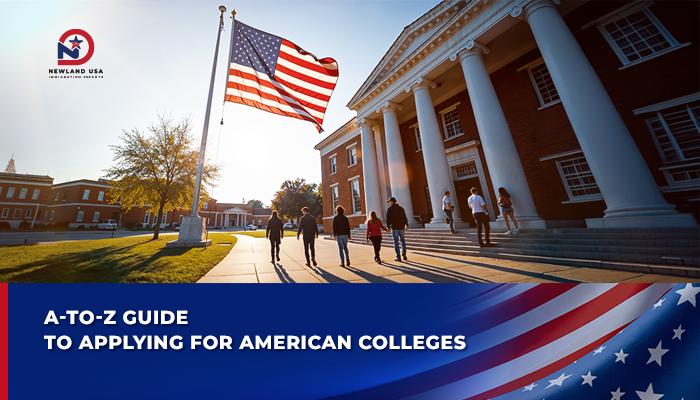
For Vietnamese families who are settling or preparing to settle in the United States, applying to American colleges is one of the most important steps in opening the door to their children’s future. Unlike the traditional study-abroad path, families who already hold a green card through programs like EB-3 or EB-5 can enjoy a wide range of outstanding green card education benefits — from reduced tuition to federal financial aid. In the article below, Newland USA provides a detailed A-to-Z roadmap so that parents and students can fully understand the entire college application process in the U.S., especially from the perspective of immigrant families.
1. Why do immigrant families need to understand the U.S. college application process?
Many Vietnamese parents who arrive in the U.S. through the EB-3 Skilled Workers program or EB-5 investor visa tend to focus on stabilizing their daily lives and careers, but few anticipate that the American college admissions system is completely different from Vietnam’s. In the U.S., there is no single national entrance exam like Vietnam’s high school graduation exam. Instead, each school evaluates applicants based on a comprehensive application package that includes grade point average (GPA), standardized test scores, a personal essay, recommendation letters, and extracurricular activities.
For families who already have a green card, sending their children to college in America offers a huge advantage over international students. Their children don’t need to apply for an F-1 student visa, aren’t limited by admissions quotas for foreign students, and most importantly are treated as “domestic students” — meaning they receive the same treatment as U.S. citizens in nearly all aspects of admissions. That’s why understanding the U.S. college application process not only helps families prepare better but also allows them to fully take advantage of the privileges that come with permanent resident status.
2. Outstanding education advantages of holding a U.S. green card
Before diving into the steps for preparing an application, parents need to understand the green card education benefits their children are entitled to. These benefits form the foundation for immigrant families to develop the right financial and academic strategy when sending their children to college in the U.S.
In-State Tuition: One of the most valuable benefits is the right to pay tuition at the in-state resident rate at public universities. The difference between in-state and out-of-state tuition can be tens of thousands of dollars per year. For example, at the University of Florida, in-state tuition is only about $6,380/year, while out-of-state students pay over $28,000. To qualify for this tuition rate, green card holders must meet the state’s residency requirements for a certain period (usually 12 months).
Federal Financial Aid: Permanent residents are fully eligible to submit the FAFSA (Free Application for Federal Student Aid) to receive non-repayable grants, low-interest subsidized loans, and work-study programs. For the 2026–2027 academic year, eligible students can access federal loans of up to $20,500/year. When filling out the FAFSA, students with a green card need to provide their Alien Registration Number (ARN), which is 8–9 digits, and select “Eligible Non-citizen” in the citizenship section.
Exclusive scholarships and grants: Beyond federal aid, many universities, private organizations, and scholarship funds offer financial support specifically for U.S. citizens and permanent residents. This is an opportunity that international students cannot access, significantly reducing the financial burden on families.
No restrictions on employment opportunities: Unlike F-1 students who are limited in the number of hours they can work, green card holders are free to work full-time or part-time without needing permission. This opens up opportunities for internships, gaining work experience, and earning income while still in school.
These green card education benefits show that U.S. education for immigrants is not just a privilege — it’s a strategic investment in the entire family’s future.

3. The U.S. college system — What parents need to know before applying
To apply to American colleges effectively, families need to understand the structure of higher education in the U.S. America has over 4,000 colleges and universities, divided into several types:
Community College: These offer 2-year programs and award an Associate degree. This is a popular choice for many newly settled families because of the low tuition and the ability to transfer to a 4-year university afterward. For green card holders, community college costs are very affordable — just a few thousand dollars per year.
Universities and Liberal Arts Colleges: These offer 4-year bachelor’s degree programs. Public universities usually have favorable in-state tuition rates, while private universities charge higher tuition but often come with attractive financial aid packages.
Research Universities: These are ideal for students with a strong academic focus who plan to pursue a master’s or doctoral degree later on.
When building a school list, experts typically recommend that parents work with their child to create a “college list” of 6–10 schools in three categories: 2–3 “reach” schools (dream schools with low acceptance rates), 3–5 “match” schools (a good fit for the student’s actual abilities), and 1–2 “likely” schools (safety schools with a high chance of acceptance). Balancing academic quality, cost, location, and campus culture will help the family make a wise decision.
4. Step-by-step timeline for preparing a U.S. college application
The U.S. college application process typically takes 12 to 18 months. Below is a detailed timeline that immigrant families should follow:
Phase 1 — 10th grade and early 11th grade (Sophomore – Junior Year): This is the golden time to start planning. Students should focus on maintaining a high GPA, participating in meaningful extracurricular activities, and beginning to research target colleges. Families should attend college fairs together, visit campuses (college visits), and research information on each school’s official website. For families who have recently arrived in the U.S., this is also when students should improve their academic English through ESL programs or AP (Advanced Placement) classes.
Phase 2 — Spring and summer of 11th grade (Spring – Summer of Junior Year): Students need to take the SAT or ACT — two standardized tests required or encouraged by most American universities. Although some schools still have a “test-optional” policy (scores are not mandatory), many top schools have returned to requiring standardized test scores starting from 2024–2025. In addition to the SAT/ACT, students should take AP Exams in May to earn college credits. Summer is the ideal time to brainstorm ideas for the personal statement and develop extracurricular projects.
Phase 3 — Fall of 12th grade (Fall of Senior Year): This is the “home stretch.” Students need to finalize their Common App Essay, write supplemental essays for each school, request recommendation letters from teachers and school counselors, and submit applications according to each round’s deadline. Parents play a supporting role: helping their child track deadlines and prepare financial documents.
Phase 4 — Spring of 12th grade (Spring of Senior Year): Students receive admissions decisions, compare financial aid packages from the schools they’ve been accepted to, attend “admitted student day” events, and make their final decision before May 1 (National Decision Day).
5. Key components of a U.S. college application
When applying to American colleges, students need to prepare the following components:
High School Transcript: This is the official record of all academic results from 9th through 12th grade. American schools place great value on grade trends — meaning a GPA that improves over the years sends a positive signal.
Standardized Test Scores (SAT/ACT): Although test-optional policies still exist at some schools, the current trend shows that many prestigious universities are bringing back the requirement. An ideal SAT score for top-50 schools is usually 1,300 or above, and for the ACT, 28 or above.
Personal Statement / Common App Essay: This essay is about 650 words long and showcases the applicant’s personality, life experiences, and vision. For children of immigrant families, stories about the immigration journey, adapting to a new culture, or overcoming language barriers can become incredibly compelling and authentic essay material.
Letters of Recommendation: Typically, 2–3 letters are needed from subject teachers and school counselors. Students should ask teachers who know them best and request letters early — ideally before September of senior year.
Extracurricular Activities: American schools look for diversity and long-term commitment. It’s not necessary to join many activities; instead, choose a few areas that show passion, leadership, and community impact.
Financial Documents (CSS Profile/FAFSA): As mentioned, families with a green card are eligible to file FAFSA. In addition, many private schools also require the CSS Profile — a more detailed form managed by the College Board that helps schools assess a family’s financial need.
6. Admissions rounds and important deadlines
The U.S. college admissions system has several application rounds, each suited to a different strategy:
Early Decision (ED): If accepted, the applicant commits to attending that school. The deadline is usually November 1 or November 15. This round is best for students who have clearly identified their top-choice school.
Early Action (EA): Similar to ED in terms of timing but non-binding. Students can still compare offers from other schools before making a decision. This is a flexible option for families who want early results while keeping their options open.
Regular Decision (RD): The standard round with deadlines typically from January 1 to January 15. Results are usually announced in March or April. Most applicants choose this round because it allows more time for preparation.
Rolling Admissions: Some schools review applications on a rolling basis in the order they’re received until spots are filled. Results are usually given within 4–8 weeks. Families who have recently arrived in the U.S. can take advantage of this if they need more time to prepare.

7. Common App and Coalition App — Online application platforms
Most American universities accept applications through two main platforms: the Common Application (Common App) and the Coalition Application. Common App currently connects with over 1,000 schools, allowing students to apply to multiple schools at once by filling out just one set of general information. Each school may require additional supplemental essays.
For immigrant families, using Common App is very convenient: parents can track progress alongside their child, check the list of required documents, and make sure no deadline is missed. A useful tip is to create a tracker on Google Sheets or Excel with columns for: school name, deadline type (ED/EA/RD), due date, completion status for each application component, and personal notes.
8. Financial strategy for immigrant families sending their children to college in the U.S.
College costs in the U.S. are the top concern for every parent. However, thanks to green card education benefits, immigrant families have more financial tools available than study-abroad families:
First, file the FAFSA as soon as the submission period opens (usually in October each year). Filing early gives the family a better chance of receiving more types of aid, including the Pell Grant — a non-repayable grant for students with financial need. To complete the FAFSA, parents need to prepare tax returns from the two most recent years, the child’s Social Security Number, and the Alien Registration Number on the green card.
Second, look into in-state tuition policies in the state where the family resides. Each state has its own rules about the minimum residency period (usually 12 months) before qualifying for in-state tuition. Families should plan their residency early to make sure their child qualifies by the time they start school.
Third, actively search for scholarship opportunities. Beyond school-based scholarships (merit-based or need-based), there are thousands of scholarship funds from private organizations, businesses, and community groups available to permanent residents. Parents should encourage their child to start searching for and applying to scholarships from 11th grade onward.
A smart financial strategy when sending your child to college in the U.S. not only helps save money but also ensures your child can attend the most suitable school without excessive financial pressure.
9. Common mistakes to avoid when applying
The U.S. college application process has plenty of “pitfalls” that families can easily fall into:
Applying too late: Many newly settled families are not yet familiar with the American admissions timeline and can easily miss important deadlines. Start preparing at least 12–18 months before the intended enrollment date.
Not taking advantage of financial aid: Some parents assume that FAFSA is only for U.S. citizens, but in reality, green card holders are fully eligible to apply. Skipping this step means missing out on tens of thousands of dollars in potential aid.
Writing a generic essay: A “cookie-cutter” essay that simply lists academic achievements will struggle to impress the admissions committee. Instead, draw on real stories — the journey of fitting into a new homeland, the challenges of learning in a second language, or the determination to build a better life with your family.
Only targeting prestigious schools: Parents often get caught up in rankings and forget to assess actual fit. A “match” school with a strong academic program, good support community, and reasonable costs can sometimes be a wiser choice than an Ivy League school.
Not researching each school thoroughly: Every school has its own requirements for supplemental essays, interviews, portfolios, or auditions (for arts programs). Carefully reviewing each school’s official admissions page is a step you can’t skip.

10. U.S. education for immigrants — A long-term investment for the next generation
Looking at the bigger picture, U.S. education for immigrants doesn’t stop at a college degree. When children graduate in the U.S. as permanent residents, they are free to seek employment in any field without being restricted by work visas. Opportunities for internships, building professional networks, and long-term career growth are wide open.
Moreover, the U.S. education system for immigrants is designed to support cultural integration and well-rounded development. Through extracurricular activities, internship programs, and international exchange opportunities right on campus, students not only gain specialized knowledge but also develop soft skills, critical thinking, and the ability to work in a multicultural environment — essential qualities for the global job market.
For families on the EB-3 track, after stabilizing their jobs and lives in the U.S., planning for their children’s college education is the next logical and worthwhile step. A green card is not just a residence permit — it’s a key that opens the door to high-quality education for the entire family.
11. Conclusion
The journey of applying to American colleges requires thorough preparation, patience, and a clear strategy. For immigrant families, this is not a path you walk alone — with a green card in hand, your children enjoy the full range of green card education benefits on par with U.S. citizens, from reduced tuition to federal financial aid. When you send your child to college in the U.S., you’re not just investing in a degree — you’re investing in their future career, professional network, and long-term quality of life for the next generation.
Learn more:
- EB3 Immigration to the US: Can Your Spouse and Children Come Along?
- What Is the ESL Program? Free English Language Support for Newly Arrived Students in the U.S.
- Key Factors That Directly Affect EB-5 Investment Interest Rates and Returns
- Key Participants in an EB-5 Transaction
- Does the EB3 Skilled Worker Immigration to the U.S. Really Cost Billions of VND?
News Categories



Related news
A-to-Z Guide to Applying for American Colleges

Workers’ Compensation Insurance in the U.S.: Important Things Immigrant Workers Need to Know
What Is an EAD Card? Latest 2026 Regulations for the EB3 Category

EB3 Immigration to the US: Can Your Spouse and Children Come Along?

Working at Medical Glove Factories in the USA: Salary, Benefits, and EB3 Green Card Opportunities

Can Auto Mechanics Settle in the US? The Surprising Truth That Shocks Many People

Why Is 2026 the Critical Time to Invest in EB5?
What Is the ESL Program? Free English Language Support for Newly Arrived Students in the U.S.

How Much Does EB3 Skilled Worker Immigration to the US Cost? A Complete Financial Preparation Guide from A to Z