ROI Analysis When Settling in the US Through EB3 Skilled Workers
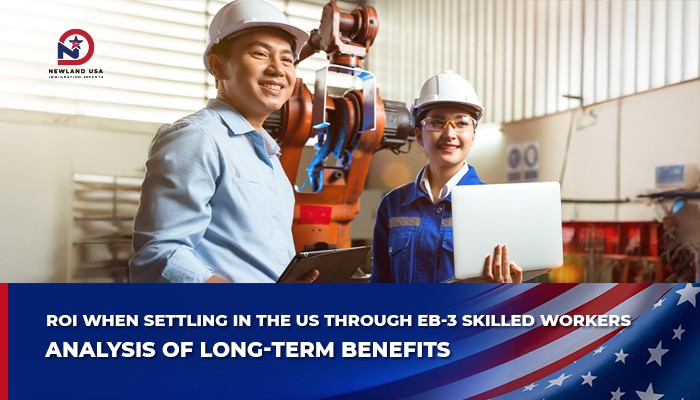
In the context of globalization and the need to seek sustainable development opportunities, the US EB3 immigration program is becoming a choice of interest to many skilled workers. Not just a simple immigration path, settling in the US through EB3 also brings exceptional ROI (Return on Investment) value compared to the initial investment. This article by Newland USA will comprehensively analyze the long-term benefits when settling in the US through the EB3 program for skilled workers, helping you better understand the profit potential and development opportunities that a green card brings to individuals and families.
1. Overview of the US EB3 Immigration Program for Skilled Workers
1.1. What is the US EB3 Immigration Program?
The US EB3 immigration program belongs to the Employment-Based Immigration visa group designed by the US Citizenship and Immigration Services (USCIS) to meet labor needs in the US job market.
The US EB3 immigration program is divided into three main groups: Skilled Workers, Professionals, and Other Workers. Among them, the skilled workers group is for those with at least 2 years of training or work experience in their professional field, meeting job requirements that are not temporary or seasonal in nature.
1.2. Criteria for Evaluating Skilled Workers in the US EB3 Immigration Program
To be approved as a skilled worker, applicants need to meet strict standards:
Professional Experience: Minimum of 2 years of work or training in a field related to the recruited position. This experience can be accumulated from multiple different companies and includes post-high school education related to the profession.
Labor Certification: The employer must complete the PERM (Program Electronic Review Management) process to prove that there are no skilled workers in the US who are qualified and willing to take the job at the prevailing wage.
Official Employment Contract: Must have a full-time, long-term job offer from a legal employer in the US. The job must not be temporary or seasonal in nature.
1.3. Why is US EB3 Immigration Attractive to Skilled Workers?
Compared to other immigration programs such as EB-1 (for people with extraordinary abilities) or EB-2 (requiring a master’s degree or special abilities), settling in the US through EB3 has more flexible conditions but still ensures similar benefits. This opens up opportunities for a large number of skilled workers with solid professional qualifications but who have not yet reached the “excellent” level according to EB-1 or EB-2 standards.
Moreover, the US EB3 immigration program does not require large capital investment like EB-5 (minimum $800,000), making it an economical and feasible choice for many families with limited financial resources but valuable professional skills.
2. Investment Cost Analysis When Settling in the US Through EB3 Skilled Workers
2.1. Basic Cost Structure
US EB3 immigration requires a relatively modest initial investment compared to other immigration programs. According to data from reputable immigration consulting companies, the total cost for the main applicant ranges from $45,000 to $80,000 (depending on the group the worker chooses), including:
Government and Application Fees:
- Form I-140 fee (Immigrant Petition for Foreign Worker): $715
- Form I-485 fee (Adjustment of Status): approximately $1,440
- Form DS-260 fee (Immigrant Visa Application): $325
- Medical examination and vaccination fees: $200-500
Attorney and Immigration Consulting Fees: $10,000 – $20,000 depending on the complexity of the application and accompanying services.
PERM Process Costs: The employer will pay for the recruitment, advertising, and labor verification process, typically ranging from $3,000 – $8,000.

2.2. Accompanying Dependents
One of the long-term benefits when settling in the US through the EB3 program is the ability to sponsor family members. Spouses and unmarried children under 21 can accompany through E34 or E35 Visas.
2.3. Premium Processing Costs (if applicable)
To shorten the processing time for Form I-140 from an average of 8-12 months to 15 business days, applicants can choose Premium Processing service for a fee of $2,805. Although not mandatory, this is an investment worth considering if you want to speed up the settling in the US through EB3 process.
2.4. Cost Comparison with Other Immigration Programs
When placed in a broader context, the cost of US EB3 immigration for skilled workers is significantly lower compared to:
- EB-5 (Investor Immigration): Minimum investment of $800,000 – $1,050,000
- EB-2 (Advanced Degree or Exceptional Ability): Slightly higher attorney fees ($15,000 – $25,000) due to the need to prove exceptional abilities or advanced degrees
- EB-1 (Extraordinary Ability): Substantial costs for preparing evidence dossiers ($20,000 – $40,000)
Thus, settling in the US through EB3 for skilled workers is not only feasible but also the most cost-effective choice for those without large capital but possessing professional skills and real work experience.
3. Direct Benefits from US EB3 Skilled Worker Immigration
3.1. High Income and Advancement Opportunities
One of the most attractive long-term benefits when settling in the US is significantly increased income. According to the US Bureau of Labor Statistics (BLS), the average salary for skilled workers in the US is about $50,000 – $70,000/year, and can reach $80,000 – $100,000 for technical professions in fields like automotive manufacturing, electronics, construction, and healthcare.
Compared to the average income in Vietnam (about $3,000 – $6,000/year for the same position), skilled workers settling in the US can increase their income by 10-15 times. Additionally, opportunities for advancement and skill development at large corporations in the US help workers quickly achieve higher positions with correspondingly increased salaries.
3.2. Comprehensive Labor Rights
When settling in the US through EB3, workers enjoy full legal protection:
Fair Wages: The prevailing wage is clearly defined based on position, region, and industry, ensuring workers are not exploited.
Safe Working Environment: The Occupational Safety and Health Administration (OSHA) strictly supervises working conditions, minimizing risks of occupational accidents.
Benefits: Paid leave, sick leave, health insurance, and many other benefits as regulated by law. Some large companies also provide retirement pension programs (401(k)), life insurance, and bonuses.
Union Rights: Workers have the right to join unions to protect their legitimate interests.
3.3. Permanent Resident Card (Green Card) and Path to Citizenship
After successfully completing the US EB3 immigration process, the main applicant and family members receive a 10-year green card, granting the right to live, work, and travel freely in and out of the US.
After holding a green card for 5 years (or 3 years if married to a US citizen), skilled workers can apply for US citizenship. US citizenship brings even greater benefits: the right to vote, run for office (except President and Vice President), travel without a visa to most countries worldwide, and stronger legal protection.
3.4. Quality Education for Children
This is one of the most significant long-term benefits when settling in the US. Children of green card holders can attend public schools from kindergarten through high school completely free of charge. The US education system emphasizes developing critical thinking, creativity, and real-world application skills, creating a solid foundation for future generations.
At the university level, children with green cards are considered in-state students, paying significantly lower tuition fees than international students (about 1/3 to 1/2). This saves hundreds of thousands of dollars for families. Furthermore, green card holders can apply for federal financial aid, scholarships, and low-interest loans that international students cannot access.
3.5. Social Security and Healthcare
The social security system in the US, although complex, provides important support for workers and families:
Social Security: After contributing to Social Security for at least 40 quarters (about 10 years), skilled workers are entitled to retirement pensions, disability benefits, and survivor benefits.
Medicare: Upon reaching age 65, workers are eligible for federal health insurance, covering a large portion of medical examination and treatment costs, helping reduce financial burden in old age.
Unemployment Insurance: In case of job loss without fault, workers can receive unemployment benefits for up to 26 weeks (some states extend up to 99 weeks during economic crises), providing temporary financial support while looking for new work.
4. Long-Term Benefits When Settling in the US Through EB3 Skilled Workers
4.1. Asset Accumulation and Financial Freedom
One of the greatest long-term benefits when settling in the US is the ability to accumulate significant assets over time.
Real Estate Ownership: The US real estate market is stable, with a long-term trend of increasing value. Skilled workers can start purchasing homes after a few years of working with support from mortgage programs offering favorable interest rates (3%-5%/year). Owning a home not only provides stable housing but is also an effective long-term investment tool.
Retirement Investment: The 401(k) program is an employer-sponsored retirement savings plan, allowing workers to deduct a portion of their pre-tax salary for investment. Many employers also match a portion of employee contributions (typically 3%-6%), creating a significant retirement fund. After 30-40 years of work, this fund can reach from $500,000 to $1 million or more, ensuring a comfortable retirement.
Stock Market Investment: The US has the world’s largest and most liquid stock market. Skilled workers can participate in investing through index funds, ETFs, or individual stocks, generating an average annual return of 7%-10%.
4.2. Stable Living Environment and Quality of Life
Settling in the US through EB3 brings an improved living environment across many aspects:
Modern Infrastructure: From transportation, communications, water and electricity systems to parks and public recreational areas, all are invested in and maintained at high standards.
Clean Environment: The US has strict environmental protection regulations, helping major cities maintain good air quality, clean water, and green spaces.
Rich Culture and Entertainment: From Broadway theaters, world-class museums, major sports events to diverse music and art festivals, skilled workers and their families have opportunities to enjoy rich cultural experiences.
Personal Safety and Security: Although no country is completely crime-free, most residential areas in the US have good security, with professional police forces and advanced surveillance systems.
4.3. Opportunities for Personal and Professional Development
Long-term benefits when settling in the US include endless opportunities for self-improvement:
Continuing Education: The US has thousands of community colleges, vocational training centers, and certificate programs with affordable tuition, helping skilled workers continuously update their skills, learn new technologies, and advance in their careers.
Entrepreneurship: After holding a green card, workers can freely start businesses in any field without restrictions like H-1B or other temporary visas. Many skilled workers have successfully built businesses from small startups to million-dollar companies thanks to the favorable business environment and government support programs.
International Networking: Working in one of the world’s largest economies opens up opportunities to connect with leading experts and colleagues globally, creating a foundation for greater career advancement.
4.4. Freedom of Movement and Global Opportunities
Holding a US green card or citizenship allows skilled workers to:
Visa-free Travel: US citizens can travel without a visa or with visa-on-arrival to over 180 countries worldwide, making international business and leisure travel extremely convenient.
Work Globally: US work experience and qualifications are highly valued worldwide, giving skilled workers competitive advantages if they want to work at multinational companies or return home in higher positions.
Sponsor Family Members: After becoming a US citizen, you can sponsor parents, siblings, and other family members to immigrate to the US, helping the whole family reunite in a better living environment.

5. ROI (Return on Investment) Analysis When Settling in US EB3 Skilled Workers
5.1. Financial ROI
To clearly visualize ROI when settling in the US through EB3, let’s look at a specific example:
Initial Investment: $60,000 (average cost for the main applicant and spouse)
Annual Income After Immigration:
- Year 1-2: $50,000/year (starting salary for skilled workers)
- Year 3-5: $65,000/year (after initial adaptation and skill improvement)
- Year 6-10: $80,000/year (after gaining experience and possible promotion)
Cumulative Income Over 10 Years: Approximately $670,000
Deducting Living Expenses and Taxes: Assuming 50% goes to living expenses and taxes, the net income is approximately $335,000
ROI = (335,000 – 60,000) / 60,000 x 100% = 458%
This is just basic ROI, not including factors like asset value appreciation, retirement investment returns, salary increases, promotions, and accumulated asset value.
The financial ROI of settling in the US through EB3 can reach 400% – 800% in the first 10 years, a return far exceeding most traditional investments.
5.2. ROI in Career Development Opportunities
Besides direct financial benefits, long-term benefits when settling in the US also include exceptional career development:
Skill Enhancement: The US has thousands of vocational training centers, apprenticeship programs (paid on-the-job training), and professional certification courses helping skilled workers update knowledge, learn new technologies, and advance in their careers.
Networking: Working in one of the world’s largest economies opens opportunities to connect with top colleagues and experts, creating a foundation for greater advancement.
International Experience Accumulation: Work experience in the US is highly valued globally, giving skilled workers competitive advantages if they want to work at multinational companies or return home in higher positions.
5.3. ROI in Quality of Life
Long-term benefits when settling in the US are measured not only in money but also in quality of life:
Safe Living Environment: The US has a transparent legal system, modern infrastructure, clean environment, and good public services.
Advanced Healthcare: The US healthcare system leads the world in technology, treatment of serious diseases, and comprehensive health care.
Diverse and Open Culture: The US is a nation of immigrants, respecting cultural and religious diversity, helping skilled workers and families easily integrate.
Recreation and Entertainment Opportunities: From famous national parks and beautiful beaches to major cultural and sporting events, the US offers countless experiences beyond work life.
5.4. ROI for Family’s Future
US EB3 immigration is a long-term investment for multiple generations:
Second Generation: Children born in the US or naturalized early become US citizens, enjoying full benefits from the start, having a solid educational foundation and career opportunities far broader than their parents.
Financial Legacy: Assets accumulated in the US (real estate, retirement accounts, investments) can be passed down to children and grandchildren, creating a solid financial foundation for future generations.
6. Factors to Consider When Settling in the US Through EB3 Skilled Workers
6.1. Waiting Time
One challenge when settling in the US through EB3 is processing time. From submitting the PERM application to receiving a green card can take 2 to 4 years, depending on nationality and visa quota status. Applicants need financial and psychological plans to get through this waiting period.
6.2. Work Commitment
Although a green card allows freedom to change jobs, in the initial period (about 6-12 months after receiving the green card), skilled workers should maintain work with the sponsoring employer to avoid suspicion of immigration fraud.
6.3. Living Costs
Living costs in the US, especially in major cities like New York, San Francisco, Los Angeles, can be very high. Skilled workers need to prepare appropriate budgets and consider living in states with lower living costs like Texas, Florida, North Carolina to optimize ROI.
6.4. Cultural Adaptation
Integrating into a new living environment requires effort in language, culture, and society. Participating in English classes, local Vietnamese communities, and immigrant support organizations will help the adaptation process go more smoothly.

7. Comparing US EB3 Immigration with Other Immigration Programs
7.1. EB3 vs EB-5
EB-5 requires an investment of $800,000 – $1,050,000, suitable for wealthy investors. Meanwhile, settling in the US through EB3 only requires $45,000 – $80,000, much more accessible for skilled workers. EB-5 processing time may be faster (2-3 years) but financial risk is high if the investment project fails.
7.2. EB3 vs EB-2
EB-2 requires a master’s degree or exceptional ability, shorter waiting time but stricter entry criteria. US EB3 immigration is more flexible, suitable for skilled workers with practical experience but without a university degree or higher qualifications.
7.3. EB3 vs H-1B
H-1B is a temporary visa (maximum 6 years), tied to the employer, and faces the risk of not being renewed or selected in the lottery. In contrast, settling in the US through EB3 brings permanent residency, career freedom, and long-term security for skilled workers and families.
8. Conclusion
US EB3 immigration for skilled workers is not just an immigration path but also a smart investment bringing amazing ROI both financially and in quality of life. With reasonable initial costs ($45,000 – $80,000), this program opens up countless long-term benefits when settling in the US: high income, comprehensive labor rights, educational opportunities for children, solid social security, and a path to US citizenship.
Newland USA, with an experienced team of experts and the motto “Stable Settlement — Lifelong Prosperity”, is ready to consult and support in preparing applications and accompany clients throughout the US EB3 immigration process. Please contact Newland USA immediately via hotline 0785591988 or email: newsletter@newlandusa.asia for detailed and free consultation.
Learn more:
- Does the EB3 Skilled Worker Immigration to the U.S. Really Cost Billions of VND?
- Premium Processing EB3: Is It Worth Paying the Extra Fee?
- Common Questions About Settling in the U.S. Through EB3 Manufacturing Employment
- Requirements to become an automotive mechanic in the USA through EB3 Visa
- How Important is Form I-140 in the EB3 Visa Process?
News Categories

Related news

Working at Medical Glove Factories in the USA: Salary, Benefits, and EB3 Green Card Opportunities
Can Auto Mechanics Settle in the US? The Surprising Truth That Shocks Many People

Why Is 2026 the Critical Time to Invest in EB5?

What Is the ESL Program? Free English Language Support for Newly Arrived Students in the U.S.

How Much Does EB3 Skilled Worker Immigration to the US Cost? A Complete Financial Preparation Guide from A to Z

Sending Your Children to School in America: What New Immigrant Parents Need to Know
Key Factors That Directly Affect EB-5 Investment Interest Rates and Returns

What Is a Tax Refund? How to Receive a Tax Refund When Filing Taxes in the U.S.

FBAR and FATCA: What U.S. Immigrants Need to Know