Diseases That May Result in US Immigration Visa Rejection According to the Latest 2025 Guidelines
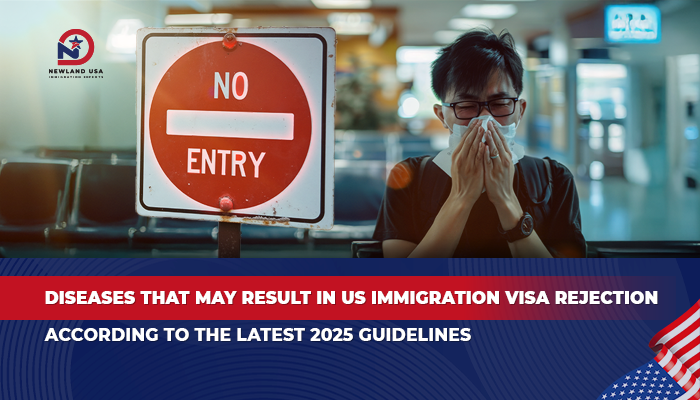
In November 2025, the US government issued new regulations for immigration application reviews, in which US immigration visas may be denied if applicants have chronic illnesses without proof of financial capacity. This decision affects millions of US immigration applications globally, especially families with elderly members or those with weak health histories. This article by Newland USA will analyze in detail the groups of diseases at high risk of rejection and how to prepare safe applications.
1. Information about new health regulations for US Visa applications
On November 6, 2025, the US State Department issued a directive guiding embassies and consulates worldwide on the health assessment process in immigration applications. This marks the return of the “public charge” policy – a legal concept used to evaluate whether an applicant is likely to become a burden on the US social welfare system.
Unlike previous periods that focused only on infectious diseases such as tuberculosis, HIV, or hepatitis, current guidelines significantly expand the scope of evaluation. Consular officers are required to consider both chronic illness conditions and the long-term healthcare payment capacity of US Visa applicants.
According to estimates from international health organizations, about 10% of the world’s population has diabetes, while cardiovascular disease is the number one cause of death globally. These numbers show that people with chronic illnesses will be greatly affected by the new policy.
2. Groups of medical conditions at high risk of rejection when applying for US immigration visa
According to the new guidance document, there are 7 main disease groups that receive special attention during the evaluation process:
2.1. Cardiovascular diseases
Cardiovascular issues such as coronary artery disease, heart failure, severe hypertension, and arrhythmia are all considered high-risk factors. These conditions typically require long-term treatment with high medical costs, including regular medication, specialized monitoring, and potential surgical intervention.
US immigrants with cardiovascular disease need to prove stable health conditions through complete medical records from cardiologists, accompanied by proof of ability to self-pay all treatment costs.
2.2. Chronic respiratory diseases
This group includes severe asthma, chronic obstructive pulmonary disease (COPD), pulmonary fibrosis, and respiratory conditions requiring regular medical intervention. Particularly, patients requiring oxygen support or home ventilators will be examined more strictly.
2.3. Cancer
A history of cancer, even after completing treatment, may still be very carefully considered. Consular officers will assess the disease stage, recurrence potential, periodic monitoring needs, and expected future treatment costs. Cancer types with high recurrence rates or requiring long-term maintenance therapy are all carefully examined by consular officers.
2.4. Diabetes and metabolic disorders
Type 1 and type 2 diabetes, especially cases with poorly controlled blood sugar, are considered chronic illnesses with high treatment costs. Patients requiring insulin, with kidney, eye, nerve, or cardiovascular complications will face higher rejection risk when applying for US Visa.
Other metabolic disorders such as thyroid disease, severe gout, and lipid disorders are also on the monitoring list.
2.5. Neurological diseases
Patients with progressive neurological diseases such as Parkinson’s, Alzheimer’s, multiple sclerosis (MS), difficult-to-control epilepsy, or other neurodegenerative diseases all belong to the potentially affected group. These conditions typically require intensive and long-term medical care.
2.6. Mental health disorders
Serious mental health issues such as severe depression, bipolar disorder, schizophrenia, or anxiety disorders requiring continuous treatment may be considered. The important thing is to prove that the condition is well controlled and does not require public medical support.
2.7. Severe obesity
Obesity is considered a risk factor leading to many other health complications such as diabetes, cardiovascular disease, high blood pressure, and musculoskeletal problems. People with BMI exceeding dangerous thresholds and accompanying related diseases will need to prove very good financial capacity when applying for US Visa.

3. The concept of “Public Charge” and its legal meaning
The term “public charge” is not a new concept in US immigration law. It has been used since the early 20th century to describe individuals likely to depend on government support for living or medical needs.
During the first term (2019-2020), the Trump administration expanded this definition, allowing rejection of US immigration visas for those unable to prove independent financial capacity. However, this policy was later suspended under the successor administration.
Currently, with reactivation and direct linkage to health conditions, the “public charge” concept has become more comprehensive. The stated goal is to protect the national budget from the burden of healthcare costs caused by immigrants. However, human rights organizations argue that this regulation may lead to discrimination based on health status or age.
4. Expert perspectives on the new policy
The immigration expert community has raised concerns about these new guidelines.
Attorney Charles Wheeler, representing the Catholic Legal Network, notes that this regulation grants too much discretionary power to consular officers – people without medical expertise to make judgments about future treatment costs or disease prognosis.
Ms. Sophia Genovese, an immigration expert at Georgetown University, points out that assessing chronic illnesses such as diabetes or cardiovascular disease is too broad and highly subjective. Many people can control their illnesses well but still be negatively affected simply because of their medical history.
Immigration attorneys also warn that the interview process may take considerably more time as consular officers need time to review more health and financial factors for each specific case.
5. Specific impact on Vietnamese people wanting to immigrate to the US
For the Vietnamese community, especially EB5 investors, EB3 workers, or families sponsoring students studying abroad, the new policy poses notable challenges:
5.1. Risks in applications with dependents
US Visa applications including elderly parents or children with health issues will face higher levels of scrutiny. Lack of private health insurance or insufficient financial evidence may lead to delays or application rejection.
5.2. Requirements for clear financial capacity proof
Applicants need to prepare:
- Bank account statements and proof of assets;
- International health insurance contracts valid in the US;
- Detailed US immigration plan including place of residence, expected healthcare facilities to use;
- Documents proving stable income and financial independence.

6. Solutions for people with chronic illnesses
Despite having medical conditions, applicants still have a chance to be approved for US immigration visa if well prepared:
6.1. Build a solid financial portfolio
Proving stable income, valuable assets, and long-term financial resources is very important. Documents need to be updated and fully notarized.
6.2. Invest in international health insurance
Purchase private health insurance packages with broad coverage and effective upon entry to the US. This shows a commitment to self-pay medical costs without relying on the public system.
6.3. Provide medical certification
Ask the treating doctor to issue certification that the disease condition is well controlled, current treatment costs are low, and no public welfare support is needed. This document should be officially translated into English.
6.4. Consult experts early
Contact reputable immigration companies to assess risks and plan applications early. This helps avoid mistakes that may lead to visa rejection.
7. Types of US immigration visas affected
Not all visa types are equally impacted. Immigration visas (immigrant visas) such as EB-5, EB3, EB2, and family sponsorship categories are the most directly affected types.
In contrast, non-immigrant visas such as F-1 student visa, B-2 tourist visa, or H-1B short-term work visa are less strictly examined regarding long-term health aspects.
8. Frequently asked questions about the new policy
Will I be rejected immediately if I have a chronic illness?
No immediate rejection. Officers will review the entire application, including disease control status, financial capacity, and health insurance. Patients with stable treatment and sufficient finances can still be approved.
Does type 2 diabetes have high risk?
There is risk if you cannot prove good blood sugar control and adequate health insurance. However, with clear medical records and financial capacity, the chance of approval is still high.
When does this policy take effect?
The guidelines are effective from November 2025 and apply to all US Visa applications submitted after the announcement date.
9. Conclusion
The current administration’s policy of tightening US immigration visa reviews reflects a trend prioritizing people with financial independence and sustainable health. For the Vietnamese community with aspirations to immigrate to the US, this is both a challenge and an opportunity to standardize applications in a professional, transparent, and complete manner.
At Newland USA, we not only provide US immigration services but also support clients in their cultural integration journey in this new country. If you need more information, please contact Newland USA immediately via hotline 0785591988 or email: newsletter@newlandusa.asia for detailed and free consultation.
Learn more:
News Categories

Related news

Working at Medical Glove Factories in the USA: Salary, Benefits, and EB3 Green Card Opportunities

Can Auto Mechanics Settle in the US? The Surprising Truth That Shocks Many People

Why Is 2026 the Critical Time to Invest in EB5?

What Is the ESL Program? Free English Language Support for Newly Arrived Students in the U.S.

How Much Does EB3 Skilled Worker Immigration to the US Cost? A Complete Financial Preparation Guide from A to Z

Sending Your Children to School in America: What New Immigrant Parents Need to Know
Key Factors That Directly Affect EB-5 Investment Interest Rates and Returns

What Is a Tax Refund? How to Receive a Tax Refund When Filing Taxes in the U.S.

FBAR and FATCA: What U.S. Immigrants Need to Know