What is NOID? A Warning from USCIS About Your US Visa Application
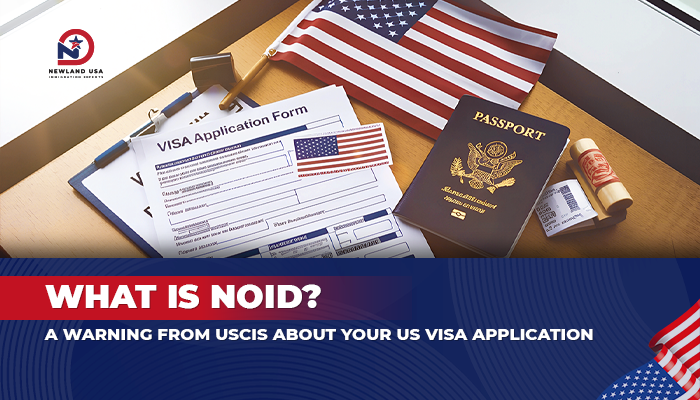
In the journey of applying for a US Visa, receiving a NOID notice from USCIS can cause anxiety and confusion for many people. What is NOID and why is it so important? This is not a final denial notice, but rather a final opportunity for you to defend and supplement your application. This article from Newland USA will help you understand the Notice of Intent to Deny (NOID), common reasons leading to this situation, how to handle it effectively, and prevention methods right from the start of your US Visa application process.
1. NOID – An Important Notice Requiring Special Attention in the US Visa Application Process
NOID – short for Notice of Intent to Deny – is an official document issued by the United States Citizenship and Immigration Services (USCIS). This is a notification that your immigration application is at high risk of being denied based on current evidence and information.
When asking “what is NOID,” many people mistakenly think this is an official denial decision. However, NOID is only a serious warning from USCIS, indicating that the agency is planning not to approve your application. But with NOID, you are still given one final opportunity to respond, provide additional evidence, and explain current issues.
1.1. Purpose of NOID
USCIS issues a Notice of Intent to Deny when they discover serious problems in the application that, if not resolved, will certainly lead to visa denial. The purpose of sending NOID is:
Reasoning: USCIS specifically lists the legal and factual grounds that may lead to your application being denied.
Right to Respond: Applicants are allowed to submit additional documents, provide legal arguments, or explain contradictions to remedy deficiencies.
Resource Optimization: This helps USCIS and applicants avoid going through a complex appeals process or resubmitting the entire application from scratch, saving both time and costs.
According to the USCIS Policy Manual (Volume 7, Part A, Chapter 11), if there are unclear points in the application, NOID must be used instead of direct denial.
2. Common Situations When USCIS Issues NOID for US Visa Applications
USCIS typically sends NOID in the following cases:
2.1. Missing Critical Evidence
When a US Visa application does not provide sufficient documents to prove the applicant meets the criteria according to immigration law, USCIS may determine that you have not completed the “burden of proof.” For example, with family sponsorship applications (Form I-130), if marriage certificates, birth certificates, or previous divorce documents are missing, a Notice of Intent to Deny may be issued.
2.2. Undisclosed Adverse Information
USCIS has a responsibility to inform applicants about any negative information they discover that the applicant is unaware of. This may include past immigration law violations, judicial records, or information from internal databases.
2.3. Document Contradictions
When USCIS discovers inconsistent information between documents – such as names, dates of birth, addresses, or work history – they may doubt the accuracy of the application. Instead of immediate denial, they send NOID to give you an opportunity to clarify.
2.4. Suspected Violations
If USCIS detects signs that you have not complied with requirements regarding residence, work, or tax obligations, they may issue a Notice of Intent to Deny requiring you to prove your compliance.

3. Common Reasons for Receiving NOID
3.1. Insufficient Evidence
This is the leading reason for receiving NOID. According to the USCIS Policy Manual (Volume 1, Part E, Chapter 6), if the initial application lacks essential evidence, reviewing officers have the right to choose Notice of Intent to Deny instead of immediate denial.
A typical example in EB-5 (investment immigration) applications is failure to clearly prove the lawful source of funds. USCIS requires documents such as bank statements, transfer contracts, and tax returns to verify “lawful source of funds.”
3.2. Mismatched Information
When documents in the application have differences in personal information, USCIS will doubt the reliability. For example, if a translation shows a different name than the original passport, or the work history declared does not match employer verification, you may receive NOID.
3.3. Legal Violations
USCIS may issue a Notice of Intent to Deny if they discover you have violated visa conditions, worked without permission, or not fully fulfilled tax obligations. According to USCIS adjudication trend data from 2025, over 18% of applications denied after NOID in employment-based visa categories were related to residence status violations or inaccurate tax filings.
3.4. Fraud Suspicions
If USCIS suspects signs of fraud – such as marriage fraud, forged documents, or untruthful information – they will issue NOID to require your explanation before making a final decision.
4. Guidelines for Handling NOID During US Visa Application Process
When receiving NOID, the most important thing is to stay calm and act carefully. Here are the steps you need to take:
Step 1: Thoroughly Study the Notice Content
The NOID will detail the issues that put your application at risk of denial. You need to analyze each point USCIS raises, accurately identifying deficiencies or contradictions that need to be addressed.
Note about the deadline: Typically, you have 30 days to respond from the date stated on the notice. If the Notice of Intent to Deny is sent by mail, you have an additional 3 days according to regulation 8 CFR 103.8(b), totaling 33 days.
Important Note: As of March 23, 2023, USCIS has ended the flexible extension policy due to COVID-19. This means you only have exactly 30 or 33 days, with no additional automatic extension time.
Step 2: Prepare Complete and Proper Supplemental Documents
USCIS emphasizes that new evidence must directly address each issue raised in the NOID, not just submitting additional documents.
Supplement missing evidence: Depending on the application type (EB5, EB2 NIW, EB3, N-400…), you need to provide specific documents such as proof of funds, professional degrees, family relationship evidence, or tax records.
Clearly explain issues raised in NOID: Clarify any points USCIS considers inconsistent.
Legal citations: Reference provisions in the Immigration and Nationality Act (INA), USCIS Policy Manual, or precedent decisions from the Administrative Appeals Office (AAO) to strengthen your argument.
Step 3: Consult with Immigration Experts
USCIS recommends applicants work with experienced immigration attorneys to ensure responses have strong legal standing. An attorney can help you:
- Accurately analyze issues in the NOID
- Build an effective response strategy
- Correctly cite code provisions
- Prepare supplemental documents according to USCIS standards
Step 4: Submit Response and Track Progress
Ensure you submit your response before the deadline, preferably several days early to avoid risks. After USCIS receives your response, they will review the entire application (including new evidence) before making an approval or denial decision.
Processing time after NOID response is not fixed and depends on the application type. For example, according to USCIS data from June 2025:
- Form I-526E (EB5) applications: average 14-20 months

5. Serious Consequences of Not Responding to NOID
If you do not respond to NOID on time or your response is not sufficiently persuasive, your application will almost certainly be officially denied.
5.1. No Response
USCIS will assume you have no intention to supplement and will issue a denial decision based on existing evidence in the application.
5.2. Inadequate Response
If supplemental documents do not directly address the issues USCIS has raised, the likelihood of application denial remains very high.
5.3. Subsequent Consequences
After receiving an official denial decision, you only have two options:
- Appeal to the Administrative Appeals Office (AAO)
- Submit a completely new application
Both options cost additional time and money. Therefore, NOID is truly the final and most important opportunity for you to defend your US Visa application.
6. Distinguishing NOID from RFE and Denial
To better understand the nature of NOID, you need to distinguish it from two other types of USCIS notices:
6.1. RFE (Request for Evidence)
Severity Level: Low – only requests supplemental missing documents
When Issued: When the application lacks documents but can be easily supplemented
Remediation Opportunity: Very high – just need to provide sufficient evidence
Response Deadline: Maximum 87 days (depending on application type)
6.2. NOID (Notice of Intent to Deny)
Severity Level: High – USCIS is leaning toward denial decision
When Issued: When evidence is insufficient or there is adverse information requiring explanation
Remediation Opportunity: Available but not high – requires very persuasive response documents
Response Deadline: 30-33 days
6.3. Denial (Official Denial)
Severity Level: Final denial decision
When Issued: After USCIS determines the application does not meet requirements
Remediation Opportunity: None – can only appeal or file new application
Response Deadline: Not applicable

7. How to Prevent NOID When Applying for US Visa
The best way to avoid receiving NOID is to prepare a thorough, complete, and accurate application from the start.
7.1. Follow USCIS Checklists
Each form type (Form I-526E, I-140, I-130, N-400…) has an official checklist on the uscis.gov website. Missing any basic documents – such as passport, birth certificate, marriage certificate, degrees, or financial reports – is the leading cause of RFE or NOID.
7.2. Ensure Information Consistency
USCIS emphasizes in the Policy Manual (Volume 1, Part E, Chapter 6) that all information in forms must match attached documents. Avoid errors such as:
- Differences in name, date of birth
- Mismatched residence or work history
- Financial figures not matching between tax returns and bank statements
7.3. Prove Legality Transparently
For EB5 applications: Prove lawful source of funds with tax returns, purchase contracts, bank documents
For I-140/I-485: Ensure degrees and work experience are validly verified
7.4. Comply with Residence and Tax Regulations
USCIS may issue NOID if they discover you have previously violated visa conditions, worked without authorization, or not fully filed taxes. According to 2025 USCIS data, over 18% of applications denied after Notice of Intent to Deny in employment-based visa groups were related to residence status violations or incorrect tax filings.
7.5. Work with Reputable Immigration Experts
USCIS recommends applicants work with immigration attorneys or experienced consulting firms. Experts can:
- Detect weaknesses in applications early
- Prepare legal arguments from the beginning
- Significantly reduce the likelihood of receiving NOID
At Newland USA, we specialize in providing comprehensive US immigration consulting services, especially the EB3 program. Our team of experts will:
- Review the entire application before submission to detect early risks that could lead to NOID
- Cross-check evidence with USCIS standards
- Accompany you throughout the process, from preparation to receiving results
- Support building a solid response if you receive a Notice of Intent to Deny
8. Frequently Asked Questions About NOID
8.1. Is NOID an official denial?
No. NOID is only a warning about the possibility of denial. You still have the opportunity to respond within the specified time before USCIS makes a final decision.
8.2. Can I request an extension for NOID response time?
No. USCIS clearly states there is no mechanism to extend the time to respond to a Notice of Intent to Deny. If you miss the deadline, the application will be automatically denied.
8.3. If denied after NOID, what can I do?
Depending on the application type, you can appeal to the Administrative Appeals Office (AAO) or file a new application with more complete supplemental evidence.
8.4. How long does USCIS take to make a decision after receiving NOID response?
There is no fixed timeframe. Processing time depends on the application type and USCIS workload. For example in 2025, EB5 applications typically take 14-20 months while family sponsorship applications take about 6-10 months.
9. Conclusion
NOID is not the end of your American dream, but an important warning and final opportunity to defend your application. Unlike RFE – which simply requests supplemental documents, and Denial – which is a final decision, Notice of Intent to Deny is a final opportunity requiring you to act quickly, accurately, and strategically.
At Newland USA, we not only provide US immigration services but also support clients in their journey to integrate into the culture of this new country. If you need more information, please contact Newland USA immediately via hotline 0785591988 or email: newsletter@newlandusa.asia for detailed and free consultation.
Learn more:
- Understanding ETA 9089 Form in the US EB3 Employment-Based Immigration Program
- Diseases That May Result in US Immigration Visa Rejection According to the Latest 2025 Guidelines
- EB3 Immigration Program – The Key to Unlocking a Bright Future for Young Vietnamese Generations
- Guide to Completing the DS-260 Form for U.S. Immigration
News Categories

Related news

What Is the IRS? Your Rights and Obligations with the U.S. Tax Agency
Retrogression: What It Is and How It Affects Your EB3 Case

How to Identify and Avoid Conflicts of Interest in EB-5 Investment Immigration
401(k): The Retirement Plan for Workers in the United States

Key Things to Know When Taking Out a Bank Loan for US Immigration

How Does the Investment Sustaining Period Affect EB-5 Investors’ Project Selection?
Financial Planning the Right Way When Settling in the U.S. Through the EB-3 Program
Why is the EB3 Visa waiting time for skilled workers faster than for other workers?

ROI Analysis When Settling in the US Through EB3 Skilled Workers