EB3 Immigration to the US: Can Your Spouse and Children Come Along?
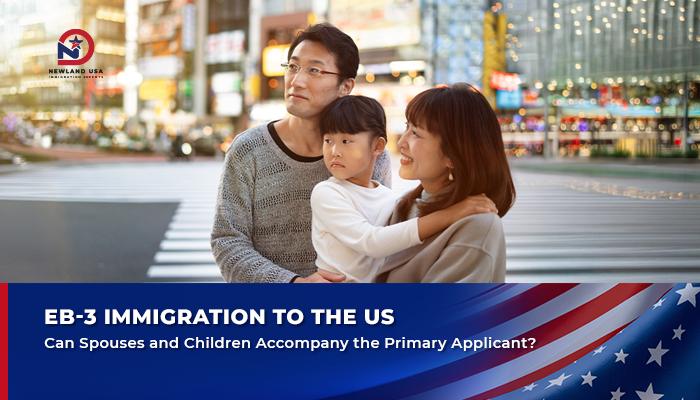
When deciding to pursue EB3 immigration to the US, one of the biggest concerns for the primary worker is whether their family — including spouses and children — can come along. Under the current rules of U.S. Citizenship and Immigration Services (USCIS), EB3 dependents are fully entitled to accompany the primary applicant and receive a green card for lawful permanent residence. In this article, Newland USA will help you understand the eligibility requirements, what benefits accompanying family members receive, and the steps needed to prepare your application so your entire family can start a new life in the US as smoothly as possible.
1. Overview of the EB3 Immigration Program
The EB3 visa is an employment-based immigrant visa that falls under the third preference category in the US immigration system. This program is designed for three groups: Skilled Workers with at least 2 years of experience or training, Professionals who hold a bachelor’s degree or higher, and Other Workers in positions requiring less than 2 years of experience. Each year, the US government issues roughly 40,000 EB3 visas to foreign workers worldwide.
A key highlight of the EB3 immigration program is that it grants green cards not only to the primary applicant but also to eligible family members. This is one of the main reasons the program is so popular among Vietnamese workers who want to build a stable future in the US. Unlike temporary visas such as the H-1B, which are time-limited and require periodic renewal, the EB3 visa provides permanent residency, opening the door to US citizenship after 5 years of continuous residence.
2. Who Qualifies as an EB3 Dependent?
According to USCIS rules, EB3 dependents include two main groups:
Legally married spouse: The primary applicant’s legally recognized spouse has the right to be included in the EB3 application. The marriage must be a monogamous union, conducted in accordance with the laws of the place where it was registered, and must not violate any US federal regulations. Temporary marriages, informal unions, or marriages not recognized by the country where they took place will not meet the requirements.
Unmarried children under 21: This includes biological children, legally adopted children, and stepchildren (if legally adopted before the child turned 16). The key requirement is that the child must be unmarried and under 21 at the time the visa is issued or the I-485 application is approved.
Including EB3 dependents in the immigration application not only ensures green cards for the whole family but also allows all members to enjoy the same benefits as the primary applicant. This is one of the standout advantages of the EB3 program compared to many other immigration pathways in the US.

3. EB3 Visa Family Benefits: What Do Spouses and Children Get?
When an EB3 immigration application is approved, all accompanying family members become Lawful Permanent Residents of the United States. Below are the EB3 visa family benefits that spouses and children immigrating to the US will enjoy:
Long-term residency and green card: All EB3 dependents receive their own green card, allowing them to live and work in the US without the time restrictions that come with temporary visas. This green card grants the freedom to travel in and out of the US, open bank accounts, sign up for insurance, and fully participate in social activities in the US.
Unrestricted work authorization: After receiving a green card, the spouse of the primary applicant has full rights to seek employment in any field that matches their skills and experience. While the I-485 application is still pending, the spouse can also apply for an Employment Authorization Document (EAD) to start working legally. This helps boost family income and financial stability during the early days of settling in.
Access to quality education: Accompanying children are entitled to free public education from kindergarten through 12th grade (K-12). At the college level, they may qualify for in-state tuition at public universities, saving a significant amount compared to what international students pay. In addition, children of permanent residents are eligible to apply for scholarships at many well-known institutions.
Access to healthcare: All family members, as permanent residents, are eligible to enroll in health insurance programs, including those under the Affordable Care Act (ACA). This ensures the family receives comprehensive medical care from the very first day they arrive in the US.
Path to US citizenship: After maintaining continuous permanent resident status for 5 years, meeting stable residency requirements, having no serious legal violations, and passing a basic English proficiency test, the entire family — including spouses and children — is eligible to apply for naturalization to become US citizens.
4. Visa Categories for EB3 Dependents
Depending on the occupational category of the primary applicant, EB3 dependents will be issued the corresponding visa type:
For the Skilled Workers category: spouses receive an E-34 visa and children receive an E-35 visa. For the Other Workers category: spouses receive an EW-4 visa and children receive an EW-5 visa. Despite the different visa codes, all EB3 dependents in these groups receive green cards with full EB3 visa family benefits as described above, including the right to live, work, study, and access social services in the US.
One important thing to note: family members share the same Priority Date as the primary applicant. This means the family’s waiting time depends entirely on how the primary applicant’s case is processed — there is no need to wait in a separate queue.

5. The Child Status Protection Act (CSPA) — A Solution When Children Are About to Age Out
One of the biggest challenges for families with children close to turning 21 while pursuing EB3 immigration to the US is the risk of “aging out.” Because EB3 processing times can stretch from several months to several years, it is not uncommon for a primary applicant’s child to cross the 21-year threshold while waiting for a visa — which means they would no longer qualify as an EB3 dependent.
To address this issue, the US Congress passed the Child Status Protection Act (CSPA) in 2002. The Act allows a child’s “immigration age” to be recalculated using a special formula instead of relying on their actual age:
CSPA Age = Actual age when a visa becomes available – Number of days the I-140 petition was pending
For example: Suppose your child is 21 years and 3 months old when a visa number becomes available, but the I-140 petition was pending for 6 months. The child’s CSPA age would be: 21 years 3 months – 6 months = 20 years 9 months. Since the result is under 21, the child still qualifies to accompany the parent under the EB3 application.
However, there are several important points to keep in mind when applying CSPA:
First, the child must take action to “seek to acquire” permanent resident status within 1 year of the date the visa becomes available. If this window is missed, CSPA protection is lost, even if the CSPA age is still under 21.
Second, the child must remain unmarried throughout the entire waiting period. If the child gets married before receiving a green card, they automatically lose their status as an EB3 dependent.
Third, under updated USCIS guidance effective August 15, 2025, the agency has reverted to using the Final Action Dates chart (Chart A) in the Visa Bulletin to determine when a visa “becomes available” for CSPA age calculation purposes. This change may affect certain cases that previously benefited from the policy of using the Dates for Filing chart. As a result, families with children approaching 21 should work closely with an immigration consultant to calculate accurately and develop the right filing strategy.
6. How to Prepare the Application for Spouses and Children Under EB3
To have spouses and children immigrate to the US alongside the primary applicant, the application process must follow these steps:
Step 1 — List dependents on the I-140 petition: When the employer files the I-140 (Immigrant Petition for Alien Workers) for the primary worker, the applicant must fully declare all accompanying family members. This is a foundational step, as all information provided at this stage directly affects whether the entire family’s application is approved.
Step 2 — Prepare documents proving family relationships: This step requires extra care. For spouses, a valid marriage certificate is needed, properly notarized and translated into English. For children, an original or certified copy of the birth certificate is required, or legal adoption documents in accordance with US immigration law. All documents in a foreign language must be translated into English and notarized to meet the standards accepted by USCIS and the Consulate.
Step 3 — File the I-485 for the entire family: Once the I-140 is approved and the Priority Date becomes current according to the Visa Bulletin, both the primary applicant and EB3 dependents file Form I-485 (Application to Register Permanent Residence or Adjust Status) to change their residency status. If the family is outside the US, the case will be transferred to the National Visa Center (NVC) and processed at the nearest US Embassy or Consulate.
Step 4 — Medical exam, biometrics, and interview: All family members, including spouses and children, must complete a medical examination using Form I-693, attend a biometrics appointment (fingerprinting), and may be required to attend an in-person interview at a USCIS office or Consulate. Children under 14 are usually exempt from the interview — parents can submit the DS-160 form on their behalf and bring the child’s passport and birth certificate to the interview.
7. Key Things to Keep in Mind When Bringing Your Whole Family to the US Under EB3
Although including your family in an EB3 application is a legally guaranteed right by USCIS, there are several factors families should pay close attention to in order to avoid unnecessary risks:
Monitor the monthly Visa Bulletin closely: The US Department of State issues the Visa Bulletin every month, updating the Priority Dates for each visa category and each country. This is the basis for determining when a family can file the I-485 or begin consular processing. Failing to keep up with these updates could cause the family to miss the right window for filing.
Ensure consistency across all documents: All information declared in the I-140 and I-485 forms must be completely consistent. USCIS cross-checks information between processing stages, and even minor discrepancies can lead to delays or even denial of the application.
Proactively calculate your child’s CSPA age: If your child is close to turning 21, work proactively with an immigration specialist to calculate the CSPA age as accurately as possible. Given that USCIS updated its policy to use the Final Action Dates chart starting in August 2025, the filing strategy needs to be tailored to each specific case.
Prepare financial support documentation: In addition to documents proving family relationships, the primary applicant must also demonstrate the financial ability to support all EB3 dependents by filing Form I-864 (Affidavit of Support). This document confirms that the family will not become a burden on the US public welfare system.
Keep copies of all documents for at least 3 years: After filing, families should keep copies of all related documents for at least 3 years, in case USCIS requests additional evidence or re-examines the case.

Conclusion
The answer to the question “Can spouses and children come along when filing an EB3 application?” is a clear YES. Under current USCIS rules, legally married spouses and unmarried children under 21 are fully entitled to accompany the primary applicant, receive permanent resident green cards, and enjoy all EB3 visa family benefits — from the right to work, study, and access healthcare to the opportunity to become US citizens in the future.
However, to make sure every family member’s rights are fully protected, families need to prepare thorough applications, stay on top of the legal requirements — especially the CSPA for cases where children are close to aging out — and work with a reputable consulting firm to optimize the EB3 immigration journey for the entire family.
Newland USA, with its team of seasoned professionals and the motto “Settle with confidence — Prosper for life,” is ready to advise and support you in preparing your application and walking with you throughout the entire EB3 immigration process. Contact Newland USA today via hotline 0785591988 or email: clientcare@newlandusa.asia for free, detailed consultation.
Learn more:
- Working at Medical Glove Factories in the USA: Salary, Benefits, and EB3 Green Card Opportunities
- How Much Does EB3 Skilled Worker Immigration to the US Cost? A Complete Financial Preparation Guide from A to Z
- Retrogression: What It Is and How It Affects Your EB3 Case
- Why is the EB3 Visa waiting time for skilled workers faster than for other workers?
- ROI Analysis When Settling in the US Through EB3 Skilled Workers
News Categories


Related news
EB3 Immigration to the US: Can Your Spouse and Children Come Along?

Working at Medical Glove Factories in the USA: Salary, Benefits, and EB3 Green Card Opportunities

Can Auto Mechanics Settle in the US? The Surprising Truth That Shocks Many People

Why Is 2026 the Critical Time to Invest in EB5?
What Is the ESL Program? Free English Language Support for Newly Arrived Students in the U.S.

How Much Does EB3 Skilled Worker Immigration to the US Cost? A Complete Financial Preparation Guide from A to Z
Sending Your Children to School in America: What New Immigrant Parents Need to Know

Key Factors That Directly Affect EB-5 Investment Interest Rates and Returns

What Is a Tax Refund? How to Receive a Tax Refund When Filing Taxes in the U.S.