U.S. Immigration Through Medical Glove Manufacturing Industry: Easy or Difficult?
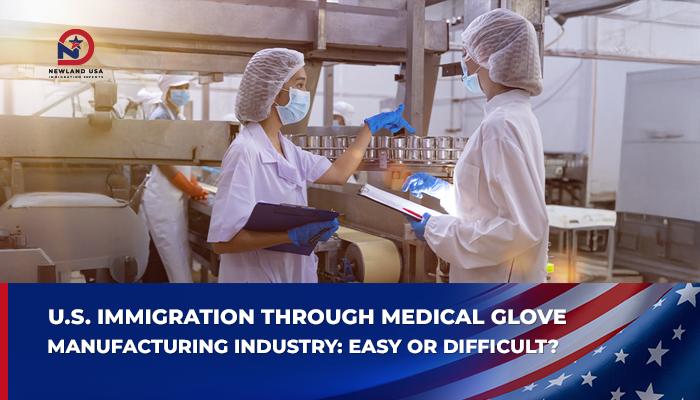
The medical glove manufacturing industry in the U.S. is opening golden opportunities for foreign workers who want to immigrate to America through the EB-3 immigration program. With high labor demand and relatively clear processes, is this path really as smooth as many people think? This article by Newland USA will provide a comprehensive analysis of the factors that determine how easy or difficult it is to immigrate to the U.S. through the medical glove manufacturing industry.
1. Overview of the Medical Glove Manufacturing Industry in the U.S.
In recent years, the medical glove manufacturing industry in the U.S. has grown strongly, especially after the COVID-19 pandemic when the U.S. government recognized the importance of having independent supply sources for critical medical equipment. Previously, the U.S. was almost entirely dependent on importing medical gloves from Southeast Asian countries like Malaysia, Thailand, and Vietnam.
The “Buy American” policy and Berry Amendment regulations (The Berry Amendment is a law requiring the U.S. Department of Defense to prioritize purchasing textiles, clothing, fabrics, and food manufactured in the U.S., unless no domestic goods meet quality, quantity, or delivery requirements. This supports domestic manufacturing as part of the “Buy American” policy) have promoted the construction of modern nitrile glove manufacturing facilities on U.S. soil.
According to published data, just one large medical glove manufacturing plant in Illinois produces up to 2.48 billion nitrile gloves per year with 31 production lines. This facility employs hundreds of workers in various positions, from engineers, chemists, welders, electricians, and CNC technicians to general production workers.
2. EB-3 Immigration Opportunities in the Medical Glove Manufacturing Industry
The EB-3 (Employment-Based Third Preference) immigration program is the legal pathway for foreign workers to obtain a green card through employment. This is considered the most popular immigration route for skilled workers.
The medical glove manufacturing industry in the U.S. is experiencing severe labor shortages. Factories need to recruit thousands of workers to operate modern production lines. This creates great opportunities for foreign workers who want to immigrate to the U.S. through the EB-3 program.
3. Three Categories in the EB-3 Immigration Program
To understand how easy or difficult it is to immigrate to the U.S. through the medical glove manufacturing industry, you need to know the three main categories in the EB-3 program:
3.1. EB-3 Professional
This category requires applicants to have a U.S. bachelor’s degree or foreign equivalent recognized by USCIS, and the job must require a bachelor’s degree as a standard condition. In the medical glove manufacturing industry, positions like chemical engineers, mechanical engineers, and quality control specialists may fall into this group.
3.2. EB-3 Skilled Workers
This group is suitable for those with at least 2 years of experience or training in a specific profession. For the medical glove manufacturing industry, positions like production line workers, packaging staff, machine operators, or production supervisors may be classified in this group. This is a popular choice for those with experience working in industrial environments.
3.3. EB-3 Other Workers
This is the most accessible category in the EB-3 program, for jobs requiring less than 2 years of training or experience. In the medical glove manufacturing industry, positions like warehouse workers typically fall into this group.

4. Specific Requirements for U.S. Immigration Through Medical Glove Manufacturing
When wanting to immigrate to the U.S. through work in the medical glove manufacturing industry, applicants need to meet some basic requirements:
For workers:
- Good health, meeting USCIS medical standards
- No serious criminal record
- Ability to work in an industrial production environment
- For the skilled group, need to prove minimum 2 years of experience or training
- Able to work in rotating shifts if the job requires
For employers:
- Must prove inability to find qualified American workers for the position
- Have financial capability to pay the prevailing wage
- Commit to providing full-time, permanent work (not temporary or seasonal)
- Complete the PERM labor certification process with the U.S. Department of Labor
5. Process for EB-3 Immigration Through Medical Glove Manufacturing
To successfully immigrate to the U.S. through the medical glove manufacturing industry, applicants need to go through a multi-step process:
Step 1: Find a sponsoring employer
This is the most important step because the EB-3 program absolutely requires sponsorship from a U.S. employer. Applicants can contact medical glove manufacturing companies directly or through reputable immigration consulting firms specializing in U.S. immigration.
Step 2: PERM Labor Certification
The employer must file for labor certification with the U.S. Department of Labor through the PERM (Program Electronic Review Management) process. In this step, the employer must prove they conducted recruitment but could not find qualified American workers. This stage usually takes 6-18 months.
Step 3: File Form I-140
After PERM approval, the employer will file Form I-140 (Immigrant Petition for Alien Worker) with USCIS to confirm that the worker meets requirements and the company has financial capability to pay wages. I-140 processing usually takes 4-8 months, or 15 days if choosing Premium Processing service.
Step 4: Wait for Priority Date
This is an important factor determining wait time for immigration. The Priority Date is determined from the PERM filing date. Applicants need to follow the monthly Visa Bulletin published by the U.S. Department of State to know when their Priority Date becomes “current.”
Step 5: File for Adjustment of Status or Consular Interview
When the Priority Date becomes current, applicants have two options:
- If legally in the U.S.: File Form I-485 for Adjustment of Status
- If outside the U.S.: Complete consular processing at a U.S. Embassy or Consulate in the country of residence
Step 6: Receive Green Card
After approval, applicants will receive a U.S. permanent resident green card. From then, they have the right to live and work long-term in the U.S., and can apply for U.S. citizenship after 5 years.
6. Challenges When Immigrating Through Medical Glove Manufacturing
Although opportunities to immigrate to the U.S. through the medical glove manufacturing industry are very real, applicants need to be aware of the following challenges:
6.1. Waiting Time
The time to complete the entire EB-3 immigration process usually ranges from 3-5 years, even longer for applicants from countries with large numbers of visa applications like India and China. For Vietnamese citizens, wait times are usually more stable but still require patience.
6.2. Financial Costs
Total costs for the immigration process can reach tens of thousands of USD, including immigration attorney fees, USCIS filing fees ($715 for I-140, $1,440 for I-485), visa processing fees, medical examination costs, and other expenses. However, by law, employers must bear costs related to PERM and I-140.
6.3. Language Requirements
Although many production positions don’t require high English proficiency, basic communication ability is still necessary to understand workplace safety procedures, work in teams, and integrate into the U.S. work environment.
6.4. Working Conditions
Work in the medical glove manufacturing industry often requires shift work, which may include night and weekend shifts. The industrial production environment requires tolerance for certain temperatures, lighting, and noise levels. Workers need physical strength and patience to work for long periods.
6.5. Competition
Despite high labor demand, the number of applicants wanting to immigrate to the U.S. is also significant. Recruiting companies often prefer candidates with good work attitudes, stable health, and high adaptability.

7. Outstanding Advantages of Immigrating Through This Industry
Besides challenges, immigrating to the U.S. through the medical glove manufacturing industry offers many significant advantages:
7.1. Not High Entry Requirements
Compared to other U.S. immigration programs like EB-1, EB-2, or EB-5 investment, the EB-3 program through medical glove manufacturing has much lower requirements. No college degree needed, no large investment capital required, no outstanding achievements or special abilities needed.
7.2. High-Demand Industry
With the U.S. government’s policy prioritizing domestic supply, medical glove manufacturing plants are being heavily invested in and have continuous recruitment needs. This increases the ability to find a sponsoring employer and shortens wait times compared to other industries.
7.3. Stable Income
Starting salaries in the medical glove manufacturing industry in the U.S. usually range from $20-29/hour, equivalent to around $60,000/year. This is a decent income compared to living costs in many states, especially states like Nevada and Arkansas.
7.4. Career Development Opportunities
After gaining work experience in a modern production environment in the U.S., workers can advance to higher positions like shift supervisor, production supervisor, or technical specialist. Many companies also support employees in obtaining additional professional certifications.
7.5. Family Benefits
People approved for EB-3 immigration can sponsor their spouse and unmarried children under 21 to come along. After getting a green card, spouses can apply for Employment Authorization Documents (EAD) and work freely in the U.S., and children receive free public education.
7.6. Path to U.S. Citizenship
After 5 years as a lawful permanent resident, workers can apply for U.S. citizenship. This is an important difference compared to temporary visas like H-1B or L-1.
8. Real Experience from Those Who Successfully Immigrated
Through researching actual cases, we can draw some valuable lessons for those who want to immigrate to the U.S. through the medical glove manufacturing industry:
- Prepare physically and mentally: Production work requires good physical strength and patience. Workers should exercise to be able to stand or sit working continuously for many hours.
- Learn basic English: Although fluency is not required, being able to communicate in basic English will make the interview process and integration easier.
- Prepare financially: Although employers bear many costs, applicants still need reserve finances for personal and family expenses during the waiting period.
- Choose reputable consulting firms: Working with immigration consulting firms with good reputations and experience in EB-3 immigration will help avoid many risks and increase success rates.
- Be patient and follow procedures: The U.S. immigration process requires persistence and strict compliance with regulations. Applicants need to submit complete documents on time and regularly track progress.
9. Comparison with Other U.S. Immigration Paths
To properly assess difficulty levels, we need to compare immigrating to the U.S. through the medical glove manufacturing industry with other paths:
- Compared to EB-1: EB-1 is for people with extraordinary ability, renowned researchers, or multinational executives. Extremely high requirements and only for a few people.
- Compared to EB-2: EB-2 requires a master’s degree or bachelor’s degree plus 5 years of experience, or exceptional ability in a professional field. More difficult than EB-3 in education requirements.
- Compared to EB-5: EB-5 requires minimum investment of $800,000 (in TEA areas) or $1,050,000 (for areas outside TEA). Extremely high financial barrier.
- Compared to family sponsorship: Wait time can be 10-20 years depending on relationship type and nationality.
- Compared to studying then staying: High tuition costs ($50,000-200,000), no guarantee of finding companies willing to sponsor visas after graduation.
Thus, EB-3 immigration through the medical glove manufacturing industry can be considered a balanced path between not-too-high requirements and quite good success rates.
10. Future Trends of the Medical Glove Manufacturing Industry in the U.S.
Long-term prospects for those wanting to immigrate to the U.S. through the medical glove manufacturing industry are very positive. The U.S. government is continuing to promote re-industrialization policies to reduce dependence on imports in critical medical products.
Agencies like the Administration for Strategic Preparedness and Response (ASPR) under the U.S. Department of Health and Human Services have been funding many projects to expand domestic medical glove production capacity. The goal is to achieve sufficient production capacity to meet national needs in public health emergencies.
This means that in the next 5-10 years, labor demand in the medical glove manufacturing industry will continue at high levels, creating more opportunities for foreign workers wanting to immigrate to the U.S. through this path.

11. Mistakes to Avoid When Immigrating Through This Industry
To increase success rates when immigrating to the U.S. through medical glove manufacturing, applicants should avoid these common mistakes:
- Avoid working with non-reputable companies: Some unlicensed or inexperienced labor brokers may make excessive promises or charge unreasonable fees. Need to research the reputation and track record of consulting firms carefully.
- Avoid providing inaccurate information: Any false information in applications can lead to visa denial and a ban on U.S. entry for many years.
- Avoid not tracking progress: Applicants need to proactively track their case status through the USCIS website and monthly Visa Bulletin.
- Avoid missing deadlines: Notices from USCIS or NVC usually have short response deadlines. Missing deadlines can result in application denial.
- Avoid not preparing for interviews: Consular interview is the final and very important step. Need to thoroughly prepare for questions about work, future plans, and current ties to Vietnam.
12. Conclusion: U.S. Immigration Through Medical Glove Manufacturing – Easy or Difficult?
Back to the original question: Is immigrating to the U.S. through the medical glove manufacturing industry easy or difficult? The answer depends on the perspective:
Entry requirements: This is a relatively easy path compared to many other U.S. immigration programs. No college degree needed, no large investment capital required, no outstanding achievements needed. Just good health, positive work attitude, and persistence.
Implementation process: The EB-3 immigration process is relatively clear and transparent. Although complex with many steps, if there is guidance from experienced immigration experts, applicants can completely overcome it.
Waiting time: This is the most difficult factor, with an average time of 3-5 years. However, for those with long-term plans and patience, this is an acceptable timeframe.
Costs: Current program costs are not too high compared to the long-term benefits of a U.S. green card and development opportunities for the whole family.
Success probability: With high labor demand in the U.S. medical glove manufacturing industry and the government’s policy encouraging domestic production, the likelihood of successfully immigrating to the U.S. through this path is quite high if applicants meet all conditions and work with reputable organizations.
In conclusion, immigrating to the U.S. through the medical glove manufacturing industry cannot be said to be completely easy, but it’s not too difficult either. This is a practical and feasible path for many Vietnamese workers aspiring to live and work long-term in the U.S. The key to success lies in thorough preparation, choosing the right partners, and determined persistence throughout the process.
Newland USA, with our team of experienced experts and the motto “Stable Settlement – Lifelong Prosperity,” is ready to consult and support you in preparing documents and accompanying you throughout the EB-3 immigration process. Please contact Newland USA immediately via hotline 0785591988 or email: newsletter@newlandusa.asia for detailed and free consultation.
Learn more:
- How Important is Form I-140 in the EB3 Visa Process?
- Why Choose EB3 U.S. Immigration Through the Medical Glove Manufacturing Industry in 2026?
- What Factors Affect EB3 Immigration Processing Time to the United States?
- Why do many people give up on their EB3 application while it’s still being processed?
- 5 Common Misconceptions About the EB3 Program That Vietnamese People Often Make
News Categories



Related news
Who Is the ESTA Program For? How to Assess Your Fit Before Applying in 2026

Who Is the ESTA Program For? How to Assess Your Fit Before Applying in 2026

From Motorcycle Mechanic to Automotive Technician in the U.S.: Skills and Qualifications to Prepare in 2026
AI in Auto Repair in the U.S. 2026: How Artificial Intelligence Diagnoses Vehicle Problems Faster and More Accurately
7 Key Technologies Every Industrial Maintenance Technician in the U.S. Needs to Know in 2026
PLC & Automation Skills: A Launchpad for Maintenance Technicians in the United States in 2026
What Is the ASE Certification? Requirements, Exam Roadmap, and Its Importance for Auto Technicians in the U.S. in 2026

EB5 Capital Recovery Time: How Long It Takes and the Key Milestones
Electric Vehicle Technicians in the U.S.: The “Golden” Skills Helping Vietnamese Auto Mechanics Get Ahead of the 2026 EV Trend