How Important is Form I-140 in the EB3 Visa Process?
In the journey of immigrating to the United States through employment-based categories, Form I-140 serves as the critical key that opens the door to a green card for foreign workers. Especially with the EB3 Visa, understanding the importance of this form not only helps applicants better prepare their applications but also allows them to grasp each step in the complex process of employer-sponsored immigration programs. This article from Newland USA will provide a comprehensive analysis of Form I-140, its role in the EB3 category, and the necessary EB3 documents to ensure your application receives approval from USCIS.
1. What is Form I-140 and its role in the U.S. immigration process?
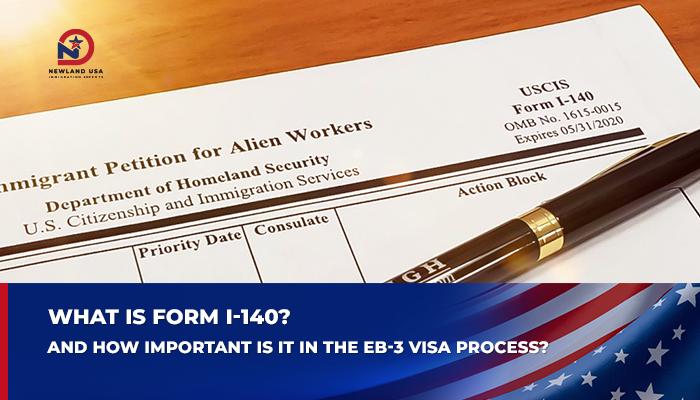
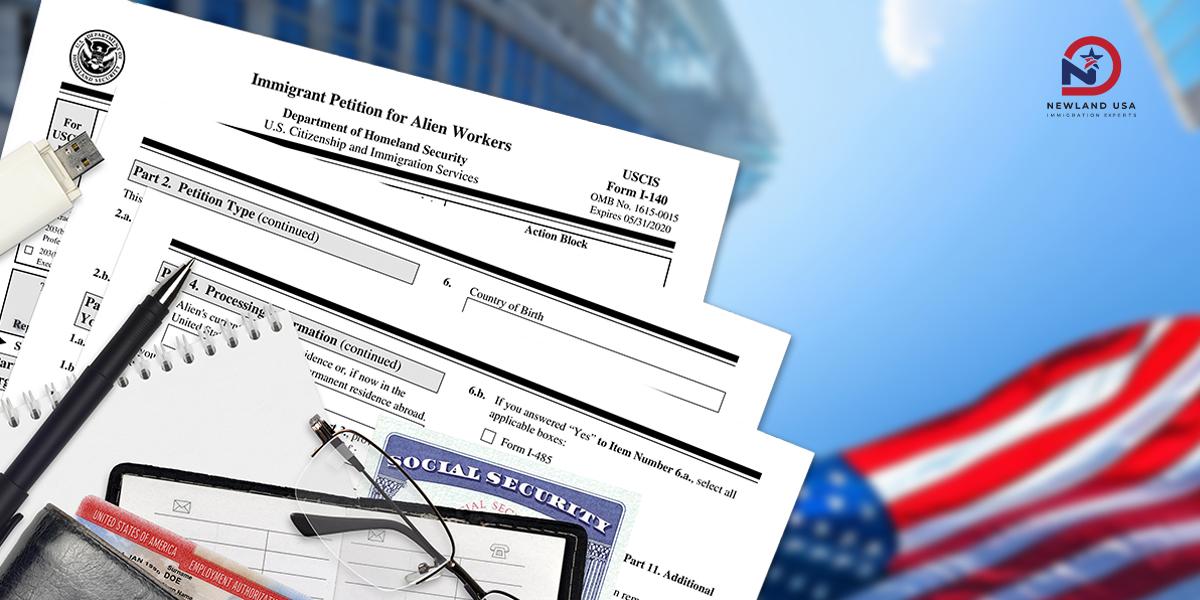
Form I-140, officially titled “Immigrant Petition for Alien Workers,” is an important legal document in the U.S. employment-based immigration system. This is the form that employers in the United States file with U.S. Citizenship and Immigration Services (USCIS) to sponsor a foreign national for an employment-based immigration application.
When it comes to the EB3 Visa, Form I-140 becomes the second step in the three-stage process to obtain lawful permanent resident status. After completing the PERM labor certification from the U.S. Department of Labor, the employer must file Form I-140 within 180 days of receiving the certification. This form not only confirms that the worker meets the requirements outlined in the labor certification but also demonstrates the company’s financial ability to pay the offered wage.
The importance of Form I-140 in the EB3 category cannot be denied. This is the official legal document that transforms a simple job offer into a concrete pathway toward permanent residence in the United States.
2. Types of employment-based immigration applications and the position of EB3
The U.S. employment-based immigration system is divided into five preference categories (EB-1 through EB-5), with each category serving different groups of applicants. The EB3 Visa belongs to the third preference category and is designed for three main groups of workers: skilled workers, professionals, and other workers.
The EB3 Visa stands out with more flexible criteria compared to EB-1 and EB-2. Unlike EB-1, which requires extraordinary ability, or EB-2, which requires a master’s degree, the EB3 category accepts workers with at least two years of work experience or training, or those with a bachelor’s degree for professional positions. Even the “other workers” group within the EB3 Visa doesn’t require any special degrees or experience, only good health to complete the job they’re hired for.
Each year, the U.S. allocates approximately 40,000 visas out of a total of 140,000 employment-based visas to the EB3 category. This number shows the scale and importance of the program to the U.S. economy. However, this also means there may be waiting times, especially for applicants from high-demand countries like India or China.
3. The process of preparing and filing Form I-140 for EB3 Visa
Preparing Form I-140 for the EB3 Visa requires close coordination between the employer and the worker. First, the employer must complete the PERM (Program Electronic Review Management) labor certification process. This is the first and mandatory step for most EB3 cases, intended to prove that there are no qualified, willing, and able U.S. workers available for the offered position.
After receiving the approved PERM certification, the employer has 180 days to file Form I-140 with USCIS. If the PERM certification expires, the entire process must start over from the beginning. Form I-140 must be completed fully and accurately, accompanied by the necessary EB3 documents including a copy of the original signed PERM certification, evidence of the company’s financial ability, and documents proving the worker meets the education and experience requirements.
USCIS will review Form I-140 to verify the validity of the job offer, the employer’s ability to pay the wage, and the beneficiary’s qualifications. Typically, the processing time for Form I-140 for EB3 Visa ranges from 6 to 12 months, although employers can choose Premium Processing service with an additional fee to shorten the time to 15 business days.
4. Necessary EB3 documents when filing Form I-140
Preparing complete EB3 documents is a determining factor for the success of Form I-140. Each type of document plays a specific role in proving the eligibility of both the employer and the beneficiary. Below is a detailed list of mandatory and important documents.
First and most important among the EB3 documents is the PERM labor certification (Form ETA-9089) that has been approved and fully signed by the Department of Labor. This document must be the original and signed by the beneficiary, attorney (if applicable), and employer. Currently, the Department of Labor sends the certification via email, so it needs to be printed on white paper and obtain original ink signatures before submitting with Form I-140.
Second, the employer must provide evidence of financial ability to pay the prevailing wage that was committed. This is an important part of the EB3 documents and may include audited financial statements, federal tax returns of the company, or annual reports. USCIS will carefully examine this documentation to ensure the company has sufficient financial resources to pay the foreign worker’s salary.
Third, documents proving the beneficiary’s qualifications are indispensable in the EB3 documents package. For skilled workers, there must be evidence of at least two years of training or work experience related to the offered position. An associate degree can be counted as two years of training. For professionals, a U.S. bachelor’s degree or foreign equivalent in a field directly related to the offered job is required. Verification letters from current and previous employers are also an important part of the EB3 documents to prove work experience.
Additionally, EB3 documents include supplementary materials such as a copy of the beneficiary’s passport, evidence of current legal immigration status (if in the U.S.), transcripts and diplomas that have been evaluated for equivalency (if studied abroad), and professional certificates if the job requires them.
5. The importance of Form I-140 in the EB3 Visa journey
Form I-140 is not just a simple administrative form but also the legal foundation for your entire EB3 Visa journey.
One of the most important benefits of having an approved Form I-140 in the EB3 category is the ability to maintain your priority date even when you transfer to another employer. This means that if you find a better job opportunity with another company, the new company can file a new Form I-140 for you and request to keep the priority date from the old petition, helping you not lose waiting time.
Moreover, an approved Form I-140 for the EB3 Visa also opens up the possibility of extending H-1B Visa beyond the typical six-year limit. If your Form I-140 has been approved but no visa number is available due to waiting time, you can receive an H-1B extension of three years at a time. This is especially useful for people from countries with long waiting times in the EB3 category.
When Form I-140 is approved and your priority date becomes current (according to the Visa Bulletin), you can proceed to the final step: filing Form I-485 Adjustment of Status if you’re legally in the U.S., or completing consular processing if you’re abroad. This is when your EB3 Visa officially becomes a permanent resident green card.
6. Important notes when preparing Form I-140 for the EB3 category
Preparing Form I-140 for the EB3 Visa requires meticulousness and attention to every detail. One of the most common mistakes is not ensuring consistency between information on the PERM certification and Form I-140. All information about job title, salary, education and experience requirements must match exactly between the two documents. Any discrepancies can lead to USCIS requesting additional evidence (Request for Evidence – RFE) or even denying Form I-140.
Another important point in the EB3 Visa process is the 180-day deadline to file Form I-140 after receiving the PERM certification. The labor certification is valid for 180 days from the approval date, and if it expires, it can no longer be used for Form I-140. USCIS will deny any petition filed with an expired PERM certification, unless the expiration date falls on a weekend or holiday – in which case, the petition will be accepted if filed on the next business day.
Evidence of the employer’s financial ability is an extremely important part of the EB3 documents. USCIS doesn’t just look at whether the company has enough money to pay the salary, but also evaluates the ability to sustain that salary level in the future. For small companies, this may be harder to prove and requires more detailed documentation. Audited financial statements are usually the most persuasive, followed by the most recent federal tax returns.
For special EB3 cases, such as downgrading from EB-2, Form I-140 needs to be carefully prepared to ensure the priority date from the previous EB-2 petition is retained. The employer must file a statement requesting to keep the older priority date and attach a copy of Form I-797 (Notice of Approval) from the previous EB-2 I-140.
7. The role of immigration attorneys in the EB3 Visa process and Form I-140
Although it’s not mandatory to have an attorney to file Form I-140 for the EB3 Visa, having support from an experienced immigration professional can significantly increase the chances of success. Immigration attorneys specializing in the EB3 category understand USCIS’s complex requirements well and can help prepare the EB3 documents package comprehensively and persuasively.
In 2025, USCIS has increased scrutiny of Form I-140 petitions, with particular focus on document quality and presentation. Legal experts note that USCIS is not just looking for certificates, licenses, or degrees, but also expects a rigorous application with a persuasive story. This is why working with an attorney in 2025 is not just about gathering documents but also about the accuracy and success potential of that application package.
Immigration attorneys also play an important role in responding to RFEs (Request for Evidence) from USCIS. If your Form I-140 receives an RFE, it means USCIS needs more information or clarification on some points in the application. Responding to an RFE correctly and timely is very important, and a mistake can lead to Form I-140 being denied. An attorney experienced with the EB3 Visa will know exactly what USCIS is looking for and how to provide that information most effectively.
8. Costs and processing time for Form I-140 in the EB3 category
The filing fee for Form I-140 for the EB3 Visa is an important investment that the employer must bear. As of 2025, the standard fee for Form I-140 is $715. However, this is only part of the total cost of the EB3 Visa process. Previously, the employer had to pay for the PERM process (no government fee but advertising and recruitment costs), and after Form I-140, the beneficiary will have to pay the fee for Form I-485 (Adjustment of Status) at $1,440 or the consular processing fee of $325.
For small companies (defined by USCIS as having 25 full-time employees or fewer), a reduced fee may apply. Additionally, employers can choose Premium Processing service by filing Form I-907 with the current fee. This service guarantees that USCIS will approve, deny, or request additional evidence (RFE) within 15 business days from receiving the request.
Processing time for Form I-140 for the EB3 Visa varies depending on which USCIS service center processes the application and the workload at the time of filing. According to fiscal year 2025 data, the average processing time is about 8 months. However, some EB3 cases may be processed faster or slower depending on the complexity of the application. You can check the current processing time for your petition type through the Case Processing Times tool on the USCIS website.
After Form I-140 is approved, the waiting time to be able to file Form I-485 or proceed with consular processing depends on the priority date and status of the Visa Bulletin. For the EB3 Visa, waiting time can range from a few months to several years depending on your country of origin. Citizens of countries like India and China typically face longer waiting times due to high demand from these countries.
9. Benefits for beneficiaries after Form I-140 is approved
When Form I-140 for the EB3 Visa is approved by USCIS, the beneficiary receives many important benefits even before officially becoming a permanent resident.
First is job portability. According to AC21 regulations, if your Form I-140 has been approved and Form I-485 has been filed for over 180 days, you can transfer to work for another employer in a “same or similar” position without affecting your EB3 Visa green card process. This provides significant flexibility for workers in career development.
For those working in the U.S. on H-1B Visa, having an approved Form I-140 for the EB3 category opens up the possibility of extending H-1B beyond the typical six-year limit. Specifically, if your Form I-140 has been approved but visa numbers are not available due to waiting time, workers can receive an H-1B extension of three years at a time. If Form I-485 has been filed and is pending, workers can receive one-year H-1B extensions until the process is complete.
Additionally, when Form I-140 is approved, the spouse and unmarried children under 21 of the beneficiary are also eligible to apply for green cards as derivative beneficiaries. They will receive the same priority date and can accompany or follow the principal beneficiary in the EB3 Visa process.
10. Special cases and exceptions in the I-140 process
Although most EB3 cases must follow the standard process with PERM certification and Form I-140, there are still some special cases worth noting. One of these is Schedule A occupations. These are occupations that the Department of Labor has predetermined have insufficient qualified U.S. workers available, so they don’t need to go through the typical PERM labor certification process.
Currently, Schedule A includes two main groups: Group I includes professional nurses and physical therapists; Group II is for those with exceptional ability in sciences or arts (including university professors). For these cases, the EB3 documents will be slightly different from the typical process. Instead of PERM certification, the employer needs to file the original Form ETA-9089 and a copy (no DOL certification needed), along with the prevailing wage determination (Form ETA-9141) from the Department of Labor.
Another special case in the EB3 Visa is “downgrading” from EB-2. Sometimes, people who have filed Form I-140 under EB-2 but find that the waiting time for EB3 is shorter (especially for certain countries) can choose to file a new Form I-140 under the EB3 Visa. The benefit of this is potentially shortening the overall waiting time. The important thing is that the employer must request to keep the priority date from the previous EB-2 I-140 when filing the new petition for the EB3 category.
There are also cases where Form I-140 needs to be amended. This happens when there are significant changes in employment conditions after Form I-140 has been filed but not yet approved. For example, if the work location changes or there’s a change in salary, an amended petition may need to be filed.

11. Common mistakes to avoid when filing Form I-140
One of the most common mistakes when preparing Form I-140 for the EB3 Visa is having inconsistent information between documents. All information on Form I-140 must match exactly with information on the PERM certification, including name, date of birth, nationality, job title, and salary. Even small discrepancies can cause USCIS to question the authenticity of the application.
Another serious mistake is not adequately demonstrating the employer’s financial ability. Many Form I-140 petitions for the EB3 category are denied or receive RFEs due to lack of convincing evidence of ability to pay the prevailing wage. Employers need to provide comprehensive financial documentation, not just showing they have enough money at the time of filing, but also demonstrating the ability to sustain this payment in the future.
On the beneficiary’s side, a common mistake is not providing complete EB3 documents proving qualifications and experience. For skilled workers, evidence of two years of experience must be specific and verifiable. Verification letters from previous employers need to describe in detail the work performed, time period of employment, and skills used. For professionals, bachelor’s degrees must be evaluated for equivalency if obtained abroad, and the major must be directly related to the offered position.
Some employers also make the mistake of not complying with the 180-day deadline to file Form I-140 after receiving PERM certification. Labor certification has a fixed time limit and cannot be extended. If it expires, the entire PERM process – an expensive and time-consuming process – will have to be done over from the beginning. Therefore, careful time planning and monitoring is very important in the EB3 Visa process.
12. Next steps after Form I-140 is approved
When Form I-140 for the EB3 Visa receives approval from USCIS, this is not the end point but an important milestone on the journey to a green card. The next step depends on whether your priority date has become current (meaning a visa number is available).
If your priority date is current and you’re in the U.S. with legal immigration status, the next step is filing Form I-485 Application to Register Permanent Residence or Adjust Status. This is the application to adjust status to lawful permanent resident. Along with Form I-485, you can also file for an Employment Authorization Document (EAD) and Advance Parole. EAD allows you to work for any employer in the U.S. while waiting for the EB3 Visa to be approved, while Advance Parole allows you to travel abroad and return without interrupting the green card process.
If you’re outside the U.S., or want to apply for a green card through consular processing, your file will be transferred to the National Visa Center (NVC). NVC will process the application and then forward it to the U.S. Embassy or Consulate in your country. You will be scheduled for an interview at the consulate, where you must submit additional EB3 documents such as birth certificate, police clearance certificate, medical examination, and other documents.
In both cases, after approval, you will officially become a lawful permanent resident of the U.S. with the EB3 Visa. You will receive the actual green card by mail within a few weeks. This green card is proof of your permanent resident status and allows you to live and work permanently in the U.S. After five years as a permanent resident (or three years if married to a U.S. citizen), you will be eligible to apply for naturalization and become a U.S. citizen.
13. Conclusion
Form I-140 plays a pivotal and indispensable role in the EB3 Visa journey of every foreign worker hoping to immigrate to the United States. From establishing the priority date, confirming the legal qualifications of both the worker and employer, to opening up important benefits like job portability and H-1B Visa extensions, Form I-140 is the legal foundation for the entire EB3 green card process.
With a deep understanding of Form I-140 and EB3 requirements, along with thorough preparation and possibly support from an experienced immigration attorney, you can maximize your chances of success on the journey to a U.S. green card. The EB3 Visa opens opportunities for tens of thousands of foreign workers each year, and with proper preparation, you can be one of them.
Newland USA, with our team of experienced experts and the motto “Stable settlement – Lifelong prosperity,” is ready to consult and support in application preparation and accompany you throughout the EB3 U.S. immigration process. Contact Newland USA today at hotline 0785591988 or email: newsletter@newlandusa.asia for detailed and free consultation.
Learn more:
- Why Choose EB3 U.S. Immigration Through the Medical Glove Manufacturing Industry in 2026?
- What Factors Affect EB3 Immigration Processing Time to the United States?
- Why do many people give up on their EB3 application while it’s still being processed?
- 5 Common Misconceptions About the EB3 Program That Vietnamese People Often Make
- Long-Term Benefits of Settling in the US via EB3 Automotive Mechanic Visa
News Categories


Related news
Who Is the ESTA Program For? How to Assess Your Fit Before Applying in 2026

Who Is the ESTA Program For? How to Assess Your Fit Before Applying in 2026

From Motorcycle Mechanic to Automotive Technician in the U.S.: Skills and Qualifications to Prepare in 2026
AI in Auto Repair in the U.S. 2026: How Artificial Intelligence Diagnoses Vehicle Problems Faster and More Accurately
7 Key Technologies Every Industrial Maintenance Technician in the U.S. Needs to Know in 2026

PLC & Automation Skills: A Launchpad for Maintenance Technicians in the United States in 2026
What Is the ASE Certification? Requirements, Exam Roadmap, and Its Importance for Auto Technicians in the U.S. in 2026

EB5 Capital Recovery Time: How Long It Takes and the Key Milestones
Electric Vehicle Technicians in the U.S.: The “Golden” Skills Helping Vietnamese Auto Mechanics Get Ahead of the 2026 EV Trend