What is Form I-829? Guide to Filing a Petition to Remove Conditions on 2-Year Green Card for EB5 Immigrant Investor Program
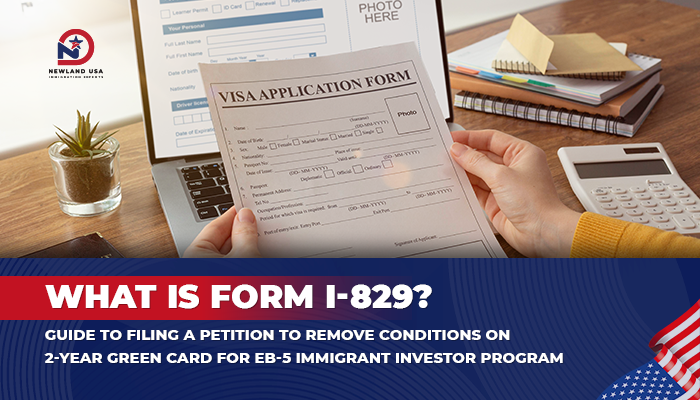
Form I-829 plays a crucial role in the journey of converting from a 2-year green card to a permanent green card for investors under the EB5 immigrant investor program. Filing on time with complete documentation will help you remove conditional status smoothly. This article by Newland USA will provide detailed guidance on the process, conditions, and important notes to increase your success rate when filing Form I-829.
1. What is Form I-829?
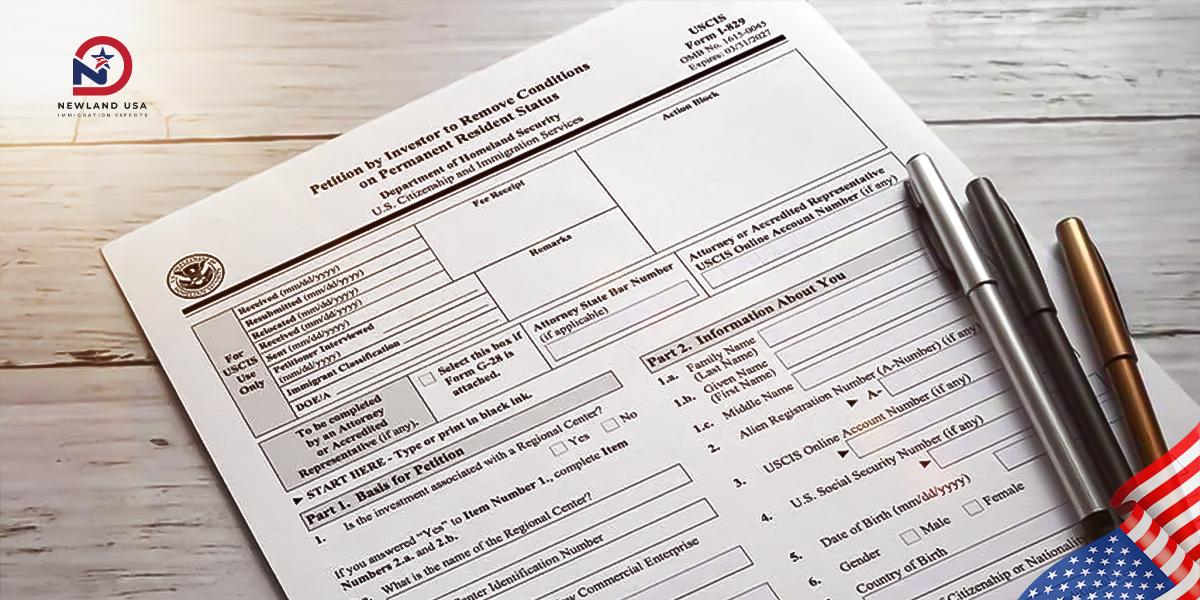
Form I-829 (Petition by Investor to Remove Conditions on Permanent Resident Status) is a legal document that investors in the EB5 immigrant investor program must file with U.S. Citizenship and Immigration Services (USCIS) to convert their residency status from conditional to permanent. This is a mandatory procedure to prove that the investor has fully completed all commitments regarding investment capital and employment requirements set by USCIS.
When participating in the EB5 immigrant investor program, investors initially receive a 2-year conditional green card (Conditional Permanent Resident Card). This is a temporary card with many limitations. To obtain long-term and stable residency rights in the United States, filing Form I-829 is an essential step in the immigration journey.
The ideal time to file Form I-829 is within 90 days before the 2-year green card expires. Delays or missing this deadline can lead to serious consequences, including loss of residency rights and having to leave U.S. territory.
2. Why is Form I-829 Important?
Removing green card conditions is not just an administrative procedure but the final step confirming the success of the entire investment immigration process. When Form I-829 is approved, the investor and accompanying family members will receive a permanent green card (Permanent Resident Card) valid for 10 years.
A permanent green card offers many superior benefits compared to a 2-year green card. Cardholders can freely live, work, and travel throughout U.S. territory without any conditional restrictions. Moreover, after obtaining a permanent green card, investors can proceed to apply for U.S. citizenship if they meet all requirements regarding residence time and other criteria.
Conversely, if Form I-829 is not filed or the petition is denied, investors will face the risk of having their permanent resident status revoked and may be deported from the United States. This is a major risk after investing a very large sum of money and spending considerable time on the EB5 immigrant investor program.
3. Required Conditions for Filing Form I-829
According to USCIS regulations, investors who want to remove conditional green card status must meet all of the following criteria:
3.1. Investment Made According to EB5 Regulations
Investors must prove they have invested the minimum capital amount required by the EB5 immigrant investor program. Currently, the investment capital is $1,050,000 for projects outside TEA areas, or $800,000 if investing in TEA areas. This investment must be made in a legitimate business project on U.S. territory.
3.2. Maintain Investment Throughout the 2-Year Green Card Period
The most important requirement when filing Form I-829 is proving that the investment has been maintained continuously throughout the period of holding the 2-year green card. Investors cannot withdraw capital early or convert to other investments before the petition is approved.
If the original EB5 project has ended or is no longer operating, investors need to reinvest in another EB5 project to ensure compliance with regulations. This must be done timely and with complete legal documentation.
3.3. Create At Least 10 Full-Time Jobs for U.S. Citizens
This is one of the core requirements of the EB5 immigrant investor program. Your investment must create or maintain at least 10 full-time job positions for workers who are U.S. citizens or lawful permanent residents (not including the investor and family members).
These jobs must exist for at least 2 years from when the investor receives the 2-year green card. When filing Form I-829, you need to provide specific evidence such as payroll records, tax reports, personnel files, and documents related to employment.
3.4. Comply with U.S. Laws
Throughout the period of holding the 2-year green card, investors and family members must strictly comply with all U.S. legal regulations. Any violation, whether small or large, can negatively affect the approval of Form I-829.
Common violations to avoid include: serious traffic violations, tax evasion, financial fraud, or any criminal offenses. USCIS will carefully review the legal background of the petitioner during the review process.
4. Documents and Papers to Prepare When Filing Form I-829
To successfully remove green card conditions, investors need to prepare a complete and accurate set of documents. Below is a list of essential materials:
4.1. Completed Form I-829
This is the official form issued by USCIS. Investors need to fill in complete personal information, information about the investment, and details related to the EB5 project. All information must be accurate and consistent with previously filed documents.
4.2. Copy of Conditional Green Card
You need to provide a photocopy of the 2-year green card of the principal investor and all accompanying family members (if any). The copy must be clear, showing both sides of the card.
4.3. Proof of Business Establishment and Maintenance
Investors must prove that the business receiving the investment capital is legally operating in the United States. Necessary documents include:
- Business licenses and company registration documents
- Federal Tax Returns of the business
- Independently audited financial statements
- Business contracts, partnership agreements
4.4. Documentation of Investment Made and Maintained
This is the most important part of the Form I-829 file. You need to prove that the EB5 investment was transferred to the project and has been maintained continuously:
- Bank account statements of the project
- International wire transfer documents
- Detailed financial reports on capital sources and usage
- Invoices and receipts related to the project
- Equipment purchase contracts, lease agreements
4.5. Documents Proving Job Creation
To meet employment requirements when filing Form I-829, investors need to provide:
- Detailed employee payroll records
- W-2 forms and wage-related tax reports
- Personnel files proving full-time employee work
- Interview minutes or employment contracts
- Confirmation reports from accountants or independent auditors
4.6. Biometric Records
After filing Form I-829, investors will receive a biometric appointment notice from USCIS. At this appointment, USCIS will collect fingerprints, signatures, and photographs of the petitioner for background checks.
4.7. Legal Documents (if there is a criminal record)
If the investor has a criminal record or legal violations, they need to provide complete documents such as arrest records, court judgments, probation papers, or related court records.

5. Detailed Form I-829 Filing Process
Step 1: Prepare Documents 90 Days in Advance
Investors should begin collecting and preparing documents at least 4-6 months before the 2-year green card expires. This ensures enough time to handle arising issues and complete the file.
Step 2: File Petition and Pay Fees
Form I-829 along with all attached documents must be sent to the USCIS address designated by the agency. Investors need to pay the processing fee (currently about $3,675) and biometric fee (if applicable).
Step 3: Receive Receipt Notice
After receiving the file, USCIS will send a receipt notice by mail. This receipt is very important because it proves that your 2-year green card is automatically extended for an additional 24 months while the petition is being processed.
Step 4: Attend Biometric Appointment
USCIS will send a biometric appointment notice. Investors must arrive on time to complete the information collection process.
Step 5: Wait for Decision
Processing time for Form I-829 typically ranges from 12 to 18 months, depending on USCIS workload and the complexity of the file. In some cases, USCIS may request additional evidence (Request for Evidence – RFE) or call for an interview.
Step 6: Receive Permanent Green Card
When Form I-829 is approved, investors will receive official notification and the 10-year permanent green card will be sent to the registered address.
6. Common Reasons for Form I-829 Denial
Despite careful preparation, many investors still face difficulties in removing conditional green card status due to some of the following reasons:
6.1. Missing or Incomplete Supporting Documents
This is the leading cause of Form I-829 denial. If investors cannot provide clear evidence of maintaining investment or creating jobs, USCIS will not approve the petition.
6.2. Withdrawing Capital or Not Maintaining Investment
Withdrawing capital from the EB5 project before Form I-829 is approved is a serious violation. Even if the project faces difficulties, investors must prove they have maintained their investment commitment.
6.3. Not Meeting Employment Requirements
If you cannot prove you have created at least 10 full-time jobs for U.S. citizens or permanent residents, Form I-829 will definitely be denied. This is one of the most important criteria of the EB5 immigrant investor program.
6.4. Violating Laws During Residency
Any legal violation, whether large or small, can affect the review results. USCIS pays special attention to issues related to taxes, financial fraud, and criminal offenses.
6.5. Inconsistent Information
If information in Form I-829 does not match previously filed documents (such as Form I-526 or I-485), USCIS may doubt the authenticity and deny the petition.
7. How to Increase Success Rate When Filing Form I-829?
7.1. Start Preparing Early
Preparation of Form I-829 documents should be undertaken as early as possible, ideally at least 6 months before the 2-year green card expires. This gives you enough time to collect documents, handle arising issues, and recheck the accuracy of the file.
7.2. Work with Experienced Immigration Experts
The EB5 immigrant investor program has many complex regulations that change frequently. Hiring an immigration attorney or professional consultant will help you avoid unnecessary mistakes and optimize your chances of success.
7.3. Ensure All Documents Are Audited and Verified
Financial statements, payroll records, and other important documents should be audited by independent third parties. This increases authenticity and helps USCIS trust the information you provide.
7.4. Maintain Investment and Strictly Comply with Laws
Until Form I-829 is officially approved, investors must continue to maintain the investment according to their commitment. At the same time, complying with all U.S. legal regulations is a prerequisite.
7.5. Be Prepared for Additional Requests
During processing, USCIS may send a Request for Evidence (RFE) or NOID. Respond quickly, completely, and accurately to avoid delays or negative results.

8. Frequently Asked Questions About Form I-829
8.1. How Long Does Form I-829 Processing Take?
Form I-829 processing time typically ranges from 12 to 18 months from the date USCIS receives the petition. However, this number may vary depending on specific cases and the immigration agency’s workload.
8.2. What Happens If Form I-829 Is Denied?
If Form I-829 is denied, investors have the right to appeal this decision or file a Motion to Reopen/Reconsider. In the worst case, you may have to leave the United States. Therefore, thorough preparation from the start is extremely important.
8.3. What Is the Cost of Filing Form I-829?
The current Form I-829 filing fee is $3,675 (including processing fee and biometric fee). Additionally, investors need to account for other costs such as attorney fees, audit fees, translation fees, and related administrative costs.
8.4. Can I Travel While Waiting for Form I-829 Processing?
Yes, investors can still travel outside the United States while waiting for Form I-829 processing. However, you need to carry the receipt notice from USCIS along with your 2-year green card when returning to the United States. This receipt proves that your green card has been automatically extended.
9. Conclusion
Form I-829 is the final but extremely important step in the EB5 immigrant investor journey. Removing green card conditions not only provides permanent residency rights but also opens the door to U.S. citizenship in the future.
Newland USA, with a team of experienced experts and the motto “Secure Settlement – Lifelong Prosperity,” is ready to advise and support you with information related to the EB5 investment program. Contact Newland USA immediately at hotline 0785591988 or email: newsletter@newlandusa.asia for detailed and free consultation.
Learn more:
News Categories


Related news

Who Is the ESTA Program For? How to Assess Your Fit Before Applying in 2026

Who Is the ESTA Program For? How to Assess Your Fit Before Applying in 2026

From Motorcycle Mechanic to Automotive Technician in the U.S.: Skills and Qualifications to Prepare in 2026

AI in Auto Repair in the U.S. 2026: How Artificial Intelligence Diagnoses Vehicle Problems Faster and More Accurately

7 Key Technologies Every Industrial Maintenance Technician in the U.S. Needs to Know in 2026

PLC & Automation Skills: A Launchpad for Maintenance Technicians in the United States in 2026
What Is the ASE Certification? Requirements, Exam Roadmap, and Its Importance for Auto Technicians in the U.S. in 2026
EB5 Capital Recovery Time: How Long It Takes and the Key Milestones

Electric Vehicle Technicians in the U.S.: The “Golden” Skills Helping Vietnamese Auto Mechanics Get Ahead of the 2026 EV Trend