How to Convert from Non-Immigrant Visa to US EB3 Visa Legally and Fastest
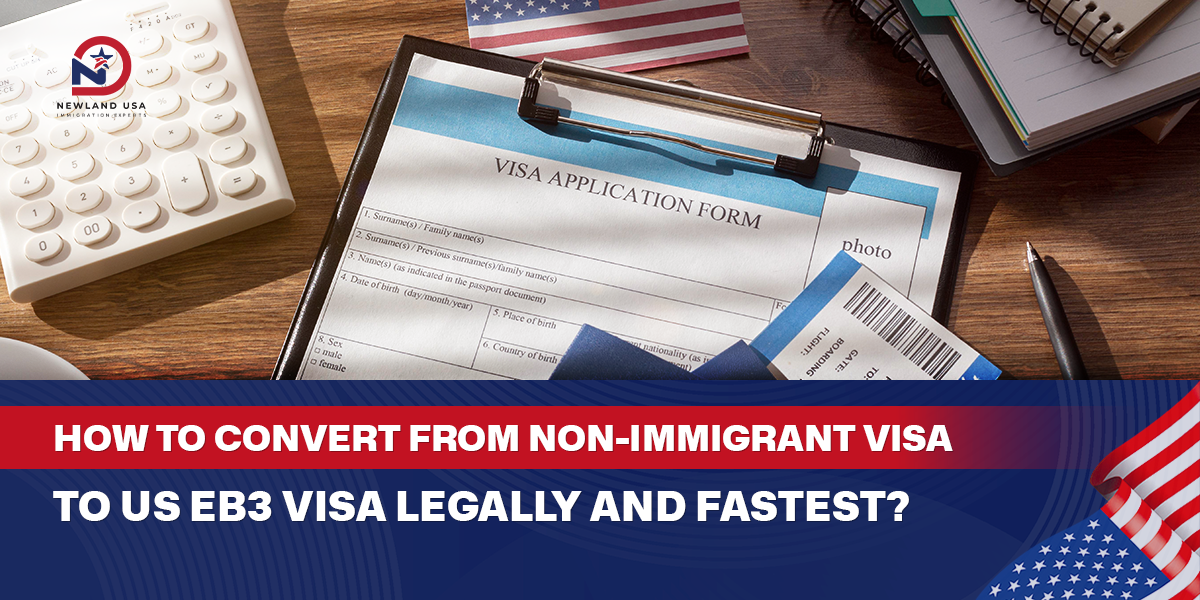
Converting from non-immigrant Visa to EB3 Visa in the US is attracting much attention from Vietnamese people. Instead of following the traditional path, you can take advantage of your current status with B1/B2 tourist Visa or F-1 student Visa to quickly and effectively transition to US EB3 permanent residence. This article by Newland USA will provide detailed guidance on the process, conditions, and important considerations to successfully complete this conversion.
1. Understanding Non-Immigrant Visa and EB3 Visa
1.1. What is a Non-Immigrant Visa?
Non-immigrant Visa is a type of Visa that allows foreign nationals to enter the US for a limited time with specific purposes such as tourism, visiting family, business, or studying. The most common types in this category include B1/B2 tourist Visa for business and tourism purposes, and F1 student Visa for international students.
There are also temporary work Visas like H1B for highly skilled professionals and J1 cultural exchange Visa for exchange programs. Each type of non-immigrant Visa has its own validity period and specific purpose, not allowing long-term residence in the US.
1.2. EB3 Visa – An Effective Path to Permanent Residence
EB3 Visa belongs to the US immigrant Visa category for skilled workers, professionals, and unskilled workers. This is one of the most popular US permanent residence pathways thanks to its moderate requirements and high success rate compared to other immigrant Visa types.
EB3 Visa is divided into three main groups. The first group is EB3 Skilled Worker for skilled laborers requiring at least two years of experience. The second group is EB3 Professional for professionals with bachelor’s degrees. The final group is EB3 Other Workers for unskilled laborers without special experience requirements.
2. Conditions for Converting from Non-Immigrant Visa to EB3 Visa
2.1. Age and Health Requirements
To convert from non-immigrant Visa to EB3 Visa in the US, applicants must be between 18 and 50 years old. This is the working age suitable for US labor market requirements.
Regarding health, applicants must be in good physical condition and capable of working. Importantly, they must not have any communicable diseases listed by the US Centers for Disease Control and Prevention (CDC).
2.2. Personal Background Requirements
A clean background is mandatory when transitioning to US EB3 permanent residence. Applicants must have no criminal record in any country. Additionally, they must never have resided illegally in any country worldwide.
Another important condition is not violating US immigration regulations in the past. Any fraudulent behavior or providing false information can affect the ability to convert to EB3 Visa.
2.3. Education and Experience Requirements
For US EB3 permanent residence in the Other Worker category, education requirements are very flexible. Applicants don’t need professional degrees or prior work experience. Specifically, they’re also not required to have English proficiency, which creates great convenience for Vietnamese workers.
However, for Skilled Worker and Professional categories, applicants need basic English communication skills. They must also have work experience or qualifications matching the job position offered by the employer.
2.4. Conversion Process Requirements
Applicants must currently hold a valid non-immigrant Visa such as F1 or B1/B2 at the time of application submission. They must also commit to working full-time for the US employer for the specified period.
A major advantage of EB3 Visa is not requiring personal financial proof. This differs completely from many other US immigrant Visa types that typically require financial sponsorship.

3. Required Documents for Conversion
3.1. Basic Personal Documents
Passport is an important document in the application, valid for at least six months from the application date. Current non-immigrant Visa such as F1 or B1/B2 must also be within its validity period.
Applicants need to prepare two photos meeting US Visa standards for size and quality requirements. Health examination certificate and vaccination records as required by CDC are also essential documents.
3.2. Work-Related Documents
Job offer letter from US employer is the legal basis for converting to EB3 Visa. Labor Certification approved by the US Department of Labor is an important document throughout the entire process.
Resume and detailed curriculum vitae help reviewing authorities understand the applicant’s experience and capabilities. Educational certificates and skill certifications (if any) need to be translated and notarized.
3.3. Application Forms
Form I-140 is the petition for foreign worker immigration, this is the official step to convert from non-immigrant Visa to US EB3 permanent residence. Form DS-260 is the online US immigrant Visa application on the National Visa Center system.
Civil status verification documents including marriage certificate, birth certificate, and family-related documents need to be prepared completely to serve family sponsorship purposes.
4. Detailed Step-by-Step Conversion Process
4.1. Stage 1: Apply for Labor Certification
This is the first and important step in the EB3 Visa conversion process. The US employer will file a Labor Certification (LC) application to the Department of Labor to prove that no suitable US workers are available for this job position.
This process requires the employer to conduct recruitment steps according to regulations, including posting job advertisements on official channels. Processing time is usually six to twelve months, with all costs borne by the employer.
4.2. Stage 2: File Application with USCIS
After obtaining approved Labor Certification, the next step is filing Form I-140 with US Citizenship and Immigration Services (USCIS). This is the petition for foreign worker immigration, officially beginning the process of converting to US EB3 permanent residence.
I-140 processing time is typically six to twelve months. However, applicants can use Premium Processing service to shorten the time to just fifteen days with additional fees.
Simultaneously, applicants also need to file Form I-485 to apply for permanent residence registration or status change from non-immigrant Visa to permanent resident.
Additionally, applicants file Form I-765 for Employment Authorization Document (EAD) and Form I-131 for travel document. These two documents allow applicants to work and travel while waiting for EB3 Visa approval.
4.3. Stage 3: Receive Notifications and Appointments
USCIS will send important notifications to the address registered by the applicant. Receipt I-797C with tracking number will be sent within two to eight weeks, helping applicants track application status online.
Biometrics appointment is usually scheduled within four to six weeks after receiving the receipt. This is a mandatory step for USCIS to collect fingerprints, photos, and other biometric information.
4.4. Stage 4: Receive EAD Card and Start Working
Upon receiving the EAD (Employment Authorization Document) card, applicants can officially start working in the US. The first step is registering for Social Security number to participate in the US labor and tax system.
Applicants need to start working for the sponsoring employer and fulfill tax filing obligations as required. Stable employment demonstrates the applicant’s commitment to the US EB3 permanent residence process.
4.5. Stage 5: Interview and Receive Green Card
After two to three months of stable employment, applicants will be invited by USCIS for an interview to review green card issuance. However, not all cases require interviews; some applications can be approved directly.
When approved, applicants will receive a ten-year green card and officially become US permanent residents. This is the culmination of the entire conversion process from non-immigrant Visa to EB3 Visa.
5. Important Notes When Converting
5.1. For F-1 Student Visa
Students holding F1 Visa need to pay special attention to maintaining valid student status throughout the conversion process. They must not stop studying or violate any regulations related to Form I-20.
The positive aspect is that students can continue studying after obtaining EB3 Visa and even enjoy in-state tuition fees. This creates dual opportunities for both permanent residence and educational advancement.
5.2. For B1/B2 Tourist Visa
People with tourist Visa must follow different procedures compared to students. They must apply for LC from Vietnam before coming to the US to avoid suspicion of immigration intent from the beginning.
Conversion should only be done after 90 days from entry date to prove no prior intent when entering the US. Note that tourist Visa only allows six months of stay, so timing must be carefully considered.
5.3. Travel Restrictions During Processing
During US EB3 permanent residence processing, applicants should not leave the US without advance parole. Departing without advance parole may be considered abandoning the immigration application.
If emergency departure is necessary, applicants need to apply for advance parole (Form I-131) before leaving the US. Violating this regulation can result in application cancellation and starting over from the beginning.
6. Benefits of Successful Conversion
6.1. Immediate Benefits After Receiving Green Card
Upon successful conversion to EB3 Visa, applicants will receive a 10-year green card with full US permanent resident rights. They can work freely in the US after completing obligations to the sponsoring employer, typically one year.
Social benefits such as health insurance, unemployment benefits, and government assistance programs can be accessed like US citizens.
6.2. Long-term Benefits
After 5 years of legal residence, people with US EB3 permanent residence can apply for US citizenship. This is the final step to become an official US citizen with full rights and obligations.
Another major benefit is the ability to sponsor spouses and unmarried children under 21 for green cards. This helps the entire family build a new life in the US.
6.3. Educational and Development Benefits
Children of EB3 Visa holders receive free education through high school at public schools. When attending college, they pay in-state tuition fees, much lower than international students.
Green card holders themselves can also receive government financial aid for education and skill development. They can access student loans with preferential interest rates to pursue higher education programs.

7. Common Rejection Cases
7.1. Legal and Violation Errors
Violating US laws during residence can lead to EB3 Visa application rejection. Even minor violations like traffic violations can affect the outcome.
Overstaying beyond the non-immigrant Visa period is a serious violation. This shows the applicant has violated entry conditions and may be a future threat to law compliance.
Illegal entry or past information fraud are also factors that can lead to rejection. USCIS has very thorough systems for checking immigration history.
7.2. Procedural and Timing Errors
Starting work without EAD authorization is a serious violation that can lead to US EB3 permanent residence application rejection. This shows the applicant doesn’t understand or comply with legal regulations.
Sponsoring company not meeting Department of Labor requirements can also cause application rejection. Thorough verification of company financial capacity and operations is necessary.
Filing incomplete documents or missing deadlines can cause the entire process to restart. Particularly important is filing Form I-485 must be after 90 days of entry for non-immigrant Visa holders.
7.3. Intent and Motivation Errors
Showing conversion intent immediately upon entry with tourist Visa can be considered fraud. US immigration authorities are very strict with cases having prior intent when using non-immigrant Visa.
Not maintaining valid status of current Visa during processing is also a common error. F1 students must continue studying, tourist Visa holders must comply with their Visa conditions.
Signs of immigration system abuse such as filing multiple US immigrant Visa applications simultaneously or having multiple Visa rejection history can also affect results.
8. Conclusion
Converting from non-immigrant Visa to EB3 Visa is a complex process with many legal risks. One small procedural error can lead to application rejection and seriously affect future immigration opportunities.
US immigration laws change constantly and have many complexities that ordinary people find difficult to fully grasp. Seeking support from experienced professionals not only saves time but also significantly increases success rates.
Newland USA, with an experienced team of specialists and the motto “Secure Settlement – Lifelong Prosperity,” is ready to consult and support in document preparation and accompany clients throughout the US EB3 permanent residence process. Contact Newland USA immediately at hotline 0785591988 or email: newsletter@newlandusa.asia for detailed and free consultation.
News Categories

Related news

What Is the IRS? Your Rights and Obligations with the U.S. Tax Agency
Retrogression: What It Is and How It Affects Your EB3 Case
How to Identify and Avoid Conflicts of Interest in EB-5 Investment Immigration
401(k): The Retirement Plan for Workers in the United States
Key Things to Know When Taking Out a Bank Loan for US Immigration

How Does the Investment Sustaining Period Affect EB-5 Investors’ Project Selection?
Financial Planning the Right Way When Settling in the U.S. Through the EB-3 Program
Why is the EB3 Visa waiting time for skilled workers faster than for other workers?
ROI Analysis When Settling in the US Through EB3 Skilled Workers